Events & Promotions
|
|

GMAT Club Daily Prep
Thank you for using the timer - this advanced tool can estimate your performance and suggest more practice questions. We have subscribed you to Daily Prep Questions via email.
Customized
for You
Track
Your Progress
Practice
Pays
Not interested in getting valuable practice questions and articles delivered to your email? No problem, unsubscribe here.
 Sep 02
01:00 PM EDT
-11:59 PM EDT
Take 30% off all study plans with code COURSEWORK - Expires on Monday 9/7 Sep 03
01:30 AM EDT
-02:30 AM EDT
At one point, she believed GMAT wasn’t for her. After scoring 595, self-doubt crept in and she questioned her potential. But instead of quitting, she made the right strategic changes. The result? A remarkable comeback to 695. Check out how Saakshi did it. Sep 04
10:00 AM PDT
-11:00 AM PDT
What does test anxiety really look like on the GMAT? For many test takers, it does not look like a panic attack. Instead, it shows up as brain fog, rereading, negative comparisons, mental noise.... Sep 06
09:30 AM EDT
-12:30 PM EST
Top scores are possible when you enroll in a powerful EA course, taught live online + 6 months access to TTP OnDemand video courses included! Perfect class schedule and easy course access for working professionals. Class starts Sundays Sept. 6, 2026.- Sep 07
12:01 AM PDT
-11:59 PM PDT
On the 7th, GMAT Club Tests will be Free! Including all the Quizzes, Questions, and Tests. 12 AM - 11:59 PM PDT  Sep 07
12:30 AM EDT
-01:30 AM EDT
Tejas studied hard but kept repeating the same mistakes. After 3 attempts at 645, a focused 4-week strategy helped him identify and fix what was holding him back—leading to a 695 with just 12–15 hours of study per week.- Sep 09
07:00 AM PDT
-10:00 AM PDT
Meet AdComs and explore top Master’s programs - MiM, MiF, MSc, MSBA and more. - Application Fee Waivers - Free 1-Week of GMAT Club Tests: - Master's Application Toolkit - Grand Prize Giveaway  Sep 15
07:00 PM EDT
-09:00 PM EST
Elite scores are possible when you enroll in a powerful GMAT course, taught live online + 6 months access to TTP OnDemand video courses included! Class starts Tues/Thurs Sept. 15, 2026 - Nov. 15, 2027, 7:00pm-9:00pm EST Sep 21
08:00 PM EDT
-10:00 PM EDT
Boost your GMAT score in less than one month in a live online class + 6 months access to TTP OnDemand video courses included! Class starts Mon, Tues, Wed, Thur, Fri Sept. 21, 2026 - Oct. 9, 2027, 7:00pm-10:00pm EST

abcsayali
Joined: 12 Oct 2022
Last visit: 07 Jul 2026
Posts: 52
Given Kudos: 52
Location: India
Schools: Ross '27 (D) Anderson '27 (A$) HBS '27 (D) Tuck '27 (WL) Booth '27 (D) Stanford '27 (II) Kellog '27 (I) Fuqua '27 (WL) Johnson '27 (II) Tepper '27 (WL)
GMAT Focus 1: 705 Q90 V83 DI82 
GRE 1: Q166 V150
Schools: Ross '27 (D) Anderson '27 (A$) HBS '27 (D) Tuck '27 (WL) Booth '27 (D) Stanford '27 (II) Kellog '27 (I) Fuqua '27 (WL) Johnson '27 (II) Tepper '27 (WL)
GMAT Focus 1: 705 Q90 V83 DI82
GRE 1: Q166 V150
Posts: 52
 10 Mar 2024, 12:34
Kudos
Bookmarks


Dropdown 1: all
Dropdown 2: all
Be sure to select an answer first to save it in the Error Log before revealing the correct answer (OA)!
Difficulty:
 35%
(medium)
35%
(medium)
Question Stats:
72% (02:15) correct 28%
(02:23)
wrong
based on 1652
sessions
28%
(02:23)
wrong
based on 1652
sessions
History
Date
Time
Result
Not Attempted Yet
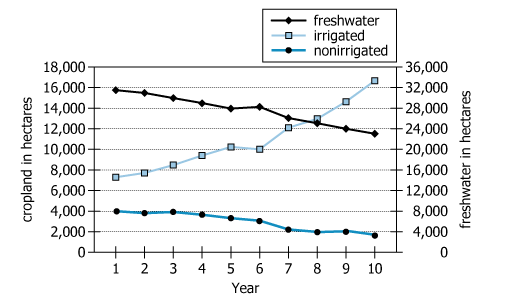
For each of 10 consecutive years (Year 1 through Year 10), the graph shows a certain region's irrigated crop land in hectares (left scale), non irrigated crop plant area in hectares (left scale) and freshwater area in hectares (right scale).
From each drop-down menu, select the option that creates the most accurate statement based on the information given.
For the 10 years shown in the graph for this reason, the number of hectares of freshwater exceeded the number of hectares of irrigated crop land in of the years.
For the 10 years shown in the graph for this region, the number of hectares of irrigated crop land exceeded the number of hectares of non irrigated crop land in of the years.

GMAT-Club-Forum-lo12dsuf.png [ 23.78 KiB | Viewed 6100 times ]
For each of 10 consecutive years (Year 1 through Year 10), the graph shows a certain region's irrigated crop land in hectares (left scale), non irrigated crop plant area in hectares (left scale) and freshwater area in hectares (right scale).
From each drop-down menu, select the option that creates the most accurate statement based on the information given.
For the 10 years shown in the graph for this reason, the number of hectares of freshwater exceeded the number of hectares of irrigated crop land in of the years.
For the 10 years shown in the graph for this region, the number of hectares of irrigated crop land exceeded the number of hectares of non irrigated crop land in of the years.
Attachment:
GMAT-Club-Forum-lo12dsuf.png [ 23.78 KiB | Viewed 6100 times ]
ShowHide Answer
Official Answer
Dropdown 1: all
Dropdown 2: all
Trying to understand why the right answer is right?
GMAT Club Tests explanations walk through concepts, shortcuts, and common traps on many questions.
See how →

 05 Jun 2024, 10:50
Kudos
Bookmarks
abcsayali
Both are all.
for first just look at the minimum value of freshwater is somewhere around the middle of 20k-24k which is way higher than the scale of cropland hectors.
and second is straight forward.
Attachment:
GMAT-Club-Forum-x5wr7ixv.png [ 23.78 KiB | Viewed 6017 times ]
 28 Jan 2025, 17:51
Kudos
Bookmarks
1. The question compares the area of the croplands and freshwater. It is key to note that the area for freshwater is shown on the right side of the graph instead of the left.
2. For the first part, across 10 years, freshwater was at least 20000 hectares and irrigated crop land was no more than 18000. This means that freshwater exceeded irrigated crop land for all 10 years.
3. For the second part, across 10 years, irrigated crop land was at least 6000 hectares and nonirrigated crop land was no more than 4000. This means that irrigated crop land exceeded nonirrigated crop land for all 10 years.
4. Our answer will be: D1 - all and D2 - all.
2. For the first part, across 10 years, freshwater was at least 20000 hectares and irrigated crop land was no more than 18000. This means that freshwater exceeded irrigated crop land for all 10 years.
3. For the second part, across 10 years, irrigated crop land was at least 6000 hectares and nonirrigated crop land was no more than 4000. This means that irrigated crop land exceeded nonirrigated crop land for all 10 years.
4. Our answer will be: D1 - all and D2 - all.






