Last visit was: 31 Aug 2026, 20:20 It is currently 31 Aug 2026, 20:20
Close
GMAT Club Daily Prep
Thank you for using the timer - this advanced tool can estimate your performance and suggest more practice questions. We have subscribed you to Daily Prep Questions via email.

Customized
for You

we will pick new questions that match your level based on your Timer History

Track
Your Progress

every week, we’ll send you an estimated GMAT score based on your performance

Practice
Pays

we will pick new questions that match your level based on your Timer History
Not interested in getting valuable practice questions and articles delivered to your email? No problem, unsubscribe here.
Close
Request Expert Reply
Confirm Cancel
User avatar
SergejK
Joined: 22 Mar 2024
Last visit: 02 May 2025
Posts: 150
Own Kudos:
1,107
 [50]
Given Kudos: 73
Posts: 150
Kudos: 1,107
 [50]
6
Kudos
Add Kudos
44
Bookmarks
Bookmark this Post
Most Helpful Reply
User avatar
Bismuth83
User avatar
DI Forum Moderator
Joined: 15 Sep 2024
Last visit: 01 Aug 2025
Posts: 708
Own Kudos:
3,600
 [6]
Given Kudos: 441
Expert
Expert reply
Posts: 708
Kudos: 3,600
 [6]
6
Kudos
Add Kudos
Bookmarks
Bookmark this Post
General Discussion
User avatar
Sidak02
Joined: 10 Apr 2024
Last visit: 18 Sep 2024
Posts: 1
Given Kudos: 3
Posts: 1
Kudos: 0
Kudos
Add Kudos
Bookmarks
Bookmark this Post
User avatar
sachi-in
Joined: 12 Oct 2023
Last visit: 16 Jun 2026
Posts: 116
Own Kudos:
359
 [2]
Given Kudos: 147
Posts: 116
Kudos: 359
 [2]
2
Kudos
Add Kudos
Bookmarks
Bookmark this Post
Sidak02
can anyone please explain the answers of it
­
1. Which one of the following statements about growing beans in Region R is most strongly supported by the information provided in the tabs?

Of the 60 farms, 95% of them had a higher yield from commercial beans than from landrace beans over the period in question.

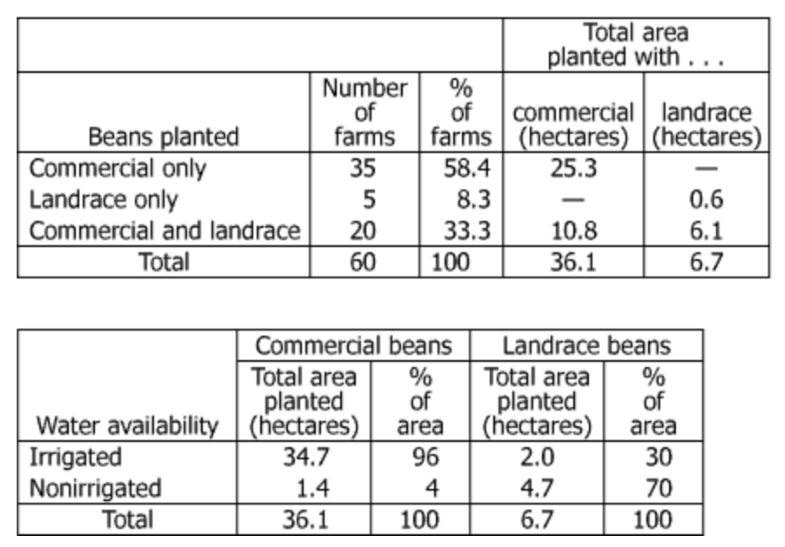
This option is tricky: 95% of land (34.1 hectare = commercial but irrigated) had better yields than 5%(2 hectare = non-commercial but irrigated) of land.
But we don't know if 95% farms had the same statistics ( that is possible only when land is divided proportionally between farms)

Hence this option isn't correct.

Growing bean varieties that farmers frequently sell on international markets may require more capital than would growing varieties that sell less frequently.
seeds cost more
irrigation cost
fertilizer cost
so yes the passage indirectly indicates commercials are capital intensive

Correct

Farmers that plant only landrace varieties do so primarily to be legally able to plant seeds from their own crops.

It's one reason ( may not be primary )

Farmers who want to maximize their yields will, without exception, plant commercial bean varieties.

No some may prefer non-commercials in unirrigated terrains

The information in the tabs defends the view that the advantages of one type of bean significantly outweigh the advantages of the other.

No there is no such conclusions­


2. For each of the following statements about Region R during the growing season represented in the two tables, select Yes if the statement accurately reflects the information in the tabs. Otherwise, select No.

For the area with landrace beans planted on it, greater than 65% of it is nonirrigated Table 2 ( nonirrigated / total = 70%) - Yes
Of those farms that grew only landrace beans, greater than 50% had beans planted on irrigated land - No
Of those farms that grew only landrace beans, greater than 50% had beans planted on nonirrigated land. - No

Because there is no statistics about no.of farms that have irrigation and those that doesn't have.


3. For each of the following statements, select Yes if the statement is supported by the information provided in the tabs. Otherwise, select No.


Generally, bean farmers in Region R assign the greatest value to protecting their bean crop against disease. - We don't know which advantage is more important - No

Some bean farmers in Region R grow their bean crops in adverse farming conditions. - Some do (table 2) - adverse conditions - no irrigation - Yes

Bean farmers in Region R would violate a law if they planted commercial seeds obtained from the previous year's crop. - It is mentioned that commercial seeds can't be replanted cuz of copyright - Yes
User avatar
divyasaxena2825
Joined: 20 Dec 2022
Last visit: 16 Jul 2025
Posts: 16
Own Kudos:
Given Kudos: 342
Status:preparing for GMAT
Affiliations: -
Location: India
Concentration: Sustainability, Economics
GPA: 8.5
Posts: 16
Kudos: 11
Kudos
Add Kudos
Bookmarks
Bookmark this Post
I did not understand your explanation to the question- ''Some bean farmers in Region R grow their bean crops in adverse farming conditions. - Some do (table 2) - adverse conditions - no irrigation - Yes''
There is nothing mentioned in table 2 regarding adverse conditions. Please could you add more details?
User avatar
vaishmahe
Joined: 05 Dec 2022
Last visit: 22 Jul 2025
Posts: 15
Own Kudos:
16
 [1]
Given Kudos: 57
Location: India
Concentration: Finance, Strategy
GMAT Focus 1: 615 Q81 V83 DI77
GMAT Focus 2: 595 Q78 V82 DI78
GPA: 8.5/10
GMAT Focus 2: 595 Q78 V82 DI78
Posts: 15
Kudos: 16
 [1]
1
Kudos
Add Kudos
Bookmarks
Bookmark this Post
divyasaxena2825
I did not understand your explanation to the question- ''Some bean farmers in Region R grow their bean crops in adverse farming conditions. - Some do (table 2) - adverse conditions - no irrigation - Yes''
There is nothing mentioned in table 2 regarding adverse conditions. Please could you add more details?
In the passage about landbeans - examples of adverse condition are mentioned - non availability of irrigation is one of them. As the tables have data pertaining to crops being raised on non-irrigated land, we can conclude some of the farmers are growing bean crop in adverse condition.
User avatar
shriyaapathi
Joined: 05 Sep 2024
Last visit: 25 Jan 2025
Posts: 5
Own Kudos:
2
 [2]
Given Kudos: 11
Posts: 5
Kudos: 2
 [2]
2
Kudos
Add Kudos
Bookmarks
Bookmark this Post
For the second question , the third sub question asked why is the answer a no?
User avatar
Ghoskrp3
Joined: 15 Jul 2024
Last visit: 18 Aug 2025
Posts: 36
Own Kudos:
12
 [3]
Given Kudos: 57
Location: India
Posts: 36
Kudos: 12
 [3]
3
Kudos
Add Kudos
Bookmarks
Bookmark this Post
1. Which one of the following statements about growing beans in Region R is most strongly supported by the information provided in the tabs?

A. Of the 60 farms, 95% of them had a higher yield from commercial beans than from landrace beans over the period in question. -There is no info. at all pertaining to the yield/output/production shared in the tables or other tabs (It says, "In good farming conditions, commercial varieties tend to produce higher yields than landrace varieties", but left to us to speculate)

B. Growing bean varieties that farmers frequently sell on international markets may require more capital than would growing varieties that sell less frequently. -Conclusive! by combination of data from tab1 & tab2 (Tab1: It says, " Landrace varieties require less capital than do commercial varieties to grow a crop, since landrace seeds may be planted from the previous year's crop" + Tab2: It says, "Farmers sell commercial bean varieties more frequently on both regional and international markets.")

C. Farmers that plant only landrace varieties do so primarily to be legally able to plant seeds from their own crops.
-Somewhat true but, surely this is an extreme option, using the words "only" & "Primarily", so should be avoided

D. Farmers who want to maximize their yields will, without exception, plant commercial bean varieties. - Definitely No!, Maximum Yield with commercial bean?, they are not hearty to withstand harsh weather and land conditions and also require to be irrigated.

E. The information in the tabs defends the view that the advantages of one type of bean significantly outweigh the advantages of the other. -I felt this too in tab1 but tab 2 also introduced points to balance out the biasness and the tables showing the farm spread also sorts this confusion, hence "slightly outweighs" would be a better term to saying "significantly outweighs"


2. For each of the following statements about Region R during the growing season represented in the two tables, select Yes if the statement accurately reflects the information in the tabs. Otherwise, select No.

A. For the area with landrace beans planted on it, greater than 65% of it is nonirrigated- Yes!, 70% of the land is unirrigated (data present in table 2)

B. Of those farms that grew only landrace beans, greater than 50% had beans planted on irrigated land.- Not Sure, There are in total of 0.6+6.1 = 6.7 hectares of landrace crop, of which "only landrace" is 0.6 hectares and table 2 says, 2 hectares of landrace crop is Irrigated and 4.7 hectares of landrace is unirrigated, but still hard to tell which is which, where is our only 0.6 hectares part of landrace growing crop actually present in these parts.

C. Of those farms that grew only landrace beans, greater than 50% had beans planted on nonirrigated land. - Again Not Sure, same issue as above


3. For each of the following statements, select Yes if the statement is supported by the information provided in the tabs. Otherwise, select No.

A. Generally, bean farmers in Region R assign the greatest value to protecting their bean crop against disease. - No!, Data not given in any of the tabs on this

B. Some bean farmers in Region R grow their bean crops in adverse farming conditions. -Yes!, In tab 1 it says " Landrace varieties are hearty. As a result, they grow better and have higher yields in adverse farming conditions—for example, in areas without irrigation, in rocky soil, or on steep hillsides—than do commercial varieties". Hence, "non irrigation" area qualifies as an adverse farming condition and by data in table 2 36% of the land is unirrigated which can be referred as "some farmers"

C. Bean farmers in Region R would violate a law if they planted commercial seeds obtained from the previous year's crop. -Yes!, shared in tab1: "By contrast, it violates patent laws for farmers to obtain, keep, or profit from the commercial seeds produced by the previous year's crop."
User avatar
RahulGrover21
Joined: 28 Nov 2024
Last visit: 19 Feb 2026
Posts: 1
Posts: 1
Kudos: 0
Kudos
Add Kudos
Bookmarks
Bookmark this Post
For question 3, Bean farmers in Region R would violate a law if they planted commercial seeds obtained from the previous year's crop, shouldn't the answer be No. Since this is applicable to Landrace beans and only mentioned in that tab. Had it been Landrace beans mentioned in the statement, wouldn't it be yes in that case?
User avatar
Ghoskrp3
Joined: 15 Jul 2024
Last visit: 18 Aug 2025
Posts: 36
Own Kudos:
Given Kudos: 57
Location: India
Posts: 36
Kudos: 12
Kudos
Add Kudos
Bookmarks
Bookmark this Post
Nope!, the answer would still be "Yes", irrespective of which tab the data is shared, as the data shared talks particularly about violation of patent laws, if commercial seeds produced by the previous year's crop

As shared in tab1: "By contrast, it violates patent laws for farmers to obtain, keep, or profit from the commercial seeds produced by the previous year's crop."

RahulGrover21
For question 3, Bean farmers in Region R would violate a law if they planted commercial seeds obtained from the previous year's crop, shouldn't the answer be No. Since this is applicable to Landrace beans and only mentioned in that tab. Had it been Landrace beans mentioned in the statement, wouldn't it be yes in that case?
User avatar
abcd1234!!
Joined: 08 Aug 2023
Last visit: 25 Sep 2025
Posts: 9
Own Kudos:
Given Kudos: 2
Posts: 9
Kudos: 3
Kudos
Add Kudos
Bookmarks
Bookmark this Post
For Q1, 95% of 60 farms is 57, but from first table, farms growing commercial only and commercial + landrace is total 55(35+20). Hence it can never be that 57 farms or 95% of farms had better yield from commercial.
User avatar
Ghoskrp3
Joined: 15 Jul 2024
Last visit: 18 Aug 2025
Posts: 36
Own Kudos:
Given Kudos: 57
Location: India
Posts: 36
Kudos: 12
Kudos
Add Kudos
Bookmarks
Bookmark this Post
Nope! it says, " Of the 60 farms, 95% of them had a higher yield from commercial beans than from landrace beans", means 95% of these farms vs 95% of those farms:

=> Yield from 95% of Commercial bean farms > Yield from 95% of landrace bean farms
=> Yield from 95% (35+x) farms > Yield from 95% of (5+y) farms, (where x+y = 20)

So, there are still 2 factors we need first to be able to definitely conclude: First is, yield (for which we have no data; out of 10 farms did all 10 produced effectively or only 2 farms produced effectively), Second, in the farms where commercial and landrace beans are planted together what portion of farms do they beans occupy each


Therefore, Answer is Niether Yes, Nor a definite No (as you tried to conclude), but will be, "Can't Be Determined".
abcd1234!!
For Q1, 95% of 60 farms is 57, but from first table, farms growing commercial only and commercial + landrace is total 55(35+20). Hence it can never be that 57 farms or 95% of farms had better yield from commercial.
User avatar
abcd1234!!
Joined: 08 Aug 2023
Last visit: 25 Sep 2025
Posts: 9
Own Kudos:
Given Kudos: 2
Posts: 9
Kudos: 3
Kudos
Add Kudos
Bookmarks
Bookmark this Post
Yes that's what I had thought at first, that 95% of farms growing commercial, landrace or both had a higher yield from commercial than from landrace. But then 95% of 60 farms thought struck me and I thought I had found a simple loophole. For your second point it is mentioned in the Data tab table that planted together they each occupy how much land or am I missing something?
Ghoskrp3
Nope! it says, " Of the 60 farms, 95% of them had a higher yield from commercial beans than from landrace beans", means 95% of these farms vs 95% of those farms:

=> Yield from 95% of Commercial bean farms > Yield from 95% of landrace bean farms
=> Yield from 95% (35+x) farms > Yield from 95% of (5+y) farms, (where x+y = 20)

So, there are still 2 factors we need first to be able to definitely conclude: First is, yield (for which we have no data; out of 10 farms did all 10 produced effectively or only 2 farms produced effectively), Second, in the farms where commercial and landrace beans are planted together what portion of farms do they beans occupy each


Therefore, Answer is Niether Yes, Nor a definite No (as you tried to conclude), but will be, "Can't Be Determined".
abcd1234!!
For Q1, 95% of 60 farms is 57, but from first table, farms growing commercial only and commercial + landrace is total 55(35+20). Hence it can never be that 57 farms or 95% of farms had better yield from commercial.
User avatar
Ghoskrp3
Joined: 15 Jul 2024
Last visit: 18 Aug 2025
Posts: 36
Own Kudos:
Given Kudos: 57
Location: India
Posts: 36
Kudos: 12
Kudos
Add Kudos
Bookmarks
Bookmark this Post
2 things, I want to understand:

1. Are you trying to prove that that since, of 57 farms or 95% of farms' yield can never be ever from Commercial so the answer should be "Option A"

2. What about the yield? (how are you factoring that?, 10 farms can yield nothing for all I know or out of 10 farms only 3 farms yield or 2 farms yield, how to conclusively prove it?)

Either way I see the argument inconclusive and rest my case ...
abcd1234!!
Yes that's what I had thought at first, that 95% of farms growing commercial, landrace or both had a higher yield from commercial than from landrace. But then 95% of 60 farms thought struck me and I thought I had found a simple loophole. For your second point it is mentioned in the Data tab table that planted together they each occupy how much land or am I missing something?
Ghoskrp3
Nope! it says, " Of the 60 farms, 95% of them had a higher yield from commercial beans than from landrace beans", means 95% of these farms vs 95% of those farms:

=> Yield from 95% of Commercial bean farms > Yield from 95% of landrace bean farms
=> Yield from 95% (35+x) farms > Yield from 95% of (5+y) farms, (where x+y = 20)

So, there are still 2 factors we need first to be able to definitely conclude: First is, yield (for which we have no data; out of 10 farms did all 10 produced effectively or only 2 farms produced effectively), Second, in the farms where commercial and landrace beans are planted together what portion of farms do they beans occupy each


Therefore, Answer is Niether Yes, Nor a definite No (as you tried to conclude), but will be, "Can't Be Determined".
abcd1234!!
For Q1, 95% of 60 farms is 57, but from first table, farms growing commercial only and commercial + landrace is total 55(35+20). Hence it can never be that 57 farms or 95% of farms had better yield from commercial.
User avatar
Rickooreo
Joined: 24 Dec 2021
Last visit: 31 Aug 2026
Posts: 327
Own Kudos:
Given Kudos: 333
Location: India
Concentration: Finance, General Management
GMAT 1: 690 Q48 V35
GPA: 3.95
WE:Real Estate (Consulting)
Products:
GMAT 1: 690 Q48 V35
Posts: 327
Kudos: 43
Kudos
Add Kudos
Bookmarks
Bookmark this Post
Confused for question 3 - statement 1
User avatar
Usernamevisible
Joined: 09 Jun 2022
Last visit: 30 Aug 2026
Posts: 480
Own Kudos:
105
 [1]
Given Kudos: 1,282
Products:
Posts: 480
Kudos: 105
 [1]
1
Kudos
Add Kudos
Bookmarks
Bookmark this Post
MSR Reasoning Framework

The core skill tested in Multi-Source Reasoning (MSR) is the ability to distinguish between what is explicitly stated, what must be inferred, what is merely possible, and what cannot be concluded. Most incorrect answers result from treating a possibility as a certainty or introducing information that the passage never provides.

---

Rule 1: Classify Every Statement

Whenever you read an answer choice, first classify it into one of four categories.

A fact is directly stated in the passage or table.

A necessary inference is not directly stated but must be true based on the given information.

A possible conclusion could be true but is not guaranteed by the information provided.

An unsupported conclusion introduces new assumptions, motivations, rankings, or generalizations that are never established.

Only facts and necessary inferences can be correct.

---

Question 1 Lessons

Option A claimed that 95% of the farms had higher yields from commercial beans. The passage only stated that commercial beans tend to have higher yields. "Tend to" indicates a general pattern, not an exact percentage. Since no yield data or percentages were provided, this statement is unsupported.

Option B stated that growing commercially sold bean varieties may require more capital than growing varieties sold less frequently. Commercial beans require purchasing new patented seeds, while landrace seeds can be saved and replanted. Since buying seeds may increase costs, the statement is supported. Notice that the word "may" keeps the claim appropriately cautious.

Option C claimed that farmers who grow only landrace beans do so primarily because they want to legally reuse seeds. The passage never explains why farmers choose one variety over another. They may choose landrace beans for many reasons, including poor soil, limited irrigation, lower costs, biodiversity, or legal seed reuse. Since motivation is never given, the statement is unsupported.

Option D claimed that farmers seeking maximum yield will always choose commercial beans. This is too strong because the passage explains that landrace beans perform better under adverse conditions. Therefore, commercial beans are not always the best choice.

Option E claimed that one bean type's advantages significantly outweigh the other's. The passage intentionally presents strengths and weaknesses of both bean types without comparing their overall value. Since no overall judgment is provided, the statement is unsupported.

The key lesson is that whenever an option explains why people behave a certain way, reject it unless the passage explicitly provides their motivation.

---

Question 2 Lessons

Statement 1 asked whether more than 65% of the landrace area was nonirrigated. The table showed 6.7 hectares of total landrace area and 4.7 hectares that were nonirrigated. Dividing 4.7 by 6.7 gives approximately 70%, which is greater than 65%, so the statement is supported.

Statement 2 claimed that more than half of the farms growing only landrace beans were irrigated. The table reports hectares, not the number of farms. A few large farms could account for most of the land area, or many small farms could account for the remainder. Because the number of farms is unknown, the statement cannot be concluded.

Statement 3 made the same mistake by referring to the number of farms while the table only reports hectares. Without knowing the distribution of farm sizes, no conclusion about the number of farms can be made.

The key lesson is to always identify exactly what is being measured. Never convert hectares into farms, revenue into customers, percentages into counts, or any other unit unless the passage explicitly allows that conversion.

---

Question 3 Lessons

Option A claimed that farmers value disease protection more than any other characteristic. The passage simply lists disease resistance as one advantage. It never ranks farmer preferences or priorities, so the statement is unsupported.

Option B stated that some bean farmers grow crops under adverse farming conditions. The passage explains that landrace beans perform better without irrigation, and the table shows that about 70% of the landrace area is nonirrigated. Therefore, some farmers clearly farm under adverse conditions. This is a necessary inference.

Option C stated that farmers would violate patent law if they replanted commercial seeds from a previous harvest. The passage explicitly states that saving and replanting commercial seeds violates patent laws. This is directly supported.

---

The Five Biggest MSR Lessons

Always answer the exact question being asked. If the question asks about farms, use farm data. If it asks about hectares, use hectare data. Never substitute one measure for another.

Pay close attention to the strength of the language. Words such as "tend to," "usually," or "often" do not justify conclusions containing "always," "every," "without exception," or "must."

Separate objective data from human motivation. Tables usually report measurable facts such as hectares, percentages, yields, or irrigation status. They rarely explain why people made their decisions unless the passage explicitly states those reasons.

Watch for certainty words. Terms such as "always," "all," "every," "without exception," "primarily," "proves," and "significantly outweighs" often make an answer incorrect because they overstate what the evidence supports.

Recognize that "may" is much easier to support than "must." A statement saying something may happen only requires that it is possible based on the evidence. A statement saying something must happen requires complete certainty from the passage.
Moderators:
Math Expert
113036 posts
DI Forum Moderator
410 posts