Last visit was: 23 Apr 2026, 11:57 It is currently 23 Apr 2026, 11:57
Close
GMAT Club Daily Prep
Thank you for using the timer - this advanced tool can estimate your performance and suggest more practice questions. We have subscribed you to Daily Prep Questions via email.

Customized
for You

we will pick new questions that match your level based on your Timer History

Track
Your Progress

every week, we’ll send you an estimated GMAT score based on your performance

Practice
Pays

we will pick new questions that match your level based on your Timer History
Not interested in getting valuable practice questions and articles delivered to your email? No problem, unsubscribe here.
Close
Request Expert Reply
Confirm Cancel
User avatar
Bunuel
User avatar
Math Expert
Joined: 02 Sep 2009
Last visit: 23 Apr 2026
Posts: 109,783
Own Kudos:
810,837
 [2]
Given Kudos: 105,853
Products:
Expert
Expert reply
Active GMAT Club Expert! Tag them with @ followed by their username for a faster response.
Posts: 109,783
Kudos: 810,837
 [2]
1
Kudos
Add Kudos
1
Bookmarks
Bookmark this Post
User avatar
Bunuel
User avatar
Math Expert
Joined: 02 Sep 2009
Last visit: 23 Apr 2026
Posts: 109,783
Own Kudos:
Given Kudos: 105,853
Products:
Expert
Expert reply
Active GMAT Club Expert! Tag them with @ followed by their username for a faster response.
Posts: 109,783
Kudos: 810,837
Kudos
Add Kudos
Bookmarks
Bookmark this Post
User avatar
Bunuel
User avatar
Math Expert
Joined: 02 Sep 2009
Last visit: 23 Apr 2026
Posts: 109,783
Own Kudos:
Given Kudos: 105,853
Products:
Expert
Expert reply
Active GMAT Club Expert! Tag them with @ followed by their username for a faster response.
Posts: 109,783
Kudos: 810,837
Kudos
Add Kudos
Bookmarks
Bookmark this Post
User avatar
Geminiggl
Joined: 12 Nov 2024
Last visit: 27 Nov 2024
Posts: 3
Location: France
Posts: 3
Kudos: 0
Kudos
Add Kudos
Bookmarks
Bookmark this Post
I think this is a high-quality question and I agree with explanation.
User avatar
ManavAilawadi
Joined: 22 Oct 2024
Last visit: 31 Aug 2025
Posts: 1
Own Kudos:
1
 [1]
Posts: 1
Kudos: 1
 [1]
1
Kudos
Add Kudos
Bookmarks
Bookmark this Post
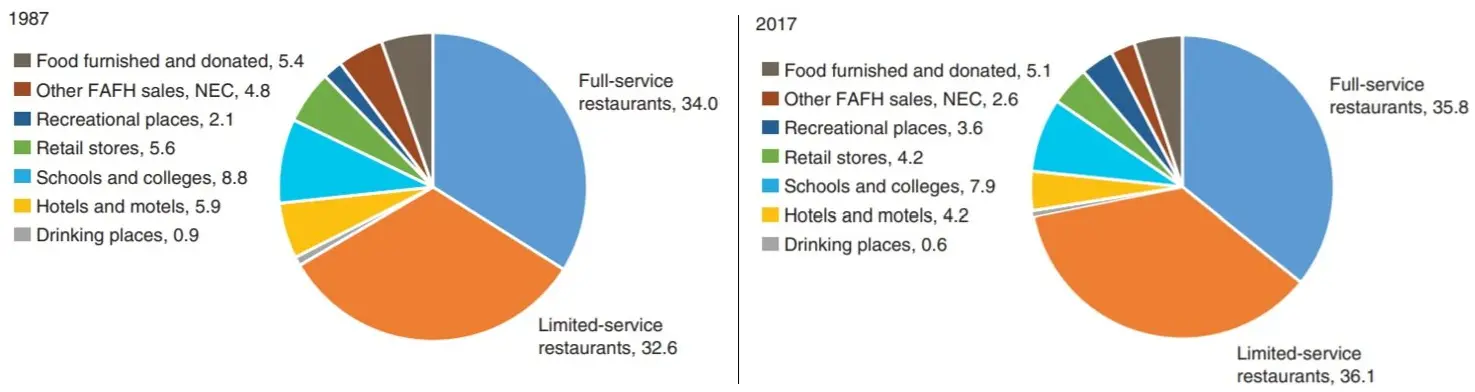
I did not quite understand the solution. We are saying recreational places have the maximum increase in the share from 2.1% to 3.6%. But if we look at Limited-Service Restaurants, the category has got the maximum increase. In 1987 its share was 32.6% and in 2017 it was 36.1%, representing a 3.5 fold increase, double that of Recreational Places.

Please help me understand why we have taken Recreational Places
User avatar
Bunuel
User avatar
Math Expert
Joined: 02 Sep 2009
Last visit: 23 Apr 2026
Posts: 109,783
Own Kudos:
810,837
 [3]
Given Kudos: 105,853
Products:
Expert
Expert reply
Active GMAT Club Expert! Tag them with @ followed by their username for a faster response.
Posts: 109,783
Kudos: 810,837
 [3]
3
Kudos
Add Kudos
Bookmarks
Bookmark this Post
ManavAilawadi
I did not quite understand the solution. We are saying recreational places have the maximum increase in the share from 2.1% to 3.6%. But if we look at Limited-Service Restaurants, the category has got the maximum increase. In 1987 its share was 32.6% and in 2017 it was 36.1%, representing a 3.5 fold increase, double that of Recreational Places.

Please help me understand why we have taken Recreational Places

You're misunderstanding the problem. The question asks for the greatest relative increase, not the absolute increase.

Recreational Places increased its share from 2.1% to 3.6%, which is a 1.7-fold increase (3.6 / 2.1 ≈ 1.7). This means its share grew by 70% relative to its original share.

Meanwhile, Limited-Service Restaurants increased from 32.6% to 36.1%, which is only about a 1.11-fold increase (36.1 / 32.6 ≈ 1.11), or 11% relative growth.

Just because Limited-Service Restaurants had a larger absolute difference doesn’t mean it had the largest relative increase. The problem specifically asks for the category with the greatest percentage increase, which refers to the proportionate growth, not the raw change in percentage points.

That’s why Recreational Places is the correct answer, and Limited-Service Restaurants isn’t.
User avatar
buku1213
Joined: 24 Dec 2024
Last visit: 23 Apr 2026
Posts: 3
Own Kudos:
1
 [1]
Posts: 3
Kudos: 1
 [1]
1
Kudos
Add Kudos
Bookmarks
Bookmark this Post
i can anyone explain the 2nd part, please? from this language,e I initially thought you were comparing the increment between 1987 and 2017. But after that in explanation, I saw you are comparing the item of 2017 only. from this word how does one understands the comparison between 2017 only, before distribution nd after distribution??
User avatar
Bunuel
User avatar
Math Expert
Joined: 02 Sep 2009
Last visit: 23 Apr 2026
Posts: 109,783
Own Kudos:
Given Kudos: 105,853
Products:
Expert
Expert reply
Active GMAT Club Expert! Tag them with @ followed by their username for a faster response.
Posts: 109,783
Kudos: 810,837
Kudos
Add Kudos
Bookmarks
Bookmark this Post
buku1213
i can anyone explain the 2nd part, please? from this language,e I initially thought you were comparing the increment between 1987 and 2017. But after that in explanation, I saw you are comparing the item of 2017 only. from this word how does one understands the comparison between 2017 only, before distribution nd after distribution??
"in 2017 were equally distributed"

This signals everything is happening within 2017 only — you're comparing the actual 2017 shares before and after redistribution, not comparing to 1987.
User avatar
sanikaprakash
Joined: 13 Apr 2024
Last visit: 30 Dec 2025
Posts: 2
Given Kudos: 2
Location: India
Schools: HBS
GPA: 8.7
Schools: HBS
Posts: 2
Kudos: 0
Kudos
Add Kudos
Bookmarks
Bookmark this Post
How to identify a "relative" percent change from an "absolute percent change in the question?
User avatar
Bunuel
User avatar
Math Expert
Joined: 02 Sep 2009
Last visit: 23 Apr 2026
Posts: 109,783
Own Kudos:
Given Kudos: 105,853
Products:
Expert
Expert reply
Active GMAT Club Expert! Tag them with @ followed by their username for a faster response.
Posts: 109,783
Kudos: 810,837
Kudos
Add Kudos
Bookmarks
Bookmark this Post
sanikaprakash
How to identify a "relative" percent change from an "absolute percent change in the question?

Here’s the short clarification:

  • Absolute change looks at the raw difference in percentage points.
    Example: Limited-service restaurants went from 32.6% to 36.1%. That’s an absolute increase of 3.5 percentage points.
  • Relative change (percentage increase) looks at how big that increase is compared to the original.
    Example: Recreational places went from 2.1% to 3.6%. The absolute change is only 1.5 points, but relative to its starting value (1.5/2.1 ≈ 70%), that’s much larger than the 11% increase for limited-service restaurants.

So, when the question asks for the greatest percentage increase, it means relative change, not absolute difference.
User avatar
harshitasinghal
Joined: 25 Apr 2024
Last visit: 23 Apr 2026
Posts: 22
Own Kudos:
Given Kudos: 5
Location: India
Products:
Posts: 22
Kudos: 2
Kudos
Add Kudos
Bookmarks
Bookmark this Post
So, there are 4 options in the drop down for the 1st question in the graph analysis. Instead of comparing these 4 fractions to each other to find the highest relative increase in share percentage. Are there shortcuts or things to note to narrow down our options for such questions?

As this ques sometimes also come in the form of 2-part analysis where you might have to compare all 10 fractions to see if its supported or not. How can we solve such a question faster and more efficiently?
User avatar
Bunuel
User avatar
Math Expert
Joined: 02 Sep 2009
Last visit: 23 Apr 2026
Posts: 109,783
Own Kudos:
Given Kudos: 105,853
Products:
Expert
Expert reply
Active GMAT Club Expert! Tag them with @ followed by their username for a faster response.
Posts: 109,783
Kudos: 810,837
Kudos
Add Kudos
Bookmarks
Bookmark this Post
harshitasinghal
So, there are 4 options in the drop down for the 1st question in the graph analysis. Instead of comparing these 4 fractions to each other to find the highest relative increase in share percentage. Are there shortcuts or things to note to narrow down our options for such questions?

As this ques sometimes also come in the form of 2-part analysis where you might have to compare all 10 fractions to see if its supported or not. How can we solve such a question faster and more efficiently?

You don't really need to calculate much in this question.

Drop-down 1:

Keep only gainers:

Full-service restaurants 34.0 to 35.8
Limited-service restaurants 32.6 to 36.1
Recreational places 2.1 to 3.6

You do not need to calculate precise ratios. The first two moved only a few points on bases around the mid-30s, so their ratios are close to 1. Recreational places jumped from about 2 to about 3.6, so its ratio is clearly the largest. Answer: Recreational places.

Drop-down 2:

“Other FAFH, NEC” in 2017 is 2.6%. Split equally across 8 categories adds about 2.6/8 ≈ 0.33 percentage points to each. With the same increment for all, percent increase equals increment/base, so the smallest base gives the largest percent increase. Drinking places starts at 0.6, so 0.33/0.6 ≈ 55%.
User avatar
f3rn4nd44m0r1m
Joined: 21 Aug 2024
Last visit: 06 Apr 2026
Posts: 47
Own Kudos:
Given Kudos: 292
Location: Brazil
Concentration: Entrepreneurship, Organizational Behavior
GMAT Focus 1: 605 Q77 V81 DI82
GPA: 8.5
WE:Project Management (Non-Profit)
Products:
Kudos
Add Kudos
Bookmarks
Bookmark this Post
I like the solution - it’s helpful.
User avatar
honouredone
Joined: 30 Sep 2025
Last visit: 21 Feb 2026
Posts: 41
Given Kudos: 90
GMAT Focus 1: 555 Q78 V80 DI75
Posts: 41
Kudos: 0
Kudos
Add Kudos
Bookmarks
Bookmark this Post
I have understood that recreational spaces is the correct answer, but how to identify what the question is asking? How to identify if the question is asking about relative increase or absolute difference in general?


Bunuel
Quote:


Here’s the short clarification:

  • Absolute change looks at the raw difference in percentage points.
    Example: Limited-service restaurants went from 32.6% to 36.1%. That’s an absolute increase of 3.5 percentage points.
  • Relative change (percentage increase) looks at how big that increase is compared to the original.
    Example: Recreational places went from 2.1% to 3.6%. The absolute change is only 1.5 points, but relative to its starting value (1.5/2.1 ≈ 70%), that’s much larger than the 11% increase for limited-service restaurants.

So, when the question asks for the greatest percentage increase, it means relative change, not absolute difference.
User avatar
Bunuel
User avatar
Math Expert
Joined: 02 Sep 2009
Last visit: 23 Apr 2026
Posts: 109,783
Own Kudos:
810,837
 [1]
Given Kudos: 105,853
Products:
Expert
Expert reply
Active GMAT Club Expert! Tag them with @ followed by their username for a faster response.
Posts: 109,783
Kudos: 810,837
 [1]
1
Kudos
Add Kudos
Bookmarks
Bookmark this Post
Bunuel


Here’s the short clarification:

  • Absolute change looks at the raw difference in percentage points.
    Example: Limited-service restaurants went from 32.6% to 36.1%. That’s an absolute increase of 3.5 percentage points.
  • Relative change (percentage increase) looks at how big that increase is compared to the original.
    Example: Recreational places went from 2.1% to 3.6%. The absolute change is only 1.5 points, but relative to its starting value (1.5/2.1 ≈ 70%), that’s much larger than the 11% increase for limited-service restaurants.

So, when the question asks for the greatest percentage increase, it means relative change, not absolute difference.

When a question says “greatest percentage increase” or uses words like “increase by what percent”, it’s referring to relative change, that is, how much bigger the new value is compared to the old one.

If instead the question says “increase in percentage points” or just “difference between percentages”, it’s referring to the absolute change, the raw difference between the two percentages.
User avatar
doloremvoluptatum
Joined: 13 Aug 2025
Last visit: 06 Apr 2026
Posts: 18
Own Kudos:
Given Kudos: 131
Location: India
Concentration: Technology, Leadership
GPA: 3.7
Posts: 18
Kudos: 5
Kudos
Add Kudos
Bookmarks
Bookmark this Post
How much time should be given to the 1st blank, knowing that calculating the difference and the division, even while using calculator can take up a lot of time for 9 sections and also understanding the question
User avatar
Bunuel
User avatar
Math Expert
Joined: 02 Sep 2009
Last visit: 23 Apr 2026
Posts: 109,783
Own Kudos:
Given Kudos: 105,853
Products:
Expert
Expert reply
Active GMAT Club Expert! Tag them with @ followed by their username for a faster response.
Posts: 109,783
Kudos: 810,837
Kudos
Add Kudos
Bookmarks
Bookmark this Post
doloremvoluptatum
How much time should be given to the 1st blank, knowing that calculating the difference and the division, even while using calculator can take up a lot of time for 9 sections and also understanding the question

I tried addressing the timing issue for this question here: https://gmatclub.com/forum/i04-437805.html#p3627111 Please review.
User avatar
SanuBest
Joined: 17 Sep 2025
Last visit: 03 Jan 2026
Posts: 10
Given Kudos: 5
Posts: 10
Kudos: 0
Kudos
Add Kudos
Bookmarks
Bookmark this Post
I did not quite understand the solution. Why is it not limited service restaurants?
User avatar
Bunuel
User avatar
Math Expert
Joined: 02 Sep 2009
Last visit: 23 Apr 2026
Posts: 109,783
Own Kudos:
810,837
 [1]
Given Kudos: 105,853
Products:
Expert
Expert reply
Active GMAT Club Expert! Tag them with @ followed by their username for a faster response.
Posts: 109,783
Kudos: 810,837
 [1]
1
Kudos
Add Kudos
Bookmarks
Bookmark this Post
SanuBest
I did not quite understand the solution. Why is it not limited service restaurants?

Your doubt is addressed in detail HERE. Hope it helps.
User avatar
SanuBest
Joined: 17 Sep 2025
Last visit: 03 Jan 2026
Posts: 10
Given Kudos: 5
Posts: 10
Kudos: 0
Kudos
Add Kudos
Bookmarks
Bookmark this Post
Thank you!

Bunuel


Your doubt is addressed in detail HERE. Hope it helps.
 1   2   
Moderators:
Math Expert
109783 posts
Founder
43154 posts