Events & Promotions
|
|

GMAT Club Daily Prep
Thank you for using the timer - this advanced tool can estimate your performance and suggest more practice questions. We have subscribed you to Daily Prep Questions via email.
Customized
for You
Track
Your Progress
Practice
Pays
Not interested in getting valuable practice questions and articles delivered to your email? No problem, unsubscribe here.
 Sep 26
01:00 PM EDT
-04:00 PM EDT
Top scores are possible when you enroll in a powerful GMAT course, taught live online + 6 months access to TTP OnDemand video courses included. Class starts Saturdays Sept. 26, 2026 - Dec. 19, 2026, 1:00pm-4:00pm ES Sep 26
06:00 PM PDT
-07:00 PM PDT
Free- full-length test + 15 concept videos + 150+ short videos + study plan! Sep 26
12:30 AM EDT
-01:30 AM EDT
Struggling to find the right strategies to score a 99 %ile on GMAT Focus? Riya (GMAT 715) boosted her score by 100-points in just 15 days! Discover how the right mentorship, tailored strategies, and an unwavering mindset can transform your GMAT prep. Sep 27
01:30 AM EDT
-02:30 AM EDT
At one point, she believed GMAT wasn’t for her. After scoring 595, self-doubt crept in and she questioned her potential. But instead of quitting, she made the right strategic changes. The result? A remarkable comeback to 695. Check out how Saakshi did it. Sep 28
07:00 PM EDT
-10:00 PM EDT
Boost your GMAT score in less than one month in a live online class + 6 months access to TTP OnDemand video courses included! Class starts Mon, Tues, Wed, Thur, Fri Sept. 28, 2026 - Oct. 16, 2027, 7:00pm-10:00pm EST Sep 29
11:00 AM EDT
-01:00 PM EDT
" Description: Top scores are possible when you enroll in a powerful GMAT course, taught live online + 6 months access to TTP OnDemand video courses included! Class starts Tues/Thur Sept. 29, 2026 - Dec. 3, 2026, 11:00am-1:00pm EST Oct 01
07:00 AM BST
-08:00 AM GMT
Welcome to the GMAT Club's Free Interview Prep Event for Top MBA Programs! Buy tickets - Virtual series that’s all set to equip you to -excel in your MBA interviews.

 23 Sep 2025, 04:55
Kudos
Bookmarks


D
Be sure to select an answer first to save it in the Error Log before revealing the correct answer (OA)!
Difficulty:
 95%
(hard)
95%
(hard)
Question Stats:
24% (01:48) correct 76%
(01:59)
wrong
based on 172
sessions
76%
(01:59)
wrong
based on 172
sessions
History
Date
Time
Result
Not Attempted Yet
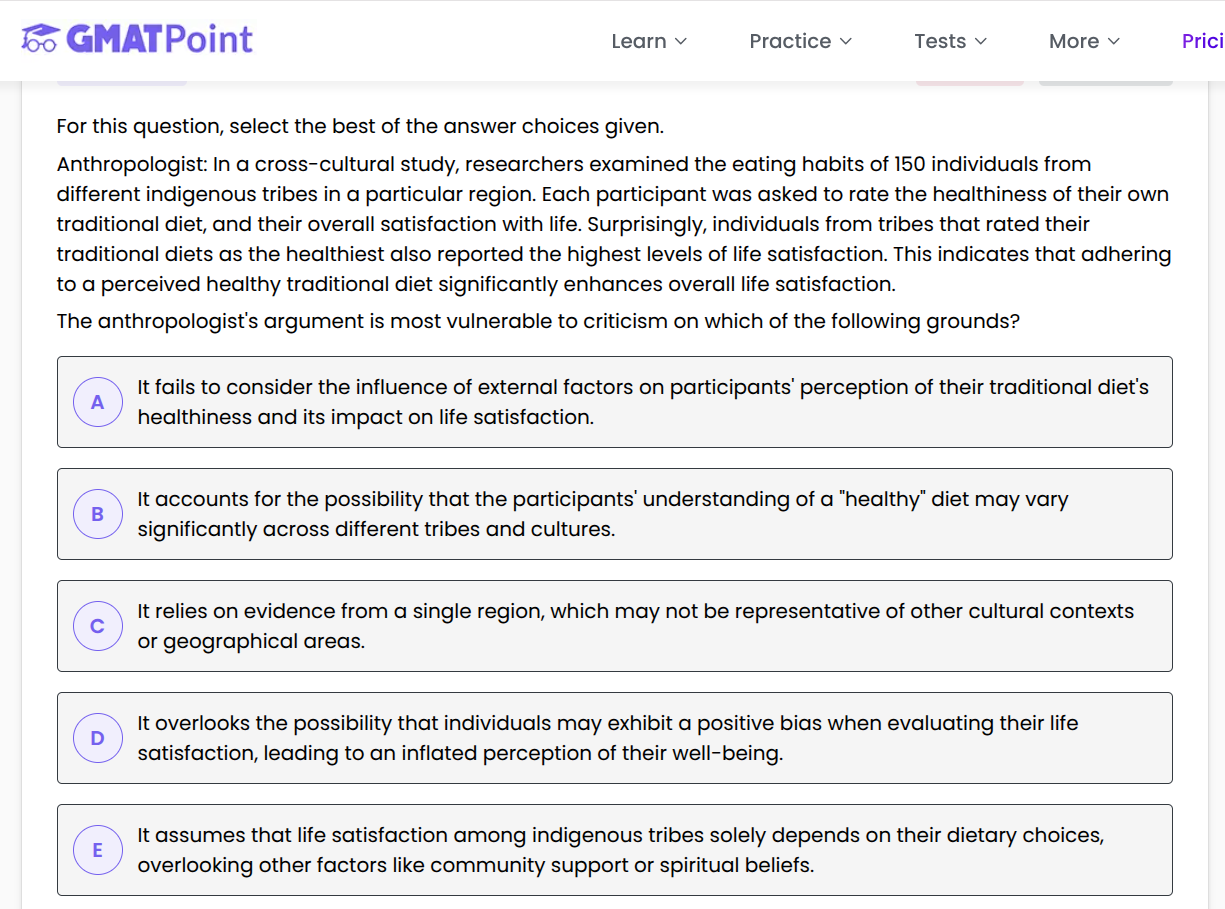
Anthropologist: In a cross-cultural study, researchers examined the eating habits of 150 individuals from different indigenous tribes in a particular region. Each participant was asked to rate the healthiness of their own traditional diet, and their overall satisfaction with life. Surprisingly, individuals from tribes that rated their traditional diets as the healthiest also reported the highest levels of life satisfaction. This indicates that adhering to a perceived healthy traditional diet significantly enhances overall life satisfaction.
The anthropologist's argument is most vulnerable to criticism on which of the following grounds?
A) It fails to consider the influence of external factors on participants' perception of their traditional diet's healthiness and its impact on life satisfaction.
B) It accounts for the possibility that the participants' understanding of a "healthy" diet may vary significantly across different tribes and cultures.
C) It relies on evidence from a single region, which may not be representative of other cultural contexts or geographical areas.
D) It overlooks the possibility that individuals may exhibit a positive bias when evaluating their life satisfaction, leading to an inflated perception of their well-being.
E) It assumes that life satisfaction among indigenous tribes solely depends on their dietary choices, overlooking other factors like community support or spiritual beliefs.
Screenshot 2025-09-23 10.56.20 AM.png [ 271.85 KiB | Viewed 1324 times ]
The anthropologist's argument is most vulnerable to criticism on which of the following grounds?
A) It fails to consider the influence of external factors on participants' perception of their traditional diet's healthiness and its impact on life satisfaction.
B) It accounts for the possibility that the participants' understanding of a "healthy" diet may vary significantly across different tribes and cultures.
C) It relies on evidence from a single region, which may not be representative of other cultural contexts or geographical areas.
D) It overlooks the possibility that individuals may exhibit a positive bias when evaluating their life satisfaction, leading to an inflated perception of their well-being.
E) It assumes that life satisfaction among indigenous tribes solely depends on their dietary choices, overlooking other factors like community support or spiritual beliefs.
Attachment:
Screenshot 2025-09-23 10.56.20 AM.png [ 271.85 KiB | Viewed 1324 times ]