Events & Promotions
|
|

GMAT Club Daily Prep
Thank you for using the timer - this advanced tool can estimate your performance and suggest more practice questions. We have subscribed you to Daily Prep Questions via email.
Customized
for You
Track
Your Progress
Practice
Pays
Not interested in getting valuable practice questions and articles delivered to your email? No problem, unsubscribe here.
 Sep 26
08:00 PM PDT
-09:00 PM PDT
Inquire for a free profile evaluation and guarantee statement for possible admits and scholarships! Sep 28
01:00 PM EDT
-02:00 PM EDT
We will highlight what Round 2 applicants should consider when evaluating their MBA profiles, including overall profile strength, target school selection, and how to build a realistic and well-balanced MBA shortlist. Oct 01
07:00 AM BST
-08:00 AM GMT
Welcome to the GMAT Club's Free Interview Prep Event for Top MBA Programs! Buy tickets - Virtual series that’s all set to equip you to -excel in your MBA interviews. Oct 01
09:00 PM IST
-10:00 PM IST
R1 is closed, R3&4 get harder. R2 is still a real strong shot at INSEAD's Sep’2027 intake. Join our Free webinar to build a competitive R2 application worth submitting, led by an INSEAD alum and a Harvard Masters admit. Oct 04
02:00 PM EDT
-03:00 PM EDT
Starting at $975 and offering up to $545 of savings, our new Amplify Hourly Packages offer structure and support in certain high-value areas (story development, resume, essays, interviewing) to help get your applications across the finish line.

 21 Apr 2024, 20:42
Kudos
Bookmarks
Hello! I have taken the time to gather the US News 2024 Business School data containing acceptance rate, base salary, employment rate at graduation, and employment rate 3 months after graduation as well as the average GMAT score and average GPA from Menlo Coaching (as I did not purchase the US News Graduate Compass) to improve the 2024 US News Ranking.
The following ranking includes the Top 35 Business Schools ranked by US News and uses the methodology used by US News in 2023, but the peer assessment and recruiter assessment scores have been removed to create a more accurate 2024 Business School Ranking.
The peer assessment score and recruiter scores seem arbitrary and appear to be included in the US News ranking to inflate the ranking of schools that are traditionally high ranked or considered prestigious even if they underperform in crucial categories such as selectivity or employment.
The following weights are equivalent to the US New's 2023 Business School methodology with the peer and recruiter assessment components removed:
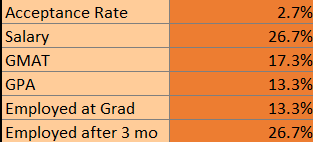
Additionally, I have included an excel sheet in which different weights can be input into cells V5:V10 so you can change the weights of categories used by US News depending on which you deem most important for your MBA journey! I hope this can be helpful for others and makes the US News ranking more transparent and less biased.
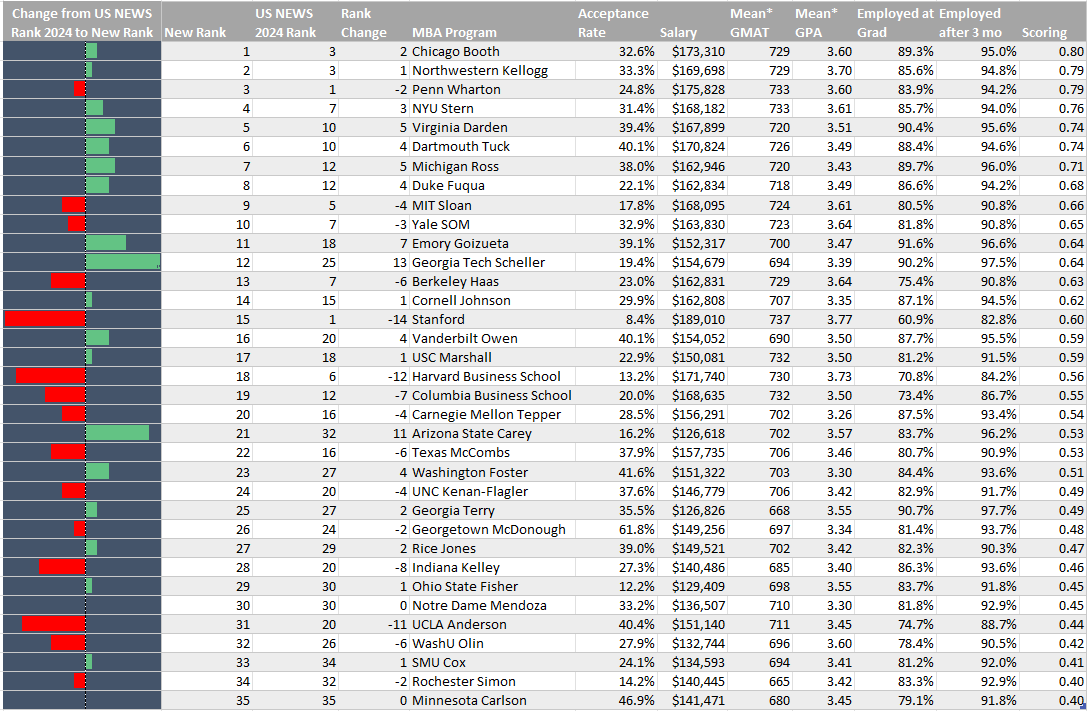

GMAT-Club-Forum-ehapl357.png [ 5.53 KiB | Viewed 9820 times ]

GMAT-Club-Forum-dyx02dnk.png [ 98.17 KiB | Viewed 9815 times ]
The following ranking includes the Top 35 Business Schools ranked by US News and uses the methodology used by US News in 2023, but the peer assessment and recruiter assessment scores have been removed to create a more accurate 2024 Business School Ranking.
The peer assessment score and recruiter scores seem arbitrary and appear to be included in the US News ranking to inflate the ranking of schools that are traditionally high ranked or considered prestigious even if they underperform in crucial categories such as selectivity or employment.
The following weights are equivalent to the US New's 2023 Business School methodology with the peer and recruiter assessment components removed:
Additionally, I have included an excel sheet in which different weights can be input into cells V5:V10 so you can change the weights of categories used by US News depending on which you deem most important for your MBA journey! I hope this can be helpful for others and makes the US News ranking more transparent and less biased.
Attachment:
GMAT-Club-Forum-ehapl357.png [ 5.53 KiB | Viewed 9820 times ]
Attachment:
GMAT-Club-Forum-dyx02dnk.png [ 98.17 KiB | Viewed 9815 times ]
Attachments
 MBA Comparisons 2024 - GMAT Club.xlsx [23.69 KiB]
Downloaded 182 times


 21 Apr 2024, 20:46
Kudos
Bookmarks
This is great!!!
I’m looking forward to digging into this!
Also pinging TargetKellogg2024 who also had a very similar idea last year. I’m sure he’ll have some additional comments!
PS. Curious why you removed the pier and recruiter components? Is the feeling that they are inherently flawed?
Posted from my mobile device
I’m looking forward to digging into this!
Also pinging TargetKellogg2024 who also had a very similar idea last year. I’m sure he’ll have some additional comments!
PS. Curious why you removed the pier and recruiter components? Is the feeling that they are inherently flawed?
Posted from my mobile device
21 Apr 2024, 21:39
Kudos
Bookmarks
Thank you for asking bb. I know any ranking will inherently be biased, and I found it troublesome how US News changes their methodology each year which can greatly affect the rankings. There is no perfect ranking and there are always schools people will pick because they find them more "prestigious" even if the outcomes might not be as promising.
To me, the peer assessment and recruiter assessment serve as a way to account for how "prestigious" a program may be and keep the rankings more stagnant, which may be important to some people. I made this corrected ranking as a way to more objectively look at the rankings by focusing on the selectivity and outcomes of each program to compare their performance numbers rather than have a large component of the ranking be the opinions of individuals who partake in the US News' surveys. Ultimately, getting a high paying job is generally the main goal of an MBA, so it seems like this should be the main factor in an MBA ranking.
The choice of 35 schools is arbitrary and more schools could be added or removed depending on one's preference.
To me, the peer assessment and recruiter assessment serve as a way to account for how "prestigious" a program may be and keep the rankings more stagnant, which may be important to some people. I made this corrected ranking as a way to more objectively look at the rankings by focusing on the selectivity and outcomes of each program to compare their performance numbers rather than have a large component of the ranking be the opinions of individuals who partake in the US News' surveys. Ultimately, getting a high paying job is generally the main goal of an MBA, so it seems like this should be the main factor in an MBA ranking.
The choice of 35 schools is arbitrary and more schools could be added or removed depending on one's preference.