Events & Promotions
|
|

GMAT Club Daily Prep
Thank you for using the timer - this advanced tool can estimate your performance and suggest more practice questions. We have subscribed you to Daily Prep Questions via email.
Customized
for You
Track
Your Progress
Practice
Pays
Not interested in getting valuable practice questions and articles delivered to your email? No problem, unsubscribe here.
 Sep 02
01:00 PM EDT
-11:59 PM EDT
Take 30% off all study plans with code COURSEWORK - Expires on Monday 9/7 Sep 04
10:00 AM PDT
-11:00 AM PDT
What does test anxiety really look like on the GMAT? For many test takers, it does not look like a panic attack. Instead, it shows up as brain fog, rereading, negative comparisons, mental noise.... Sep 04
10:00 AM EDT
-11:59 PM EDT
We’ve worked incredibly hard to build TTP into the best test prep experience possible, and it would mean a lot to us to win Newsweek’s 2026 Readers’ Choice Award for Best Test Prep. If TTP has helped you, we’d be incredibly grateful for your vote. Sep 06
09:30 AM EDT
-12:30 PM EST
Top scores are possible when you enroll in a powerful EA course, taught live online + 6 months access to TTP OnDemand video courses included! Perfect class schedule and easy course access for working professionals. Class starts Sundays Sept. 6, 2026.- Sep 07
12:01 AM PDT
-11:59 PM PDT
On the 7th, GMAT Club Tests will be Free! Including all the Quizzes, Questions, and Tests. 12 AM - 11:59 PM PDT - Sep 07
10:00 AM PDT
-11:00 AM PDT
A complete walkthrough of GMAT Club’s free 12-week GMAT study plan: what you study each week, how progress and goals are tracked, how the error log works, and how your practice unlocks paid tools at no cost. - Sep 09
07:00 AM PDT
-10:00 AM PDT
Meet AdComs and explore top Master’s programs - MiM, MiF, MSc, MSBA and more. - Application Fee Waivers - Free 1-Week of GMAT Club Tests: - Master's Application Toolkit - Grand Prize Giveaway - Sep 09
10:00 AM PDT
-11:00 AM PDT
Three MBA applications. Three rejections. No interview invites. A year later, Aman was admitted to Cambridge Judge, SMU, and IMD. In this episode of MBA Admit Stories, Aman shares how he rebuilt his MBA application...  Sep 15
07:00 PM EDT
-09:00 PM EST
Elite scores are possible when you enroll in a powerful GMAT course, taught live online + 6 months access to TTP OnDemand video courses included! Class starts Tues/Thurs Sept. 15, 2026 - Nov. 15, 2027, 7:00pm-9:00pm EST Sep 21
08:00 PM EDT
-10:00 PM EDT
Boost your GMAT score in less than one month in a live online class + 6 months access to TTP OnDemand video courses included! Class starts Mon, Tues, Wed, Thur, Fri Sept. 21, 2026 - Oct. 9, 2027, 7:00pm-10:00pm EST

Question 1


A
Be sure to select an answer first to save it in the Error Log before revealing the correct answer (OA)!
Difficulty:
 45%
(medium)
45%
(medium)
Question Stats:
58% (02:46) correct 42%
(02:43) wrong
based on 1377
sessions
42%
(02:43) wrong
based on 1377
sessions
History
Date
Time
Result
Not Attempted Yet
Question 2
A
Be sure to select an answer first to save it in the Error Log before revealing the correct answer (OA)!
Difficulty:
 75%
(hard)
75%
(hard)
Question Stats:
41% (01:11) correct 59%
(01:11) wrong
based on 1457
sessions
History
Date
Time
Result
Not Attempted Yet
Question 3
A
Be sure to select an answer first to save it in the Error Log before revealing the correct answer (OA)!
Difficulty:
35%
(medium)
Question Stats:
66% (01:01) correct 34%
(00:59) wrong
based on 1394
sessions
History
Date
Time
Result
Not Attempted Yet
Question 4
E
Be sure to select an answer first to save it in the Error Log before revealing the correct answer (OA)!
Difficulty:
65%
(hard)
Question Stats:
50% (01:10) correct 50%
(01:24) wrong
based on 1354
sessions
History
Date
Time
Result
Not Attempted Yet
GMAT-Club-Forum-crjmthit.png [ 186.33 KiB | Viewed 6658 times ]

GMAT-Club-Forum-cg9qv6gx.png [ 36.72 KiB | Viewed 6656 times ]
GMAT-Club-Forum-3g2dmv7j.png [ 54.65 KiB | Viewed 6655 times ]
GMAT-Club-Forum-ptnyf4sj.png [ 45.52 KiB | Viewed 6659 times ]
GMAT-Club-Forum-vitkerv4.png [ 72 KiB | Viewed 6658 times ]
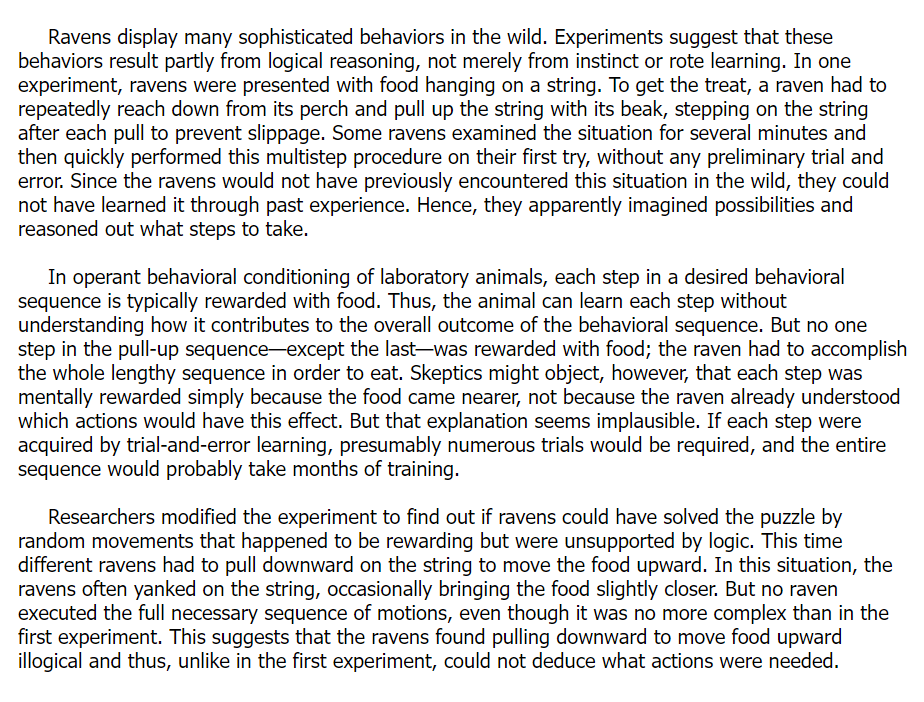
Ravens display many sophisticated behaviors in the wild. Experiments suggest that these behaviors result partly from logical reasoning, not merely from instinct or rote learning. In one experiment, ravens were presented with food hanging on a string. To get the treat, a raven had to repeatedly reach down from its perch and pull up the string with its beak, stepping on the string after each pull to prevent slippage. Some ravens examined the situation for several minutes and then quickly performed this multistep procedure on their first try, without any preliminary trial and error. Since the ravens would not have previously encountered this situation in the wild, they could not have learned it through past experience. Hence, they apparently imagined possibilities and reasoned out what steps to take.
In operant behavioral conditioning of laboratory animals, each step in a desired behavioral sequence is typically rewarded with food. Thus, the animal can learn each step without understanding how it contributes to the overall outcome of the behavioral sequence. But no one step in the pull-up sequence—except the last—was rewarded with food; the raven had to accomplish the whole lengthy sequence in order to eat. Skeptics might object, however, that each step was mentally rewarded simply because the food came nearer, not because the raven already understood which actions would have this effect. But that explanation seems implausible. If each step were acquired by trial-and-error learning, presumably numerous trials would be required, and the entire sequence would probably take months of training.
Researchers modified the experiment to find out if ravens could have solved the puzzle by random movements that happened to be rewarding but were unsupported by logic. This time different ravens had to pull downward on the string to move the food upward. In this situation, the ravens often yanked on the string, occasionally bringing the food slightly closer. But no raven executed the full necessary sequence of motions, even though it was no more complex than in the first experiment. This suggests that the ravens found pulling downward to move food upward illogical and thus, unlike in the first experiment, could not deduce what actions were needed.
In operant behavioral conditioning of laboratory animals, each step in a desired behavioral sequence is typically rewarded with food. Thus, the animal can learn each step without understanding how it contributes to the overall outcome of the behavioral sequence. But no one step in the pull-up sequence—except the last—was rewarded with food; the raven had to accomplish the whole lengthy sequence in order to eat. Skeptics might object, however, that each step was mentally rewarded simply because the food came nearer, not because the raven already understood which actions would have this effect. But that explanation seems implausible. If each step were acquired by trial-and-error learning, presumably numerous trials would be required, and the entire sequence would probably take months of training.
Researchers modified the experiment to find out if ravens could have solved the puzzle by random movements that happened to be rewarding but were unsupported by logic. This time different ravens had to pull downward on the string to move the food upward. In this situation, the ravens often yanked on the string, occasionally bringing the food slightly closer. But no raven executed the full necessary sequence of motions, even though it was no more complex than in the first experiment. This suggests that the ravens found pulling downward to move food upward illogical and thus, unlike in the first experiment, could not deduce what actions were needed.
1. The main purpose of the passage is to
A. present evidence that ravens are capable of logical reasoning
B. describe various experiments designed to measure ravens’ mental ability
C. explain how ravens learn by trial and error
D. discuss the many sophisticated behaviors displayed by ravens
E. analyze the behavioral conditioning of ravens in a laboratory setting
A. present evidence that ravens are capable of logical reasoning
B. describe various experiments designed to measure ravens’ mental ability
C. explain how ravens learn by trial and error
D. discuss the many sophisticated behaviors displayed by ravens
E. analyze the behavioral conditioning of ravens in a laboratory setting
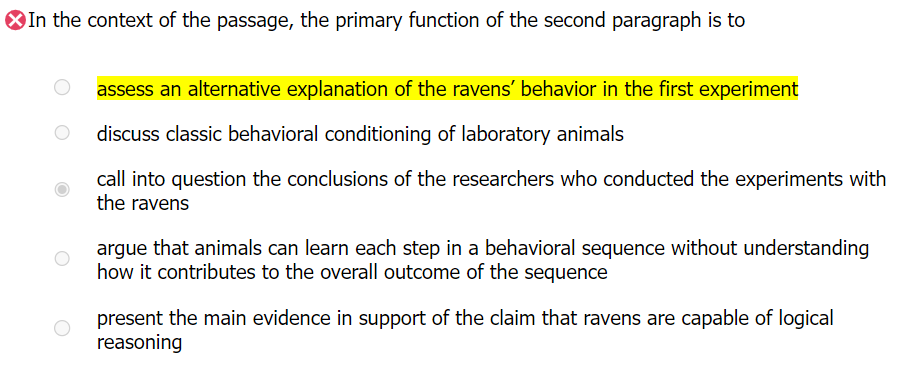
2. In the context of the passage, the primary function of the second paragraph is to
A. assess an alternative explanation of the ravens’ behavior in the first experiment
B. discuss classic behavioral conditioning of laboratory animals
C. call into question the conclusions of the researchers who conducted the experiments with the ravens
D. argue that animals can learn each step in a behavioral sequence without understanding how it contributes to the overall outcome of the sequence
E. present the main evidence in support of the claim that ravens are capable of logical reasoning
A. assess an alternative explanation of the ravens’ behavior in the first experiment
B. discuss classic behavioral conditioning of laboratory animals
C. call into question the conclusions of the researchers who conducted the experiments with the ravens
D. argue that animals can learn each step in a behavioral sequence without understanding how it contributes to the overall outcome of the sequence
E. present the main evidence in support of the claim that ravens are capable of logical reasoning
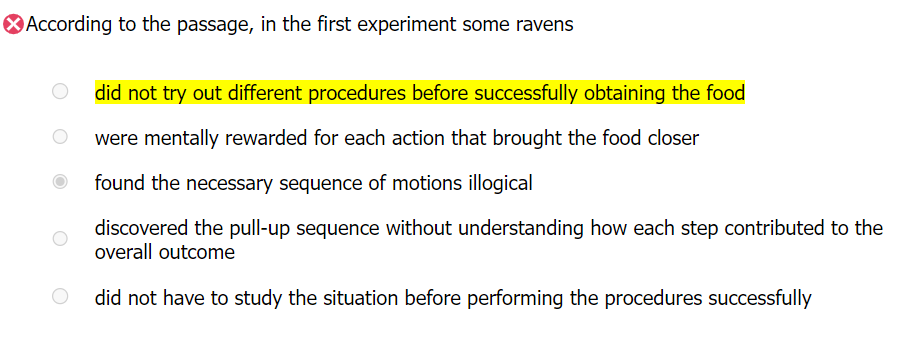
3. According to the passage, in the first experiment some ravens
A. did not try out different procedures before successfully obtaining the food
B. were mentally rewarded for each action that brought the food closer
C. found the necessary sequence of motions illogical
D. discovered the pull-up sequence without understanding how each step contributed to the overall outcome
E. did not have to study the situation before performing the procedures successfully
A. did not try out different procedures before successfully obtaining the food
B. were mentally rewarded for each action that brought the food closer
C. found the necessary sequence of motions illogical
D. discovered the pull-up sequence without understanding how each step contributed to the overall outcome
E. did not have to study the situation before performing the procedures successfully
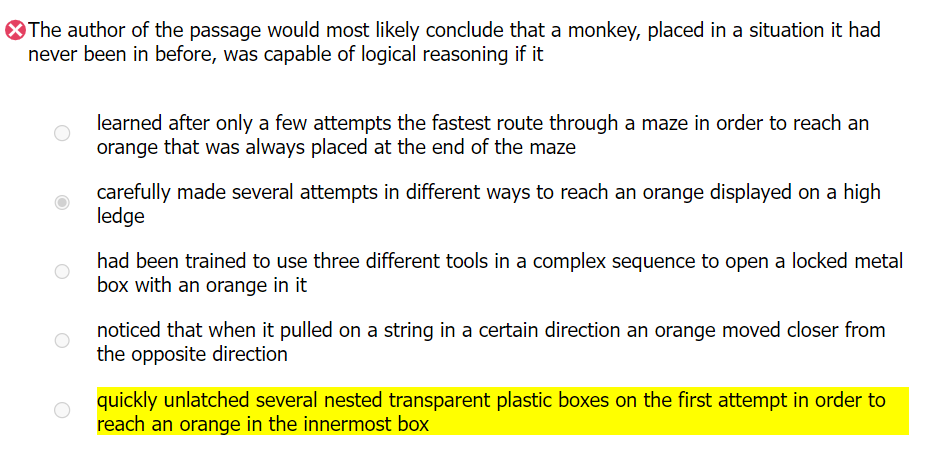
4. The author of the passage would most likely conclude that a monkey, placed in a situation it had never been in before, was capable of logical reasoning if it
A. learned after only a few attempts the fastest route through a maze in order to reach an orange that was always placed at the end of the maze
B. carefully made several attempts in different ways to reach an orange displayed on a high ledge
C. had been trained to use three different tools in a complex sequence to open a locked metal box with an orange in it
D. noticed that when it pulled on a string in a certain direction an orange moved closer from the opposite direction
E. quickly unlatched several nested transparent plastic boxes on the first attempt in order to reach an orange in the innermost box
A. learned after only a few attempts the fastest route through a maze in order to reach an orange that was always placed at the end of the maze
B. carefully made several attempts in different ways to reach an orange displayed on a high ledge
C. had been trained to use three different tools in a complex sequence to open a locked metal box with an orange in it
D. noticed that when it pulled on a string in a certain direction an orange moved closer from the opposite direction
E. quickly unlatched several nested transparent plastic boxes on the first attempt in order to reach an orange in the innermost box
Attachment:
GMAT-Club-Forum-crjmthit.png [ 186.33 KiB | Viewed 6658 times ]
Attachment:
GMAT-Club-Forum-cg9qv6gx.png [ 36.72 KiB | Viewed 6656 times ]
Attachment:
GMAT-Club-Forum-3g2dmv7j.png [ 54.65 KiB | Viewed 6655 times ]
Attachment:
GMAT-Club-Forum-ptnyf4sj.png [ 45.52 KiB | Viewed 6659 times ]
Attachment:
GMAT-Club-Forum-vitkerv4.png [ 72 KiB | Viewed 6658 times ]
Need more Tests to Practice?
GMAT Club Tests give expert solutions for every question in full and sectional GMAT Focus mocks.
Learn more →


 25 Apr 2024, 08:33
Kudos
Bookmarks
satvikd22
(E) contradicts the passage which clearly states that some ravens examined the situation for several minutes before performing the multistep procedure. Therefore, they did have to study the situation before successfully performing the procedures.