Last visit was: 22 Apr 2026, 22:59 It is currently 22 Apr 2026, 22:59
Close
GMAT Club Daily Prep
Thank you for using the timer - this advanced tool can estimate your performance and suggest more practice questions. We have subscribed you to Daily Prep Questions via email.

Customized
for You

we will pick new questions that match your level based on your Timer History

Track
Your Progress

every week, we’ll send you an estimated GMAT score based on your performance

Practice
Pays

we will pick new questions that match your level based on your Timer History
Not interested in getting valuable practice questions and articles delivered to your email? No problem, unsubscribe here.
Close
Request Expert Reply
Confirm Cancel
User avatar
egobappe
Joined: 24 Oct 2023
Last visit: 18 Dec 2025
Posts: 4
Own Kudos:
138
 [57]
Given Kudos: 3
Location: India
Posts: 4
Kudos: 138
 [57]
5
Kudos
Add Kudos
52
Bookmarks
Bookmark this Post
Most Helpful Reply
User avatar
liberoasperiores
Joined: 19 Nov 2025
Last visit: 27 Feb 2026
Posts: 36
Own Kudos:
49
 [5]
Given Kudos: 75
Location: India
Posts: 36
Kudos: 49
 [5]
5
Kudos
Add Kudos
Bookmarks
Bookmark this Post
General Discussion
User avatar
candyhouse151
Joined: 27 Nov 2023
Last visit: 14 Jun 2024
Posts: 4
Given Kudos: 1
Posts: 4
Kudos: 0
Kudos
Add Kudos
Bookmarks
Bookmark this Post
User avatar
gmatophobia
User avatar
Quant Chat Moderator
Joined: 22 Dec 2016
Last visit: 19 Apr 2026
Posts: 3,173
Own Kudos:
Given Kudos: 1,862
Location: India
Concentration: Strategy, Leadership
Posts: 3,173
Kudos: 11,450
Kudos
Add Kudos
Bookmarks
Bookmark this Post
 
egobappe
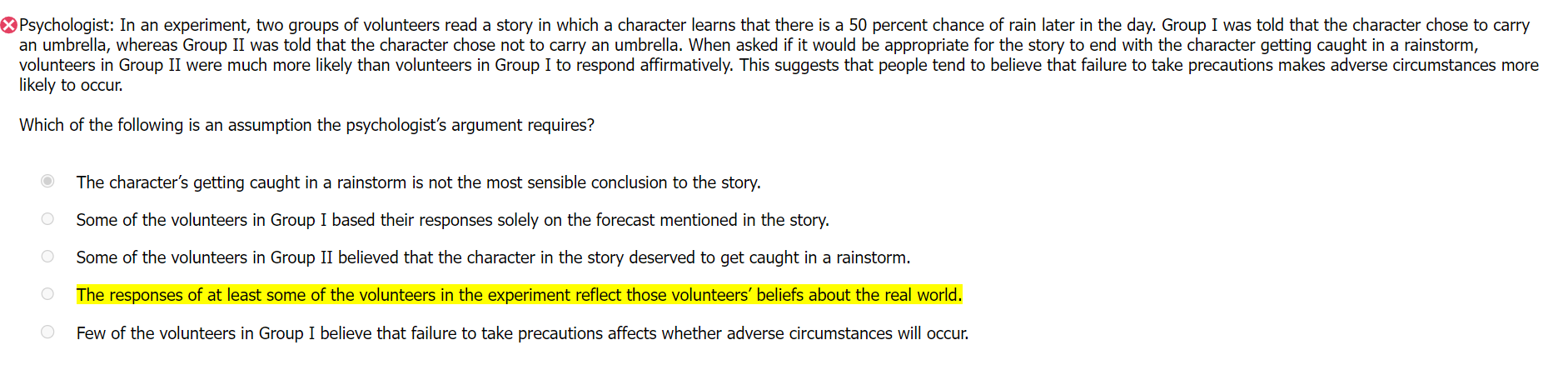
­Psychologist: In an experiment, two groups of volunteers read a story in which a character learns that there is a 50 percent chance of rain later in the day. Group I was told that the character chose to carry an umbrella, whereas Group II was told that the character chose not to carry an umbrella. When asked if it would be appropriate for the story to end with the character getting caught in a rainstorm, volunteers in Group II were much more likely than volunteers in Group I to respond affirmatively. This suggests that people tend to believe that failure to take precautions makes adverse circumstances more likely to occur

Which of the following is an assumption the psychologist's argument requires?

A) The character's getting caught in a rainstorm is not the most sensible conclusion to the story.

B) Some of the volunteers in Group I based their responses solely on the forecast mentioned in the story.

C) Some of the volunteers in Group II believed that the character in the story deserved to get caught in a rainstorm.

D) The responses of at least some of the volunteers in the experiment reflect those volunteers' beliefs about the real world.

E) Few of the volunteers in Group I believe that failure to take precautions affects whether adverse circumstances will occur.­­
­
The conclusion of the passage is stated in the last line of the passage "people tend to believe that failure to take precautions makes adverse circumstances more likely to occur". The author has drawn a real-world conclusion based on the results of the experiment that was conducted.

Support given for the author's conclusion - "When asked if it would be appropriate for the story to end with the character getting caught in a rainstorm, volunteers in Group II were much more likely than volunteers in Group I to respond affirmatively."

Hence, the author assumes that the responses of the volunteers in Group II reflect their actual beliefs and that the volunteers didn't lie about their beliefs. 

Answer choice elimination

A) The character's getting caught in a rainstorm is not the most sensible conclusion to the story.

This is not an assumption. The author doesn't base the conclusion on what should be the most sensible conclusion to the story. Eliminate A. 

B) Some of the volunteers in Group I based their responses solely on the forecast mentioned in the story.

This assumption is not necessary for the psychologist's argument. The author based his conclusion on the response of the volunteers in Group II. Hence, the reason for Group I's response is not necessary for the argument to hold. 

C) Some of the volunteers in Group II believed that the character in the story deserved to get caught in a rainstorm.

This option is also not necessary for the conclusion to hold. Hence, eliminate C. 

D) The responses of at least some of the volunteers in the experiment reflect those volunteers' beliefs about the real world.

This assumption directly relates to the psychologist's argument, as the conclusion is based on the assumption that the responses in the experiment reflect real-world beliefs.

Negation: The responses of none of the volunteers in the experiment reflect those volunteers' beliefs about the real world.
If this were true, we cannot conclude that people tend to believe that failure to take precautions makes adverse circumstances more likely to occur.

Keep D. 

E) Few of the volunteers in Group I believe that failure to take precautions affects whether adverse circumstances will occur.­­

The conclusion of the argument is based on the response of the volunteers in Group II. Hence, this statement is not an assumption. 

Option D­
User avatar
kakarot10
Joined: 04 Oct 2023
Last visit: 19 Mar 2025
Posts: 43
Own Kudos:
Given Kudos: 28
Location: India
Concentration: Technology, Other
GMAT Focus 1: 595 Q79 V83 DI76
GPA: 3.5
GMAT Focus 1: 595 Q79 V83 DI76
Posts: 43
Kudos: 16
Kudos
Add Kudos
Bookmarks
Bookmark this Post
I was stuck between the options c and d. But it turns out that the answer is C. Perhaps the reason is that some of them had got caught in rainstorm when they had forgotten the umbrella, and that memory has stuck with them and influences their thinking
User avatar
Fish181
Joined: 13 Dec 2023
Last visit: 22 Jan 2025
Posts: 133
Own Kudos:
1,185
 [1]
Given Kudos: 53
Status:Applying in R1 of 2024 to t15
Affiliations: University of Tennessee
Location: United States (CO)
Concentration: Strategy, Finance
GMAT Focus 1: 605 Q76 V84 DI80
GMAT Focus 2: 615 Q78 V86 DI78
GPA: 3.62
WE:Analyst (Consumer Packaged Goods)
GMAT Focus 2: 615 Q78 V86 DI78
Posts: 133
Kudos: 1,185
 [1]
1
Kudos
Add Kudos
Bookmarks
Bookmark this Post
The negation technique is how you get this one correct quickly.

D) The responses of at least some of the volunteers in the experiment reflect those volunteers' beliefs about the real world.

Imagine if this said

The responses of NONE of the volunteers in the experiment reflect those volunteers' beliefs about the real world.

Well if this is true then how can you apply observations from the study to the conclusion in the real world people tend to believe that failure to take precautions makes adverse circumstances more likely to occur.

Since it strongly affects the argument this is your clear winner.
User avatar
EMPOWERgmatVerbal
User avatar
EMPOWERgmat Instructor
Joined: 23 Feb 2015
Last visit: 17 Feb 2025
Posts: 1,686
Own Kudos:
15,310
 [1]
Given Kudos: 766
Expert
Expert reply
Posts: 1,686
Kudos: 15,310
 [1]
1
Kudos
Add Kudos
Bookmarks
Bookmark this Post
egobappe
­Psychologist: In an experiment, two groups of volunteers read a story in which a character learns that there is a 50 percent chance of rain later in the day. Group I was told that the character chose to carry an umbrella, whereas Group II was told that the character chose not to carry an umbrella. When asked if it would be appropriate for the story to end with the character getting caught in a rainstorm, volunteers in Group II were much more likely than volunteers in Group I to respond affirmatively. This suggests that people tend to believe that failure to take precautions makes adverse circumstances more likely to occur

Which of the following is an assumption the psychologist's argument requires?

A) The character's getting caught in a rainstorm is not the most sensible conclusion to the story.

B) Some of the volunteers in Group I based their responses solely on the forecast mentioned in the story.

C) Some of the volunteers in Group II believed that the character in the story deserved to get caught in a rainstorm.

D) The responses of at least some of the volunteers in the experiment reflect those volunteers' beliefs about the real world.

E) Few of the volunteers in Group I believe that failure to take precautions affects whether adverse circumstances will occur.­­
­This is a relatively tricky question that requires us to carefully analyze the psychologist's argument and identify the underlying assumption. Let's break it down step by step to find the correct answer.

The psychologist's main conclusion is that people tend to believe that failure to take precautions makes adverse circumstances more likely to occur. This conclusion is based on the different responses from the two groups of volunteers.

To identify the necessary assumption, we need to find a statement that, if false, would weaken or invalidate the psychologist's conclusion.

Let's examine each answer choice:

(A) The character's getting caught in a rainstorm is not the most sensible conclusion to the story.
This statement does not directly affect the psychologist's conclusion about people's beliefs. Even if getting caught in a rainstorm is not the most sensible conclusion, it doesn't undermine the idea that people believe failing to take precautions makes adverse circumstances more likely.

(B) Some of the volunteers in Group I based their responses solely on the forecast mentioned in the story.
This statement, if true, would not weaken the psychologist's conclusion. Even if some volunteers based their responses solely on the forecast, it doesn't change the fact that the two groups responded differently.

(C) Some of the volunteers in Group II believed that the character in the story deserved to get caught in a rainstorm.
This statement suggests a possible reason for Group II's responses but does not directly affect the psychologist's conclusion about people's beliefs regarding precautions and adverse circumstances.

(D) The responses of at least some of the volunteers in the experiment reflect those volunteers' beliefs about the real world.
This is the correct answer. The psychologist's conclusion is about people's beliefs in general, not just their beliefs about the story. If the volunteers' responses do not reflect their real-world beliefs, then the psychologist cannot draw a conclusion about people's beliefs based on this experiment.

(E) Few of the volunteers in Group I believe that failure to take precautions affects whether adverse circumstances will occur.
This statement, if true, would support the psychologist's conclusion rather than weaken it. If few volunteers in Group I believe that failure to take precautions affects adverse circumstances, it would be consistent with the difference in responses between the two groups.

Therefore, the correct answer is (D). The psychologist's argument assumes that the volunteers' responses in the experiment reflect their beliefs about the real world.

In Critical Reasoning Assumption questions, look for the assumption that, if false, would blow up the argument.
User avatar
GmatKnightTutor
User avatar
Major Poster
Joined: 31 Jan 2020
Last visit: 01 Nov 2025
Posts: 5,205
Own Kudos:
1,574
 [2]
Given Kudos: 18
Posts: 5,205
Kudos: 1,574
 [2]
2
Kudos
Add Kudos
Bookmarks
Bookmark this Post
Psychologist: In an experiment, two groups of volunteers read a story in which a character learns that there is a 50 percent chance of rain later in the day. Group I was told that the character chose to carry an umbrella, whereas Group II was told that the character chose not to carry an umbrella. When asked if it would be appropriate for the story to end with the character getting caught in a rainstorm, volunteers in Group II were much more likely than volunteers in Group I to respond affirmatively. This suggests that people tend to believe that failure to take precautions makes adverse circumstances more likely to occur

Basically, we're told about two groups. One group is told a story in which a person, let's say John, CHOOSES to carry an umbrella. The other group is told the same story in which John doesn't. Even though John is told in the story that there's an equal chance of rain or no rain, the second group of volunteers is like "It's definitely more APPROPRIATE that John is going to end up drenched!" compared to the first group. The psychologist goes on to say this means people in the real world will ALSO think it's more likely something bad will happen if you don't prepare for it.

Which of the following is an assumption the psychologist's argument requires?

A) The character's getting caught in a rainstorm is not the most sensible conclusion to the story.
Nope. This is an interesting one, though. Thing is, even if it IS the most sensible conclusion to the story, both groups should believe rain is more appropriate to a similar extent. This is not something necessary for the argument the psychologist is specifically making as to why one of the groups thinks it's MUCH MORE appropriate.

B) Some of the volunteers in Group I based their responses solely on the forecast mentioned in the story.
No. It's worth mentioning that the passage doesn't say anyone in Group 1 believed the 50% forecast to be exactly true. The passage simply says that group 2 believed it was more APPROPRIATE for the story to end with John getting drenched basically. Perhaps 60 percent of Group 1 thought it was appropriate and 80 percent of Group 2 thought it was appropriate.

C) Some of the volunteers in Group II believed that the character in the story deserved to get caught in a rainstorm.
Nope. Although I admit this could be a reason for why some people in Group 2 think it's more appropriate for John to get drenched, it's not something NECESSARY for the argument to work. The precise REASON for why people believed (or said what they did) isn't important here. It's whether this translates into the real world the same way.

D) The responses of at least some of the volunteers in the experiment reflect those volunteers' beliefs about the real world.
Here we go. This is the answer. If everyone, for example, is only pessimistic when it comes stories but very logical when it comes to the real world, the argument collapses.

E) Few of the volunteers in Group I believe that failure to take precautions affects whether adverse circumstances will occur.­
Nope. This is not something we require. It's worth remembering we're focused on why group 2 believes a rainstorm happening in the story is more appropriate than group 1 and whether this way of thinking crosses over into the real world.­
User avatar
sayan640
Joined: 29 Oct 2015
Last visit: 22 Apr 2026
Posts: 1,119
Own Kudos:
Given Kudos: 789
GMAT 1: 570 Q42 V28
Products:
GMAT 1: 570 Q42 V28
Posts: 1,119
Kudos: 861
Kudos
Add Kudos
Bookmarks
Bookmark this Post
egobappe
­Psychologist: In an experiment, two groups of volunteers read a story in which a character learns that there is a 50 percent chance of rain later in the day. Group I was told that the character chose to carry an umbrella, whereas Group II was told that the character chose not to carry an umbrella. When asked if it would be appropriate for the story to end with the character getting caught in a rainstorm, volunteers in Group II were much more likely than volunteers in Group I to respond affirmatively. This suggests that people tend to believe that failure to take precautions makes adverse circumstances more likely to occur

Which of the following is an assumption the psychologist's argument requires?

A) The character's getting caught in a rainstorm is not the most sensible conclusion to the story.

B) Some of the volunteers in Group I based their responses solely on the forecast mentioned in the story.

C) Some of the volunteers in Group II believed that the character in the story deserved to get caught in a rainstorm.

D) The responses of at least some of the volunteers in the experiment reflect those volunteers' beliefs about the real world.

E) Few of the volunteers in Group I believe that failure to take precautions affects whether adverse circumstances will occur.­­
In which line of the conclusion was it mentioned that the conclusion is about the real life beliefs of the people?
EMPOWERgmatVerbal GmatKnightTutor gmatphobia

Posted from my mobile device
User avatar
EMPOWERgmatVerbal
User avatar
EMPOWERgmat Instructor
Joined: 23 Feb 2015
Last visit: 17 Feb 2025
Posts: 1,686
Own Kudos:
Given Kudos: 766
Expert
Expert reply
Posts: 1,686
Kudos: 15,310
Kudos
Add Kudos
Bookmarks
Bookmark this Post
sayan640

egobappe
­Psychologist: In an experiment, two groups of volunteers read a story in which a character learns that there is a 50 percent chance of rain later in the day. Group I was told that the character chose to carry an umbrella, whereas Group II was told that the character chose not to carry an umbrella. When asked if it would be appropriate for the story to end with the character getting caught in a rainstorm, volunteers in Group II were much more likely than volunteers in Group I to respond affirmatively. This suggests that people tend to believe that failure to take precautions makes adverse circumstances more likely to occur

Which of the following is an assumption the psychologist's argument requires?

A) The character's getting caught in a rainstorm is not the most sensible conclusion to the story.

B) Some of the volunteers in Group I based their responses solely on the forecast mentioned in the story.

C) Some of the volunteers in Group II believed that the character in the story deserved to get caught in a rainstorm.

D) The responses of at least some of the volunteers in the experiment reflect those volunteers' beliefs about the real world.

E) Few of the volunteers in Group I believe that failure to take precautions affects whether adverse circumstances will occur.­­
In which line of the conclusion was it mentioned that the conclusion is about the real life beliefs of the people?
EMPOWERgmatVerbal GmatKnightTutor gmatphobia

Posted from my mobile device
Hi sayan640,

Sure, let's take a look. So the psychologist's conclusion, "This suggests that people tend to believe that failure to take precautions makes adverse circumstances more likely to occur," is a general statement about people's beliefs, not specifically limited to the story in the experiment.

The use of the phrase "people tend to believe" implies that the conclusion is about people's real-world beliefs, not just their beliefs within the context of the story.

So, although the conclusion is not explicitly stated as being about real-life beliefs, the wording suggests that the psychologist is drawing a broader conclusion about human beliefs based on the results of the experiment.

This is why assumption (D) is necessary for the argument to hold - if the volunteers' responses do not reflect their real-world beliefs, then the psychologist cannot logically conclude anything about people's general beliefs based on this experiment alone.­
User avatar
saurabhmishrano1
Joined: 25 May 2021
Last visit: 14 May 2025
Posts: 17
Own Kudos:
11
 [1]
Given Kudos: 20
Posts: 17
Kudos: 11
 [1]
1
Kudos
Add Kudos
Bookmarks
Bookmark this Post
­Let's analyze each answer option:

A. The character’s getting caught in a rainstorm is not the most sensible conclusion to the story.

   - This assumption is not necessary for the argument because the psychologist's conclusion focuses on the participants' perceptions and responses, rather than the sensibility of the story's conclusion.

   - Example: Even if the story's conclusion were deemed sensible by the participants, it would not affect the psychologist's conclusion regarding the participants' tendency to associate lack of precaution with adverse outcomes.


B. Some of the volunteers in Group I based their responses solely on the forecast mentioned in the story.

   - This assumption is not necessary for the argument because the psychologist's conclusion is about the difference in responses between the two groups, not the specific reasons for individual responses within each group.

   - Example: Even if all volunteers in Group I based their responses solely on the forecast, it would not impact the psychologist's conclusion about the overall trend observed between Group I and Group II.


C. Some of the volunteers in Group II believed that the character in the story deserved to get caught in a rainstorm.

   - This assumption is not necessary for the argument because the psychologist's conclusion is not about the volunteers' moral judgments or beliefs about the character's deserts but rather about their tendency to associate lack of precaution with adverse outcomes.

   - Example: Even if some volunteers in Group II believed that the character deserved to get caught in a rainstorm, it would not directly relate to the psychologist's conclusion regarding the association between lack of precautions and adverse circumstances.


D.The responses of at least some of the volunteers in the experiment reflect those volunteers’ beliefs about the real world.

   - This assumption is crucial for the argument because the psychologist's conclusion is based on the observed responses of the volunteers in the experiment and their implications for understanding human behavior in the real world.

   - Example: If the responses of the volunteers in the experiment did not reflect their beliefs about the real world, the psychologist's conclusion about people's tendency to associate lack of precautions with adverse circumstances would be called into question.


E. Few of the volunteers in Group I believe that failure to take precautions affects whether adverse circumstances will occur.


   - This assumption is not necessary for the argument because the psychologist's conclusion is about the difference in responses between Group I and Group II, not the specific beliefs of volunteers within Group I.

   - Example: Even if few volunteers in Group I believed that failure to take precautions affects whether adverse circumstances will occur, it would not directly impact the psychologist's conclusion regarding the observed difference in responses between the two groups.
­
User avatar
egmat
User avatar
e-GMAT Representative
Joined: 02 Nov 2011
Last visit: 22 Apr 2026
Posts: 5,632
Own Kudos:
33,433
 [2]
Given Kudos: 707
GMAT Date: 08-19-2020
Expert
Expert reply
Active GMAT Club Expert! Tag them with @ followed by their username for a faster response.
Posts: 5,632
Kudos: 33,433
 [2]
2
Kudos
Add Kudos
Bookmarks
Bookmark this Post
This is a classic example of a hidden assumption involving the leap from experimental evidence to real-world psychological claims. Let me break down the logical structure to help you see why D is correct.

Step 1: Identify the Conclusion
The psychologist concludes: "People tend to believe that failure to take precautions makes adverse circumstances more likely to occur."
This is a claim about people's beliefs regarding causation in the real world.

Step 2: Analyze the Evidence
The evidence comes from an experiment where:

Both groups read about 50% rain chance
Group I: character took umbrella → fewer said "appropriate" to get caught in rain
Group II: character didn't take umbrella → more said "appropriate" to get caught in rain

Step 3: Find the Gap
Here's the critical insight: The evidence is about what people think is an appropriate story ending, but the conclusion is about what people believe about real-world causation.
The psychologist assumes these story judgments reflect actual beliefs about how the world works, not just literary preferences or narrative satisfaction.

Step 4: Evaluate Answer D
D: "The responses of at least some of the volunteers in the experiment reflect those volunteers' beliefs about the real world."

This bridges the gap perfectly. If this assumption is false (meaning the responses only reflect story preferences, not real-world beliefs), then the conclusion completely falls apart. The psychologist must assume that at least some volunteers' story responses reveal their actual beliefs about causation.

Why Other Choices Fail:

A: Irrelevant to whether responses reflect causal beliefs
B: Doesn't matter if some focused only on probability
C: "Deserved" (moral judgment) ≠ "more likely" (causal belief)
E: Goes beyond what's necessary and seems inconsistent


Want to master the complete framework for identifying assumption gaps and avoiding trap answers systematically? Check out the step-by-step solution on Neuron by e-GMAT, which includes 3 alternative approaches and shows how this pattern appears across similar CR questions. You can also explore all GMAT Official Guide questions with detailed solutions on Neuron for structured practice.

The full Neuron solution reveals the systematic approach to spotting fiction-to-reality leaps in assumptions and provides a reusable framework for similar question types.
User avatar
Alilee
Joined: 10 Jun 2023
Last visit: 22 Apr 2026
Posts: 17
Own Kudos:
1
 [1]
Given Kudos: 3
Location: United States
Posts: 17
Kudos: 1
 [1]
1
Kudos
Add Kudos
Bookmarks
Bookmark this Post
Argument: Bc. group II think the chararcter should get caught by a storm means that ppl believe that not taking procaution will likely make bad situations to occur
Goal: Assumption (what must be true in order for the argument to be intact?)

C. Some of the volunteers in Group II believed that the character in the story deserved to get caught in a rainstorm.
Use the "not" tool.
- If some of the volunteers in group II DID NOT believe that the characters in the story deserved to be caught in the storm. <- even so doesn't do much for the argument
- If ALL or NONE of the volunteers in group II believe that the characters in the story deserved to be caught in the storm. <- even so doesn't do much for the argument
D. The responses of at least some of the volunteers in the experiment reflect those volunteers’ beliefs about the real world.
CORRECT. Use the "not" tool.
- The response of NONE of the volunteers in the experiment reflect thier beliefes about the real world <- if this is the case, then the argument falls apart because the argument is based on people's beliefs.

egobappe
Quote:
Psychologist: In an experiment, two groups of volunteers read a story in which a character learns that there is a 50 percent chance of rain later in the day. Group I was told that the character chose to carry an umbrella, whereas Group II was told that the character chose not to carry an umbrella. When asked if it would be appropriate for the story to end with the character getting caught in a rainstorm, volunteers in Group II were much more likely than volunteers in Group I to respond affirmatively. This suggests that people tend to believe that failure to take precautions makes adverse circumstances more likely to occur.

Which of the following is an assumption the psychologists argument requires?

A. The character’s getting caught in a rainstorm is not the most sensible conclusion to the story.
B. Some of the volunteers in Group I based their responses solely on the forecast mentioned in the story.
C. Some of the volunteers in Group II believed that the character in the story deserved to get caught in a rainstorm.
D. The responses of at least some of the volunteers in the experiment reflect those volunteers’ beliefs about the real world.
E. Few of the volunteers in Group I believe that failure to take precautions affects whether adverse circumstances will occur.


Attachment:
GMAT-Club-Forum-bnvba75z.png
Moderators:
GMAT Club Verbal Expert
7391 posts
499 posts
358 posts