Last visit was: 23 Apr 2026, 03:00 It is currently 23 Apr 2026, 03:00
Close
GMAT Club Daily Prep
Thank you for using the timer - this advanced tool can estimate your performance and suggest more practice questions. We have subscribed you to Daily Prep Questions via email.

Customized
for You

we will pick new questions that match your level based on your Timer History

Track
Your Progress

every week, we’ll send you an estimated GMAT score based on your performance

Practice
Pays

we will pick new questions that match your level based on your Timer History
Not interested in getting valuable practice questions and articles delivered to your email? No problem, unsubscribe here.
Close
Request Expert Reply
Confirm Cancel
655-705 (Hard)|   Geometry|                        
User avatar
Bunuel
User avatar
Math Expert
Joined: 02 Sep 2009
Last visit: 23 Apr 2026
Posts: 109,766
Own Kudos:
Given Kudos: 105,853
Products:
Expert
Expert reply
Active GMAT Club Expert! Tag them with @ followed by their username for a faster response.
Posts: 109,766
Kudos: 810,727
 [495]
39
Kudos
Add Kudos
456
Bookmarks
Bookmark this Post
Most Helpful Reply
avatar
fozzzy
Joined: 29 Nov 2012
Last visit: 17 May 2015
Posts: 573
Own Kudos:
7,002
 [275]
Given Kudos: 543
Posts: 573
Kudos: 7,002
 [275]
221
Kudos
Add Kudos
53
Bookmarks
Bookmark this Post
User avatar
Bunuel
User avatar
Math Expert
Joined: 02 Sep 2009
Last visit: 23 Apr 2026
Posts: 109,766
Own Kudos:
Given Kudos: 105,853
Products:
Expert
Expert reply
Active GMAT Club Expert! Tag them with @ followed by their username for a faster response.
Posts: 109,766
Kudos: 810,727
 [183]
105
Kudos
Add Kudos
77
Bookmarks
Bookmark this Post
User avatar
cyberjadugar
Joined: 29 Mar 2012
Last visit: 01 Apr 2026
Posts: 264
Own Kudos:
1,814
 [64]
Given Kudos: 23
Location: India
GMAT 1: 640 Q50 V26
GMAT 2: 660 Q50 V28
GMAT 3: 730 Q50 V38
GMAT 3: 730 Q50 V38
Posts: 264
Kudos: 1,814
 [64]
45
Kudos
Add Kudos
18
Bookmarks
Bookmark this Post
Hi,

With reference to the attached diagram:
In triangle DFB, angle DFB = 180 - angle FDB - angle FBD
=180 - v - z

Similary, in other triangles,
angle AJC = 180 - y - w
angle EIB = 180 - x - z
angle AHD = 180 - v - y
angle EGC = 180 - x - w

Adding all, angle DFB + angle AJC + angle EIB + angle AHD +angle EGC = sum of interior angles of pentagon
=540 = 5*180 - 2(v+w+x+y+z)
so, v+w+x+y+z = 180

Answer (C)

Regards,
Attachments

angles.jpg
angles.jpg [ 12.75 KiB | Viewed 148429 times ]

User avatar
BrentGMATPrepNow
User avatar
Major Poster
Joined: 12 Sep 2015
Last visit: 31 Oct 2025
Posts: 6,733
Own Kudos:
36,448
 [53]
Given Kudos: 799
Location: Canada
Expert
Expert reply
Posts: 6,733
Kudos: 36,448
 [53]
41
Kudos
Add Kudos
12
Bookmarks
Bookmark this Post
Bunuel
The Official Guide for GMAT® Review, 13th Edition - Quantitative Questions Project

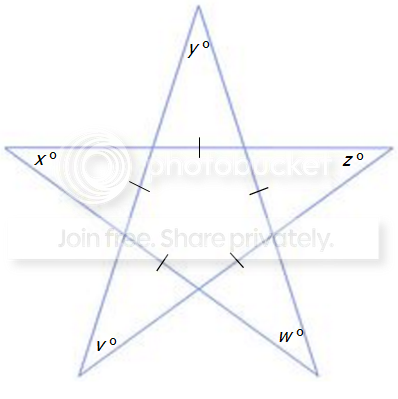
In the figure shown, what is the value of v+x+y+z+w?
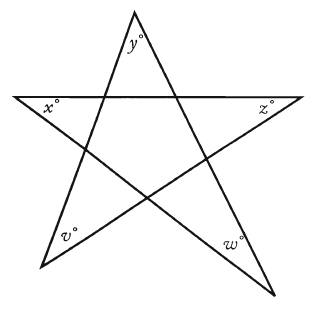


(A) 45
(B) 90
(C) 180
(D) 270
(E) 360

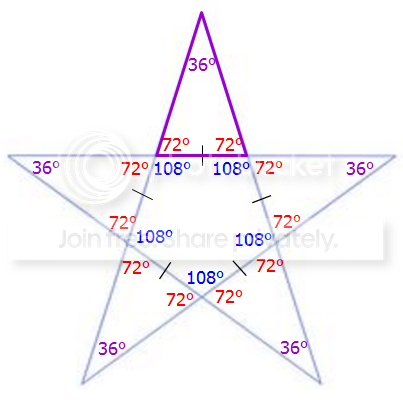
First, let's consider a PERFECT star.


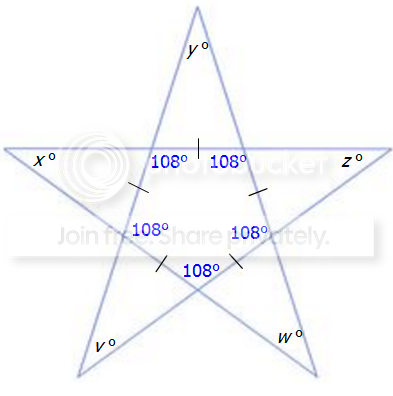
Notice that the pentagon in the center is a perfect (regular) pentagon, which means ALL 5 angles are equal.
The sum of the angles in an n-sided figure = 180(n-2) degrees
So, the sum of the angles in this 5-sided figure = 180(5-2) = 180(3) = 540 degrees
Since ALL 5 angles are equal, then the measure of each angle = 540/5 = 108 degrees.


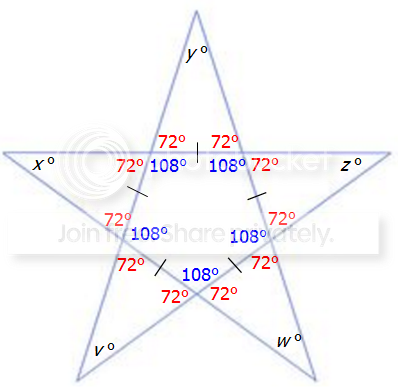
Since two angles on a line must add to 180 degrees, we can see that the angles adjacent to the 108-degree angles must equal 72 degrees (since 180 - 108 = 72)


At this point, we can see that we're dealing with 5 triangles, and for each triangle, we know two of the angle measurements.
Since the sum of the angles in a triangle = 180, we know that each missing angle = 36 degrees (180 - 72 - 72 = 36)


So, v + x + y + z + w = 36 + 36 + 36 + 36 + 36
= 180 degrees

Answer: C
User avatar
EvaJager
Joined: 22 Mar 2011
Last visit: 31 Aug 2016
Posts: 513
Own Kudos:
2,370
 [26]
Given Kudos: 43
WE:Science (Education)
Posts: 513
Kudos: 2,370
 [26]
18
Kudos
Add Kudos
7
Bookmarks
Bookmark this Post
Bunuel
The Official Guide for GMAT® Review, 13th Edition - Quantitative Questions Project

In the figure shown, what is the value of v+x+y+z+w?
Attachment:
The attachment Star.png is no longer available
(A) 45
(B) 90
(C) 180
(D) 270
(E) 360

Diagnostic Test
Question: 10
Page: 21
Difficulty: 650

GMAT Club is introducing a new project: The Official Guide for GMAT® Review, 13th Edition - Quantitative Questions Project

Each week we'll be posting several questions from The Official Guide for GMAT® Review, 13th Edition and then after couple of days we'll provide Official Answer (OA) to them along with a slution.

We'll be glad if you participate in development of this project:
1. Please provide your solutions to the questions;
2. Please vote for the best solutions by pressing Kudos button;
3. Please vote for the questions themselves by pressing Kudos button;
4. Please share your views on difficulty level of the questions, so that we have most precise evaluation.

Thank you!

I can suggest two solutions:

Solution A

We can compute the sum of the angles from the five triangles created on the sides of the pentagon ABCDE. In those triangles, we have five pairs of congruent angles (see them marked by colored arcs in the attached drawing). Those angles are external angles for the pentagon and their sum is \(360^o\). See at the end of the post the justification for the fact that in every convex polygon, the sum of the external angles is \(360^o\).
Therefore, v + x + y + z + w = 5 ∙ 180 – 2 ∙ 360 = 900 – 720= 180.

Solution B

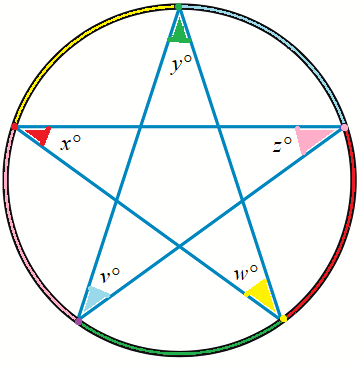
Since the question is a multiple choice one, we can assume that there is one correct answer and that that answer does not depend on the shape of the “star”. Assuming that the star can be inscribed in a circle, we can see that the requested sum of the angles is 360/2 = 180, because each angle is inscribed in the circle and the five corresponding arcs complete the circle.
Remark: If one of the answers would have been “It cannot be determined” or something similar, than this argument wouldn’t work.

Correct answer: C

Sum of the external angles for a convex polygon:

We know that the sum of the interior angles in a convex polygon with n sides (n being a positive integer greater than 2) is given by the formula:
(n – 2)∙180 = 180n – 360.
Each external angle is 180 – the corresponding interior angle. Therefore, the total sum of the exterior angles is 180n – (n – 2) ∙ 180 = 180n – 180n + 360 = 360.

Note: Convex polygons have the property that each of their angles is less than 180. All the polygons dealt with on GMAT are convex (triangle, quadrilateral, pentagon, hexagon,...) or are made up of convex polygons. In this question, the figure of the star, without the sides of the small convex pentagon, is an example of a non-convex decagon: it has 10 sides, and 5 angles which are greater, and 5, which are smaller than 180.
Attachments

OG13-D10-A.png
OG13-D10-A.png [ 26.98 KiB | Viewed 147901 times ]

OG13-D10-B.png
OG13-D10-B.png [ 38.38 KiB | Viewed 147430 times ]

General Discussion
User avatar
ashish8
Joined: 28 Sep 2011
Last visit: 24 Apr 2015
Posts: 46
Own Kudos:
86
 [10]
Given Kudos: 10
Location: United States
GMAT 1: 520 Q34 V27
GMAT 2: 690 Q47 V38
GPA: 3.01
WE:Information Technology (Commercial Banking)
GMAT 2: 690 Q47 V38
Posts: 46
Kudos: 86
 [10]
10
Kudos
Add Kudos
Bookmarks
Bookmark this Post
The sum of all the angles of the pentagon in the middle is (5-3)180 = 540.
Each vertex of the pentagon has a angle of 108 degrees (on average).
Lets look at triangle AYW, since A is a vertex of the pentagon, the sum of y + w = 72.
In this same scenario z + v also = 72 and x equals 36 (72/2).

72 + 72 + 36 = 180
User avatar
EvaJager
Joined: 22 Mar 2011
Last visit: 31 Aug 2016
Posts: 513
Own Kudos:
Given Kudos: 43
WE:Science (Education)
Posts: 513
Kudos: 2,370
Kudos
Add Kudos
Bookmarks
Bookmark this Post
ashish8
The sum of all the angles of the pentagon in the middle is (5-3)180 = 540.
Each vertex of the pentagon has a angle of 108 degrees (on average).
Lets look at triangle AYW, since A is a vertex of the pentagon, the sum of y + w = 72.
In this same scenario z + v also = 72 and x equals 36 (72/2).

72 + 72 + 36 = 180

Nice! In other words, if we understand from the answers that the sum does not depend on the shape of the star, we can consider a regular pentagon. Then each of its angles is 108, and each angle of the star is 36, so the sum is 180.
avatar
nitestr
Joined: 03 Feb 2011
Last visit: 28 Mar 2015
Posts: 11
Own Kudos:
Given Kudos: 16
Posts: 11
Kudos: 22
Kudos
Add Kudos
Bookmarks
Bookmark this Post
Hi Bunuel,

I didn't understand the part where you used "Central Angle Theorem". Is it correct to assume that if I see one or more triangles then If I draw a
circle around those triangles which are kind of inter-connected then can I use the "Central Angle Theorem"?

Thanks a lot for the help,

LR
User avatar
Bunuel
User avatar
Math Expert
Joined: 02 Sep 2009
Last visit: 23 Apr 2026
Posts: 109,766
Own Kudos:
810,727
 [6]
Given Kudos: 105,853
Products:
Expert
Expert reply
Active GMAT Club Expert! Tag them with @ followed by their username for a faster response.
Posts: 109,766
Kudos: 810,727
 [6]
5
Kudos
Add Kudos
1
Bookmarks
Bookmark this Post
nitestr
Hi Bunuel,

I didn't understand the part where you used "Central Angle Theorem". Is it correct to assume that if I see one or more triangles then If I draw a
circle around those triangles which are kind of inter-connected then can I use the "Central Angle Theorem"?

Thanks a lot for the help,

LR

Not sure understand what you mean.

Anyway, the Central Angle Theorem states that the measure of inscribed angle is always half the measure of the central angle:


For more check here: math-circles-87957.html
avatar
nitestr
Joined: 03 Feb 2011
Last visit: 28 Mar 2015
Posts: 11
Own Kudos:
Given Kudos: 16
Posts: 11
Kudos: 22
Kudos
Add Kudos
Bookmarks
Bookmark this Post
I'm ok with the Theorem, but I want to know how you came up the assumption " Let's simplify the problem by imagining that we have a star that is inscribed in a circle as shown below" as you mentioned above?
User avatar
anilisanil
Joined: 18 Aug 2006
Last visit: 04 May 2016
Posts: 75
Own Kudos:
179
 [1]
Given Kudos: 43
Location: United States
WE:Consulting (Telecommunications)
Posts: 75
Kudos: 179
 [1]
1
Kudos
Add Kudos
Bookmarks
Bookmark this Post
nitestr
I'm ok with the Theorem, but I want to know how you came up the assumption " Let's simplify the problem by imagining that we have a star that is inscribed in a circle as shown below" as you mentioned above?
You are right, not always can we conclude that five points in a plan are co-circular; while it is true that three points are always co-circular.

However, the solution works if we imagine two circles for three points each. It was just a coincidence that the assumption that all the given points are co-circular worked.
avatar
Plastelin
Joined: 19 Jan 2014
Last visit: 03 Sep 2018
Posts: 23
Own Kudos:
23
 [5]
Given Kudos: 1
GMAT 1: 730 Q50 V39
WE:Accounting (Accounting)
GMAT 1: 730 Q50 V39
Posts: 23
Kudos: 23
 [5]
4
Kudos
Add Kudos
1
Bookmarks
Bookmark this Post
Attachment:
star-sol.png
star-sol.png [ 10.08 KiB | Viewed 103934 times ]

i didn't know the central angle theorem, and tried solving with a different way.
sorry for my mad paint skills :D

here is my solution:
1. Draw a line via vertex of angle Y, parallel to the line between angles V and Z. In a picture the red coloured lines are parallel.
2. Draw a line via vertex of angle Y, parallel to the line between angles X and Z (violet coloured)
3. Draw a line via vertex of angle Y, parallel to the line between angles X and W (blue coloured)

The following can be concluded from the pic accoridng to thales theorem:
a. angles between red and violet lines will be same (angle Z)
b. angles between black and red lines will be same (angle V)
c. angles between blue and black lines will be same (angle W)
d. angles between blue and violet lines will be same (angle X)

as a result sum of 5 angles will be a violet line and equal to 180 degrees


My solution is obviously not as simple and quick as Bunuel's one, but maybe you can use my approach for solving similar problems
User avatar
AdmitJA
Joined: 04 Jul 2014
Last visit: 26 Mar 2018
Posts: 276
Own Kudos:
1,243
 [16]
Given Kudos: 420
Location: India
GMAT 1: 640 Q44 V34
GMAT 2: 710 Q49 V37
GPA: 3.58
WE:Analyst (Accounting)
Products:
GMAT 2: 710 Q49 V37
Posts: 276
Kudos: 1,243
 [16]
10
Kudos
Add Kudos
6
Bookmarks
Bookmark this Post
Wow! See what I found with a little googling! :-D

A star is always regularly shaped (this clarifies why Bunuel assumed that the start would get inscribed in the circle)!
1. The sum of the angles formed at the tips of the five pointed star is 180; the sum of the angles formed at the tips of the six pointed star is 360.
2. The formula for the sum of the angle measurements at the tips of an n-pointed star is f(n)=180(n)-720 where n is an integer greater than 4.

Read more here: https://mathforum.org/pom2/nov.98/winner.html :-D

This clarifies my doubts Very Happy
avatar
pluto82
Joined: 21 Jul 2015
Last visit: 23 Mar 2017
Posts: 27
Own Kudos:
64
 [9]
Given Kudos: 31
Posts: 27
Kudos: 64
 [9]
5
Kudos
Add Kudos
4
Bookmarks
Bookmark this Post
Interior angle of a polygon = \(((n-2)180)/n\)
For Pentagon = \((5-3)180/5\) = 108
sum of angles in each triangle angle x+(180-108)+(180-108) = 180 .... x = 36
there are 5 triangles ... 36*5 = 180
Answer (C)
avatar
GovKohli
Joined: 16 Sep 2015
Last visit: 01 Mar 2018
Posts: 9
Own Kudos:
5
 [3]
Posts: 9
Kudos: 5
 [3]
3
Kudos
Add Kudos
Bookmarks
Bookmark this Post
Alternate Solution with just the basics.
(I have not named every vertex separately in order to avoid confusion (mess). Every vertex of the star is named by the angle it depicts in the picture)
Attachments

File comment: y+A+B+C = 360 (sum of all the angles in quadrilateral-YABC )
A= 180-(y+v) (sum of all angles in a triangle is 180,Triangle YAV)
B= 180-(x+z) (Triangle XBZ)
C= 180-(y+w) (Triangle YCW)

Now, Substitute the values of A, B and C in the equation : A+B+C+y=360
(180-y-v) + (180-x-z) + (180-y-w) + y =360
By solving the above, we get:
540 - w - v - z - x - 2y + y=360
x+y+v+z+w=180
ANSWER - C

Govind Kohli
Kudos if this helps

step0004.png
step0004.png [ 5.55 KiB | Viewed 102532 times ]

User avatar
Icecream87
Joined: 23 Sep 2015
Last visit: 02 Aug 2018
Posts: 332
Own Kudos:
353
 [19]
Given Kudos: 72
Location: France
GMAT 1: 690 Q47 V38
GMAT 2: 700 Q48 V38
WE:Real Estate (Mutual Funds and Brokerage)
Products:
GMAT 2: 700 Q48 V38
Posts: 332
Kudos: 353
 [19]
15
Kudos
Add Kudos
4
Bookmarks
Bookmark this Post
\(A + B + C + D + E = (5-2)*180 = 540\)

\(A+x+z=180\)
\(B+y+v=180\)
\(C+x+w=180\)
\(D+v+z=180\)
\(E+y+w=180\)

When we add it all:
\(A + B + C + D + E +2x+2y+2z+2w+2v =900\)

\(540 + 2x+2y+2z+2w+2v = 900\)

\(2x+2y+2z+2w+2v = 360\)

\(x+y+z+w+v=180\)
Attachments

GMAT.png
GMAT.png [ 8.59 KiB | Viewed 102572 times ]

User avatar
mikedays
Joined: 13 Apr 2017
Last visit: 02 Sep 2018
Posts: 3
Own Kudos:
11
 [2]
Given Kudos: 3
Location: Portugal
Concentration: General Management, Economics
WE:General Management (Retail: E-commerce)
Posts: 3
Kudos: 11
 [2]
2
Kudos
Add Kudos
Bookmarks
Bookmark this Post
Although GMAT pictures may be not completely accurate and drawn to scale, I realize they don't usually try to "trick" users... Therefore I just drew the figure on a piece of paper and given the answer choices I realized the sum of the angles must be somewhere around 180 degrees:
Attachment:
star.png
star.png [ 31.16 KiB | Viewed 101316 times ]

Probably this approach is not the most scientific and reliable way to solve the problem, but I guess it worked on this one.
User avatar
Mahmud6
User avatar
Retired Moderator
Joined: 10 Mar 2013
Last visit: 01 Apr 2026
Posts: 381
Own Kudos:
901
 [2]
Given Kudos: 235
Status:The best is yet to come.....
Posts: 381
Kudos: 901
 [2]
Kudos
Add Kudos
2
Bookmarks
Bookmark this Post
In a regular pentagram (5-pointed star, NOT Pentagon), the angle in each point is 36 degrees, so the angles in all five points sum to 180 degrees.
Attachment:
1.jpg
1.jpg [ 8.1 KiB | Viewed 56515 times ]

In an irregular pentagram (NOT Pentagon), the angles might be all different from each other, but the angles in all five points still sum to 180 degrees.
Attachment:
2.jpg
2.jpg [ 17.66 KiB | Viewed 56485 times ]
User avatar
ScottTargetTestPrep
User avatar
Target Test Prep Representative
Joined: 14 Oct 2015
Last visit: 22 Apr 2026
Posts: 22,278
Own Kudos:
26,529
 [2]
Given Kudos: 302
Status:Founder & CEO
Affiliations: Target Test Prep
Location: United States (CA)
Expert
Expert reply
Active GMAT Club Expert! Tag them with @ followed by their username for a faster response.
Posts: 22,278
Kudos: 26,529
 [2]
2
Kudos
Add Kudos
Bookmarks
Bookmark this Post
Bunuel
The Official Guide for GMAT® Review, 13th Edition - Quantitative Questions Project

In the figure shown, what is the value of v+x+y+z+w?


(A) 45
(B) 90
(C) 180
(D) 270
(E) 360


Solution:

To start, you should recognize that the sum of the exterior angles of any polygon is 360.

Let’s solve the question for the case where the pentagon formed in the center is regular. When that is the case, each of the 5 exterior angles of the pentagon equals 360/5 = 72. Then you’ll see that the vertical angles of the triangles are all equal, so each of those angles is also 72. Thus, x, y, z, w, and v, respectively, each equals 180 - 2 x 72 = 36. Finally, this means the sum of v + x + y + z + w is 36 x 5 = 180.

Now, notice that, even if the pentagon is not regular, neither the sum of the interior angles nor the relations between the angles of the pentagon and the angles x, y, z, w and v change. Therefore, the answer for the general case is also 180.

Alternative Solution:

Basically, the problem is asking for the total measure of the 5 marked angles, and yes, we should recognize that the sum of exterior angles of any polygon is 360 degrees. The 5 triangles that have the 5 marked angles also have 10 unmarked angles, which form two sets of exterior angles to the pentagon in the center. Therefore, the total measure of these 10 angles is 2 x 360 = 720 degrees. Therefore, we can say the following (TM means “total measure”):

TM of the angles of 5 triangles = TM of the 5 marked angles + TM of the 10 unmarked angles

5 x 180 = TM of the 5 marked angles + 720

900 = TM of the 5 marked angles + 720

180 = TM of the 5 marked angles

Answer: C
 1   2   
Moderators:
Math Expert
109766 posts
Tuck School Moderator
853 posts