Events & Promotions
|
|

GMAT Club Daily Prep
Thank you for using the timer - this advanced tool can estimate your performance and suggest more practice questions. We have subscribed you to Daily Prep Questions via email.
Customized
for You
Track
Your Progress
Practice
Pays
Not interested in getting valuable practice questions and articles delivered to your email? No problem, unsubscribe here.
 Sep 21
07:00 PM EDT
-10:00 PM EDT
Boost your GMAT score in less than one month in a live online class + 6 months access to TTP OnDemand video courses included!


 21 May 2019, 00:38
Kudos
Bookmarks


C
Be sure to select an answer first to save it in the Error Log before revealing the correct answer (OA)!
Difficulty:
 35%
(medium)
35%
(medium)
Question Stats:
70% (01:34) correct 30%
(02:22)
wrong
based on 54
sessions
30%
(02:22)
wrong
based on 54
sessions
History
Date
Time
Result
Not Attempted Yet
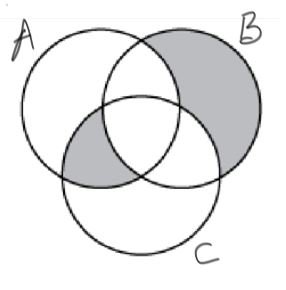
The area of each of the three circular regions in the figure shown is 40, and the area of the intersection of any two of the circular regions is 15. What is the sum of the areas of the shaded regions?
A. 15
B. 20
C. 25
D. 30
E. 35
Attachment:
pp2_06.png [ 20.47 KiB | Viewed 4944 times ]

firas92

Current Student
Joined: 16 Jan 2019
Last visit: 24 Jul 2026
Posts: 616
Given Kudos: 142
Location: India
Concentration: General Management
Schools: Tepper '23 (M$) Foster '23 (D)
GMAT 1: 740 Q50 V40
WE:Sales (Other)
Products:
22 May 2019, 23:48
Kudos
Bookmarks
The areas of the regions where there is an intersection of exactly two circles and not 3 circles are all equal (A=B=C) since all the circles are of the same area and all intersections of any two circles are of the same area
So lets imagine we interchange the positions of A and B.
Now the required area is simply the area of 1 circle minus the area of intersection of 2 circles
40-15 = 25
Answer is (C)
So lets imagine we interchange the positions of A and B.
Now the required area is simply the area of 1 circle minus the area of intersection of 2 circles
40-15 = 25
Answer is (C)
 24 May 2019, 10:25
Kudos
Bookmarks
If your first thought, when you looked at this question, was to solve this using the concept of Venn diagrams, you are not alone. This is probably the biggest trap in this question.
The actual approach, however, should be based on Geometry. From the question statement, we know that all three circles are congruent (of equal area). How and when we use this crucial element, will define whether we will be able to solve this question convincingly.
Let us name the circles, as A,B and C, as shown below
24th May 2019 - Reply 4 -1.JPG [ 16.08 KiB | Viewed 4361 times ]
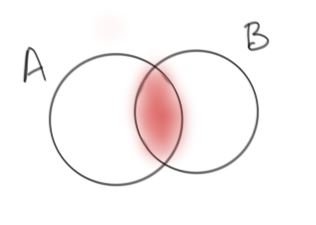
If we consider only circles A and B, we can see that the intersection of these two circles is as shown in the figure below
24th May 2019 - Reply 4 -2.JPG [ 12.42 KiB | Viewed 4338 times ]
As per the question, the area of the portion shaded in red is 15 , because this represents the intersection of two circles. It’s very easy to confuse this with the intersection of sets, but let us reiterate here, that this is not a question on Set theory.
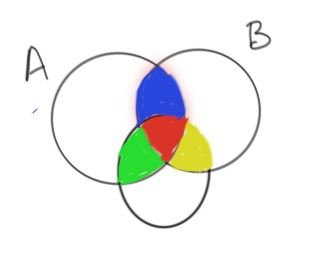
When we now bring in the third circle C, we have a diagram that looks like the one below
24th May 2019 - Reply 4 -3.JPG [ 13.8 KiB | Viewed 4303 times ]
The red area, with any one of the blue or green or yellow areas will equal 15. Because the three circles are congruent and because the red area is common, it is now easy to understand that each of the green, yellow and blue regions should have the same area.
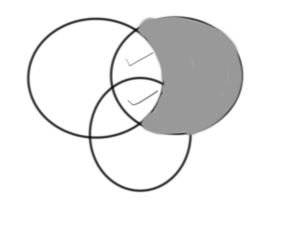
Therefore, in place of the figure given in the question, we can have a figure like this (because the two parts are equal, it doesn’t matter whether we take the green part or the yellow part)
24th May 2019 - Reply 4 -4.JPG [ 12.22 KiB | Viewed 4275 times ]
Clearly, from our discussion above, the area of the regions with a tick mark is 15. The area of the entire circle is 40. So, the area of the shaded portion is 40 – 15 = 25.
The correct answer option is C.
In this question, the biggest challenge may be that you have to pull yourself from a situation where you have already decided to go the Venn diagram way, to making a conscious effort towards solving this question using Geometry. Therefore, it’s hard to say what would be an ideal time to solve this question, but we would like to ball park it between 2 minutes to 3 minutes.
Hope this helps!
The actual approach, however, should be based on Geometry. From the question statement, we know that all three circles are congruent (of equal area). How and when we use this crucial element, will define whether we will be able to solve this question convincingly.
Let us name the circles, as A,B and C, as shown below
Attachment:
24th May 2019 - Reply 4 -1.JPG [ 16.08 KiB | Viewed 4361 times ]
If we consider only circles A and B, we can see that the intersection of these two circles is as shown in the figure below
Attachment:
24th May 2019 - Reply 4 -2.JPG [ 12.42 KiB | Viewed 4338 times ]
As per the question, the area of the portion shaded in red is 15 , because this represents the intersection of two circles. It’s very easy to confuse this with the intersection of sets, but let us reiterate here, that this is not a question on Set theory.
When we now bring in the third circle C, we have a diagram that looks like the one below
Attachment:
24th May 2019 - Reply 4 -3.JPG [ 13.8 KiB | Viewed 4303 times ]
The red area, with any one of the blue or green or yellow areas will equal 15. Because the three circles are congruent and because the red area is common, it is now easy to understand that each of the green, yellow and blue regions should have the same area.
Therefore, in place of the figure given in the question, we can have a figure like this (because the two parts are equal, it doesn’t matter whether we take the green part or the yellow part)
Attachment:
24th May 2019 - Reply 4 -4.JPG [ 12.22 KiB | Viewed 4275 times ]
Clearly, from our discussion above, the area of the regions with a tick mark is 15. The area of the entire circle is 40. So, the area of the shaded portion is 40 – 15 = 25.
The correct answer option is C.
In this question, the biggest challenge may be that you have to pull yourself from a situation where you have already decided to go the Venn diagram way, to making a conscious effort towards solving this question using Geometry. Therefore, it’s hard to say what would be an ideal time to solve this question, but we would like to ball park it between 2 minutes to 3 minutes.
Hope this helps!
Attachments
24th May 2019 - Reply 4 -1.JPG [ 16.08 KiB | Viewed 4227 times ]




