Last visit was: 23 Apr 2026, 09:03 It is currently 23 Apr 2026, 09:03
Close
GMAT Club Daily Prep
Thank you for using the timer - this advanced tool can estimate your performance and suggest more practice questions. We have subscribed you to Daily Prep Questions via email.

Customized
for You

we will pick new questions that match your level based on your Timer History

Track
Your Progress

every week, we’ll send you an estimated GMAT score based on your performance

Practice
Pays

we will pick new questions that match your level based on your Timer History
Not interested in getting valuable practice questions and articles delivered to your email? No problem, unsubscribe here.
Close
Request Expert Reply
Confirm Cancel
User avatar
guddo
Joined: 25 May 2021
Last visit: 22 Apr 2026
Posts: 1,013
Own Kudos:
11,323
 [24]
Given Kudos: 32
Posts: 1,013
Kudos: 11,323
 [24]
2
Kudos
Add Kudos
22
Bookmarks
Bookmark this Post
User avatar
Bunuel
User avatar
Math Expert
Joined: 02 Sep 2009
Last visit: 23 Apr 2026
Posts: 109,779
Own Kudos:
810,802
 [3]
Given Kudos: 105,853
Products:
Expert
Expert reply
Active GMAT Club Expert! Tag them with @ followed by their username for a faster response.
Posts: 109,779
Kudos: 810,802
 [3]
1
Kudos
Add Kudos
2
Bookmarks
Bookmark this Post
User avatar
Danou
Joined: 14 Feb 2024
Last visit: 09 Mar 2025
Posts: 29
Own Kudos:
Given Kudos: 24
Posts: 29
Kudos: 112
Kudos
Add Kudos
Bookmarks
Bookmark this Post
User avatar
bb
User avatar
Founder
Joined: 04 Dec 2002
Last visit: 22 Apr 2026
Posts: 43,154
Own Kudos:
83,715
 [4]
Given Kudos: 24,677
Location: United States
GMAT 1: 750 Q49 V42
GPA: 3
Products:
Expert
Expert reply
Active GMAT Club Expert! Tag them with @ followed by their username for a faster response.
GMAT 1: 750 Q49 V42
Posts: 43,154
Kudos: 83,715
 [4]
3
Kudos
Add Kudos
1
Bookmarks
Bookmark this Post
Danou

­
Could you elaborate? I don't understand the question/answer.
­
Hi. if a number is Square Root of 5, which technically is 2.23, that means [n] = 2, since it has to be the largest integer that is lesser or equal to n. Does that make sense?
It is a bit convoluted, but you can figure it out after trying the question a bit.
Hope it helps.
User avatar
Bunuel
User avatar
Math Expert
Joined: 02 Sep 2009
Last visit: 23 Apr 2026
Posts: 109,779
Own Kudos:
Given Kudos: 105,853
Products:
Expert
Expert reply
Active GMAT Club Expert! Tag them with @ followed by their username for a faster response.
Posts: 109,779
Kudos: 810,802
Kudos
Add Kudos
Bookmarks
Bookmark this Post
Danou
Bunuel
guddo
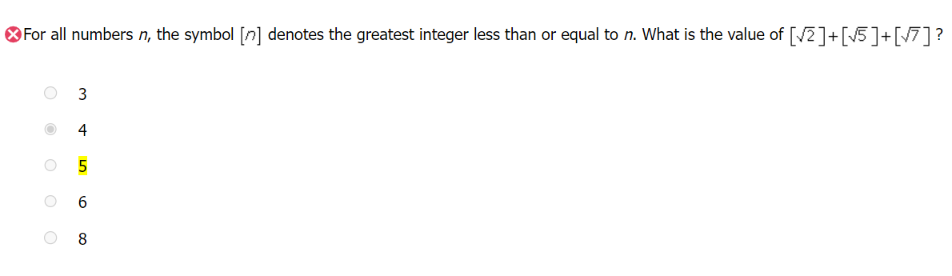
For all numbers n, the symbol [n] denotes the greatest integer less than or equal to n. What is the value of [√2] + [√5] + [√7] ?

A. 3
B. 4
C. 5
D. 6
E. 8
Attachment:
2024-01-29_11-43-37.png

    [√2] + [√5] + [√7] == [1.something] + [2.something] + [2.something] == 1 + 2 + 2 == 5.

Answer: C.
­
Could you elaborate? I don't understand the question/answer.
­
The square brackets in this question represent the 'floor function', which rounds down a number to the closest integer less than or equal to that number. Here's how it works:


[4.7] = 4, because 4 is the greatest integer less than or equal to 4.7;
[7] = 7, because 7 is the greatest integer less than or equal to 7;
[-12.1] = -13, because -13 is the greatest integer less than or equal to -12.1;
[-8] = - 8, because -8 is the greatest integer less than or equal to -8.

Since √2 ≈ 1.4, then [√2] = 1, because 1 is the greatest integer less than or equal to 1.4;
Since √5 ≈ 2.2, then [√5] = 2, because 2 is the greatest integer less than or equal to 2.2;
Since √7 ≈ 2.6, then [√7] = 2, because 3 is the greatest integer less than or equal to 2.6.

Hope it's clear.

For more information, you can check out these links:

13. Functions


For more check below:
ALL YOU NEED FOR QUANT ! ! !
Ultimate GMAT Quantitative Megathread­

Hope this helps.
User avatar
GMATinsight
User avatar
Major Poster
Joined: 08 Jul 2010
Last visit: 23 Apr 2026
Posts: 6,976
Own Kudos:
Given Kudos: 128
Status:GMAT/GRE Tutor l Admission Consultant l On-Demand Course creator
Location: India
GMAT: QUANT+DI EXPERT
Schools: IIM (A) ISB '24
GMAT 1: 750 Q51 V41
WE:Education (Education)
Products:
Expert
Expert reply
Schools: IIM (A) ISB '24
GMAT 1: 750 Q51 V41
Posts: 6,976
Kudos: 16,906
Kudos
Add Kudos
Bookmarks
Bookmark this Post
guddo
For all numbers n, the symbol [n] denotes the greatest integer less than or equal to n. What is the value of [√2] + [√5] + [√7] ?

A. 3
B. 4
C. 5
D. 6
E. 8

Attachment:
2024-01-29_11-43-37.png
­Given, [n] denotes the greatest integer less than or equal to n

Now, [√2] = the greatest integer less than or equal to √2 = the greatest integer less than or equal to 1.4 = 1
Similarly, [√5] = the greatest integer less than or equal to √5 = the greatest integer less than or equal to 2.2 = 2
Similarly, [√7] = the greatest integer less than or equal to √7 = the greatest integer less than or equal to 2.7 = 2

i.e. [√2] + [√5] + [√7] = 1+2+2 = 5

Answer: Option C
User avatar
SergejK
Joined: 22 Mar 2024
Last visit: 02 May 2025
Posts: 152
Own Kudos:
Given Kudos: 74
Posts: 152
Kudos: 978
Kudos
Add Kudos
Bookmarks
Bookmark this Post
It's easier to check for squares of larger and smaller integers if one doesn't see right away what the square routes of those numbers are.

1^2<sqrt(2)<2^2, hence 1
2^2<sqrt(5)<3^2, hence 2
2^2<sqrt(7)<3^2, hence 2

1+2+2=5
User avatar
bumpbot
User avatar
Non-Human User
Joined: 09 Sep 2013
Last visit: 04 Jan 2021
Posts: 38,965
Own Kudos:
Posts: 38,965
Kudos: 1,117
Kudos
Add Kudos
Bookmarks
Bookmark this Post
Automated notice from GMAT Club BumpBot:

A member just gave Kudos to this thread, showing it’s still useful. I’ve bumped it to the top so more people can benefit. Feel free to add your own questions or solutions.

This post was generated automatically.
Moderators:
Math Expert
109779 posts
Tuck School Moderator
853 posts