Last visit was: 24 Apr 2026, 02:48 It is currently 24 Apr 2026, 02:48
Close
GMAT Club Daily Prep
Thank you for using the timer - this advanced tool can estimate your performance and suggest more practice questions. We have subscribed you to Daily Prep Questions via email.

Customized
for You

we will pick new questions that match your level based on your Timer History

Track
Your Progress

every week, we’ll send you an estimated GMAT score based on your performance

Practice
Pays

we will pick new questions that match your level based on your Timer History
Not interested in getting valuable practice questions and articles delivered to your email? No problem, unsubscribe here.
Close
Request Expert Reply
Confirm Cancel
kiranicole214
Joined: 31 Dec 1969
Last visit: -
Own Kudos:
0
 [4]
Kudos: 0
 [4]
Kudos
Add Kudos
4
Bookmarks
Bookmark this Post
User avatar
srini123
Joined: 13 Oct 2009
Last visit: 17 Feb 2021
Posts: 152
Own Kudos:
265
 [1]
Given Kudos: 38
Affiliations: PMP
Posts: 152
Kudos: 265
 [1]
1
Kudos
Add Kudos
Bookmarks
Bookmark this Post
User avatar
lagomez
Joined: 05 Mar 2008
Last visit: 18 Sep 2011
Posts: 1,224
Own Kudos:
Given Kudos: 31
Posts: 1,224
Kudos: 563
Kudos
Add Kudos
Bookmarks
Bookmark this Post
avatar
gintojin
Joined: 16 Jun 2015
Last visit: 17 Jun 2015
Posts: 1
Given Kudos: 1
Posts: 1
Kudos: 0
Kudos
Add Kudos
Bookmarks
Bookmark this Post
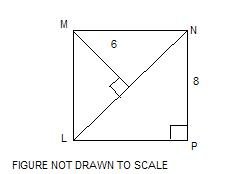
I am having difficulty understanding the logic path to solving this problem. I see the equations individually and can see the solutions, yet the path for solving this is a challenge for me. Can someone take the time to explain it?
Can you assume LP = 8 since NP=8?
How was the Pythagorean Theorem manipulated to extract an answer?
Where does MO come from.

Respectfully, Puzzled.
User avatar
GMATinsight
User avatar
Major Poster
Joined: 08 Jul 2010
Last visit: 24 Apr 2026
Posts: 6,976
Own Kudos:
16,912
 [1]
Given Kudos: 128
Status:GMAT/GRE Tutor l Admission Consultant l On-Demand Course creator
Location: India
GMAT: QUANT+DI EXPERT
Schools: IIM (A) ISB '24
GMAT 1: 750 Q51 V41
WE:Education (Education)
Products:
Expert
Expert reply
Schools: IIM (A) ISB '24
GMAT 1: 750 Q51 V41
Posts: 6,976
Kudos: 16,912
 [1]
1
Kudos
Add Kudos
Bookmarks
Bookmark this Post
gintojin
I am having difficulty understanding the logic path to solving this problem. I see the equations individually and can see the solutions, yet the path for solving this is a challenge for me. Can someone take the time to explain it?
Respectfully, Puzzled.

About the Area of Triangle, There is only one Basic

i.e. Area of Triangle = (1/2) Base of Triangle x Height of triangle

You must Understand that Base can be any side of the triangle but Height in each case will be the perpendicular Distance of Third Vertex pf Triangle from the Base taken

i.e. Take area of Triangle LNP and Consider tha Base= LP, Then Height will be the Perpendicular Distance of LP from N i.e. NP=8

i.e. Area of Triangle LNM = (1/2) x LP x 8 = 32 (Given)

i.e. LP = 8

Now LNP is a right angle Triangle therefore we can apply Pythagorus Theorem to calculate Hypotenuse of the Triangle

i.e. LN^2 = 8^2 + 8^2
i.e. LN = \(8\sqrt{2}\)

Now Area of LNM = (1/2) LN x 6 = \((1/2) * 8\sqrt{2} * 6 = 24\sqrt{2}\)
User avatar
amarinetti
Joined: 05 Apr 2016
Last visit: 05 Jan 2017
Posts: 18
Own Kudos:
11
 [1]
Given Kudos: 23
Posts: 18
Kudos: 11
 [1]
1
Kudos
Add Kudos
Bookmarks
Bookmark this Post
That 6 correspond to the length MN or to the height of the triangle LMN?
avatar
ProfX
Joined: 24 Jul 2016
Last visit: 03 Dec 2017
Posts: 67
Own Kudos:
Given Kudos: 5
Location: United States (MI)
GMAT 1: 730 Q51 V40
GPA: 3.6
GMAT 1: 730 Q51 V40
Posts: 67
Kudos: 16
Kudos
Add Kudos
Bookmarks
Bookmark this Post
Height I think, since the OA is 24 sqrt 2


Sent from my iPhone using GMAT Club Forum mobile app
User avatar
WilDThiNg
Joined: 29 Dec 2014
Last visit: 06 May 2019
Posts: 50
Own Kudos:
9
 [1]
Given Kudos: 996
Posts: 50
Kudos: 9
 [1]
1
Kudos
Add Kudos
Bookmarks
Bookmark this Post
Pardon me but a very fundamental question - Why would the areas of triangles LMN and LNP be different?
User avatar
Manonamission
Joined: 11 Jul 2016
Last visit: 22 Mar 2017
Posts: 72
Own Kudos:
Given Kudos: 87
Posts: 72
Kudos: 208
Kudos
Add Kudos
Bookmarks
Bookmark this Post
Area of triangle LMP = 32 = 1/2.b.h => b = 8

LN = Sq rt (8^2 + 8^2) = 8 sq rt 2

Area of triangle LNM = 1/2. 8 sq rt 2 . 6 = 24√2
User avatar
KrishnakumarKA1
Joined: 05 Jan 2017
Last visit: 13 Oct 2020
Posts: 398
Own Kudos:
Given Kudos: 15
Location: India
Posts: 398
Kudos: 314
Kudos
Add Kudos
Bookmarks
Bookmark this Post
Area of triangle LNP = ½ * LP*NP
or 32 = ½ *LP*4
or LP = 8.
Therefore using Pythagoras in triangle LNP we can say that the value of LN = 8 √2
Area of LMN = ½ *6*8 √2 = 24 √2
User avatar
bumpbot
User avatar
Non-Human User
Joined: 09 Sep 2013
Last visit: 04 Jan 2021
Posts: 38,966
Own Kudos:
Posts: 38,966
Kudos: 1,117
Kudos
Add Kudos
Bookmarks
Bookmark this Post
Automated notice from GMAT Club BumpBot:

A member just gave Kudos to this thread, showing it’s still useful. I’ve bumped it to the top so more people can benefit. Feel free to add your own questions or solutions.

This post was generated automatically.
Moderators:
Math Expert
109802 posts
Tuck School Moderator
853 posts