Last visit was: 22 Apr 2026, 18:56 It is currently 22 Apr 2026, 18:56
Close
GMAT Club Daily Prep
Thank you for using the timer - this advanced tool can estimate your performance and suggest more practice questions. We have subscribed you to Daily Prep Questions via email.

Customized
for You

we will pick new questions that match your level based on your Timer History

Track
Your Progress

every week, we’ll send you an estimated GMAT score based on your performance

Practice
Pays

we will pick new questions that match your level based on your Timer History
Not interested in getting valuable practice questions and articles delivered to your email? No problem, unsubscribe here.
Close
Request Expert Reply
Confirm Cancel
User avatar
apoorvasrivastva
Joined: 29 Jul 2009
Last visit: 11 Oct 2021
Posts: 44
Own Kudos:
364
 [100]
Given Kudos: 24
Posts: 44
Kudos: 364
 [100]
8
Kudos
Add Kudos
92
Bookmarks
Bookmark this Post
Most Helpful Reply
User avatar
Bunuel
User avatar
Math Expert
Joined: 02 Sep 2009
Last visit: 22 Apr 2026
Posts: 109,754
Own Kudos:
Given Kudos: 105,823
Products:
Expert
Expert reply
Active GMAT Club Expert! Tag them with @ followed by their username for a faster response.
Posts: 109,754
Kudos: 810,672
 [41]
17
Kudos
Add Kudos
24
Bookmarks
Bookmark this Post
User avatar
Bunuel
User avatar
Math Expert
Joined: 02 Sep 2009
Last visit: 22 Apr 2026
Posts: 109,754
Own Kudos:
Given Kudos: 105,823
Products:
Expert
Expert reply
Active GMAT Club Expert! Tag them with @ followed by their username for a faster response.
Posts: 109,754
Kudos: 810,672
 [28]
10
Kudos
Add Kudos
18
Bookmarks
Bookmark this Post
User avatar
johnwesley
Joined: 24 Jan 2013
Last visit: 20 Nov 2013
Posts: 61
Own Kudos:
431
 [23]
Given Kudos: 6
Posts: 61
Kudos: 431
 [23]
18
Kudos
Add Kudos
5
Bookmarks
Bookmark this Post
See attached drawing.

The probability will be the area of the dark triangle divided by the area of the original triangle:

Area dark triangle (where X>Y is true): \(\frac{1}{2}*4*4\)

Area original triangle: \(\frac{1}{2}*4*5\)

\(Probability=\frac{(0.5*4*4)}{(0.5*4*5)}=\frac{4}{5}\)

Solution E
Attachments

File comment: Drawing resolution
Drawing resolution.jpg
Drawing resolution.jpg [ 13.41 KiB | Viewed 30215 times ]

General Discussion
User avatar
apoorvasrivastva
Joined: 29 Jul 2009
Last visit: 11 Oct 2021
Posts: 44
Own Kudos:
364
 [1]
Given Kudos: 24
Posts: 44
Kudos: 364
 [1]
Kudos
Add Kudos
1
Bookmarks
Bookmark this Post
Bunuel


We have right triangle with the area=4*5/2=10. Consider the line y<x. All the points which satisfy this equation (are below the line y=x) and lie in the triangular region obviously will have x more than y, which is exactly what we want (as x>y --> x-y>0).

The probability that the point will be from this region is: Area of this region/Area of the triangle.

Favorable region is also right triangle with vertexes at (0,0) (0,4) and (4,4). As y=x intersects the side of our original triangle at the point (4,4). You''ll see it easily if you draw it. So favorable are=4*4/2=8.

P=8/10=4/5

Answer: E.

If i go by the way u say....
shouldn't the probability be <4/5?

probability = area of region where x-y>0 / total are of region = x/0.5*4*5 = x/10

point (4,4) is where x-y=0. point(4, <4) is where x-y>0.

x = 0.5 * 4*(<4) = <8 hence x/10 = <8/10 = <4/5


the point here is that to get 4/5 you would have to take the region where x and y = 4 in which case x-y is not >0. any value of y below 4 would give x-y>0 hence the probability should be less than 4/5...I dont think you can place an exact value on the probability as x and y can be decimals...
User avatar
IanStewart
User avatar
GMAT Tutor
Joined: 24 Jun 2008
Last visit: 17 Apr 2026
Posts: 4,143
Own Kudos:
11,270
 [3]
Given Kudos: 99
Expert
Expert reply
Posts: 4,143
Kudos: 11,270
 [3]
3
Kudos
Add Kudos
Bookmarks
Bookmark this Post
apoorvasrivastva

Also if i go by the way u say....
shouldn't the probability be <4/5?

probability = area of region where x-y>0 / total are of region = x/0.5*4*5 = x/10

point (4,4) is where x-y=0. point(4, <4) is where x-y>0.

x = 0.5 * 4*(<4) = <8 hence x/10 = <8/10 = <4/5


the point here is that to get 4/5 you would have to take the region where x and y = 4 in which case x-y is not >0. any value of y below 4 would give x-y>0 hence the probability should be less than 4/5...I dont think you can place an exact value on the probability as x and y can be decimals...

I responded to this same post on BTG, but I'll paste that here:

To respond specifically to the concern above: the answer is still exactly 4/5, regardless of whether the question says x-y > 0 or x-y > 0. Note that the region where x-y=0 is just the line x=y; its area is zero. So you can subtract its area in your calculation if you like, but it won't change the answer.
User avatar
mbaiseasy
Joined: 13 Aug 2012
Last visit: 29 Dec 2013
Posts: 316
Own Kudos:
2,095
 [1]
Given Kudos: 11
Concentration: Marketing, Finance
GPA: 3.23
Posts: 316
Kudos: 2,095
 [1]
1
Kudos
Add Kudos
Bookmarks
Bookmark this Post
sagarsabnis
In the xy- plane, a triangle has vertexes (0,0), (4,0) and (4,5). If a point (x,y) is selected at random from the triangular region, What is the probability that x-y>0 ?

A. 1/5
B. 1/3
c. 1/2
D. 2/3
E. 4/5
please help with this one.

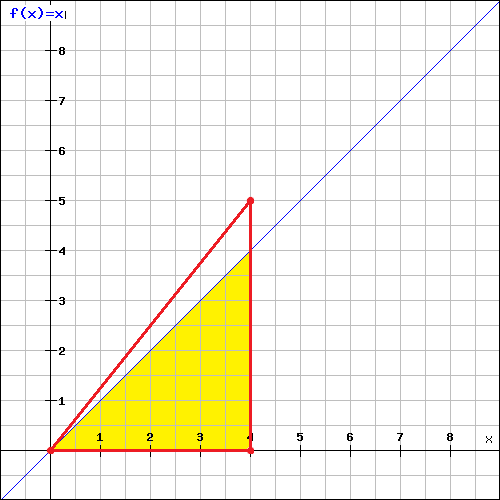
My approach is to use the x=y line which is the boundary that divides x>y and x<y coordinate system. Below the x=y line is the region of points with x > y. Above the x=y line is the region of points with x < y.

Get the area of the given triangle: (4)(5) / 2 = 10
Get the area of the smaller triangle drawn below the line x=y which has (0,0), (4,0) and (4,4) for its coordinates: (4)(4)/2 = 8

P = 8/10 = 4/5

Answer: E

Detailed Solution: Line x=y as a Boundary
avatar
perilm41
Joined: 17 Nov 2012
Last visit: 16 Feb 2016
Posts: 1
Own Kudos:
1
 [1]
Posts: 1
Kudos: 1
 [1]
1
Kudos
Add Kudos
Bookmarks
Bookmark this Post
johnwesley
See attached drawing.

The probability will be the area of the dark triangle divided by the area of the original triangle:

Area dark triangle (where X>Y is true): \(\frac{1}{2}*4*4\)

Area original triangle: \(\frac{1}{2}*4*5\)

\(Probability=\frac{(0.5*4*4)}{(0.5*4*5)}=\frac{4}{5}\)

Solution E

What about (4,4)? that is in the shaded region, but is not greater than 0 (or algebraically x=4 is not greater than y=4)?
User avatar
Bunuel
User avatar
Math Expert
Joined: 02 Sep 2009
Last visit: 22 Apr 2026
Posts: 109,754
Own Kudos:
Given Kudos: 105,823
Products:
Expert
Expert reply
Active GMAT Club Expert! Tag them with @ followed by their username for a faster response.
Posts: 109,754
Kudos: 810,672
Kudos
Add Kudos
Bookmarks
Bookmark this Post
perilm41
johnwesley
See attached drawing.

The probability will be the area of the dark triangle divided by the area of the original triangle:

Area dark triangle (where X>Y is true): \(\frac{1}{2}*4*4\)

Area original triangle: \(\frac{1}{2}*4*5\)

\(Probability=\frac{(0.5*4*4)}{(0.5*4*5)}=\frac{4}{5}\)

Solution E

What about (4,4)? that is in the shaded region, but is not greater than 0 (or algebraically x=4 is not greater than y=4)?

A point by definition has no length, area or any other dimension, thus this won't affect the answer.

Check this discussion for more: a-5-meter-long-wire-is-cut-into-two-pieces-if-the-longer-106448.html
avatar
Jaisri
Joined: 09 Jun 2012
Last visit: 19 Jan 2015
Posts: 23
Own Kudos:
Given Kudos: 13
Posts: 23
Kudos: 133
Kudos
Add Kudos
Bookmarks
Bookmark this Post
Bunuel

Favorable region is also right triangle with vertexes at (0,0) (0,4) and (4,4).
Answer: E.

Hi Bunuel,

Since we have to select a point within the given triangular region formed by (0,0(, (4,0) and (4,5), isn't the favorable region formed by (0,0), (4,4) and (4,5)?
If not, kindly clarify how the vertexes for favorable region would be (0,0) (0,4) and (4,4).
User avatar
Narenn
User avatar
Major Poster
Joined: 22 Feb 2012
Last visit: 22 Apr 2026
Posts: 9,291
Own Kudos:
Given Kudos: 4,711
Affiliations: GMAT Club
Test: Test
Posts: 9,291
Kudos: 11,303
Kudos
Add Kudos
Bookmarks
Bookmark this Post
Jaisri

Hi Bunuel,
Since we have to select a point within the given triangular region formed by (0,0(, (4,0) and (4,5), isn't the favorable region formed by (0,0), (4,4) and (4,5)?
If not, kindly clarify how the vertexes for favorable region would be (0,0) (0,4) and (4,4).

Yes, The points fall below the line y = x will give us x > y and hence it is the favorable region.
Refer this article for more info on Geometric Probabilities https://gmatclub.com/blog/2013/02/geomet ... -the-gmat/

apoorvasrivastva
In the xy-plane, a triangle has vertexes (0,0), (4,0) and (4,5). If a point (x,y) is selected at random from the triangular region, What is the probability that x-y>0 ?

A. 1/5
B. 1/3
c. 1/2
D. 2/3
E. 4/5

User avatar
Mahmud6
User avatar
Retired Moderator
Joined: 10 Mar 2013
Last visit: 01 Apr 2026
Posts: 381
Own Kudos:
Given Kudos: 235
Status:The best is yet to come.....
Posts: 381
Kudos: 901
Kudos
Add Kudos
Bookmarks
Bookmark this Post
Bunuel
sagarsabnis
In the xy- plane, a triangle has vertexes (0,0), (4,0) and (4,5). If a point (x,y) is selected at random from the triangular region, What is the probability that x-y>0 ?

A. 1/5
B. 1/3
c. 1/2
D. 2/3
E. 4/5

please help with this one.

We have right triangle with the area=4*5/2=10. Consider the line y<x. All the points which satisfy this equation (are below the line y=x) and lie in the triangular region obviously will have x more than y, which is exactly what we want (as x>y --> x-y>0).

The probability that the point will be from this region is: Area of this region/Area of the triangle.

Favorable region is also right triangle with vertexes at (0,0) (4,0) and (4,4). As y=x intersects the side of our original triangle at the point (4,4). You''ll see it easily if you draw it. So favorable are=4*4/2=8.

P=8/10=4/5

Answer: E.

Just out of curiosity!

In the above case, what would be the probability that x-y<0 and that x=y?

I think P(x-y<0)=0.2, but don't know exactly the P(x=y). It may be 0, but don't know why.

P(x-y>0)=0.8
P(x-y<0)=0.2
P(x=y)=0
Total 1.0

Would you help me?
User avatar
Bunuel
User avatar
Math Expert
Joined: 02 Sep 2009
Last visit: 22 Apr 2026
Posts: 109,754
Own Kudos:
810,672
 [1]
Given Kudos: 105,823
Products:
Expert
Expert reply
Active GMAT Club Expert! Tag them with @ followed by their username for a faster response.
Posts: 109,754
Kudos: 810,672
 [1]
1
Kudos
Add Kudos
Bookmarks
Bookmark this Post
Mahmud6
Bunuel
sagarsabnis
In the xy- plane, a triangle has vertexes (0,0), (4,0) and (4,5). If a point (x,y) is selected at random from the triangular region, What is the probability that x-y>0 ?

A. 1/5
B. 1/3
c. 1/2
D. 2/3
E. 4/5

please help with this one.

We have right triangle with the area=4*5/2=10. Consider the line y<x. All the points which satisfy this equation (are below the line y=x) and lie in the triangular region obviously will have x more than y, which is exactly what we want (as x>y --> x-y>0).

The probability that the point will be from this region is: Area of this region/Area of the triangle.

Favorable region is also right triangle with vertexes at (0,0) (4,0) and (4,4). As y=x intersects the side of our original triangle at the point (4,4). You''ll see it easily if you draw it. So favorable are=4*4/2=8.

P=8/10=4/5

Answer: E.

Just out of curiosity!

In the above case, what would be the probability that x-y<0 and that x=y?

I think P(x-y<0)=0.2, but don't know exactly the P(x=y). It may be 0, but don't know why.

P(x-y>0)=0.8
P(x-y<0)=0.2
P(x=y)=0
Total 1.0

Would you help me?

A line segment has only one dimension, length, no area. So, P(x=y) = 0.
User avatar
CEdward
Joined: 11 Aug 2020
Last visit: 14 Apr 2022
Posts: 1,162
Own Kudos:
Given Kudos: 332
Posts: 1,162
Kudos: 289
Kudos
Add Kudos
Bookmarks
Bookmark this Post
Bunuel
In the xy- plane, a triangle has vertexes (0,0), (4,0) and (4,5). If a point (x,y) is selected at random from the triangular region, What is the probability that x-y>0 ?

A. 1/5
B. 1/3
c. 1/2
D. 2/3
E. 4/5


We have right triangle with the area = 4*5/2 = 10. Consider the line y<x. All the points which satisfy this equation (are below the line y = x) and lie in the triangular region obviously will have x more than y, which is exactly what we want (as x > y --> x - y > 0).

The probability that the point will be from this region is: (Area of this region)/(Area of the triangle).

Favorable region is also right triangle with vertexes at (0,0) (0,4) and (4,4). As y = x intersects the side of our original triangle at the point (4,4). You''ll see it easily if you draw it. So favorable area = 4*4/2 = 8.

\(P=\frac{8}{10}=\frac{4}{5}\).

Answer: E.

Attachment:
Untitled.png

Of course after Bunuel answers it becomes exceedingly clear. However, perhaps this is too rudimentary...what triggered you to use y = x? That's the key to this question and I didn't recognize that it's needed to answer. Is there a 'general rule' for when we should use it?
User avatar
ShreyashGupta188
Joined: 25 May 2020
Last visit: 06 Apr 2026
Posts: 27
Own Kudos:
Given Kudos: 151
Location: India
GPA: 2.63
Kudos
Add Kudos
Bookmarks
Bookmark this Post
My logic is different but answer is correct.

I used 1-P(not) so taking all points that don't satisfy x-y>0

0,0 1,1 2,2 3,3 4,4 and 4,5
= 6 points
And all points on the plane

6x5 = 30 points

Applied 1- 6/30

Answer = 4/5

If this method is right bb let me know

Posted from my mobile device
User avatar
akt715
Joined: 12 May 2021
Last visit: 06 Aug 2023
Posts: 57
Own Kudos:
Given Kudos: 126
Posts: 57
Kudos: 8
Kudos
Add Kudos
Bookmarks
Bookmark this Post
Bunuel
In the xy- plane, a triangle has vertexes (0,0), (4,0) and (4,5). If a point (x,y) is selected at random from the triangular region, What is the probability that x-y>0 ?

A. 1/5
B. 1/3
c. 1/2
D. 2/3
E. 4/5


We have right triangle with the area = 4*5/2 = 10. Consider the line y<x. All the points which satisfy this equation (are below the line y = x) and lie in the triangular region obviously will have x more than y, which is exactly what we want (as x > y --> x - y > 0).

The probability that the point will be from this region is: (Area of this region)/(Area of the triangle).

Favorable region is also right triangle with vertexes at (0,0) (0,4) and (4,4). As y = x intersects the side of our original triangle at the point (4,4). You''ll see it easily if you draw it. So favorable area = 4*4/2 = 8.

\(P=\frac{8}{10}=\frac{4}{5}\).

Answer: E.

Attachment:
Untitled.png


I have one doubt , it is given that x> y and ,as per the explanation, favorable region has vertexes at (0,0) (0,4) and (4,4). So, the randomly picked point can be (4,4) then doesn't this violate the condition x>y?
User avatar
Bunuel
User avatar
Math Expert
Joined: 02 Sep 2009
Last visit: 22 Apr 2026
Posts: 109,754
Own Kudos:
Given Kudos: 105,823
Products:
Expert
Expert reply
Active GMAT Club Expert! Tag them with @ followed by their username for a faster response.
Posts: 109,754
Kudos: 810,672
Kudos
Add Kudos
Bookmarks
Bookmark this Post
akt715
Bunuel
In the xy- plane, a triangle has vertexes (0,0), (4,0) and (4,5). If a point (x,y) is selected at random from the triangular region, What is the probability that x-y>0 ?

A. 1/5
B. 1/3
c. 1/2
D. 2/3
E. 4/5


We have right triangle with the area = 4*5/2 = 10. Consider the line y<x. All the points which satisfy this equation (are below the line y = x) and lie in the triangular region obviously will have x more than y, which is exactly what we want (as x > y --> x - y > 0).

The probability that the point will be from this region is: (Area of this region)/(Area of the triangle).

Favorable region is also right triangle with vertexes at (0,0) (0,4) and (4,4). As y = x intersects the side of our original triangle at the point (4,4). You''ll see it easily if you draw it. So favorable area = 4*4/2 = 8.

\(P=\frac{8}{10}=\frac{4}{5}\).

Answer: E.

Attachment:
Untitled.png


I have one doubt , it is given that x> y and ,as per the explanation, favorable region has vertexes at (0,0) (0,4) and (4,4). So, the randomly picked point can be (4,4) then doesn't this violate the condition x>y?

Your doubt is already addressed here: https://gmatclub.com/forum/in-the-xy-pl ... l#p1203738
User avatar
bumpbot
User avatar
Non-Human User
Joined: 09 Sep 2013
Last visit: 04 Jan 2021
Posts: 38,964
Own Kudos:
Posts: 38,964
Kudos: 1,117
Kudos
Add Kudos
Bookmarks
Bookmark this Post
Automated notice from GMAT Club BumpBot:

A member just gave Kudos to this thread, showing it’s still useful. I’ve bumped it to the top so more people can benefit. Feel free to add your own questions or solutions.

This post was generated automatically.
Moderators:
Math Expert
109754 posts
Tuck School Moderator
853 posts