Last visit was: 23 Apr 2026, 10:44 It is currently 23 Apr 2026, 10:44
Close
GMAT Club Daily Prep
Thank you for using the timer - this advanced tool can estimate your performance and suggest more practice questions. We have subscribed you to Daily Prep Questions via email.

Customized
for You

we will pick new questions that match your level based on your Timer History

Track
Your Progress

every week, we’ll send you an estimated GMAT score based on your performance

Practice
Pays

we will pick new questions that match your level based on your Timer History
Not interested in getting valuable practice questions and articles delivered to your email? No problem, unsubscribe here.
Close
Request Expert Reply
Confirm Cancel
User avatar
chetan2u
User avatar
GMAT Expert
Joined: 02 Aug 2009
Last visit: 22 Apr 2026
Posts: 11,229
Own Kudos:
45,002
 [2]
Given Kudos: 335
Status:Math and DI Expert
Location: India
Concentration: Human Resources, General Management
GMAT Focus 1: 735 Q90 V89 DI81
Products:
Expert
Expert reply
GMAT Focus 1: 735 Q90 V89 DI81
Posts: 11,229
Kudos: 45,002
 [2]
1
Kudos
Add Kudos
1
Bookmarks
Bookmark this Post
User avatar
chetan2u
User avatar
GMAT Expert
Joined: 02 Aug 2009
Last visit: 22 Apr 2026
Posts: 11,229
Own Kudos:
45,002
 [1]
Given Kudos: 335
Status:Math and DI Expert
Location: India
Concentration: Human Resources, General Management
GMAT Focus 1: 735 Q90 V89 DI81
Products:
Expert
Expert reply
GMAT Focus 1: 735 Q90 V89 DI81
Posts: 11,229
Kudos: 45,002
 [1]
1
Kudos
Add Kudos
Bookmarks
Bookmark this Post
User avatar
Aadi01
Joined: 11 Sep 2019
Last visit: 10 Dec 2023
Posts: 94
Own Kudos:
Given Kudos: 55
Location: India
Schools: ISB'22
Schools: ISB'22
Posts: 94
Kudos: 65
Kudos
Add Kudos
Bookmarks
Bookmark this Post
User avatar
Raxit85
Joined: 22 Feb 2018
Last visit: 02 Aug 2025
Posts: 761
Own Kudos:
Given Kudos: 135
Posts: 761
Kudos: 1,202
Kudos
Add Kudos
Bookmarks
Bookmark this Post
chetan2u,

Thanks to the detailed explaination. I found it very useful. Can you please let me know the similar posts that describes different approaches to each type of questions in quant section, whether created by you or any other expert/GC member? Your help is highly appreciated.

@Chetan2u/@Bunuel,

Is there any absolute value official questions (or any other material questions) in the forum which are explained by graphical approach, either by you or by any other expert, that can strengthen the concept.

Regards.


chetan2u
Attachment:
docu1.png
I had a PM and a profile comment asking about the absolute modulus, its concept and in particular a Question discussed on various occassion " How many solutions does the equation |x+3|-|4-x|=|8+x| have?....
Just thought to write down few concepts I have gathered. I have not gone through various Topics on Absolute Modulus in this Forum, so maybe few points are repetition.

Although difficult for a topic like this, I'll try to follow KISS- Keep It Short and Simple. So, let me touch the concepts now..

what is absolute modulus?


Absolute modulus is the numeric value of any number without any sign or in other words ' the distance from the origin'. It will always be positive.

What kind of Qs can one see in GMAT?


The Q will ask either the values of x or how many values can x take?..
most often what one can encounter is a linear Equation with...
a) only one Mod
eg.. |x+2| + 2x= 3..
b) two mods..
|x+2|=|x-3|+1..
c) three mods.. very rare
|x+3|-|4-x|=|8+x| ..

What are the methods

..
three methods..
1) As the property suggests, Open each modulus in both +ive and -ive ....
2) Critical value
3) Graphical method..

Opening each modulus


It is a time consuming process where you open each mod in both positive and negative and the number of Equations thus formed will increase as we increase the no of mods..

a) only one Mod
eg.. |x+2| + 2x= 3..

i) (x+2) + 2x=3.. 3x+2=3 x=1/3.. valid value
ii) -(x+2)+2x=3.. x-2=3..x=5...
but if we substitute x=5 in |x+2| + 2x= 3..... (x+2) will turn out to be a positive value, while we took x=2 to be negative so discard
so one value of x..

b) two mods..
|x+2|=|x-3|+1..
here you will have four equations..
i)(x+2)=(x-3)+1.. both positive

ii)-(x+2)=-(x-3)+1.. both negative

iii)-(x+2)=(x-3)+1..one positive and other negative

iv)(x+2)=-(x-3)+1.. opposite of the one on top


c) three mods.. very rare
|x+3|-|4-x|=|8+x| ..
it will further increase the number of equations..

Suggestion.. time consuming and susceptible to errors in opening of brackets and at times requires more to negate the values found as in first example.

Critical method


lets find what happens in this before trying the Qs as this was the main query..
Step 1 :- for each mod, there is a value of x that will make that mod to 0..
Step 2 :- the minimum value of a mod will be 0 and at this value of x, the mod has the lowest value...
Once we know this critical value, we work on the mod for values lesser than(<) that or more than(>)that and including the critical value in either of them,
we assign a sign, + or -, depending on what will happen to the value inside the mod in each scenario(in one scenario it will be positive and in other, negative)..
Step 3 :- after assigning the sign, we solve for x and see if the value of x that we get is possible depending on which side of critical value we are working on..

So what are we doing here
We are assuming a certain region for value of x and then solving for x.. If the value found matches the initial assumption, we take that as a solution or discard that value, which would mean that there is no value of x in that assumed region

lets see the three examples
a) only one Mod
eg.. |x+2| + 2x= 3..
here x+2 will be 0 at x=-2..
so Critical value =-2..
so two regions are <-2 and >= -2

i)when x<-2, |x+2|will be given negative sign.. for this assign any value in that region say -3 in this case x+2 will become -3+2=-1 hence a negative sign..
-(x+2)+2x=3..
x-2=3.. x=5, which is not in the region <-2.. so not a valid value..

ii)when x>=-2, |x+2|will be given positive sign.. for this assign any value in that region say 3 in this case x+2 will become 3+2= 5 hence a positive sign..
(x+2)+2x=3..
3x+2=3.. x=1/3, which is in the region >=-2.. so a valid value..


b) two mods..
|x+2|=|x-3|+1..
critical values -2 and 3...
so regions are <-2, -2<=x<3, x>=3..

i) x<-2...
x+2 will be -ive and x-3 will be negative ..
eq becomes -(x+2)=-(x-3)+1.. both negative
-x-2=-x+3+1..... no values..

ii) \(-2<=x<3\)..
x+2 will be positive and x-3 will be negative ..
eq becomes (x+2)=-(x-3)+1..
x+2=-x+3+1..
x=1.. valid value

iii)x>=3..
x+2 will be positive and x-3 will be positive ..
eq becomes (x+2)=(x-3)+1..
x+2=x-3+1..
no valid value..
so the solution is x=1

c) three mods.. very rare
|x+3|-|4-x|=|8+x| ..
its time consuming and can be solved similarly..

Graphical method


for graphical method we will have to again use the critical point..
at critical point, it is the lowest value of mod and on either side it increases with a negative slope on one side and positive slope on other side
so it forms a 'V' shape in linear equation and a 'U ' curve for Quadratic Equation..
If the mod has a negative sign in front, -|x+3|, it will have an "inverted V" shape with max value at critical value..

lets see the three examples..

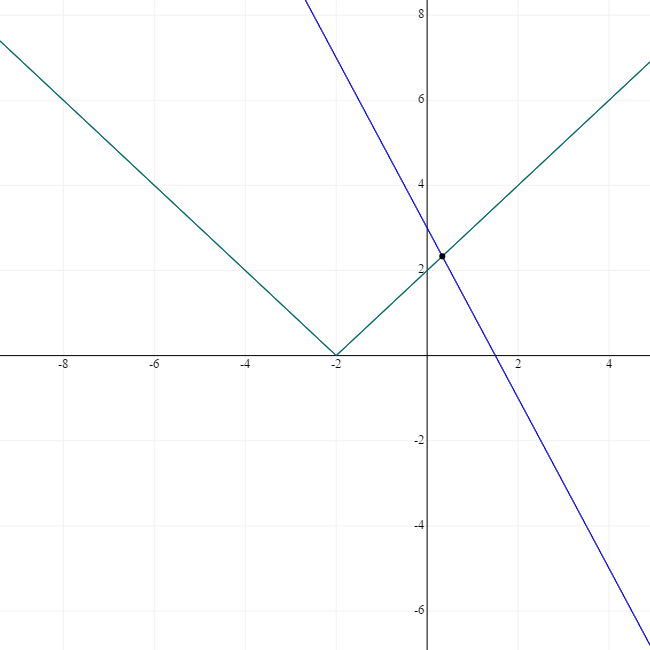
a) only one Mod
eg.. |x+2| + 2x= 3..
critical value at -2 and equation can be written as
|x+2| = 3-2x..
we take y=|x+2| and draw a graph and then take y=3-2x and again draw graph..
the point of intersection is our value..


b) two mods..
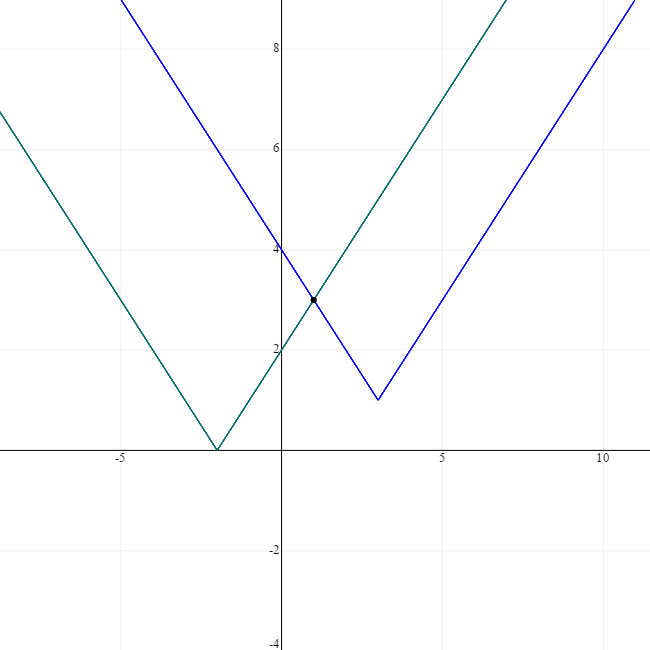
|x+2|=|x-3|+1..
here we will take y=|x+2| and y=|x-3|+1
again the point of intersection of two sides will give us the value of x..

c) three mods.. very rare
|x+3|-|4-x|=|8+x| ..
Here we have three critical values, but the graph will still be only two, one for LHS and one for RHS..
It will not be three for three mod as someone has drawn it in one of the discussions on this Q..
again we see the intersection of two graph..
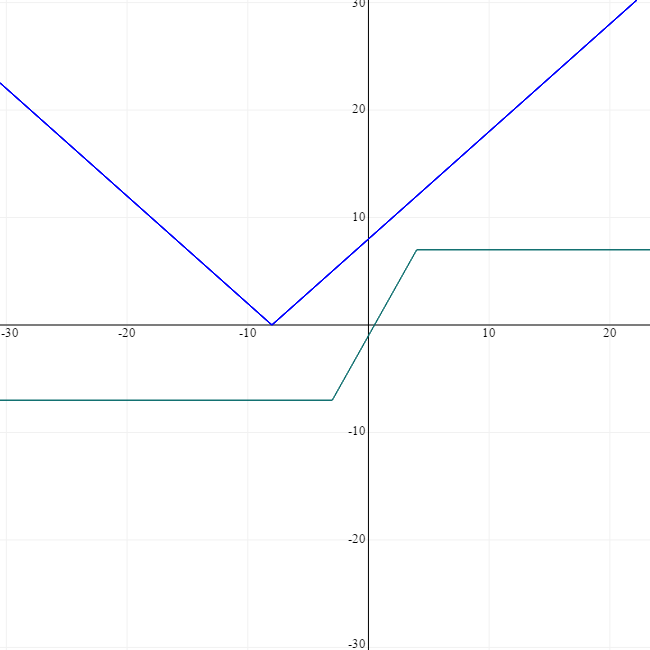

there are no points of intersection , so no solution

THE FINER POINT


1) Opening modulus is time consuming, susceptible to error, and the answer found can still be wrong and has to checked by putting the values in mod again..
should be least priority and should be used by someone has not been able to grasp finer points of other two methods..

2) "Critical method" should be the one used in most circumstances although it requires a good understanding of signs given to the mod when opened within a region.
It has to be the method, when you are looking for values of X..

3) "Graphical method" is useful in finding the number of values of x, as getting accurate values of x may be difficult while estimating from free hand graphs..
but if understood much faster and easier to find sol for Q like How many solutions does the equation |x+3|-|4-x|=|8+x| have?....

Hope it helps atleast a few of you..
User avatar
Raxit85
Joined: 22 Feb 2018
Last visit: 02 Aug 2025
Posts: 761
Own Kudos:
1,202
 [1]
Given Kudos: 135
Posts: 761
Kudos: 1,202
 [1]
Kudos
Add Kudos
1
Bookmarks
Bookmark this Post
Bunuel,

Can you please let me know the similar posts that describes different approaches to each type of questions in quant section, whether created by you or any other expert/GC member? Your help is highly appreciated.

Is there any absolute value official questions (or any other material questions) in the forum which are explained by graphical approach, either by you or by any other expert, that can strengthen the concept.

Regards.


chetan2u
Attachment:
docu1.png
I had a PM and a profile comment asking about the absolute modulus, its concept and in particular a Question discussed on various occassion " How many solutions does the equation |x+3|-|4-x|=|8+x| have?....
Just thought to write down few concepts I have gathered. I have not gone through various Topics on Absolute Modulus in this Forum, so maybe few points are repetition.

Although difficult for a topic like this, I'll try to follow KISS- Keep It Short and Simple. So, let me touch the concepts now..

what is absolute modulus?


Absolute modulus is the numeric value of any number without any sign or in other words ' the distance from the origin'. It will always be positive.

What kind of Qs can one see in GMAT?


The Q will ask either the values of x or how many values can x take?..
most often what one can encounter is a linear Equation with...
a) only one Mod
eg.. |x+2| + 2x= 3..
b) two mods..
|x+2|=|x-3|+1..
c) three mods.. very rare
|x+3|-|4-x|=|8+x| ..

What are the methods

..
three methods..
1) As the property suggests, Open each modulus in both +ive and -ive ....
2) Critical value
3) Graphical method..

Opening each modulus


It is a time consuming process where you open each mod in both positive and negative and the number of Equations thus formed will increase as we increase the no of mods..

a) only one Mod
eg.. |x+2| + 2x= 3..

i) (x+2) + 2x=3.. 3x+2=3 x=1/3.. valid value
ii) -(x+2)+2x=3.. x-2=3..x=5...
but if we substitute x=5 in |x+2| + 2x= 3..... (x+2) will turn out to be a positive value, while we took x=2 to be negative so discard
so one value of x..

b) two mods..
|x+2|=|x-3|+1..
here you will have four equations..
i)(x+2)=(x-3)+1.. both positive

ii)-(x+2)=-(x-3)+1.. both negative

iii)-(x+2)=(x-3)+1..one positive and other negative

iv)(x+2)=-(x-3)+1.. opposite of the one on top


c) three mods.. very rare
|x+3|-|4-x|=|8+x| ..
it will further increase the number of equations..

Suggestion.. time consuming and susceptible to errors in opening of brackets and at times requires more to negate the values found as in first example.

Critical method


lets find what happens in this before trying the Qs as this was the main query..
Step 1 :- for each mod, there is a value of x that will make that mod to 0..
Step 2 :- the minimum value of a mod will be 0 and at this value of x, the mod has the lowest value...
Once we know this critical value, we work on the mod for values lesser than(<) that or more than(>)that and including the critical value in either of them,
we assign a sign, + or -, depending on what will happen to the value inside the mod in each scenario(in one scenario it will be positive and in other, negative)..
Step 3 :- after assigning the sign, we solve for x and see if the value of x that we get is possible depending on which side of critical value we are working on..

So what are we doing here
We are assuming a certain region for value of x and then solving for x.. If the value found matches the initial assumption, we take that as a solution or discard that value, which would mean that there is no value of x in that assumed region

lets see the three examples
a) only one Mod
eg.. |x+2| + 2x= 3..
here x+2 will be 0 at x=-2..
so Critical value =-2..
so two regions are <-2 and >= -2

i)when x<-2, |x+2|will be given negative sign.. for this assign any value in that region say -3 in this case x+2 will become -3+2=-1 hence a negative sign..
-(x+2)+2x=3..
x-2=3.. x=5, which is not in the region <-2.. so not a valid value..

ii)when x>=-2, |x+2|will be given positive sign.. for this assign any value in that region say 3 in this case x+2 will become 3+2= 5 hence a positive sign..
(x+2)+2x=3..
3x+2=3.. x=1/3, which is in the region >=-2.. so a valid value..


b) two mods..
|x+2|=|x-3|+1..
critical values -2 and 3...
so regions are <-2, -2<=x<3, x>=3..

i) x<-2...
x+2 will be -ive and x-3 will be negative ..
eq becomes -(x+2)=-(x-3)+1.. both negative
-x-2=-x+3+1..... no values..

ii) \(-2<=x<3\)..
x+2 will be positive and x-3 will be negative ..
eq becomes (x+2)=-(x-3)+1..
x+2=-x+3+1..
x=1.. valid value

iii)x>=3..
x+2 will be positive and x-3 will be positive ..
eq becomes (x+2)=(x-3)+1..
x+2=x-3+1..
no valid value..
so the solution is x=1

c) three mods.. very rare
|x+3|-|4-x|=|8+x| ..
its time consuming and can be solved similarly..

Graphical method


for graphical method we will have to again use the critical point..
at critical point, it is the lowest value of mod and on either side it increases with a negative slope on one side and positive slope on other side
so it forms a 'V' shape in linear equation and a 'U ' curve for Quadratic Equation..
If the mod has a negative sign in front, -|x+3|, it will have an "inverted V" shape with max value at critical value..

lets see the three examples..

a) only one Mod
eg.. |x+2| + 2x= 3..
critical value at -2 and equation can be written as
|x+2| = 3-2x..
we take y=|x+2| and draw a graph and then take y=3-2x and again draw graph..
the point of intersection is our value..


b) two mods..
|x+2|=|x-3|+1..
here we will take y=|x+2| and y=|x-3|+1
again the point of intersection of two sides will give us the value of x..


c) three mods.. very rare
|x+3|-|4-x|=|8+x| ..
Here we have three critical values, but the graph will still be only two, one for LHS and one for RHS..
It will not be three for three mod as someone has drawn it in one of the discussions on this Q..
again we see the intersection of two graph..


there are no points of intersection , so no solution

THE FINER POINT


1) Opening modulus is time consuming, susceptible to error, and the answer found can still be wrong and has to checked by putting the values in mod again..
should be least priority and should be used by someone has not been able to grasp finer points of other two methods..

2) "Critical method" should be the one used in most circumstances although it requires a good understanding of signs given to the mod when opened within a region.
It has to be the method, when you are looking for values of X..

3) "Graphical method" is useful in finding the number of values of x, as getting accurate values of x may be difficult while estimating from free hand graphs..
but if understood much faster and easier to find sol for Q like How many solutions does the equation |x+3|-|4-x|=|8+x| have?....

Hope it helps atleast a few of you..
[/quote]
User avatar
Bunuel
User avatar
Math Expert
Joined: 02 Sep 2009
Last visit: 23 Apr 2026
Posts: 109,782
Own Kudos:
810,824
 [1]
Given Kudos: 105,853
Products:
Expert
Expert reply
Active GMAT Club Expert! Tag them with @ followed by their username for a faster response.
Posts: 109,782
Kudos: 810,824
 [1]
Kudos
Add Kudos
1
Bookmarks
Bookmark this Post
Raxit85
Bunuel,

Can you please let me know the similar posts that describes different approaches to each type of questions in quant section, whether created by you or any other expert/GC member? Your help is highly appreciated.

Is there any absolute value official questions (or any other material questions) in the forum which are explained by graphical approach, either by you or by any other expert, that can strengthen the concept.

Regards.


chetan2u
Attachment:
docu1.png
I had a PM and a profile comment asking about the absolute modulus, its concept and in particular a Question discussed on various occassion " How many solutions does the equation |x+3|-|4-x|=|8+x| have?....
Just thought to write down few concepts I have gathered. I have not gone through various Topics on Absolute Modulus in this Forum, so maybe few points are repetition.

Although difficult for a topic like this, I'll try to follow KISS- Keep It Short and Simple. So, let me touch the concepts now..

what is absolute modulus?


Absolute modulus is the numeric value of any number without any sign or in other words ' the distance from the origin'. It will always be positive.

What kind of Qs can one see in GMAT?


The Q will ask either the values of x or how many values can x take?..
most often what one can encounter is a linear Equation with...
a) only one Mod
eg.. |x+2| + 2x= 3..
b) two mods..
|x+2|=|x-3|+1..
c) three mods.. very rare
|x+3|-|4-x|=|8+x| ..

What are the methods

..
three methods..
1) As the property suggests, Open each modulus in both +ive and -ive ....
2) Critical value
3) Graphical method..

Opening each modulus


It is a time consuming process where you open each mod in both positive and negative and the number of Equations thus formed will increase as we increase the no of mods..

a) only one Mod
eg.. |x+2| + 2x= 3..

i) (x+2) + 2x=3.. 3x+2=3 x=1/3.. valid value
ii) -(x+2)+2x=3.. x-2=3..x=5...
but if we substitute x=5 in |x+2| + 2x= 3..... (x+2) will turn out to be a positive value, while we took x=2 to be negative so discard
so one value of x..

b) two mods..
|x+2|=|x-3|+1..
here you will have four equations..
i)(x+2)=(x-3)+1.. both positive

ii)-(x+2)=-(x-3)+1.. both negative

iii)-(x+2)=(x-3)+1..one positive and other negative

iv)(x+2)=-(x-3)+1.. opposite of the one on top


c) three mods.. very rare
|x+3|-|4-x|=|8+x| ..
it will further increase the number of equations..

Suggestion.. time consuming and susceptible to errors in opening of brackets and at times requires more to negate the values found as in first example.

Critical method


lets find what happens in this before trying the Qs as this was the main query..
Step 1 :- for each mod, there is a value of x that will make that mod to 0..
Step 2 :- the minimum value of a mod will be 0 and at this value of x, the mod has the lowest value...
Once we know this critical value, we work on the mod for values lesser than(<) that or more than(>)that and including the critical value in either of them,
we assign a sign, + or -, depending on what will happen to the value inside the mod in each scenario(in one scenario it will be positive and in other, negative)..
Step 3 :- after assigning the sign, we solve for x and see if the value of x that we get is possible depending on which side of critical value we are working on..

So what are we doing here
We are assuming a certain region for value of x and then solving for x.. If the value found matches the initial assumption, we take that as a solution or discard that value, which would mean that there is no value of x in that assumed region

lets see the three examples
a) only one Mod
eg.. |x+2| + 2x= 3..
here x+2 will be 0 at x=-2..
so Critical value =-2..
so two regions are <-2 and >= -2

i)when x<-2, |x+2|will be given negative sign.. for this assign any value in that region say -3 in this case x+2 will become -3+2=-1 hence a negative sign..
-(x+2)+2x=3..
x-2=3.. x=5, which is not in the region <-2.. so not a valid value..

ii)when x>=-2, |x+2|will be given positive sign.. for this assign any value in that region say 3 in this case x+2 will become 3+2= 5 hence a positive sign..
(x+2)+2x=3..
3x+2=3.. x=1/3, which is in the region >=-2.. so a valid value..


b) two mods..
|x+2|=|x-3|+1..
critical values -2 and 3...
so regions are <-2, -2<=x<3, x>=3..

i) x<-2...
x+2 will be -ive and x-3 will be negative ..
eq becomes -(x+2)=-(x-3)+1.. both negative
-x-2=-x+3+1..... no values..

ii) \(-2<=x<3\)..
x+2 will be positive and x-3 will be negative ..
eq becomes (x+2)=-(x-3)+1..
x+2=-x+3+1..
x=1.. valid value

iii)x>=3..
x+2 will be positive and x-3 will be positive ..
eq becomes (x+2)=(x-3)+1..
x+2=x-3+1..
no valid value..
so the solution is x=1

c) three mods.. very rare
|x+3|-|4-x|=|8+x| ..
its time consuming and can be solved similarly..

Graphical method


for graphical method we will have to again use the critical point..
at critical point, it is the lowest value of mod and on either side it increases with a negative slope on one side and positive slope on other side
so it forms a 'V' shape in linear equation and a 'U ' curve for Quadratic Equation..
If the mod has a negative sign in front, -|x+3|, it will have an "inverted V" shape with max value at critical value..

lets see the three examples..

a) only one Mod
eg.. |x+2| + 2x= 3..
critical value at -2 and equation can be written as
|x+2| = 3-2x..
we take y=|x+2| and draw a graph and then take y=3-2x and again draw graph..
the point of intersection is our value..


b) two mods..
|x+2|=|x-3|+1..
here we will take y=|x+2| and y=|x-3|+1
again the point of intersection of two sides will give us the value of x..


c) three mods.. very rare
|x+3|-|4-x|=|8+x| ..
Here we have three critical values, but the graph will still be only two, one for LHS and one for RHS..
It will not be three for three mod as someone has drawn it in one of the discussions on this Q..
again we see the intersection of two graph..


there are no points of intersection , so no solution

THE FINER POINT


1) Opening modulus is time consuming, susceptible to error, and the answer found can still be wrong and has to checked by putting the values in mod again..
should be least priority and should be used by someone has not been able to grasp finer points of other two methods..

2) "Critical method" should be the one used in most circumstances although it requires a good understanding of signs given to the mod when opened within a region.
It has to be the method, when you are looking for values of X..

3) "Graphical method" is useful in finding the number of values of x, as getting accurate values of x may be difficult while estimating from free hand graphs..
but if understood much faster and easier to find sol for Q like How many solutions does the equation |x+3|-|4-x|=|8+x| have?....

Hope it helps atleast a few of you..
[/quote]

Check below for more:
ALL YOU NEED FOR QUANT ! ! !
Ultimate GMAT Quantitative Megathread

Hope it helps.
User avatar
Akshayiray
Joined: 07 Jun 2017
Last visit: 02 Mar 2024
Posts: 6
Own Kudos:
Given Kudos: 45
Posts: 6
Kudos: 7
Kudos
Add Kudos
Bookmarks
Bookmark this Post
Wow! This thread is really helpful. I am able to understand the Mod concept better
Thanks to chetan2u
avatar
bones2020
Joined: 23 Sep 2019
Last visit: 29 Jul 2020
Posts: 6
Given Kudos: 41
Posts: 6
Kudos: 0
Kudos
Add Kudos
Bookmarks
Bookmark this Post
how come we place a negative sign in front of the modulus when we are looking at values less than the critical values?
User avatar
chetan2u
User avatar
GMAT Expert
Joined: 02 Aug 2009
Last visit: 22 Apr 2026
Posts: 11,229
Own Kudos:
Given Kudos: 335
Status:Math and DI Expert
Location: India
Concentration: Human Resources, General Management
GMAT Focus 1: 735 Q90 V89 DI81
Products:
Expert
Expert reply
GMAT Focus 1: 735 Q90 V89 DI81
Posts: 11,229
Kudos: 45,002
Kudos
Add Kudos
Bookmarks
Bookmark this Post
bones2020
how come we place a negative sign in front of the modulus when we are looking at values less than the critical values?

We place the negative sign whenever the value in modulus Becomes negative if some value in that range is substituted for the variable.

For example |x-3|, when you are looking at x<3, (x-3) will be negative. So when you open this mod, it becomes -(x-3) or 3-x
User avatar
Nups1324
Joined: 05 Jan 2020
Last visit: 12 Sep 2023
Posts: 104
Own Kudos:
Given Kudos: 353
Posts: 104
Kudos: 65
Kudos
Add Kudos
Bookmarks
Bookmark this Post
chetan2u
Attachment:
docu1.png
I had a PM and a profile comment asking about the absolute modulus, its concept and in particular a Question discussed on various occassion " How many solutions does the equation |x+3|-|4-x|=|8+x| have?....
Just thought to write down few concepts I have gathered. I have not gone through various Topics on Absolute Modulus in this Forum, so maybe few points are repetition.

Although difficult for a topic like this, I'll try to follow KISS- Keep It Short and Simple. So, let me touch the concepts now..

what is absolute modulus?


Absolute modulus is the numeric value of any number without any sign or in other words ' the distance from the origin'. It will always be positive.

What kind of Qs can one see in GMAT?


The Q will ask either the values of x or how many values can x take?..
most often what one can encounter is a linear Equation with...
a) only one Mod
eg.. |x+2| + 2x= 3..
b) two mods..
|x+2|=|x-3|+1..
c) three mods.. very rare
|x+3|-|4-x|=|8+x| ..

What are the methods

..
three methods..
1) As the property suggests, Open each modulus in both +ive and -ive ....
2) Critical value
3) Graphical method..

Opening each modulus


It is a time consuming process where you open each mod in both positive and negative and the number of Equations thus formed will increase as we increase the no of mods..

a) only one Mod
eg.. |x+2| + 2x= 3..

i) (x+2) + 2x=3.. 3x+2=3 x=1/3.. valid value
ii) -(x+2)+2x=3.. x-2=3..x=5...
but if we substitute x=5 in |x+2| + 2x= 3..... (x+2) will turn out to be a positive value, while we took x=2 to be negative so discard
so one value of x..

b) two mods..
|x+2|=|x-3|+1..
here you will have four equations..
i)(x+2)=(x-3)+1.. both positive

ii)-(x+2)=-(x-3)+1.. both negative

iii)-(x+2)=(x-3)+1..one positive and other negative

iv)(x+2)=-(x-3)+1.. opposite of the one on top


c) three mods.. very rare
|x+3|-|4-x|=|8+x| ..
it will further increase the number of equations..

Suggestion.. time consuming and susceptible to errors in opening of brackets and at times requires more to negate the values found as in first example.

Critical method


lets find what happens in this before trying the Qs as this was the main query..
Step 1 :- for each mod, there is a value of x that will make that mod to 0..
Step 2 :- the minimum value of a mod will be 0 and at this value of x, the mod has the lowest value...
Once we know this critical value, we work on the mod for values lesser than(<) that or more than(>)that and including the critical value in either of them,
we assign a sign, + or -, depending on what will happen to the value inside the mod in each scenario(in one scenario it will be positive and in other, negative)..
Step 3 :- after assigning the sign, we solve for x and see if the value of x that we get is possible depending on which side of critical value we are working on..

So what are we doing here
We are assuming a certain region for value of x and then solving for x.. If the value found matches the initial assumption, we take that as a solution or discard that value, which would mean that there is no value of x in that assumed region

lets see the three examples
a) only one Mod
eg.. |x+2| + 2x= 3..
here x+2 will be 0 at x=-2..
so Critical value =-2..
so two regions are <-2 and >= -2

i)when x<-2, |x+2|will be given negative sign.. for this assign any value in that region say -3 in this case x+2 will become -3+2=-1 hence a negative sign..
-(x+2)+2x=3..
x-2=3.. x=5, which is not in the region <-2.. so not a valid value..

ii)when x>=-2, |x+2|will be given positive sign.. for this assign any value in that region say 3 in this case x+2 will become 3+2= 5 hence a positive sign..
(x+2)+2x=3..
3x+2=3.. x=1/3, which is in the region >=-2.. so a valid value..


b) two mods..
|x+2|=|x-3|+1..
critical values -2 and 3...
so regions are <-2, -2<=x<3, x>=3..

i) x<-2...
x+2 will be -ive and x-3 will be negative ..
eq becomes -(x+2)=-(x-3)+1.. both negative
-x-2=-x+3+1..... no values..

ii) \(-2<=x<3\)..
x+2 will be positive and x-3 will be negative ..
eq becomes (x+2)=-(x-3)+1..
x+2=-x+3+1..
x=1.. valid value

iii)x>=3..
x+2 will be positive and x-3 will be positive ..
eq becomes (x+2)=(x-3)+1..
x+2=x-3+1..
no valid value..
so the solution is x=1

c) three mods.. very rare
|x+3|-|4-x|=|8+x| ..
its time consuming and can be solved similarly..

Graphical method


for graphical method we will have to again use the critical point..
at critical point, it is the lowest value of mod and on either side it increases with a negative slope on one side and positive slope on other side
so it forms a 'V' shape in linear equation and a 'U ' curve for Quadratic Equation..
If the mod has a negative sign in front, -|x+3|, it will have an "inverted V" shape with max value at critical value..

lets see the three examples..

a) only one Mod
eg.. |x+2| + 2x= 3..
critical value at -2 and equation can be written as
|x+2| = 3-2x..
we take y=|x+2| and draw a graph and then take y=3-2x and again draw graph..
the point of intersection is our value..


b) two mods..
|x+2|=|x-3|+1..
here we will take y=|x+2| and y=|x-3|+1
again the point of intersection of two sides will give us the value of x..


c) three mods.. very rare
|x+3|-|4-x|=|8+x| ..
Here we have three critical values, but the graph will still be only two, one for LHS and one for RHS..
It will not be three for three mod as someone has drawn it in one of the discussions on this Q..
again we see the intersection of two graph..


there are no points of intersection , so no solution

THE FINER POINT


1) Opening modulus is time consuming, susceptible to error, and the answer found can still be wrong and has to checked by putting the values in mod again..
should be least priority and should be used by someone has not been able to grasp finer points of other two methods..

2) "Critical method" should be the one used in most circumstances although it requires a good understanding of signs given to the mod when opened within a region.
It has to be the method, when you are looking for values of X..

3) "Graphical method" is useful in finding the number of values of x, as getting accurate values of x may be difficult while estimating from free hand graphs..
but if understood much faster and easier to find sol for Q like How many solutions does the equation |x+3|-|4-x|=|8+x| have?....

Hope it helps atleast a few of you..


Hi chetan2u,

I went through your post. It's beautiful.

I understood the critical method but I'm having trouble understanding the graphical method. To be precise, how the lines are drawn?. I'm having an intuition that y=mx+b form is used, but I'm not sure.

I read it later in your post that the graphical method is only for number of solutions and not the accurate value. But I still want to learn it, if it's absolutely essential for a top score.

Then I read the post by gmatexam439. I was amazed by how simple this topic is if you really understand it. Your post is beautiful as well gmatexam439. (I wish I had done engineering, but nevermind :P )

So I just wanted to understand whether one can find both, the accurate value as well as number of values, by the method provided by gmatexam439.?


Tagging others just in case chetan2u is busy or offline
Bunuel, yashikaaggarwal, gmatexam439, GMATinsight


Thank you :)

Posted from my mobile device
avatar
Sadoce18
Joined: 01 Nov 2019
Last visit: 30 Oct 2021
Posts: 2
Own Kudos:
Given Kudos: 6
Posts: 2
Kudos: 1
Kudos
Add Kudos
Bookmarks
Bookmark this Post
gmatexam439
Thank you Chetan for this. I would like to share an alternate method for solving absolute equations which can be used for as many variables: [I used this while persuing my engg.]

While solving the below equation:
|x+3|-|4-x|=|8+x|

=> |x+3|-|4-x|-|8+x|=0
Therefore the critical points will be x=-8,-3 and 4

Case 1. Now when x<-8 on the number line
|x+3| will open with a -ve sign, |4-x| will open with a +ve sign and |8+x| will open with a -ve sign
Therefore, equation will be
=> -x-3-4+x+8+x=0
=> x=-1; Now if we notice this value of x doesn't match with the case value i.e. x<-8 therefore this is not a correct answer.

Case 2. Now when -8<x<-3 on the number line
|x+3| will open with a +ve sign, |4-x| will open with a +ve sign and |8+x| will open with a +ve sign
Therefore, equation will be
=> x+3-4+x-8-x=0
=> x=9; Now if we notice this value of x doesn't match with the case value i.e. -8<x<-3 therefore this is not a correct answer.

Case 3. Now when -3<x<4 on the number line
|x+3| will open with a +ve sign, |4-x| will open with a +ve sign and |8+x| will open with a +ve sign
Therefore, equation will be
=> x+3-4+x-8-x=0
=> x=9; Now if we notice this value of x doesn't match with the case value i.e. -3<x<4 therefore this is not a correct answer.

Case 4. Now when x>4 on the number line
|x+3| will open with a +ve sign, |4-x| will open with a -ve sign and |8+x| will open with a +ve sign
Therefore, equation will be
=> x+3+4-x-8-x=0
=> x=-1; Now if we notice this value of x doesn't match with the case value i.e. x>4 therefore this is not a correct answer.

Therefore there is no solution to this equation.


thank you!!! exactly what i was looking for! :)
User avatar
bansalgaurav
Joined: 26 Mar 2021
Last visit: 20 Nov 2021
Posts: 112
Own Kudos:
Given Kudos: 36
Location: India
Concentration: General Management, Strategy
Schools: IIMB EPGP'23
GMAT 1: 640 Q50 V25
Schools: IIMB EPGP'23
GMAT 1: 640 Q50 V25
Posts: 112
Kudos: 32
Kudos
Add Kudos
Bookmarks
Bookmark this Post
one of the shortcuts to nail inequality cases like :: |x| (inequality sign) |y| is
::: square both the sides keeping the inequality the same;

Example: if given is |aX+b| > |bX+c|
then (ax+b)^2 > (bx+c)^2 (because |x| >=0 and |x|^2 = x^2)
Now with the derived solution check for the available options.
avatar
amoghhlgr
Joined: 16 Jun 2019
Last visit: 19 Jul 2023
Posts: 27
Own Kudos:
Given Kudos: 135
Location: India
Schools: Said'16
GMAT 1: 690 Q44 V40
GPA: 3.5
Schools: Said'16
GMAT 1: 690 Q44 V40
Posts: 27
Kudos: 9
Kudos
Add Kudos
Bookmarks
Bookmark this Post
chetan2u Thank you for the wonderful explanation. But it didn't cover questions types where we have to answer whether \(|A-B| > |A| - |B| \) or \(|A+B| < |A-B|\) etc. Can these type of questions be solved by the 'open the modulus' method?

Thank you!
avatar
archana21
Joined: 12 Apr 2021
Last visit: 20 Mar 2022
Posts: 30
Own Kudos:
Given Kudos: 15
Location: India
Posts: 30
Kudos: 36
Kudos
Add Kudos
Bookmarks
Bookmark this Post
Thank you for the explanation! I am stuck with two places. Could you please help and clarify, chetan2u, Bunuel?

chetan2u

b) two mods..
|x+2|=|x-3|+1..
critical values -2 and 3...
so regions are <-2, -2<=x<3, x>=3..

i) x<-2...
x+2 will be -ive and x-3 will be negative ..
eq becomes -(x+2)=-(x-3)+1.. both negative
-x-2=-x+3+1..... no values..

ii) \(-2<=x<3\)..
x+2 will be positive and x-3 will be negative ..
eq becomes (x+2)=-(x-3)+1..
x+2=-x+3+1..
x=1.. valid value

iii)x>=3..
x+2 will be positive and x-3 will be positive ..
eq becomes (x+2)=(x-3)+1..
x+2=x-3+1..
no valid value..
so the solution is x=1


Query 1: In the case x<-2, how is "x-3 will be negative" determined?
Similarly in the case x>=3, how is "x+2 will be positive" determined?

Query 2: I understand how a value from -2<=x<3 solves for x. Which means, x can take more than one value between -2 and 3. But the conclusion (highlighted above) says "so the solution is x=1". Could you please explain this?

Thank you in advance!
User avatar
Tejasvigmat123
Joined: 14 May 2017
Last visit: 25 Jul 2023
Posts: 4
Own Kudos:
Given Kudos: 8
Location: India
Posts: 4
Kudos: 1
Kudos
Add Kudos
Bookmarks
Bookmark this Post
ii) −2<=x<3−2<=x<3..
x+2 will be positive and x-3 will be negative ..
eq becomes (x+2)=-(x-3)+1..
x+2=-x+3+1..
x=1.. valid value
Hey, chetan2u, Can you please tell me, why (x+2) becomes positive and not Negative, and (x-3) becomes negative and not positive. Is there a specific reason why you did that. Can I reverse the order ?? If not, why ?
User avatar
Francescoc97
Joined: 20 Aug 2022
Last visit: 31 Oct 2024
Posts: 1
Given Kudos: 41
Location: Austria
Posts: 1
Kudos: 0
Kudos
Add Kudos
Bookmarks
Bookmark this Post
gmatexam439
Thank you Chetan for this. I would like to share an alternate method for solving absolute equations which can be used for as many variables: [I used this while persuing my engg.]

While solving the below equation:
|x+3|-|4-x|=|8+x|

=> |x+3|-|4-x|-|8+x|=0
Therefore the critical points will be x=-8,-3 and 4

Case 1. Now when x<-8 on the number line
|x+3| will open with a -ve sign, |4-x| will open with a +ve sign and |8+x| will open with a -ve sign
Therefore, equation will be
=> -x-3-4+x+8+x=0
=> x=-1; Now if we notice this value of x doesn't match with the case value i.e. x<-8 therefore this is not a correct answer.

Case 2. Now when -8<x<-3 on the number line
|x+3| will open with a +ve sign, |4-x| will open with a +ve sign and |8+x| will open with a +ve sign
Therefore, equation will be
=> x+3-4+x-8-x=0
=> x=9; Now if we notice this value of x doesn't match with the case value i.e. -8<x<-3 therefore this is not a correct answer.

Case 3. Now when -3<x<4 on the number line
|x+3| will open with a +ve sign, |4-x| will open with a +ve sign and |8+x| will open with a +ve sign
Therefore, equation will be
=> x+3-4+x-8-x=0
=> x=9; Now if we notice this value of x doesn't match with the case value i.e. -3<x<4 therefore this is not a correct answer.

Case 4. Now when x>4 on the number line
|x+3| will open with a +ve sign, |4-x| will open with a -ve sign and |8+x| will open with a +ve sign
Therefore, equation will be
=> x+3+4-x-8-x=0
=> x=-1; Now if we notice this value of x doesn't match with the case value i.e. x>4 therefore this is not a correct answer.

Therefore there is no solution to this equation.


I think there might be a mistake.
In case 2: when -8<x<-3 on the number line
you open all the modulus with the +ve sign exactly like in case 3. But in case 2 |x+3| should open with the - ve sign, |4-x| will open with a +ve sign and |8+x| will open with a +ve sign
Therefore, equation will be
=> -x-3-4+x-8-x=0
=> x=-15. the solution is still not valid.
User avatar
kop18
Joined: 30 Sep 2020
Last visit: 09 Jan 2025
Posts: 87
Own Kudos:
Given Kudos: 98
GMAT 1: 610 Q40 V35
GMAT 1: 610 Q40 V35
Posts: 87
Kudos: 22
Kudos
Add Kudos
Bookmarks
Bookmark this Post
chetan2u
Attachment:
docu1.png
I had a PM and a profile comment asking about the absolute modulus, its concept and in particular a Question discussed on various occassion " How many solutions does the equation |x+3|-|4-x|=|8+x| have?....
Just thought to write down few concepts I have gathered. I have not gone through various Topics on Absolute Modulus in this Forum, so maybe few points are repetition.

Although difficult for a topic like this, I'll try to follow KISS- Keep It Short and Simple. So, let me touch the concepts now..

what is absolute modulus?


Absolute modulus is the numeric value of any number without any sign or in other words ' the distance from the origin'. It will always be positive.

What kind of Qs can one see in GMAT?


The Q will ask either the values of x or how many values can x take?..
most often what one can encounter is a linear Equation with...
a) only one Mod
eg.. |x+2| + 2x= 3..
b) two mods..
|x+2|=|x-3|+1..
c) three mods.. very rare
|x+3|-|4-x|=|8+x| ..

What are the methods

..
three methods..
1) As the property suggests, Open each modulus in both +ive and -ive ....
2) Critical value
3) Graphical method..

Opening each modulus


It is a time consuming process where you open each mod in both positive and negative and the number of Equations thus formed will increase as we increase the no of mods..

a) only one Mod
eg.. |x+2| + 2x= 3..

i) (x+2) + 2x=3.. 3x+2=3 x=1/3.. valid value
ii) -(x+2)+2x=3.. x-2=3..x=5...
but if we substitute x=5 in |x+2| + 2x= 3..... (x+2) will turn out to be a positive value, while we took x=2 to be negative so discard
so one value of x..

b) two mods..
|x+2|=|x-3|+1..
here you will have four equations..
i)(x+2)=(x-3)+1.. both positive

ii)-(x+2)=-(x-3)+1.. both negative

iii)-(x+2)=(x-3)+1..one positive and other negative

iv)(x+2)=-(x-3)+1.. opposite of the one on top


c) three mods.. very rare
|x+3|-|4-x|=|8+x| ..
it will further increase the number of equations..

Suggestion.. time consuming and susceptible to errors in opening of brackets and at times requires more to negate the values found as in first example.

Critical method


lets find what happens in this before trying the Qs as this was the main query..
Step 1 :- for each mod, there is a value of x that will make that mod to 0..
Step 2 :- the minimum value of a mod will be 0 and at this value of x, the mod has the lowest value...
Once we know this critical value, we work on the mod for values lesser than(<) that or more than(>)that and including the critical value in either of them,
we assign a sign, + or -, depending on what will happen to the value inside the mod in each scenario(in one scenario it will be positive and in other, negative)..
Step 3 :- after assigning the sign, we solve for x and see if the value of x that we get is possible depending on which side of critical value we are working on..

So what are we doing here
We are assuming a certain region for value of x and then solving for x.. If the value found matches the initial assumption, we take that as a solution or discard that value, which would mean that there is no value of x in that assumed region

lets see the three examples
a) only one Mod
eg.. |x+2| + 2x= 3..
here x+2 will be 0 at x=-2..
so Critical value =-2..
so two regions are <-2 and >= -2

i)when x<-2, |x+2|will be given negative sign.. for this assign any value in that region say -3 in this case x+2 will become -3+2=-1 hence a negative sign..
-(x+2)+2x=3..
x-2=3.. x=5, which is not in the region <-2.. so not a valid value..

ii)when x>=-2, |x+2|will be given positive sign.. for this assign any value in that region say 3 in this case x+2 will become 3+2= 5 hence a positive sign..
(x+2)+2x=3..
3x+2=3.. x=1/3, which is in the region >=-2.. so a valid value..


b) two mods..
|x+2|=|x-3|+1..
critical values -2 and 3...
so regions are <-2, -2<=x<3, x>=3..

i) x<-2...
x+2 will be -ive and x-3 will be negative ..
eq becomes -(x+2)=-(x-3)+1.. both negative
-x-2=-x+3+1..... no values..

ii) \(-2<=x<3\)..
x+2 will be positive and x-3 will be negative ..
eq becomes (x+2)=-(x-3)+1..
x+2=-x+3+1..
x=1.. valid value

iii)x>=3..
x+2 will be positive and x-3 will be positive ..
eq becomes (x+2)=(x-3)+1..
x+2=x-3+1..
no valid value..
so the solution is x=1

c) three mods.. very rare
|x+3|-|4-x|=|8+x| ..
its time consuming and can be solved similarly..

Graphical method


for graphical method we will have to again use the critical point..
at critical point, it is the lowest value of mod and on either side it increases with a negative slope on one side and positive slope on other side
so it forms a 'V' shape in linear equation and a 'U ' curve for Quadratic Equation..
If the mod has a negative sign in front, -|x+3|, it will have an "inverted V" shape with max value at critical value..

lets see the three examples..

a) only one Mod
eg.. |x+2| + 2x= 3..
critical value at -2 and equation can be written as
|x+2| = 3-2x..
we take y=|x+2| and draw a graph and then take y=3-2x and again draw graph..
the point of intersection is our value..


b) two mods..
|x+2|=|x-3|+1..
here we will take y=|x+2| and y=|x-3|+1
again the point of intersection of two sides will give us the value of x..


c) three mods.. very rare
|x+3|-|4-x|=|8+x| ..
Here we have three critical values, but the graph will still be only two, one for LHS and one for RHS..
It will not be three for three mod as someone has drawn it in one of the discussions on this Q..
again we see the intersection of two graph..


there are no points of intersection , so no solution

THE FINER POINT


1) Opening modulus is time consuming, susceptible to error, and the answer found can still be wrong and has to checked by putting the values in mod again..
should be least priority and should be used by someone has not been able to grasp finer points of other two methods..

2) "Critical method" should be the one used in most circumstances although it requires a good understanding of signs given to the mod when opened within a region.
It has to be the method, when you are looking for values of X..

3) "Graphical method" is useful in finding the number of values of x, as getting accurate values of x may be difficult while estimating from free hand graphs..
but if understood much faster and easier to find sol for Q like How many solutions does the equation |x+3|-|4-x|=|8+x| have?....

Hope it helps atleast a few of you..

Hi chetan2u,
Thank you for this explanation. I have a quick question with respect to "critical method". If I have an inequality like this |x-6| > |3x+6|. Then in this case will the 2 critical points for the absolutes be +6 and -6 or do we need to pull 3 common from the second absolute and the 2nd point becomes -2?
My idea to pose this question is to check whether the critical point method only work when x is free of any constant or does it work even with coefficients?
User avatar
chetan2u
User avatar
GMAT Expert
Joined: 02 Aug 2009
Last visit: 22 Apr 2026
Posts: 11,229
Own Kudos:
45,002
 [1]
Given Kudos: 335
Status:Math and DI Expert
Location: India
Concentration: Human Resources, General Management
GMAT Focus 1: 735 Q90 V89 DI81
Products:
Expert
Expert reply
GMAT Focus 1: 735 Q90 V89 DI81
Posts: 11,229
Kudos: 45,002
 [1]
1
Kudos
Add Kudos
Bookmarks
Bookmark this Post
kop18


Hi chetan2u,
Thank you for this explanation. I have a quick question with respect to "critical method". If I have an inequality like this |x-6| > |3x+6|. Then in this case will the 2 critical points for the absolutes be +6 and -6 or do we need to pull 3 common from the second absolute and the 2nd point becomes -2?
My idea to pose this question is to check whether the critical point method only work when x is free of any constant or does it work even with coefficients?


Hi
The meaning of Critical point would answer your query.
Critical point is where the modulus becomes 0, thereby giving us the point above which the modulus is positive and below which is negative.

So, what ever be the coefficient of x, the modulus should become 0.
|3x-6| will become 0 at x=2
Another example:- |2x-3| => Put the inside of modulus as 0 to get x, 2x-3=0 or x=3/2.
User avatar
liviofrol
Joined: 30 Jan 2019
Last visit: 21 Aug 2024
Posts: 6
Own Kudos:
Given Kudos: 29
Posts: 6
Kudos: 195
Kudos
Add Kudos
Bookmarks
Bookmark this Post
chetan2u

In my last GMAT Focus exam i saw a question with a mudulos inside a modulus with variable x inside that modulus... may you share some insights how to work with that?

something like: \(||x-3|+5| > 2\)
User avatar
chetan2u
User avatar
GMAT Expert
Joined: 02 Aug 2009
Last visit: 22 Apr 2026
Posts: 11,229
Own Kudos:
Given Kudos: 335
Status:Math and DI Expert
Location: India
Concentration: Human Resources, General Management
GMAT Focus 1: 735 Q90 V89 DI81
Products:
Expert
Expert reply
GMAT Focus 1: 735 Q90 V89 DI81
Posts: 11,229
Kudos: 45,002
Kudos
Add Kudos
Bookmarks
Bookmark this Post
liviofrol
chetan2u

In my last GMAT Focus exam i saw a question with a mudulos inside a modulus with variable x inside that modulus... may you share some insights how to work with that?

something like: \(||x-3|+5| > 2\)


Hi
\(||x-3|+5| > 2\)
\(|x-3|+5\geq 5\), so whatever be the value of x, the term will be true.
You can solve it differently by opening the modulus. But you will have to be more specific in case it was not exactly like this.
   1   2   3   4   
Moderators:
Math Expert
109782 posts
Tuck School Moderator
853 posts