Events & Promotions
| Last visit was: 26 Sep 2026, 22:37 |
It is currently 26 Sep 2026, 22:37 |
|
|

GMAT Club Daily Prep
Thank you for using the timer - this advanced tool can estimate your performance and suggest more practice questions. We have subscribed you to Daily Prep Questions via email.
Customized
for You
Track
Your Progress
Practice
Pays
Not interested in getting valuable practice questions and articles delivered to your email? No problem, unsubscribe here.
 Sep 28
07:00 PM EDT
-10:00 PM EDT
Boost your GMAT score in less than one month in a live online class + 6 months access to TTP OnDemand video courses included! Class starts Mon, Tues, Wed, Thur, Fri Sept. 28, 2026 - Oct. 16, 2027, 7:00pm-10:00pm EST Sep 29
11:00 AM EDT
-01:00 PM EDT
" Description: Top scores are possible when you enroll in a powerful GMAT course, taught live online + 6 months access to TTP OnDemand video courses included! Class starts Tues/Thur Sept. 29, 2026 - Dec. 3, 2026, 11:00am-1:00pm EST Oct 01
07:00 AM BST
-08:00 AM GMT
Welcome to the GMAT Club's Free Interview Prep Event for Top MBA Programs! Buy tickets - Virtual series that’s all set to equip you to -excel in your MBA interviews. Oct 03
01:00 PM EDT
-04:00 PM EDT
Top scores are possible when you enroll in a powerful GMAT course, taught live online + 6 months access to TTP OnDemand video courses included! Class starts Saturdays Oct. 3, 2026 - Dec. 26, 2026, 1:00pm-4:00pm EST



E
Be sure to select an answer first to save it in the Error Log before revealing the correct answer (OA)!
Difficulty:
 95%
(hard)
95%
(hard)
Question Stats:
49% (02:14) correct 51%
(02:27)
wrong
based on 897
sessions
51%
(02:27)
wrong
based on 897
sessions
History
Date
Time
Result
Not Attempted Yet
As a large corporation in a small country, Hachnut wants its managers to have international experience, so each year it sponsors management education abroad for its management trainees. Hachnut has found, however, that the attrition rate from this program is becoming increasingly high, with many especially promising participants leaving Hachnut to join competing firms even before completing the program. Hachnut does use performance during the program as a criterion in deciding among candidates for management positions, but it finds itself more and more in the position of selecting from a critically depleted pool of candidates. The program is thus beginning to work against Hachnut's interest. Therefore, if the attrition problem cannot be successfully addressed, Hachnut should discontinue the sponsorship program.
In the argument given, the two boldfaced portions play which of the following roles?
A. The first describes a practice that the argument seeks to justify; the second states the main conclusion of the argument.
B. The first describes a practice that the argument seeks to justify; the second identifies a standard that any successful Justification would have to meet.
C. The first is an intermediate conclusion that is drawn in order to support the main conclusion of the argument; the second states that main conclusion.
D. The first introduces a policy that the argument seeks to evaluate; the second states a criterion to be used in that evaluation.
E. The first raises a consideration against abandoning the policy that the argument seeks to evaluate; the second states the evaluation at which the argument arrives.
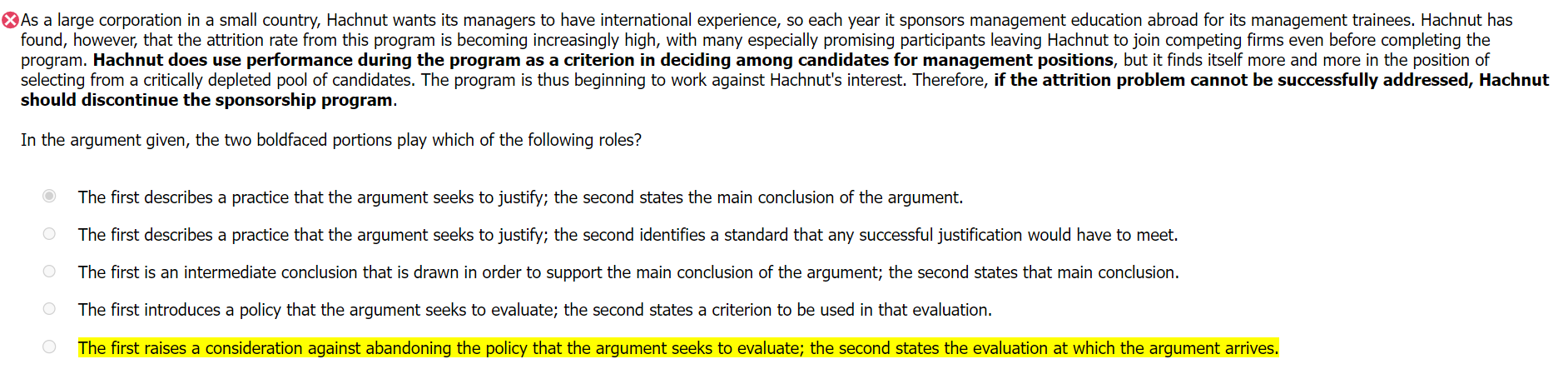
GMAT-Club-Forum-x5fp6ldo.png [ 136.59 KiB | Viewed 3788 times ]
In the argument given, the two boldfaced portions play which of the following roles?
A. The first describes a practice that the argument seeks to justify; the second states the main conclusion of the argument.
B. The first describes a practice that the argument seeks to justify; the second identifies a standard that any successful Justification would have to meet.
C. The first is an intermediate conclusion that is drawn in order to support the main conclusion of the argument; the second states that main conclusion.
D. The first introduces a policy that the argument seeks to evaluate; the second states a criterion to be used in that evaluation.
E. The first raises a consideration against abandoning the policy that the argument seeks to evaluate; the second states the evaluation at which the argument arrives.
Attachment:
GMAT-Club-Forum-x5fp6ldo.png [ 136.59 KiB | Viewed 3788 times ]
Using official mocks already?
Add GMAT Club Tests for harder practice, analytics, and explanations without overlapping Official Guide or official mock questions.
Try it now →
Try it now →


 05 Dec 2023, 08:23
Kudos
Bookmarks
Explanation
As a large corporation in a small country, Hachnut wants its managers to have international experience, so each year it sponsors management education abroad for its management trainees. Hachnut has found, however, that the attrition rate from this program is becoming increasingly high, with many especially promising participants leaving Hachnut to join competing firms even before completing the program. Hachnut does use performance during the program as a criterion in deciding among candidates for management positions, but it finds itself more and more in the position of selecting from a critically depleted pool of candidates. The program is thus beginning to work against Hachnut's interest. Therefore, if the attrition problem cannot be successfully addressed, Hachnut should discontinue the sponsorship program.
In the argument given, the two boldfaced portions play which of the following roles?
The passage presents a program that Hachnut uses to get its managers to have international experience: "each year it sponsors management education abroad for its management trainees."
It then presents an issue with the program: "the attrition rate from this program is becoming increasingly high."
It presents a reason to continue using the program: "Hachnut does use performance during the program as a criterion."
It expands on the problem with the program: "it finds itself more and more in the position of selecting from a critically depleted pool of candidates. The program is thus beginning to work against Hachnut's interest."
Finally, it states a conclusion indicated by use of the conclusion word "therefore": "if the attrition problem cannot be successfully addressed, Hachnut should discontinue the sponsorship program."
A. The first describes a practice that the argument seeks to justify; the second states the main conclusion of the argument.
Many people choose this choice, and there are multiple reasons why.
One is that the second portion of this choice is correct since the second boldface portion does state the main conclusion of the argument.
Another is that the first boldface portion does describe a practice.
However, what we need to notice to eliminate this choice is that it is not the case that the argument "seeks to justify" the practice of using performance during the program as a criterion in deciding among candidates. The argument simply mentions that practice as a reason to continue the management education program without seeking to justify that practice.
So, "seeks to justify" in this choice is a failure point.
Eliminate.
B. The first describes a practice that the argument seeks to justify; the second identifies a standard that any successful justification would have to meet.
As discussed in the explanation for choice (A), the first part of this choice is incorrect since the passage does not seek to justify the practice described by the first boldface portion.
Also, the second part of this choice is incorrect because the second boldface portion does not identify a standard that a justification of the first would have to meet since there's no discussion of such a justification in the first place.
At the same time, we can see that the question-writer did make the second portion of this choice a little tricky since "if the attrition problem cannot be successfully addressed," could be considered a presentation of a standard.
Eliminate.
C. The first is an intermediate conclusion that is drawn in order to support the main conclusion of the argument; the second states that main conclusion.
This choice is tricky because the second boldfaced portion does state the main conclusion of the argument and the first boldfaced portion precedes the second. So, if we're not careful, we could perceive this choice to be correct.
However, the truth is that the first boldfaced portion does not present an intermediate conclusion. Rather it presents a consideration in favor of continuing the management education program.
Eliminate.
D. The first introduces a policy that the argument seeks to evaluate; the second states a criterion to be used in that evaluation.
The question-writer made this choice a little tricky by including a couple correct parts:
The first is that the first boldfaced portion does present a policy: using performance during the program as a criterion in deciding among candidates.
The second is that "if the attrition problem cannot be successfully addressed," could be considered a criterion for evaluating a policy.
However, the rest of this choice is incorrect. After all, the argument merely mentions the policy of using performance during the program as a criterion in deciding among candidates and does not seek to evaluate it, and the criterion stated in the second boldfaced portion is not used for evaluating the policy presented by the first boldfaced portion.
Eliminate.
E. The first raises a consideration against abandoning the policy that the argument seeks to evaluate; the second states the evaluation at which the argument arrives.
Many people choose (A) over this one, for a few reasons:
One is that, as we have seen, much of (A) is correct.
Another is that the first portion of this choice is convoluted. As we saw in our review of the passage, the first boldfaced portion presents a reason for Hachnut to continue using the management education program: "Hachnut does use performance during the program as a criterion." However, the first portion of this choice doesn't say that in a simple way. Rather it says the same thing in a convoluted way:
A final reason why people don't select this choice is that the second portion says "the argument's main conclusion" in an unexpected and unfamiliar way, "the evaluation at which the argument arrives." So, even though we can readily tell that the second boldfaced portion presents the argument's main conclusion, we can easily miss that the second portion of this choice is correct.
Nevertheless, as we can see, the first and second portions of this choice correctly describe the first and second boldfaced portions of the passage.
The correct answer is (E).
As a large corporation in a small country, Hachnut wants its managers to have international experience, so each year it sponsors management education abroad for its management trainees. Hachnut has found, however, that the attrition rate from this program is becoming increasingly high, with many especially promising participants leaving Hachnut to join competing firms even before completing the program. Hachnut does use performance during the program as a criterion in deciding among candidates for management positions, but it finds itself more and more in the position of selecting from a critically depleted pool of candidates. The program is thus beginning to work against Hachnut's interest. Therefore, if the attrition problem cannot be successfully addressed, Hachnut should discontinue the sponsorship program.
In the argument given, the two boldfaced portions play which of the following roles?
The passage presents a program that Hachnut uses to get its managers to have international experience: "each year it sponsors management education abroad for its management trainees."
It then presents an issue with the program: "the attrition rate from this program is becoming increasingly high."
It presents a reason to continue using the program: "Hachnut does use performance during the program as a criterion."
It expands on the problem with the program: "it finds itself more and more in the position of selecting from a critically depleted pool of candidates. The program is thus beginning to work against Hachnut's interest."
Finally, it states a conclusion indicated by use of the conclusion word "therefore": "if the attrition problem cannot be successfully addressed, Hachnut should discontinue the sponsorship program."
A. The first describes a practice that the argument seeks to justify; the second states the main conclusion of the argument.
Many people choose this choice, and there are multiple reasons why.
One is that the second portion of this choice is correct since the second boldface portion does state the main conclusion of the argument.
Another is that the first boldface portion does describe a practice.
However, what we need to notice to eliminate this choice is that it is not the case that the argument "seeks to justify" the practice of using performance during the program as a criterion in deciding among candidates. The argument simply mentions that practice as a reason to continue the management education program without seeking to justify that practice.
So, "seeks to justify" in this choice is a failure point.
Eliminate.
B. The first describes a practice that the argument seeks to justify; the second identifies a standard that any successful justification would have to meet.
As discussed in the explanation for choice (A), the first part of this choice is incorrect since the passage does not seek to justify the practice described by the first boldface portion.
Also, the second part of this choice is incorrect because the second boldface portion does not identify a standard that a justification of the first would have to meet since there's no discussion of such a justification in the first place.
At the same time, we can see that the question-writer did make the second portion of this choice a little tricky since "if the attrition problem cannot be successfully addressed," could be considered a presentation of a standard.
Eliminate.
C. The first is an intermediate conclusion that is drawn in order to support the main conclusion of the argument; the second states that main conclusion.
This choice is tricky because the second boldfaced portion does state the main conclusion of the argument and the first boldfaced portion precedes the second. So, if we're not careful, we could perceive this choice to be correct.
However, the truth is that the first boldfaced portion does not present an intermediate conclusion. Rather it presents a consideration in favor of continuing the management education program.
Eliminate.
D. The first introduces a policy that the argument seeks to evaluate; the second states a criterion to be used in that evaluation.
The question-writer made this choice a little tricky by including a couple correct parts:
The first is that the first boldfaced portion does present a policy: using performance during the program as a criterion in deciding among candidates.
The second is that "if the attrition problem cannot be successfully addressed," could be considered a criterion for evaluating a policy.
However, the rest of this choice is incorrect. After all, the argument merely mentions the policy of using performance during the program as a criterion in deciding among candidates and does not seek to evaluate it, and the criterion stated in the second boldfaced portion is not used for evaluating the policy presented by the first boldfaced portion.
Eliminate.
E. The first raises a consideration against abandoning the policy that the argument seeks to evaluate; the second states the evaluation at which the argument arrives.
Many people choose (A) over this one, for a few reasons:
One is that, as we have seen, much of (A) is correct.
Another is that the first portion of this choice is convoluted. As we saw in our review of the passage, the first boldfaced portion presents a reason for Hachnut to continue using the management education program: "Hachnut does use performance during the program as a criterion." However, the first portion of this choice doesn't say that in a simple way. Rather it says the same thing in a convoluted way:
| Simple Way | Convoluted Way |
| a reason to continue using | a consideration against abandoning |
| the management education program | the policy that the argument seeks to evaluate |
A final reason why people don't select this choice is that the second portion says "the argument's main conclusion" in an unexpected and unfamiliar way, "the evaluation at which the argument arrives." So, even though we can readily tell that the second boldfaced portion presents the argument's main conclusion, we can easily miss that the second portion of this choice is correct.
Nevertheless, as we can see, the first and second portions of this choice correctly describe the first and second boldfaced portions of the passage.
The correct answer is (E).
General Discussion

 17 Apr 2024, 12:44
Kudos
Bookmarks
Similar questions to practice:
https://gmatclub.com/forum/as-a-large-c ... 28679.html (GMAT Prep Focus)
https://gmatclub.com/forum/as-a-large-c ... 59626.html (GMAT Prep)
https://gmatclub.com/forum/as-a-large-c ... 28679.html (GMAT Prep Focus)
https://gmatclub.com/forum/as-a-large-c ... 59626.html (GMAT Prep)
 02 Sep 2024, 03:05
Kudos
Bookmarks
vmn2007
We need to break down the argument into its parts first
Policy:
Each year Hachnut sponsors management education abroad for its management trainees.
Considerations in favour of the Policy:
As a large corporation in a small country, Hachnut wants its managers to have international experience
Hachnut uses performance during the program as a criterion in deciding among candidates for management positions.
Considerations against the Policy:
Hachnut has found, however, that the attrition rate of graduates from this program is very high, with many of them leaving Hachnut to join competing firms even before completing the program.
Intermediate Conlcusion:
The program is thus beginning to work against Hachnut's interest.
Conclusion:
If the attrition problem cannot be successfully addressed, Hachnut should discontinue the sponsorship program.
The first is a consideration in favour of the policy. The second is the main conclusion of the argument. Let's look at the options now:
A. The first describes a practice that the argument seeks to justify; the second states the main conclusion of the argument.
This is the first BF: Hachnut uses performance during the program as a criterion in deciding among candidates for management positions.
It describes a practice - true - but the argument is not trying to justify this practice. The argument does not say that this practice is good because otherwise there is no other quantitative measure to compare candidates etc; that using performance during the program as a criterion in deciding among candidates for management positions makes sense etc.
The argument gives this statement simply to tell us why the policy (the policy of conducting management trainings) is useful. Hence this option is incorrect.
The second is indeed the main conclusion of the argument.
B. The first describes a practice that the argument seeks to justify; the second identifies a standard that any successful Justification would have to meet.
The first describes a utility of the program. The argument is not trying to justify this practice. Ignore second in any case.
C. The first is an intermediate conclusion that is drawn in order to support the main conclusion of the argument; the second states that main conclusion.
First is not the intermediate conclusion.
D. The first introduces a policy that the argument seeks to evaluate; the second states a criterion to be used in that evaluation.
Again, as discussed in option (A), the argument does not seek to evaluate the practice/policy given by the first statement. The argument gives this BF1 simply to tell us why the policy of conducting management trainings is useful. Hence this option is incorrect. The argument is actually evaluating the policy of conducting management trainings. It is not evaluating the policy of using performance during the program as a criterion in deciding among candidates for management positions.
E. The first raises a consideration against abandoning the policy that the argument seeks to evaluate; the second states the evaluation at which the argument arrives.
The argument does seek to evaluate a policy (which is "Each year Hachnut sponsors management education abroad for its management trainees.") The first is a consideration in favour of this policy. It is a use of the policy. It gives Hachnut parameters to decide who to put in management positions. Hence it is a consideration against abandoning the policy that the argument seeks to evaluate.
"the evaluation at which the argument arrives" is another way of saying "the main conclusion of the argument". Hence BF2 is correct too.
Answer (E)
Discussion on Boldface Questions: https://youtu.be/U57vXdqujkY
Attachment:
GMAT-Club-Forum-e9qqp6wl.png [ 136.59 KiB | Viewed 3738 times ]