|
|

GMAT Club Daily Prep
Thank you for using the timer - this advanced tool can estimate your performance and suggest more practice questions. We have subscribed you to Daily Prep Questions via email.
Customized
for You
Track
Your Progress
Practice
Pays
Not interested in getting valuable practice questions and articles delivered to your email? No problem, unsubscribe here.

 20 Mar 2026, 06:27
Kudos
Bookmarks
Creating wine requires the fermentation of grapes using yeast. The yeast breaks down the sugars present in the grapes and converts them into carbon dioxide and ethanol (a form of edible alcohol) as byproducts. This process is what makes wine an alcoholic beverage. The amount of sugar that gets broken down can vary, but it is generally substantial. The remaining sugar, called residual sugar, in wine is what makes it sweet.
There are many factors that influence the alcohol content of wine.
The primary factors include the sugar content in the grapes at harvest, the yeast's fermentation activity, and the winemaker's decisions during the winemaking process, such as when to stop fermentation. All of these factors contribute to different wines having different ABVs (alcohol by volume).
Most of the time, we try to maintain the actual alcohol content as stated on the label of the bottle. However, sometimes we deliberately choose to understate the alcohol content on a wine label, within the range of error permitted by the law, because we believe that it would be advantageous for marketing the wine to do so.
At the same time, the effect of climate change on wine cannot also be discounted. Warmer temperatures usually accelerate grape ripening, leading to higher sugar levels in the grapes. Temperature affects the activity of yeast during fermentation. Higher temperatures can lead to more vigorous fermentation, potentially resulting in higher alcohol levels.
There are many factors that influence the alcohol content of wine.
The primary factors include the sugar content in the grapes at harvest, the yeast's fermentation activity, and the winemaker's decisions during the winemaking process, such as when to stop fermentation. All of these factors contribute to different wines having different ABVs (alcohol by volume).
Most of the time, we try to maintain the actual alcohol content as stated on the label of the bottle. However, sometimes we deliberately choose to understate the alcohol content on a wine label, within the range of error permitted by the law, because we believe that it would be advantageous for marketing the wine to do so.
At the same time, the effect of climate change on wine cannot also be discounted. Warmer temperatures usually accelerate grape ripening, leading to higher sugar levels in the grapes. Temperature affects the activity of yeast during fermentation. Higher temperatures can lead to more vigorous fermentation, potentially resulting in higher alcohol levels.


Alcohol levels in wine are directly correlated with the amount of sugar that developed in the grapes at harvest time.: Yes
Sweet wines having high residual sugar cannot have a higher alcohol content than permitted by the Liquor Control Board of Ontario.: No
Climate change is not primarily responsible for effecting a change in alcohol content.: Yes
Be sure to select an answer first to save it in the Error Log before revealing the correct answer (OA)!
Difficulty:
 95%
(hard)
95%
(hard)
Question Stats:
36% (03:21) correct 64%
(03:45)
wrong
based on 99
sessions
64%
(03:45)
wrong
based on 99
sessions
History
Date
Time
Result
Not Attempted Yet
For each of the following statements, select Yes if the information in either passage indicates that the statement is true. Otherwise, select No.
| Yes | No | |
| Alcohol levels in wine are directly correlated with the amount of sugar that developed in the grapes at harvest time. | ||
| Sweet wines having high residual sugar cannot have a higher alcohol content than permitted by the Liquor Control Board of Ontario. | ||
| Climate change is not primarily responsible for effecting a change in alcohol content. |
ShowHide Answer
Official Answer
Alcohol levels in wine are directly correlated with the amount of sugar that developed in the grapes at harvest time.: Yes
Sweet wines having high residual sugar cannot have a higher alcohol content than permitted by the Liquor Control Board of Ontario.: No
Climate change is not primarily responsible for effecting a change in alcohol content.: Yes
Every country that exports wine to Canada tends to understate the alcohol levels of their wines.: Not Supported
Every country that could have exported wine to Canada by abiding to the norms stipulated by Liquor Control Board of Ontario during 1992 to 2009 could be supposed to have safely exported the same wine to the UK.: Not Supported
Winemakers tend to benefit by the tolerance in alcohol content provided by the Liquor Control Board of Ontario to support wine sales in the export market.: Supported
Be sure to select an answer first to save it in the Error Log before revealing the correct answer (OA)!
Difficulty:
95%
(hard)
Question Stats:
41% (01:55) correct
59%
(01:59)
wrong
based on 110
sessions
History
Date
Time
Result
Not Attempted Yet
For each of the following, select Supported if it is validated by the information provided in either or both the passages, but not in table. Otherwise, select Not Supported.
| Supported | Not Supported | |
| Every country that exports wine to Canada tends to understate the alcohol levels of their wines. | ||
| Every country that could have exported wine to Canada by abiding to the norms stipulated by Liquor Control Board of Ontario during 1992 to 2009 could be supposed to have safely exported the same wine to the UK. | ||
| Winemakers tend to benefit by the tolerance in alcohol content provided by the Liquor Control Board of Ontario to support wine sales in the export market. |
ShowHide Answer
Official Answer
Every country that exports wine to Canada tends to understate the alcohol levels of their wines.: Not Supported
Every country that could have exported wine to Canada by abiding to the norms stipulated by Liquor Control Board of Ontario during 1992 to 2009 could be supposed to have safely exported the same wine to the UK.: Not Supported
Winemakers tend to benefit by the tolerance in alcohol content provided by the Liquor Control Board of Ontario to support wine sales in the export market.: Supported
The alcohol content in red wine was mostly more understated than that in white wine for wine consumed in Canada from 1992 to 2009.
Be sure to select an answer first to save it in the Error Log before revealing the correct answer (OA)!
Difficulty:
85%
(hard)
Question Stats:
48% (01:49) correct
52%
(01:45)
wrong
based on 90
sessions
History
Date
Time
Result
Not Attempted Yet
Based on the information given, which one of the following can be most logically inferred?
| Winemakers fail to exercise control on the alcohol content if the sugar content in the grapes at the time of harvesting is high. | |
| Argentina, Chile, and the United States tend to understate the alcohol content on the label the most, while Portugal and South Africa do the least. | |
| Unlike other wines, sweet and dessert wines can be supposed to be produced from relatively less sweet grapes. | |
| Imported white wine is supposedly consumed more in Canada than imported red wine. | |
| The alcohol content in red wine was mostly more understated than that in white wine for wine consumed in Canada from 1992 to 2009. |
ShowHide Answer
Official Answer
The alcohol content in red wine was mostly more understated than that in white wine for wine consumed in Canada from 1992 to 2009.
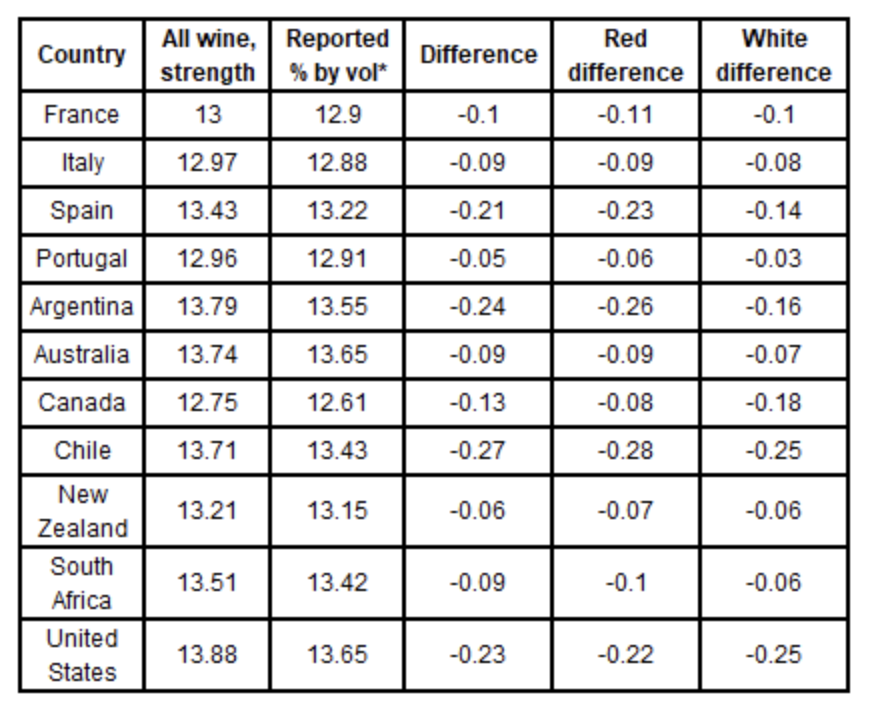
Tab 3: table
Source=TCYOnline

GMAT-Club-Forum-t4t3rsx3.png [ 145.33 KiB | Viewed 651 times ]
Source=TCYOnline
Attachment:
GMAT-Club-Forum-t4t3rsx3.png [ 145.33 KiB | Viewed 651 times ]
Archived Topic
Hi there,
This topic has been closed and archived due to inactivity or violation of community quality standards. No more replies are possible here.
Where to now? Join ongoing discussions on thousands of quality questions in our Multi-Source Reasoning (MSR) Forum
Still interested in this question? Check out the "Best Topics" block below for a better discussion on this exact question, as well as several more related questions.
Thank you for understanding, and happy exploring!

arushi118

Joined: 21 Jul 2024
Last visit: 20 Sep 2026
Posts: 280
Own Kudos:
Given Kudos: 894
Location: India
Concentration: Leadership, General Management
Schools: INSEAD Aug '26 LBS '26 Kellogg '26
GPA: 8.2/10
Products:
24 Mar 2026, 07:29
Kudos
Bookmarks
In the first ques, how is it "Yes" for the first statement? The passage states that alcohol levels in wine are dependent on a number of factors. So I was not too sure about if the alcohol levels will be directly related to the amount of sugar developed at harvest.
And in the 3rd ques how is the answer E? The difference for red wine is -0.08 and for white wine it is -0.18 in Canada -- SO should it not be that the alcohol content in white wine is more understated than that in red wine in canada?
And in the 3rd ques how is the answer E? The difference for red wine is -0.08 and for white wine it is -0.18 in Canada -- SO should it not be that the alcohol content in white wine is more understated than that in red wine in canada?
 24 Mar 2026, 09:41
Kudos
Bookmarks
Two great questions, arushi118. Let me take them one at a time.
On Question 1 (the Yes/No question): You're right that the passage lists multiple factors - sugar at harvest, yeast activity, winemaker decisions. But "directly correlated" just means there's a positive relationship, not that it's the only factor. The passage literally says yeast converts sugar into alcohol. More sugar in the grapes = more material to be converted = higher potential ABV. Even with other variables in play, the underlying chemical relationship IS a direct correlation. The answer is Yes because the passage establishes the mechanism directly.
On Question 3 (the inference question): Here's the part that tripped you up, and honestly it trips most people. You looked at the Canada row in the table, which shows Canada as a wine-PRODUCING country - not as a market. The row says Canadian-labeled wines have a red difference of -0.08 and white difference of -0.18, so white is more understated for Canadian producers, yes.
But the question asks about wine CONSUMED in Canada from 1992-2009. That means ALL the wine from ALL countries in the table, since the LCBO was testing imports from multiple countries. If you average the red differences across all countries in the table: approximately -0.11, -0.09, -0.23, -0.06, -0.26, -0.09, -0.08, -0.28, -0.07, -0.10, -0.22 - the overall average red understating is about -0.15. For white: -0.10, -0.08, -0.14, -0.03, -0.16, -0.07, -0.18, -0.25, -0.06, -0.06, -0.25 - average white understating is about -0.13.
So when you look at the whole picture of what was consumed in Canada (all countries), red wine is more understated on average than white. Option E holds.
The MSR trap here is reading one row as "Canada" and forgetting the table is about countries of origin, not the destination market.
On Question 1 (the Yes/No question): You're right that the passage lists multiple factors - sugar at harvest, yeast activity, winemaker decisions. But "directly correlated" just means there's a positive relationship, not that it's the only factor. The passage literally says yeast converts sugar into alcohol. More sugar in the grapes = more material to be converted = higher potential ABV. Even with other variables in play, the underlying chemical relationship IS a direct correlation. The answer is Yes because the passage establishes the mechanism directly.
On Question 3 (the inference question): Here's the part that tripped you up, and honestly it trips most people. You looked at the Canada row in the table, which shows Canada as a wine-PRODUCING country - not as a market. The row says Canadian-labeled wines have a red difference of -0.08 and white difference of -0.18, so white is more understated for Canadian producers, yes.
But the question asks about wine CONSUMED in Canada from 1992-2009. That means ALL the wine from ALL countries in the table, since the LCBO was testing imports from multiple countries. If you average the red differences across all countries in the table: approximately -0.11, -0.09, -0.23, -0.06, -0.26, -0.09, -0.08, -0.28, -0.07, -0.10, -0.22 - the overall average red understating is about -0.15. For white: -0.10, -0.08, -0.14, -0.03, -0.16, -0.07, -0.18, -0.25, -0.06, -0.06, -0.25 - average white understating is about -0.13.
So when you look at the whole picture of what was consumed in Canada (all countries), red wine is more understated on average than white. Option E holds.
The MSR trap here is reading one row as "Canada" and forgetting the table is about countries of origin, not the destination market.





