Last visit was: 14 Jul 2026, 12:39 It is currently 14 Jul 2026, 12:39
Close
GMAT Club Daily Prep
Thank you for using the timer - this advanced tool can estimate your performance and suggest more practice questions. We have subscribed you to Daily Prep Questions via email.

Customized
for You

we will pick new questions that match your level based on your Timer History

Track
Your Progress

every week, we’ll send you an estimated GMAT score based on your performance

Practice
Pays

we will pick new questions that match your level based on your Timer History
Not interested in getting valuable practice questions and articles delivered to your email? No problem, unsubscribe here.
Close
Request Expert Reply
Confirm Cancel
User avatar
MrWallSt
Joined: 21 Nov 2013
Last visit: 03 Feb 2016
Posts: 11
Own Kudos:
105
 [95]
Given Kudos: 9
Posts: 11
Kudos: 105
 [95]
1
Kudos
Add Kudos
94
Bookmarks
Bookmark this Post
Most Helpful Reply
User avatar
KarishmaB
Joined: 16 Oct 2010
Last visit: 14 Jul 2026
Posts: 16,562
Own Kudos:
80,333
 [21]
Given Kudos: 486
Location: Pune, India
Expert
Expert reply
Active GMAT Club Expert! Tag them with @ followed by their username for a faster response.
Posts: 16,562
Kudos: 80,333
 [21]
14
Kudos
Add Kudos
7
Bookmarks
Bookmark this Post
General Discussion
User avatar
MrWallSt
Joined: 21 Nov 2013
Last visit: 03 Feb 2016
Posts: 11
Own Kudos:
Given Kudos: 9
Posts: 11
Kudos: 105
Kudos
Add Kudos
Bookmarks
Bookmark this Post
User avatar
CrackverbalGMAT
User avatar
Major Poster
Joined: 03 Oct 2013
Last visit: 14 Jul 2026
Posts: 4,849
Own Kudos:
9,278
 [4]
Given Kudos: 229
Affiliations: CrackVerbal
Location: India
Expert
Expert reply
Posts: 4,849
Kudos: 9,278
 [4]
3
Kudos
Add Kudos
1
Bookmarks
Bookmark this Post
MrWallSt
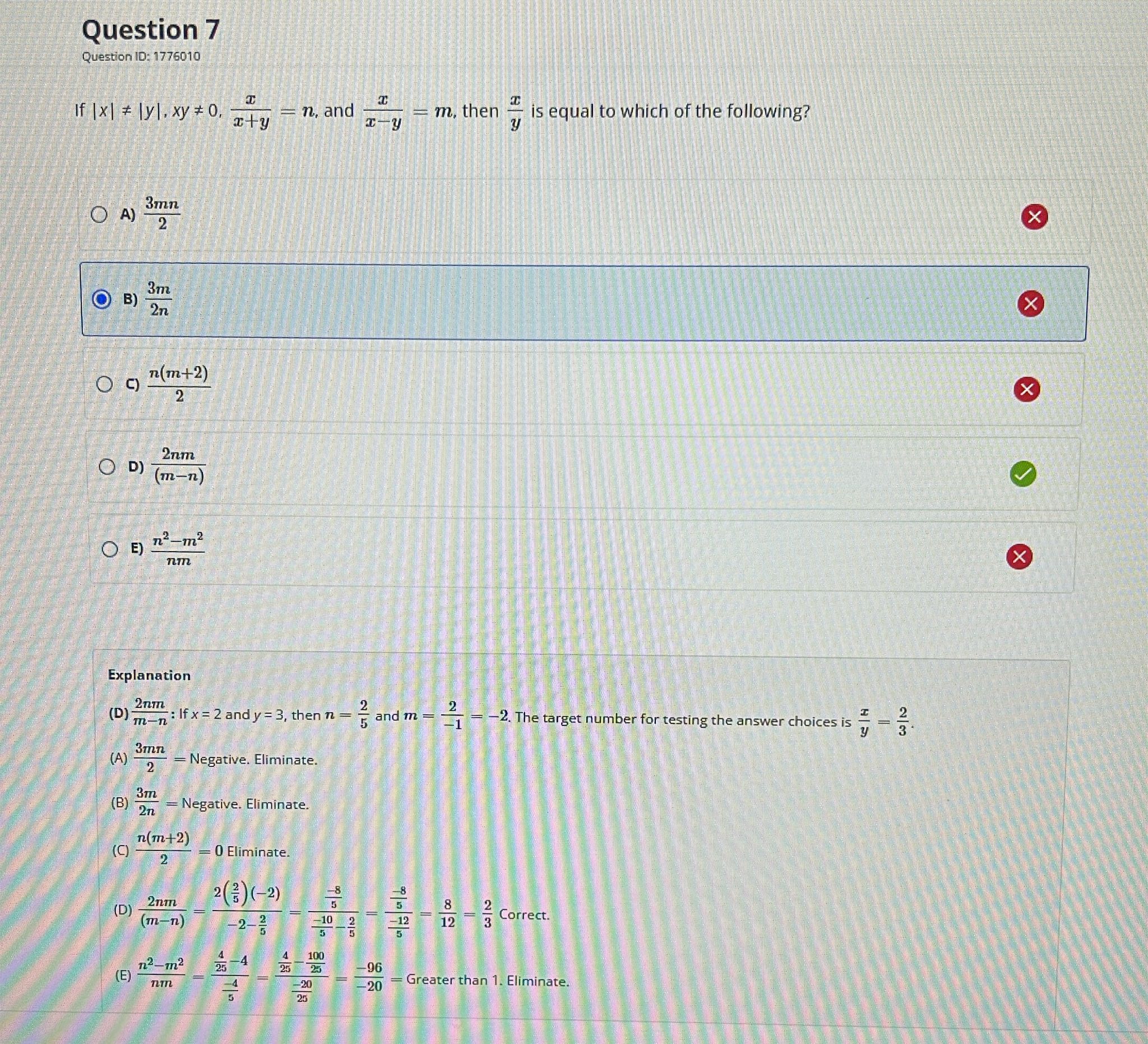
If x / (x+y) = n, and x / (x-y) = m, then x/y=? (|x| does not equal |y|, xy does not equal 0)

A. 3mn/2
B. (3m)/(2n)
C. (n * (m+2))/2
D. 2nm / (m-n)
E. (n^2 - m^2) / nm

Let us say x = 3, y = 1, n = 0.75, m = 1.5

x/y = 3

(A) 3(3/2)(3/4) = 9/8 (Eliminated)
(B) 3(3/2) 2(3/4) = (Eliminated)
(C) (3/4) (3/2 + 2)/2 = (Eliminated)
(D) 2(3/4)(3/2)/(.75) = 3 (BINGO!)
(E) Eliminated

Hence answer is D
avatar
Alaukik
Joined: 01 Aug 2014
Last visit: 13 Feb 2017
Posts: 36
Own Kudos:
Given Kudos: 46
Location: India
GPA: 3.65
Posts: 36
Kudos: 16
Kudos
Add Kudos
Bookmarks
Bookmark this Post
CrackVerbalGMAT
MrWallSt
If x / (x+y) = n, and x / (x-y) = m, then x/y=? (|x| does not equal |y|, xy does not equal 0)

A. 3mn/2
B. (3m)/(2n)
C. (n * (m+2))/2
D. 2nm / (m-n)
E. (n^2 - m^2) / nm

Let us say x = 3, y = 1, n = 0.75, m = 1.5

x/y = 3

(A) 3(3/2)(3/4) = 9/8 (Eliminated)
(B) 3(3/2) 2(3/4) = (Eliminated)
(C) (3/4) (3/2 + 2)/2 = (Eliminated)
(D) 2(3/4)(3/2)/(.75) = 3 (BINGO!)
(E) Eliminated

Hence answer is D

Sorry for opening a long answered question.

with algebric solution, i am getting many answers in terms of m & n. so the problem needed to be solved by picking numbers.
when we pick x = 3 & y = 1. I am getting B & D both as answer and but with x = 2 & y= 3. I am getting D as an answer. shouldnt it be unique for all numbers, since there is no restriction (like x, y = consequetive or x>y or viceversa) on picking numbers.
User avatar
KarishmaB
Joined: 16 Oct 2010
Last visit: 14 Jul 2026
Posts: 16,562
Own Kudos:
80,333
 [2]
Given Kudos: 486
Location: Pune, India
Expert
Expert reply
Active GMAT Club Expert! Tag them with @ followed by their username for a faster response.
Posts: 16,562
Kudos: 80,333
 [2]
Kudos
Add Kudos
2
Bookmarks
Bookmark this Post
Alaukik
CrackVerbalGMAT
MrWallSt
If x / (x+y) = n, and x / (x-y) = m, then x/y=? (|x| does not equal |y|, xy does not equal 0)

A. 3mn/2
B. (3m)/(2n)
C. (n * (m+2))/2
D. 2nm / (m-n)
E. (n^2 - m^2) / nm

Let us say x = 3, y = 1, n = 0.75, m = 1.5

x/y = 3

(A) 3(3/2)(3/4) = 9/8 (Eliminated)
(B) 3(3/2) 2(3/4) = (Eliminated)
(C) (3/4) (3/2 + 2)/2 = (Eliminated)
(D) 2(3/4)(3/2)/(.75) = 3 (BINGO!)
(E) Eliminated

Hence answer is D

Sorry for opening a long answered question.

with algebric solution, i am getting many answers in terms of m & n. so the problem needed to be solved by picking numbers.
when we pick x = 3 & y = 1. I am getting B & D both as answer and but with x = 2 & y= 3. I am getting D as an answer. shouldnt it be unique for all numbers, since there is no restriction (like x, y = consequetive or x>y or viceversa) on picking numbers.

When you take one of the numbers as 1 or 0, or when you take numbers to be equal, you could get multiple options satisfying your conditions.

For example, if n = 1
3n/(m+n) will give the same result as 3/(m+n).

Sometimes, you will get the same answer from multiple options if the options are written intelligently. So you could need to try out 2 or even 3 sets of values.
avatar
Alaukik
Joined: 01 Aug 2014
Last visit: 13 Feb 2017
Posts: 36
Own Kudos:
Given Kudos: 46
Location: India
GPA: 3.65
Posts: 36
Kudos: 16
Kudos
Add Kudos
Bookmarks
Bookmark this Post
VeritasPrepKarishma

When you take one of the numbers as 1 or 0, or when you take numbers to be equal, you could get multiple options satisfying your conditions.

For example, if n = 1
3n/(m+n) will give the same result as 3/(m+n).

Sometimes, you will get the same answer from multiple options if the options are written intelligently. So you could need to try out 2 or even 3 sets of values.

well the question states xy != 0, so x or y cant be 0. also |x| != |y| so they cant be equal either.

I was hoping for a more bullet proof solution for this question. as 2 sets will take more time. we will get answer but at a huge expense of time.
User avatar
KarishmaB
Joined: 16 Oct 2010
Last visit: 14 Jul 2026
Posts: 16,562
Own Kudos:
Given Kudos: 486
Location: Pune, India
Expert
Expert reply
Active GMAT Club Expert! Tag them with @ followed by their username for a faster response.
Posts: 16,562
Kudos: 80,333
Kudos
Add Kudos
Bookmarks
Bookmark this Post
Alaukik
VeritasPrepKarishma

When you take one of the numbers as 1 or 0, or when you take numbers to be equal, you could get multiple options satisfying your conditions.

For example, if n = 1
3n/(m+n) will give the same result as 3/(m+n).

Sometimes, you will get the same answer from multiple options if the options are written intelligently. So you could need to try out 2 or even 3 sets of values.

well the question states xy != 0, so x or y cant be 0. also |x| != |y| so they cant be equal either.

I was hoping for a more bullet proof solution for this question. as 2 sets will take more time. we will get answer but at a huge expense of time.

Note that it is a generic comment about number plugging - not just specific to this question.

Also, I have given the algebra solution above - as "bulletproof" as you can get.
User avatar
evdo
Joined: 11 Nov 2011
Last visit: 02 Aug 2018
Posts: 43
Own Kudos:
Given Kudos: 101
Location: United States
Concentration: Finance, Human Resources
GPA: 3.33
WE:Consulting (Non-Profit and Government)
Posts: 43
Kudos: 20
Kudos
Add Kudos
Bookmarks
Bookmark this Post
VeritasPrepKarishma your solution is excellence. I am wondering, how do we know that one form of fraction (you mentioned it as case) is easier to manipulate than another? I tried to solve this problem using the original form of fraction but I ended up nowhere. Do you have the solution using original form of the fraction?
User avatar
KarishmaB
Joined: 16 Oct 2010
Last visit: 14 Jul 2026
Posts: 16,562
Own Kudos:
80,333
 [3]
Given Kudos: 486
Location: Pune, India
Expert
Expert reply
Active GMAT Club Expert! Tag them with @ followed by their username for a faster response.
Posts: 16,562
Kudos: 80,333
 [3]
3
Kudos
Add Kudos
Bookmarks
Bookmark this Post
evdo
VeritasPrepKarishma your solution is excellence. I am wondering, how do we know that one form of fraction (you mentioned it as case) is easier to manipulate than another? I tried to solve this problem using the original form of fraction but I ended up nowhere. Do you have the solution using original form of the fraction?

When you need to separate the variables, multiple terms in the numerator are easy to handle since you can split them:

(x+y)/ x = x/x + y/x = 1 + y/x

But if they are in the denominator, you cannot separate them.

You can start with the equations as they are but you will eventually cross multiply to simplify the denominator. If you do different things with the equations, you will get different but equivalent expressions. So a case can be made to do the question by number plugging instead.
avatar
jmmanquez
Joined: 07 Jan 2018
Last visit: 08 Jun 2019
Posts: 5
Own Kudos:
Given Kudos: 7
Kudos
Add Kudos
Bookmarks
Bookmark this Post
Hello,

Could someone explain why is it not possible to assume that: x = n(x+y) and x = m(x-y); so n(x+y) = m(x-y) if we solve this we arrive to x/y = (n+m) / (m-n)

I know it is not the correct answer, but I would like to understand my mistake. Many thanks
User avatar
KarishmaB
Joined: 16 Oct 2010
Last visit: 14 Jul 2026
Posts: 16,562
Own Kudos:
80,333
 [1]
Given Kudos: 486
Location: Pune, India
Expert
Expert reply
Active GMAT Club Expert! Tag them with @ followed by their username for a faster response.
Posts: 16,562
Kudos: 80,333
 [1]
1
Kudos
Add Kudos
Bookmarks
Bookmark this Post
jmmanquez
Hello,

Could someone explain why is it not possible to assume that: x = n(x+y) and x = m(x-y); so n(x+y) = m(x-y) if we solve this we arrive to x/y = (n+m) / (m-n)

I know it is not the correct answer, but I would like to understand my mistake. Many thanks

It is not incorrect, it is just not what you need. Different manipulations can lead to different but equivalent expressions.
User avatar
sambitspm
Joined: 05 Aug 2019
Last visit: 13 Jan 2022
Posts: 317
Own Kudos:
315
 [1]
Given Kudos: 130
Location: India
Concentration: Leadership, Technology
GMAT 1: 600 Q50 V22
GMAT 2: 670 Q50 V28 (Online)
GPA: 4
GMAT 2: 670 Q50 V28 (Online)
Posts: 317
Kudos: 315
 [1]
1
Kudos
Add Kudos
Bookmarks
Bookmark this Post
Kindly see the attachment.
It took me around 2:45 min to solve this.

At first, my answer didn't match any of the options. I tried checking my calculation but didn't get to the right choice. Lastly, I went to replacing m and n in options and landed in D. Option D was my first guess, but since it was not exam mode, I was inclined on solving this.

VeritasKarishma, your both approaches help to get a new perspective on this question.

Attachments

1.jpeg
1.jpeg [ 100.83 KiB | Viewed 11910 times ]

User avatar
rxb266
Joined: 30 Nov 2018
Last visit: 27 Jun 2024
Posts: 138
Own Kudos:
154
 [2]
Given Kudos: 79
Location: India
Concentration: Strategy, Marketing
GPA: 4
1
Kudos
Add Kudos
1
Bookmarks
Bookmark this Post
This is the simplest question

substitute values to each variable and check with the option provided

assuming x=5 and y = 1
m =5/4 and n=5/6

and my x/y should be = 5 (ie,5/1)

only in option D when i substitute the variables I get the value as 5.. Hence my answer is D

(In Gmat the time is a luxury.. try to avoid algebra whenever possible)
User avatar
Raunak1x
Joined: 27 Mar 2026
Last visit: 14 Jul 2026
Posts: 5
Own Kudos:
Given Kudos: 22
Products:
Posts: 5
Kudos: 1
Kudos
Add Kudos
Bookmarks
Bookmark this Post
KarishmaB


You can do it either algebraically or by assuming numbers:

Algebra:
Note that we are happier with (x+y)/x rather than x/(x+y) since in the former case we can make manipulations easily. So let's take the inverse of both n and m

\(\frac{1}{n} = \frac{(x+y)}{x} = 1 + \frac{y}{x}\) ....(I)
\(\frac{1}{m} = \frac{(x-y)}{x} = 1 - \frac{y}{x}\) .....(II)

Since we have both m and n in our answer, lets subtract II from I to get

\(\frac{1}{n} - \frac{1}{m} = \frac{2y}{x}\)

\(\frac{(m-n)}{2mn} = \frac{y}{x}\)

\(\frac{x}{y} = \frac{2mn}{(m-n)}\)

Answer (D)

Or Plug in numbers: x = 2, y = 1
n = x/(x+y) = 2/3
m = x/(x-y) = 2

x/y = 2

Now put n = 2/3 and m = 2 in the options. Only option (D) gives you x/y = 2.

Hence answer (D)
KarishmaB

I tried the numbers x=8 and y=4, which yields me n=2/3 and m=2 and x/y=2.

Then even 3mn/2=x/y and I marked the answer A.

Apparently even D yields the same answer.

How do I avoid this trap altogether while following the time constraint for future such questions using the number route? Your reply would really be helpful!
User avatar
KarishmaB
Joined: 16 Oct 2010
Last visit: 14 Jul 2026
Posts: 16,562
Own Kudos:
80,333
 [1]
Given Kudos: 486
Location: Pune, India
Expert
Expert reply
Active GMAT Club Expert! Tag them with @ followed by their username for a faster response.
Posts: 16,562
Kudos: 80,333
 [1]
1
Kudos
Add Kudos
Bookmarks
Bookmark this Post
Raunak1x

KarishmaB

I tried the numbers x=8 and y=4, which yields me n=2/3 and m=2 and x/y=2.

Then even 3mn/2=x/y and I marked the answer A.

Apparently even D yields the same answer.

How do I avoid this trap altogether while following the time constraint for future such questions using the number route? Your reply would really be helpful!
When you plug in numbers to get the correct option, you MUST check for each option and zero in only when you get a single option satisfying those numbers. If 2 options satisfy a set of numbers, you must try another different set to pick one of those 2. This is the time that number plugging demands and you cannot circumvent it. That is why I usually like to try some very simple values first to eliminate some options and then focus on a small subset only.
When you have a lot of variables, algebraic manipulation could prove to be more time efficient.
Moderator:
Math Expert
111929 posts