Events & Promotions
|
|

GMAT Club Daily Prep
Thank you for using the timer - this advanced tool can estimate your performance and suggest more practice questions. We have subscribed you to Daily Prep Questions via email.
Customized
for You
Track
Your Progress
Practice
Pays
Not interested in getting valuable practice questions and articles delivered to your email? No problem, unsubscribe here.
 Sep 21
07:00 PM EDT
-10:00 PM EDT
Boost your GMAT score in less than one month in a live online class + 6 months access to TTP OnDemand video courses included! Sep 23
12:30 AM EDT
-01:30 AM EDT
Learn how Keshav, a Chartered Accountant, scored an impressive 705 on GMAT in just 30 days with GMATWhiz's expert guidance. In this video, he shares preparation tips and strategies that worked for him, including the mock, time management, and more Sep 24
01:30 AM EDT
-01:30 AM EDT
Tejas studied hard but kept repeating the same mistakes. After 3 attempts at 645, a focused 4-week strategy helped him identify and fix what was holding him back—leading to a 695 with just 12–15 hours of study per week. Sep 26
06:00 PM PDT
-07:00 PM PDT
Free- full-length test + 15 concept videos + 150+ short videos + study plan!


 16 Sep 2014, 00:43
Kudos
Bookmarks
If the area of a parallelogram is 100 square units, what is its perimeter?
(1) The parallelogram has a base measuring 10 units.
(2) One of the parallelogram's angles measures 45 degrees.
(1) The parallelogram has a base measuring 10 units.
(2) One of the parallelogram's angles measures 45 degrees.
16 Sep 2014, 00:43
Kudos
Bookmarks
Official Solution:
If the area of a parallelogram is 100 square units, what is its perimeter?
Refer to the diagram below:
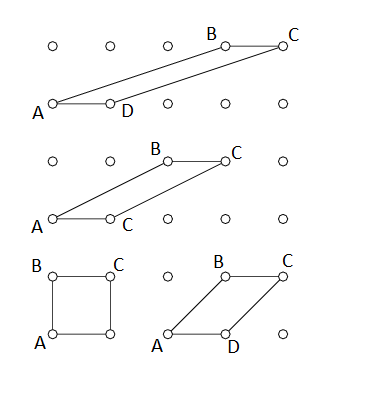
Given: \(Area = base*height = 100\). We want to find the perimeter, \(P = 2b + 2l\), where \(b\) is the base and \(l\) is the leg (side length).
(1) The parallelogram has a base measuring 10 units.
So, \(base = height = 10\). Infinitely many cases are possible. Observe the diagram (let the distance between two horizontal and vertical points be 10 units): all 4 parallelograms have \(base = height = 10\) but they have different perimeters. Therefore, this information is not sufficient.
(2) One of the angles of the parallelogram is 45 degrees.
Clearly insufficient by itself. However, from this statement, we know that height \(BX\) and \(AX\) form an isosceles right triangle: \(height = BX = AX\).
(1) + (2) Combining both statements, from (2) we have that \(height = BX = AX\), and from (1) we have that \(base = height = 10\), so \(AX = base = AD = 10\). This means that points \(X\) and \(D\) coincide (case #4 in the diagram). Thus, leg \(AB\) becomes the hypotenuse of the isosceles right triangle with sides equal to 10 units, hence \(AB = 10\sqrt{2}\). Therefore, the perimeter \(P = 20 + 20\sqrt{2}\). Both statements together are sufficient.
Answer: C
If the area of a parallelogram is 100 square units, what is its perimeter?
Refer to the diagram below:
Given: \(Area = base*height = 100\). We want to find the perimeter, \(P = 2b + 2l\), where \(b\) is the base and \(l\) is the leg (side length).
(1) The parallelogram has a base measuring 10 units.
So, \(base = height = 10\). Infinitely many cases are possible. Observe the diagram (let the distance between two horizontal and vertical points be 10 units): all 4 parallelograms have \(base = height = 10\) but they have different perimeters. Therefore, this information is not sufficient.
(2) One of the angles of the parallelogram is 45 degrees.
Clearly insufficient by itself. However, from this statement, we know that height \(BX\) and \(AX\) form an isosceles right triangle: \(height = BX = AX\).
(1) + (2) Combining both statements, from (2) we have that \(height = BX = AX\), and from (1) we have that \(base = height = 10\), so \(AX = base = AD = 10\). This means that points \(X\) and \(D\) coincide (case #4 in the diagram). Thus, leg \(AB\) becomes the hypotenuse of the isosceles right triangle with sides equal to 10 units, hence \(AB = 10\sqrt{2}\). Therefore, the perimeter \(P = 20 + 20\sqrt{2}\). Both statements together are sufficient.
Answer: C
General Discussion

Schools: Stern '19 CBS '19 (A) Booth '19 LBS '19 Insead Sept '17
GMAT 1: 750 Q50 V42
Posts: 2
Kudos:
0
26 Jul 2016, 04:41
Kudos
Bookmarks
Why can't I use the second statement to calculate the length of the other side using sin 45. I know the height is 10. Shouldn't the answer be B?





