Last visit was: 29 Apr 2026, 20:07 It is currently 29 Apr 2026, 20:07
Close
GMAT Club Daily Prep
Thank you for using the timer - this advanced tool can estimate your performance and suggest more practice questions. We have subscribed you to Daily Prep Questions via email.

Customized
for You

we will pick new questions that match your level based on your Timer History

Track
Your Progress

every week, we’ll send you an estimated GMAT score based on your performance

Practice
Pays

we will pick new questions that match your level based on your Timer History
Not interested in getting valuable practice questions and articles delivered to your email? No problem, unsubscribe here.
Close
Request Expert Reply
Confirm Cancel
User avatar
newsMadison
Joined: 22 Nov 2013
Last visit: -
Posts: 448
Own Kudos:
Schools: AGSM '18
Schools: AGSM '18
Posts: 448
Kudos: 1
Kudos
Add Kudos
Bookmarks
Bookmark this Post
User avatar
newsMadison
Joined: 22 Nov 2013
Last visit: -
Posts: 448
Own Kudos:
Schools: AGSM '18
Schools: AGSM '18
Posts: 448
Kudos: 1
Kudos
Add Kudos
Bookmarks
Bookmark this Post
User avatar
newsMadison
Joined: 22 Nov 2013
Last visit: -
Posts: 448
Own Kudos:
Schools: AGSM '18
Schools: AGSM '18
Posts: 448
Kudos: 1
Kudos
Add Kudos
Bookmarks
Bookmark this Post
User avatar
newsMadison
Joined: 22 Nov 2013
Last visit: -
Posts: 448
Own Kudos:
Schools: AGSM '18
Schools: AGSM '18
Posts: 448
Kudos: 1
Kudos
Add Kudos
Bookmarks
Bookmark this Post
FROM Madison(Wisconsin) Admissions Blog: WSB Accounting Doctoral Alums Receive Outstanding Dissertation Awards From the American Accounting Association
Three Wisconsin School of Business accounting alumni were honored by the American Accounting Association (AAA) with Outstanding Dissertation Awards during 2022 and 2023. The awards recognize dissertation excellence across the various fields in accounting.

WSB Accounting Doctoral Alums Receive Outstanding Dissertation Awards From the American Accounting Association appeared first on Wisconsin School of Business.
This Blog post was imported into the forum automatically. We hope you found it helpful. Please use the Kudos button if you did, or please PM/DM me if you found it disruptive and I will take care of it. -BB

User avatar
newsMadison
Joined: 22 Nov 2013
Last visit: -
Posts: 448
Own Kudos:
Schools: AGSM '18
Schools: AGSM '18
Posts: 448
Kudos: 1
Kudos
Add Kudos
Bookmarks
Bookmark this Post
FROM Madison(Wisconsin) Admissions Blog: Job Shadow, Career Trek Programs Give WSB Students the Jump on Career Success
Career discovery might be considered a process just as much as it is a finite destination: Finding a good fit means learning about oneself as well as what opportunities are available in the professional world.

Two recent Wisconsin School of Business programs helped undergraduate Business Badgers navigate this important exploration. Designed as part of WSB’s Career Forward program and taking place over the winter break, the job shadow program and the Austin career trek offered students immersive, real-world experiences with the chance to shadow industry professionals, grow their network, explore career pathways and individualized industry tracks, and observe different workplace and company cultures.

“These types of experiential learning programs help students get hands-on with their own exploration of different career pathways and industries,” says Brett Jones, director of employer engagement for WSB’s undergraduate program. “We are excited to partner with several UW–Madison alums and industry collaborators to offer these unique opportunities.”

‘An eye-opening experience’

WSB’s job shadow program, which relaunched this year after last occurring in 2018, offers students short-term, on-site learning experiences with employer partners.

Michael Quesnell, assistant director of employer development with WSB’s undergraduate office, says that post-pandemic, employers have a renewed interest in participating in these kinds of events.

“The idea is to give students, particularly freshmen and sophomores, a close-up look at a company or industry by shadowing professionals through a normal day on the job,” he says. “These unique opportunities are designed to allow students to explore possibilities as well as network with employers.”

Spanning two weeks in January, more than 80 WSB students completed 90 shadows—each ranging from a half to a full day—at sites in Madison, the greater Milwaukee area, Chicago, and Minneapolis. The participating companies included Aldi, Alliant Energy, Deloitte, EY, Kohler, Milwaukee Tool, PwC, Spaulding Ridge, and Uline.

Accompanied by WSB’s Jamie Mickelson, assistant director of career engagement, and Alex Lawver, career coach, students had the opportunity to:

  • learn about different aspects of each company, such as its history and background

  • shadow day-to-day operations and responsibilities

  • participate in discussions around ESG (environmental, social, and corporate governance principals) strategy and sustainability, employee Q&A panels, and networking lunches

  • tour the campuses, factories, and stores unique to each shadow site,

Students were able to sign up for multiple job shadows and to choose from different tracks, such as marketing or supply chain management, within a single shadow experience.


Kohler offered students two tracks to choose from as well as tours of its manufacturing and innovation centers.

The job shadow program is ideal for students who have yet to choose a major, as it gives them a chance to experience a day-in-the-life of an individual working in a specific business domain.

“This is an awesome opportunity for those students who are still undecided,” Quesnell says. “It’s both a low-stakes way to go about evaluating different options in different fields, kind of from a 10,000 foot view, but also to apply that in a ‘does that feel right for me?’ kind of way.”

Julia Blankenship (BBA ’24), who is double majoring in accounting and finance, says that the PwC job shadow allowed her to talk with industry professionals who had completed WSB’s MAcc program as well as others who had pursued double or triple majors to qualify for the CPA exam.

Blankenship also participated in the job shadow at Kohler, and says it was “an eye-opening experience” to get a glimpse into the company’s culture and daily activities.

Kohler hosted students within two tracks, supply chain and finance/accounting. Students had the opportunity to tour the company’s innovation center and manufacturing facility before splitting into their chosen tracks for more focused conversations and learning.

For Blankenship, the chance to network with accounting and finance professionals at both entry-level and senior vice president positions was highly valuable.

“As a result of this networking, I was able to connect a Kohler professional with Women in Finance and Accounting, a student organization that I am the co-president for. We are planning to host them later this semester for an event.”

Tech and innovation immersion

Career treks—multi-day trips for WSB students to visit a major U.S. city to meet with top employers and learn about the region’s business culture—have been a staple of the school’s career exploration offerings.


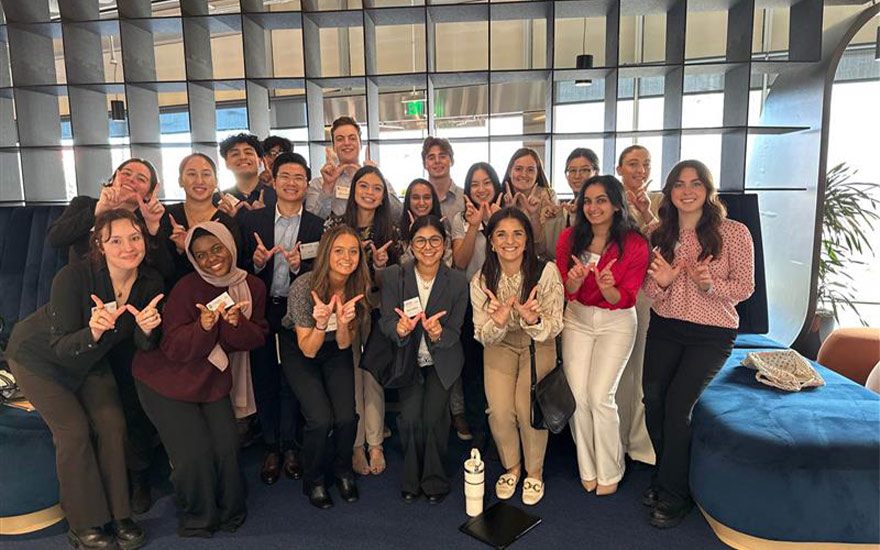
Career trek students throw the “W” during a site visit to Expedia’s Austin headquarters.

In January, 20 WSB students, mostly sophomores and juniors, took a three-day career trek to tech hub Austin, Texas—the first trek taking place outside of the Midwest.

“We chose Austin as we’ve seen an increase in student interest to the area given the number of post-graduate placements over the past several years,” Quesnell says. “Austin is also a growing hub for tech talent that has witnessed the relocation and establishment of many prominent tech-based companies’ primary and regional headquarters.”

Participating employers included Self Financial, Expedia Corporation, Dell Corporation, Visa, Oracle, and Whole Foods Market. Students visited each companies’ headquarters in two-hour increments, taking part in “speed networking” sessions and networking lunches with company employees, hearing from alumni in Q&A panels, learning about company culture and history, and participating in facility tours.

Arwa Bashir (BBA ’24) says she would highly recommend the experience.

“I decided to attend the Austin career trek because I wanted to gain some insight on real-world experiences and meet new people of diverse backgrounds in a corporate setting,” says Bashir. “Because the focus of the trek was on technology and innovation, which aligns with my goals for the future, I was excited to see what life would be like if I pursue this field.”

For marketing and supply chain management major An “Simon” Cao (BBA ’25), the trip offered a fresh perspective.

“The Austin career trek truly showed me that career paths aren’t supposed to be linear,” says Cao. “Learning and listening to industry professionals and recognizing that some of their academic backgrounds didn’t correlate to what they are doing now truly made me realize I should be open to learning all disciplines within the realm of business—and most importantly, that it is ok to be uncertain of your future career paths.”

Quesnell says the annual two-track career trek in finance/real estate and marketing/consulting is set for Chicago in March, with another trek planned to Minneapolis in August. Treks in January and May will rotate locations annually, with options including Seattle, Boston, San Francisco, and New York City.

The trek expansion plans are just one part of the school’s larger vision for WSB undergraduate students.

“As part of our Career Forward initiative, we are committed to supporting student career exploration and development through the creation of signature experiences,” says Jones.  “We look forward to continuing to expand our offerings for these types of opportunities in the future.”

The post Job Shadow, Career Trek Programs Give WSB Students the Jump on Career Success appeared first on Wisconsin School of Business.
This Blog post was imported into the forum automatically. We hope you found it helpful. Please use the Kudos button if you did, or please PM/DM me if you found it disruptive and I will take care of it. -BB
User avatar
newsMadison
Joined: 22 Nov 2013
Last visit: -
Posts: 448
Own Kudos:
Schools: AGSM '18
Schools: AGSM '18
Posts: 448
Kudos: 1
Kudos
Add Kudos
Bookmarks
Bookmark this Post
FROM Madison(Wisconsin) Admissions Blog: Business Casual: March 2023
The Briefing


Meet the members of WSB’s External Advisory Board
WSB’s 2022–2023 External Advisory Board (EAB) has added six new members and named returning member Carrianne Basler (BBA ’91) as vice chair. Members of the EAB work with WSB leadership to help shape the school’s strategic direction and operational priorities to expand reach and reputation. Board members also serve as WSB ambassadors and philanthropists within the business community and alumni network.


Revamped job shadow program launches students into career development opportunities
Thanks to WSB’s relaunched job shadow program, more than 80 undergraduate students spent their recent winter break maximizing career development. Working with employer partners, the program offered daylong immersive experiences for students to explore different career pathways and industries. Students also had the opportunity to travel to Austin, Texas—the first career trek taking place outside of the Midwest—to visit companies like Expedia Corporation, Visa, and Whole Foods Market.


New study highlights the benefits of AI-human collaboration in the hiring process 
Can artificial intelligence (AI) help sales managers hire more efficiently and cost-effectively? A recent study by WSB’s Ishita Chakraborty says yes—but only when humans and AI work together. Chakraborty’s research suggests that AI-human collaboration during the recruitment process may save managerial time by streamlining the process of candidate evaluation. 

The Ticker

  • Real impact to real estate: As program director of Baker Tilly’s DevelUP Initiative, WSB alum Matt Paschall (BBA ’19) addresses the main barriers to entry for real estate developers of color.

  • Why they do it: WSB faculty share their favorite part of teaching (and no, it’s not summer vacation!).

  • [b]Need a new podcast?: [/b]WSB’s Binnu Palta Hill (BA ’97) appeared as the first guest on Poets & Quants’ new six-part podcast series, “The Diversity Dimension.”

  • [b]It’s showtime: [/b]Don’t miss the premiere of Renovation 911, starring Update magazine’s Lindsey Uselding (BBA ’02), on March 28 at 8 p.m. CDT. Watch on HGTV and stream on discovery+.

  • [b]Career-ready resources: [/b]Learn how WSB’s Career Forward program prepares students for success after graduation.


Back to School

That’s one hot major

WSB’s supply chain management major recently landed on UW–Madison’s hottest majors list, ranking #8 among undergraduate majors that added the most students over the last four years. We asked Jake Dean (MBA ’09), director of the Grainger Center for Supply Chain Management, to weigh in on the major’s rapid growth.

Q: The supply chain management major has doubled in size since 2018. How did it get so popular?

A: From individuals to corporations, almost everyone experienced the impacts that the COVID-19 pandemic had on the supply chain. These widespread issues led to a newfound respect and understanding of how important a properly-managed supply chain is to daily life—which galvanized student interest and caused enrollment numbers to soar. Also, the resources of the Grainger Center allow us to provide an exceptional student experience.

Q: Where do supply chain management graduates end up?

A: Anything you can touch—and even some things you can’t touch—has a supply chain. Graduates utilize their skills in virtually every industry, from retail and manufacturing to technology and healthcare. With roles in sourcing, planning, forecasting, inventory, logistics, and so much more, graduates find themselves at top-producing companies like Target, Kohler, and BP.

Q: What does the future of the supply chain management major look like?

A: We hope to implement a stronger focus on sustainability and analytics as those areas continue to grow across WSB’s undergraduate, master’s, and MBA programs. 


Tip Sheet

Got PTO? Then get OOO!

It’s officially spring break season! That means beach vacations, road trips, and well-deserved relaxation for students. But what about alumni? Despite the many benefits of taking time off work, Americans frequently let their hard-earned vacation days go to waste.

We encourage you to take advantage of your paid time off and enjoy some R&R this spring. To help you get away faster, here are some out-of-office messages to use—whether you’re feeling serious or spunky.

1. The classic, straightforward OOO message for any occasion:

Thank you for your email. I will be out of the office from March 13 to March 17. I will respond as soon as possible upon my return on March 20. If you require immediate assistance, please reach out to Bucky Badger at [email protected].

2. The fun, not-so-ordinary OOO message for a beach vacation:

I’m delighted to inform you that I am on a sandy beach in the Bahamas, actively not checking my email. If you wish to reach me, please travel to Paradise Beach and look for a red and white striped beach umbrella. Under it, you will find me working on my tan and reading a book entirely unrelated to my job.

If this feat is too extraordinary, you can reach out to Bucky Badger at [email protected] for immediate assistance. I will respond to your email when I return to this frozen tundra on March 20.

Need more inspiration? Check out Bucky Badger’s OOO message:

All this madness in March is too much for me, so I’ve escaped to an undisclosed tropical island for some much-needed R&R. As such, I’ll be out of the office (and off the sidelines) from March 13 to March 17.

I’ll resume my regularly scheduled jumping around duties on March 20. Oh, and I’ll do my best to respond to your email then—that is, if I still remember how to type with these giant fingers.

Alumni Opportunities

March 28: Register now for MBA Student/Alumni Speed Networking

March 28–29: Give back to your alma mater during UW–Madison’s annual day of giving, Day of the Badger

Stay Connected: Update your contact information with WSB

Volunteer: Check out the various volunteer opportunities available for WSB alumni looking to create a positive impact on the Business Badger community

Past events: Learn about the wine industry from alumni experts in WSB’s recent event: The Business of Wine

Job search resources: Use online tools and videos to help plan a career move now or in the future

About Business Casual

Every other month, alumni and friends of the Wisconsin School of Business will receive insider updates with news about our alumni, faculty, students, and programs. If you want to share Business Casual with friends, they can sign up at go.wisc.edu/wsb-biz-cas.

Questions or comments? Email [email protected]

The post Business Casual: March 2023 appeared first on Wisconsin School of Business.
This Blog post was imported into the forum automatically. We hope you found it helpful. Please use the Kudos button if you did, or please PM/DM me if you found it disruptive and I will take care of it. -BB

User avatar
newsMadison
Joined: 22 Nov 2013
Last visit: -
Posts: 448
Own Kudos:
Schools: AGSM '18
Schools: AGSM '18
Posts: 448
Kudos: 1
Kudos
Add Kudos
Bookmarks
Bookmark this Post
FROM Madison(Wisconsin) Admissions Blog: Ask an Expert: Should We Move To a Four-Day, 32-Hour Work Week?
A recent study done in the U.K. compressed the regular work week into 32 hours across four days—and most of the participating companies plan on keeping it that way now that the trial is over. Alex Stajkovic, an associate professor of management and human resources at the Wisconsin School of Business, weighs in.

Q: There’s been a lot of buzz in the media about this four-day work week study, and the results seem overwhelmingly positive. When it comes down to it, who wouldn’t want to work fewer days for the same amount of money? Perhaps you can shed some light on what seems like a no-brainer, a real win for employees and that elusive work-life balance.

Wisconsin Public Radio where I talked at length about the U.K. study, so I’ll reiterate some of those thoughts here. I have concerns about the reliability of the study.

First of all, 4 Day Week, the British advocacy group behind the study, likely has a vested interest in promoting the concept of a four-day week, so it raises questions about the independence of the study. It was not peer reviewed, and data w not made publicly available, at least that I could find. That would be a red flag given the way we operate in the peer-review world of academia.

But for me, the biggest issue with the pilot study is one of measurement. The independent variable of a “meaningful reduction in work time” was undefined: Companies took different approaches during the study in terms of hours and how they were structured. So even though it’s being portrayed as a four-day week of eight hours each day, that’s not what was actually done. Going from five days to four is a 20% reduction, but the study started with 4.86 average days and ended up with 4.52 days on average, which is only a 7% difference. Getting the same performance results with only a 7% reduction in time worked is much easier than with 20% in time drop, as advertised.

Let’s say they had actually done a 20% reduction in time. By squeezing four days into 32 hours, you’re now increasing goal difficulty (because you’ve decreased the time available to complete the original goal) by a lot—a whopping 20% overnight. As someone who studies organizational behavior and motivation, I would argue that even if this is possible, which is debatable, it may not be healthy for employees. If it is possible, what does that say about your employee productivity now? Also, there are some jobs where a four-day week just won’t work, such as mail carriers who have a specific route that probably cannot safely be done any faster. As I asked my radio talk-show host, how would you do it, just talk faster?

There is also a host of other considerations with a four-day week that people are automatically assuming, but cannot be supported or debunked since these were not included in the study. For example, how do we know that the pressure employees are under for the four work days won’t outweigh the three free days they have to “rest it off”? Or maybe one’s household is more stressful than being at work. We learned that during the pandemic many people reported feeling more trapped at home, particularly if they had a difficult, unhappy, or even dangerous home environment.

I think another consideration that puts this debate into perspective is that the 40-hour week was not a mandate imposed on us, designed for our suffering. We forget that back when the government passed the Fair Labor Standards Act in 1940, children were still in the workforce. Adults were working 12 hour days, six days a week, so the Act was really to help us, not hurt us. As it stands today, some people work more, some less, but the 40-hour week still functions well for many.

What would I say to managers who want to pursue this avenue for their employees? I would suggest starting on a small scale. I would talk to my team first, get their concerns, hear their ideas. And it’s got to be measurable.

The post Ask an Expert: Should We Move To a Four-Day, 32-Hour Work Week? appeared first on Wisconsin School of Business.
This Blog post was imported into the forum automatically. We hope you found it helpful. Please use the Kudos button if you did, or please PM/DM me if you found it disruptive and I will take care of it. -BB

User avatar
newsMadison
Joined: 22 Nov 2013
Last visit: -
Posts: 448
Own Kudos:
Schools: AGSM '18
Schools: AGSM '18
Posts: 448
Kudos: 1
Kudos
Add Kudos
Bookmarks
Bookmark this Post
FROM Madison(Wisconsin) Admissions Blog: 5 Student Entrepreneurs to Keep an Eye On
For some Badgers, being a college student means more than going to class, writing papers, and studying for exams. It also means starting a business.

Hundreds of University of Wisconsin–Madison students have entrepreneurial ambitions. In fact, entrepreneurship has been the #1 most popular certificate program on campus since 2018.

That comes as no surprise to Dan Olszewski, the Goldberg Family Director of the Weinert Center for Entrepreneurship at the Wisconsin School of Business.

“UW–Madison students are focused on solving problems and making the world a better place,” Olszewski says. “Some do so by working in a research lab, others by volunteering at a nonprofit, and some choose to be entrepreneurs to see their vision become a reality in the market.”

Part of entrepreneurship’s appeal is its “sky’s the limit” potential and the fact that there’s no single path to get there—each journey is as unique as the entrepreneurs themselves.

Regardless of major or degree program, UW–Madison sets students up for entrepreneurial success by providing a vast web of resources, programs, and networks that Badgers can tap into while on campus. And when they leave campus, these young entrepreneurs are ready to expand their impact by growing their companies, creating new jobs, and delivering innovative goods and services.

Meet five students whose grit, entrepreneurial spirit, and business know-how are already taking them places.

Jayla Thompson: Helping college students lead healthy lives

College can be an exciting time with countless new opportunities—but the sedentary, pizza-based lifestyle doesn’t have to be one of them. Marketing major Jayla Thompson’s (BBA ’23)wellness startup, Shape with Jay, helps students get on a healthy track during their university years with meal planning, individual training, and personalized support. Though Thompson designed Shape with Jay for all students, she had one group in particular in mind. “You don’t really see that many Black women in the wellness space,” she says. “I’m providing a platform and a voice for women who look like me and helping them realize what they’re capable of with just a little support.” Looking ahead, she hopes to offer resources for healthy living that appeal to Black culture, speak at school districts, provide a space for women to focus on wellness, and open her own gym.

Xiaohan Shen: Harnessing the power of AI for personalization

Xiaohan Shen (BA ’23)and Hankel Bao (BA ’23) met while studying computer science and data science at UW–Madison and soon after co-founded Easyjobs, an AI-based tool that helps job seekers stay organized and save time by finding relevant positions and automatically filling applicant information. Later, after writing more than 1,000 personalized sales emails for Easyjobs—which ate up their own time—Shen and Bao saw room for further innovation. Enter their second startup, Coldreach, which uses AI to generate personalized sales emails at scale. Coldreach was recently accepted into and backed by Y-Combinator, a highly competitive, San Francisco-based accelerator program that has launched companies such as Instacart, DoorDash, and Airbnb.

Jake Piekarski: Creating flexible job opportunities for students

With three majors and three startups, Jake Piekarski (BBA ’23) is as busy as they come. But his drive for providing students with flexible job opportunities makes it worth his while. The Huntington Beach, California, native founded ChoreHub, an online marketplace that connects homeowners with college students for maintenance tasks. First launched during the pandemic, ChoreHub now has more than 80 student contractors across California and Wisconsin. Following the success of ChoreHub, Piekarski turned to two other student-centered businesses: He launched the snow-removal service Snow Scholars and became the campus co-founder of Storage Scholars, handling marketing and storage solutions for UW–Madison students after seeing the company on Shark Tank.

Oyindamola “Damola” Owolabi: Developing technology that connects Africans

The daughter of entrepreneurial parents in Lagos, Nigeria, Damola Owolabi’s (MS ’23) first startup, Spicy Nigerian, gives Nigerians living overseas a taste of home through artisanal foods that showcase the region’s trademark hot peppers and spices. Her latest venture is a dating app called Jaiye that is designed to connect Africa’s 1.4+ billion people with the continent’s expatriates living abroad. A global citizen herself after growing up in Nigeria and England and now living in Wisconsin, Owolabi says “the dating apps that exist today don’t serve Africans at all and even barely serve Black Americans.” Currently in the hiring process to grow her startup team, Owolabi will put her business analytics degree to use with Jaiye, leveraging the power of data to grow her business and expand its reach.

CJ Wilkerson: Building community by building business

For CJ Wilkerson (BBA ’25), creating a business and creating community go hand in hand. Originally from Washington, D.C., Wilkerson started a barbershop inside his high school before founding his apparel brand, Croesus, in 2019. He’s grown both businesses while pursuing a double major in marketing and graphic design and working toward the entrepreneurship certificate. Wilkerson has a clear vision for the future: to create a space that is half-barbershop, half-clothing store. After that, he plans to pay it forward. A long-term goal is to start a scholarship program that helps people learn about accessing and building wealth. “Business can be broken down into a lot of different categories, but ultimately for me, it’s people,” he says.

From healthy living and apparel, to dating apps and artificial intelligence, these students are just five examples among many UW–Madison students who are charting their own courses and developing the entrepreneurial chops to build companies and create opportunity.

“Our students cultivate an entrepreneurial mindset in their courses, student groups, and for some, the ventures they start while at UW–Madison,” says Olszewski. “This entrepreneurial mindset of imagining, creating, and leading serves them well as both a student and whatever future career they choose.”

The post 5 Student Entrepreneurs to Keep an Eye On appeared first on Wisconsin School of Business.
This Blog post was imported into the forum automatically. We hope you found it helpful. Please use the Kudos button if you did, or please PM/DM me if you found it disruptive and I will take care of it. -BB

User avatar
newsMadison
Joined: 22 Nov 2013
Last visit: -
Posts: 448
Own Kudos:
Schools: AGSM '18
Schools: AGSM '18
Posts: 448
Kudos: 1
Kudos
Add Kudos
Bookmarks
Bookmark this Post
FROM Madison(Wisconsin) Admissions Blog: WSB Alumni Recognized with 2023 Chancellor’s Entrepreneurial Achievement Award


2023 Entrepreneurial Awards Winners: Wes Schroll & Tyler Kennedy

Two Wisconsin School of Business alumni are the recipients of a 2023 Chancellor’s Entrepreneurial Achievement Award.

Wes Schroll (x ’15) and Tyler Kennedy (BBA ’13) are the founders of the Madison-based startup Fetch. Schroll and Kennedy met as students at UW–Madison and officially launched Fetch—which was born out of a WSB assignment—in 2013. The popular consumer rewards app is now used by millions of users each month and is considered a “unicorn,” or a privately held startup company valued at $1 billion or more.

The two entrepreneurs were recognized at a ceremony on April 27. The Chancellor’s Entrepreneurial Achievement Awards recognize UW innovators and alumni who further the Wisconsin Idea through outstanding accomplishments in entrepreneurship.

“Wes and Tyler are wonderful examples of what student entrepreneurs can accomplish when you combine vision, skills, and a whole lot of hard work,” says Dan Olszewski, Goldberg Family Director of the Weinert Center for Entrepreneurship at the Wisconsin School of Business. “In addition to their business success, they’ve also graciously given their time to return to campus to speak and connect with our students. They do an amazing job of sharing the story of their entrepreneurial journey and inspiring the next generation of Badger entrepreneurs.”

Read more about the 2023 Chancellor’s Entrepreneurial Achievement Awards.

Video courtesy of the University of Wisconsin–Madison

The post WSB Alumni Recognized with 2023 Chancellor’s Entrepreneurial Achievement Award appeared first on Wisconsin School of Business.
This Blog post was imported into the forum automatically. We hope you found it helpful. Please use the Kudos button if you did, or please PM/DM me if you found it disruptive and I will take care of it. -BB
User avatar
newsMadison
Joined: 22 Nov 2013
Last visit: -
Posts: 448
Own Kudos:
Schools: AGSM '18
Schools: AGSM '18
Posts: 448
Kudos: 1
Kudos
Add Kudos
Bookmarks
Bookmark this Post
FROM Madison(Wisconsin) Admissions Blog: WSB’s Fabio Gaertner Wins 2023 Distinguished Teaching Award
Fabio Gaertner, the Cynthia and Jay Ihlenfeld Professor for Inspired Learning in Business and an associate professor of accounting and information systems at the Wisconsin School of Business, is the recipient of a 2023 Distinguished Teaching Award from the University of Wisconsin–Madison.

Honored in a recent award ceremony, Gaertner is one of only 12 winners campus-wide to receive the designation. Since 1953, the Distinguished Teaching Awards have acknowledged some of the university’s top educators. Gaertner was granted the Chancellor’s Teaching Innovation Award, which recognizes innovation in approach to learning.

Gaertner “is one of the most effective instructors I have seen,” says Tom Linsmeier, Richard J. Johnson Chair of the Department of Accounting and Information Systems and the Thomas G. Ragatz Accounting and Law Distinguished Chair.

Gaertner currently teaches Financial Accounting for MBAs, a core class in the school’s MBA program that brings together students with varied accounting experience—everyone from first-time accounting students to certified public accountants—and it’s also highly quantitative making it quite challenging to teach.

“When Fabio first started teaching the class in 2016, it had consistently been the lowest rated course in the full-time MBA program,” says Linsmeier.

The course is now a student favorite, and not solely because it’s enjoyable.

“Students report being challenged and feeling confident in the subject, that they learn lifelong financial skills that empower them in their personal and professional lives. Fabio has connected with students in this course in a way no instructor has before,”says Linsmeier.

Gaertner’s research includes the effects of executive compensation and taxes on corporate outcomes, asset prices, and accounting information. His work also examines how different ownership and governance features interact with explicit management incentives in shaping managers’ decision making.

Gaertner was named a Poets&Quants’ Best 40 Under 40 MBA Professor in 2020. He received WSB’s Erwin A. Gaumitz Distinguished Faculty Teaching Award in 2021.

Read more about the 2023 Distinguished Teaching Award recipients.

The post WSB’s Fabio Gaertner Wins 2023 Distinguished Teaching Award appeared first on Wisconsin School of Business.
This Blog post was imported into the forum automatically. We hope you found it helpful. Please use the Kudos button if you did, or please PM/DM me if you found it disruptive and I will take care of it. -BB

User avatar
newsMadison
Joined: 22 Nov 2013
Last visit: -
Posts: 448
Own Kudos:
Schools: AGSM '18
Schools: AGSM '18
Posts: 448
Kudos: 1
Kudos
Add Kudos
Bookmarks
Bookmark this Post
FROM Madison(Wisconsin) Admissions Blog: WSB Faculty and Staff Excellence Honored During Annual End-of-Year Celebration
Each spring, the Wisconsin School of Business recognizes faculty and staff for outstanding achievement in the areas of research; teaching; student learning and engagement; service and staff recognition; and diversity, equity, and inclusion. The annual awards ceremony also commemorates faculty and staff for milestone years of service and honors those retiring in the current year.

Here is a full list of the 2023 awardees:

Faculty Research Awards

WSB presents the Erwin A. Gaumnitz Research Awards to recognize noteworthy achievement in an area of research. The awards are peer-nominated based on the caliber, significance, and productivity of the research.

  • Erwin A.Gaumnitz Distinguished Junior Faculty Research Award:
    • Cheng He, assistant professor of marketing

  • Erwin A.Gaumnitz Distinguished Junior Faculty Research Award:
    • Victoria Zhang, assistant professor of management and human resources

  • Erwin A. Gaumnitz Distinguished Faculty Research Award:
    • Dean Corbae, professor of finance

Teaching Awards

The school recognizes excellence in teaching with four teaching awards.

  • Henry C. Naiman Outstanding Graduate Student Teaching Award:
    • Carol Liu, doctoral student, marketing

  • Mabel W. Chipman Outstanding Academic Staff Award for Excellence in Teaching:
    • Cody Baldwin, director of masters business analytics, MBA and master’s programs

  • Mabel W. Chipman Outstanding Junior Faculty Award for Excellence in Teaching:
    • Aziza Jones, assistant professor of marketing

  • Erwin A. Gaumnitz Distinguished Faculty Teaching Award:
    • Amber Epp, associate professor of marketing

Student Learning and Engagement Award

This award recognizes faculty and instructional staff member(s) who have inspired student learning, demonstrated collaborative efforts across units, and built in plans to grow and/or be sustainable over time.

  • Natalie Arriaga de Brooks, student life manager for engagement, undergraduate program office

Wisconsin School of Business Service Awards

WSB’s service awards recognize an individual’s outstanding contribution and exemplary service to the school.

  • Erwin A. Gaumnitz Distinguished Faculty Award for Service: Daniel Bauer, professor of risk and insurance

Wisconsin School of Business Staff Recognition Awards

WSB recognizes outstanding employee contributions that illustrate and reinforce our core values and contribute to the success of our students, corporate partners, alumni, and each other. The awardees demonstrate characteristics that set us apart; that contribute to The Wisconsin Idea, and are building blocks for Roadmap 2025, the school’s strategic plan.

  • Wisconsin School of Business Individual Staff Recognition Award
    • Gina Srenaski, business services associate, financial management office

  • Wisconsin School of Business Individual Staff Recognition Award
    • Betsy Kacizak, director of admissions and recruitment, MBA and masters admissions

  • Wisconsin School of Business Group Staff Recognition Award
    • Dana Outhouse and Brigid Patterson, academic planners II, office of the dean

  • Wisconsin School of Business Group Staff Recognition Award
    • The Undergraduate Career and Employer Engagement Team: Melissa Leffin, Alex Lawver, Brian Whitmore, Craig Wiroll, Elin Filbey, Jamie Mickelson, Shawn Johnson, Brett Jones, Amanda Eannelli, Bryan Zaramba, Cindy Johnson, Jenny Lanzel, Michael Quesnell

Diversity, Equity and Inclusion Awards

WSB recognizes outstanding employee contributions that illustrate and reinforce our core values and contribute to the success of our students, corporate partners, alumni, and each other.

  • Faculty or Instructional Staff: Excellence in Allyship
    • Erwan Quintin, professor of finance, and Joan Schmit, professor of risk and insurance

  • Faculty or Staff: Excellence in Embedding DEI in the Curriculum Award
    • Florence Honore, assistant professor of management and human resources

  • Department, Program Office, or Unit: Excellence in Cross-Disciplinary Collaboration to Advance DEI
    • Jon Eckhardt, associate professor of management and human resources, and team: Markus Brauer, Molly Carnes, Clint Harris, Chuan Chen, Carren Martin, Minah Park, Typhaine Morrison, Katie Schauer, Brent Goldfarb, Subra Tangirala
The post WSB Faculty and Staff Excellence Honored During Annual End-of-Year Celebration appeared first on Wisconsin School of Business.
This Blog post was imported into the forum automatically. We hope you found it helpful. Please use the Kudos button if you did, or please PM/DM me if you found it disruptive and I will take care of it. -BB
User avatar
newsMadison
Joined: 22 Nov 2013
Last visit: -
Posts: 448
Own Kudos:
Schools: AGSM '18
Schools: AGSM '18
Posts: 448
Kudos: 1
Kudos
Add Kudos
Bookmarks
Bookmark this Post
FROM Madison(Wisconsin) Admissions Blog: A Powerhouse in Her Field, WSB’s Joan Schmit Honored by Risk Management Society
Joan Schmit, professor of risk and insurance at the Wisconsin School of Business, is the 2023 recipient of the Harry and Dorothy Goodell Award from RIMS, the risk management society®.

Schmit, American Family Insurance Distinguished Chair in Risk Management and Insurance, was presented with the award at RISKWORLD®, the organization’s annual conference held this year in Atlanta.

The Harry and Dorothy Goodell Award recognizes outstanding lifetime achievement in the field of risk management.

“The Goodell award pays tribute to individuals who have furthered the goals of RIMS and the risk management discipline through outstanding service and achievement. I cannot think of anyone who embodies this description better than Joan,” says Christy Kaufman (BBA ’97, MS ’00), vice president of risk management at Zillow, an adjunct faculty member with WSB’s Department of Risk and Insurance, and a global board director with RIMS.

Founded in 1950, the society is the preeminent risk and insurance association. Its 80 chapters serve more than 200,000 risk practitioners and business leaders from more than 75 countries through networking, professional development, certification, advocacy, and research.

“Joan is so deserving of this recognition. Her career accomplishments and contributions in the areas of research, teaching, and outreach—or what we call the Wisconsin Idea—have set the standard to which all faculty should aspire,” says Terry Warfield, PwC Chair in Accounting, and a professor and senior associate dean at WSB.

A career marked by impact and influence

A feature in RIMS’ publication, Risk Management, charts Schmit’s career from its early beginnings in Thiensville, Wisconsin, watching how her father managed his automobile dealership, choosing risk management as an undergraduate at the University of Wisconsin–Madison, working as a risk analyst, and ultimately earning her PhD in insurance at Indiana University.

“Often, when students feel uneasy about the path they have taken, wanting to make a difference in the world, I tell them about my dad, who I believe changed quite a few young people’s lives by giving them a chance at the dealership, and demonstrating how the world functions better by being a good human being,” Schmit says in the magazine article.

Schmit arrived at WSB in 1988 as an assistant professor, beginning an academic career with deep impact across campus, community, and industry. A prolific researcher, Schmit’s areas of expertise include insurance regulation, enterprise risk management, and the interaction of law and economics in an insurance and risk management context.

“Her influence extends beyond risk and insurance, through her scholarship in risk management, which informs research in many business disciplines,” says Warfield.

Schmit has published extensively in insurance and legal journals. She serves as the editor of the top-ranked Journal of Risk and Insurance and is a past resident of the American Risk and Insurance Association as well as the Risk Theory Society.

Her career as an instructor has been equally outstanding. She teaches Principles of Risk Management and the graduate-level Advanced Topics in Risk Management.

“Joan is one of the best examples of the best researchers also being the best teachers,” Warfield says. “Her introductory risk management course has served as a valued breadth element in the curricula of many undergraduate and graduate students.”

And giving back to the school, her students, colleagues, and the university is an integral part of her legacy.

Throughout her tenure, Schmit has mentored countless numbers of risk management students and doctoral students, as well as female faculty across all disciplines at WSB. She was given campus’ Slesinger Award for Excellence in Mentoring in 2019, an award that celebrates the often-hidden work of individuals who help women faculty achieve their goals and reach their highest potential at UW–Madison.

A nominating letter for the mentorship award signed by every female WSB faculty member stated, “One permeating theme is how Joan truly cares about people, and how she is unbelievably respectful of individual callings and talents. She does not judge; her focus is always on how to help people realize their own values, and how to help them find ways in which they can authentically contribute to the mission and positive impact of WSB and UW–Madison.”

From 2008 to 2012, Schmit served in the dean’s office as senior associate dean, vice dean, and interim dean. She was the risk department chair three times, most recently from 2014 until 2022. She is also a lead with the cross-disciplinary Creative Destruction Lab-Risk stream, a nonprofit that supports deep-tech startups that are increasing society’s resiliency.

“Joan embodies the essential tenets of servant–leadership as a mentor and ally to many faculty (including me) and through her substantive contributions to the Wisconsin School of Business, the UW–Madison, and the broader risk management and business communities,” Warfield says.

Leading the way in risk management and insurance

Schmit has been instrumental in building WSB’s risk management and insurance program, currently the #1 ranked undergraduate risk and insurance program among U.S. universities. It has also been named a Center of Actuarial Excellence by the Society of Actuaries® and a 2017 Global Center of Insurance Excellence by the International Insurance Society.

Departmental offerings include an undergraduate major in risk management and insurance or actuarial science; a capstone certificate in actuarial science; the full-time MBA specialization in risk management and insurance; and a PhD in actuarial science, risk management, and insurance.

Students benefit from the latest cutting-edge insights and research from the department’s top-ranked faculty, as well as experiential learning and opportunities to engage with industry practitioners and corporate partners. Students graduate prepared to become innovators, leaders, and changemakers in the risk and insurance industry—a true testament to the impact Schmit has made and the legacy her students will carry forward.

“When you look at the body of work and what [Schmit] has created over time—over decades—[that work has] now gone into every different field that affects risk management and pushes our knowledge forward,” says Carl Barlett, WSB’s risk and insurance program director in a RIMS video commemorating Schmit’s Goodell win. “It’s staggering.”

Read the Risk Management story featuring Joan Schmit and watch the video

The post A Powerhouse in Her Field, WSB’s Joan Schmit Honored by Risk Management Society appeared first on Wisconsin School of Business.
This Blog post was imported into the forum automatically. We hope you found it helpful. Please use the Kudos button if you did, or please PM/DM me if you found it disruptive and I will take care of it. -BB
User avatar
newsMadison
Joined: 22 Nov 2013
Last visit: -
Posts: 448
Own Kudos:
Schools: AGSM '18
Schools: AGSM '18
Posts: 448
Kudos: 1
Kudos
Add Kudos
Bookmarks
Bookmark this Post
FROM Madison(Wisconsin) Admissions Blog: WSB’s Terry Warfield Receives 2023 American Accounting Association’s Best Paper Award
Terry Warfield, PwC Chair in Accounting, professor of accounting and information systems, and senior associate dean at the Wisconsin School of Business, is the recipient of the 2023 Accounting Horizons Best Paper Award from the American Accounting Association (AAA).

The paper, “Stakeholder Engagement and Effective Standard-Setting,” was co-authored with Amanda Convery of the University of Delaware and Matt Kaufman of Portland State University. It was published in the June 2022 issue of Accounting Horizons, AAA’s quarterly journal that publishes papers focusing on the scholarship of integration and application. The Accounting Horizons Best Paper Award is presented to the best paper published each calendar year.

The authors will be presented with the award during AAA’s annual meeting in Denver, Colorado, this August.

Warfield earned his undergraduate degree and his MBA from Indiana University, and a PhD from the University of Iowa. Prior to his academic career, he worked for five years in the banking industry. From 1995 to 1996, he served as the academic accounting fellow in the Office of the Chief Accountant at the U.S. Securities and Exchange Commission. Warfield teaches financial reporting courses and has served on numerous PhD dissertation committees. He has developed several case studies published in Issues in Accounting Education and the American Institute of Certified Public Accountants’ Professor-Practitioner Case Development Program. Warfield’s research examines accounting standards and disclosure policies, including the effects of accounting information and disclosures on securities markets. He has served on a variety of AAA committees, including as one of three academic members of the Advisory Council to the Financial Accounting Standards Board from 2005 to 2009, and as a trustee for the Financial Accounting Foundation from 2013 to 2019.

Founded in 1916, AAA is the largest community of accountants in academia. The organization serves to further the discipline and profession of accounting through education, research, and service.

The post WSB’s Terry Warfield Receives 2023 American Accounting Association’s Best Paper Award appeared first on Wisconsin School of Business.
This Blog post was imported into the forum automatically. We hope you found it helpful. Please use the Kudos button if you did, or please PM/DM me if you found it disruptive and I will take care of it. -BB

User avatar
newsMadison
Joined: 22 Nov 2013
Last visit: -
Posts: 448
Own Kudos:
Schools: AGSM '18
Schools: AGSM '18
Posts: 448
Kudos: 1
Kudos
Add Kudos
Bookmarks
Bookmark this Post
FROM Madison(Wisconsin) Admissions Blog: WSB Spring 2023 Graduates: Writing the Story of What Comes Next
The Wisconsin School of Business has a lot to celebrate this season. Come May 13, WSB will graduate more than 1,230 students across its undergraduate, MBA, master’s, and PhD programs. Whether embarking on a first job or pivoting to a new career path, one thing is certain: These graduates are charting their own course—and writing the story of what comes next.

“Our graduates do business differently; they measure success differently,” says Vallabh “Samba” Sambamurthy, WSB’s Albert O. Nicholas Dean. “They are blazing a new trail, one that aligns with their personal values and their collective belief in what business should be and do for others. We can’t help but be inspired by what these Business Badgers have done while here at the school, and we can’t wait to see what they do next.”

While the tossing of the caps into the air is truly a transcendent moment, the real journey begins afterward: It’s one of lifelong learning, staying curious, and learning how to grow and navigate change.

Four soon-to-be WSB graduates, all of whom were featured in the school’s Trusted to Lead campaign, share words of advice to future Business Badgers:

WSB Spring 2023 Graduates: Writing the Story of What Comes Next appeared first on Wisconsin School of Business.
This Blog post was imported into the forum automatically. We hope you found it helpful. Please use the Kudos button if you did, or please PM/DM me if you found it disruptive and I will take care of it. -BB

User avatar
newsMadison
Joined: 22 Nov 2013
Last visit: -
Posts: 448
Own Kudos:
Schools: AGSM '18
Schools: AGSM '18
Posts: 448
Kudos: 1
Kudos
Add Kudos
Bookmarks
Bookmark this Post
FROM Madison(Wisconsin) Admissions Blog: New Model for Career Customization Positions WSB Students for Success
The Wisconsin School of Business (WSB) at the University of Wisconsin–Madison is bringing career customization at scale to its more than 4,300 students. Career development services and curriculum have been innovated and expanded to offer students an individualized path to success—all while setting WSB up to be responsive to an ever-evolving business world. What began as three programs with standard career development services has developed into three expanded programs offering access to 40+ formal pathways, a dozen badges, and new career tracks built around in-demand fields like data analytics and technology. The result is that every student can define their personalized route to success in business.

“The intentional shift to modernizing and expanding our scope of business programs makes them more relevant to the world today and makes students better prepared to enter the modern business world.”
Vallabh “Samba” Sambamurthy

“The intentional shift to modernizing and expanding our scope of business programs makes them more relevant to the world today and makes students better prepared to enter the modern business world,” says Vallabh “Samba” Sambamurthy, WSB’s Albert O. Nicholas Dean.“These tools not only help us stay ahead of the curve in the rapidly evolving education landscape, but also allow our students to tailor their learning experience to their unique interests, skills, and goals.”

WSB’s modular curriculum is designed to provide practical and theoretical knowledge, preparing students for careers in emerging fields like sustainability, inclusive leadership, tech, and AI. Business Badgers are trained to connect the dots that others miss, bringing a passion for business-minded thinking to every endeavor. They are integrating a desire to respond to society without compromising their success or values.

“We know that students are interested in marrying their passion with a business degree,” says Melissa Leffin, director of career engagement for WSB’s undergraduate program. “Our goal is to challenge the conventional definition of business success and inspire students to pursue their passion beyond their major. By offering a more flexible approach to curriculum and career development and encouraging this exploration during their educational journey, we equip students to lead through change as business evolves.”


Undergraduate career pathways help students find success
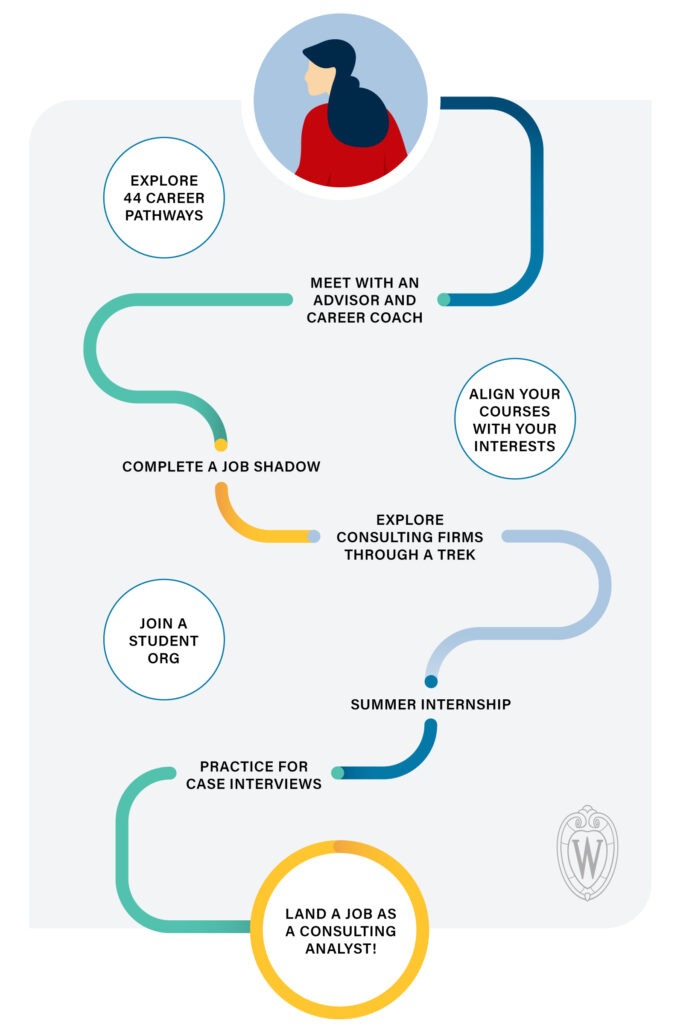
Through the Career Forward program, undergraduate students can explore 44 career pathways like technology consulting, product management, corporate risk management, supply chain planning, corporate finance, and marketing analytics and insights. These specific pathways provide students with a clear roadmap for their education, guiding them through the courses and experiences they need to succeed in their chosen field. Each path includes personalized career support coaching and help connecting students with alumni, employers, and other professionals who can provide guidance and opportunities.

Students can expand their network and connect to alumni, employers, and other professionals through unique student experiences like job shadowing, career treks, career fairs, and global programs. Treks are intentionally designed company visits in the Midwest or as far as New York and Austin to give students a taste of careers in fields like tech or consulting.

“By offering a more flexible approach to curriculum and career development and encouraging this exploration during their educational journey, we equip students to lead through change as business evolves.”
Melissa Leffin

“I participated in the Spring 2023 career trek to Chicago on the marketing and consulting track, and I am exploring opportunities in the sports business/management industry,” says Corinne Wright (BBA ’25). “I loved our visit to the Chicago Bulls. We got a tour of their facilities and front office at the United Center and got to hear from a panel of speakers across a variety of business functions.”

One of Career Forward’s main objectives is to provide every student with an opportunity to succeed, no matter their business background. The holistic student support model includes a career coach, an academic advisor, and career pathway consultants within the academic departments. The school has intentionally hired pathway consultants out of industry to help inform career preparation and grow employer partnerships for each pathway. Even with exponential growth in its undergraduate program, the school aims to keep its advisor-to-student ratio low so that students receive consistent individual guidance.

“As the Wisconsin School of Business grows, we recognize that many undergraduate students enter a professional business school with vastly disparate experiences,” says  Leffin. “WSB has implemented processes and initiatives to help make experiences like career treks, global programs, and participation in student organizations more accessible to everyone.”

Redesigned graduate portfolio empowers students to tailor their careers

WSB is continually upgrading its graduate portfolio to include new and redesigned programs that keep pace with changing market demand and provide students with flexible, innovative degree options—from the new one-year Master of Science: Business Analytics (MSBA) program and full-time MBA with specializations, to a revamped professional MBA that takes working professionals to the next level. 

Specializations and specialized tracks within the master’s programs provide a deeper focus and expertise, allowing students to hone their skills in specific areas. Examples of specializations include data analytics, real estate, and supply chain management. The MSBA program has specialized tracks in digital marketing and digital risk, while the master’s in real estate offers four tracks: core real estate, private equity investment, applied real estate investment, and affordable housing, all providing comprehensive education, networking opportunities, and training in the chosen field.

The Wisconsin Full-Time MBA allows students to choose one of eight specializations to tailor their MBA experience to their specific career goals and interests. Within each specialization, they also have access to a range of career pathways, and they build experiences in the program that allow them to continue building up their résumé in a way that is tailored to their future career.

“The MBA program has always been known for its rigorous and comprehensive curriculum, but now students have even more flexibility in choosing the courses that are most relevant to their career aspirations”
Enno Siemsen

“The MBA program has always been known for its rigorous and comprehensive curriculum, but now students have even more flexibility in choosing the courses that are most relevant to their career aspirations,” says Enno Siemsen, associate dean of the MBA and master’s programs.

MBA students are also coached by industry mentors and work directly with companies through consulting projects to gain hands-on expertise. For example, students could manage stock portfolios, real estate securities portfolios, or market research for top companies.

“The first company-run class I had was with Intuit with an emphasis on collaboration across different functions,” says Luke La Salvia (MBA ’24). “Interacting with other MBA students from the tech strategy and product management specialization in a problem-solving context was great preparation for what it’s going to be like working on projects during our career.”


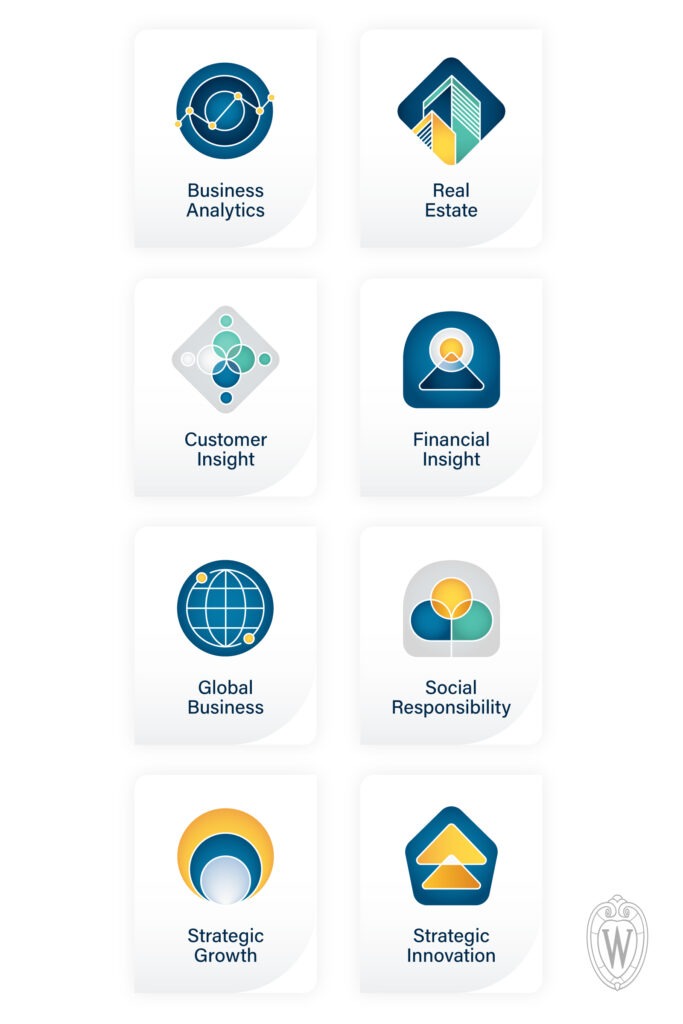
The Wisconsin Professional MBA offers its curriculum through a 50/50 hybrid delivery, giving students flexibility in how and when they consume course content while also allowing them to benefit from the rich experience of in-person learning and collaboration. The flexibility and focus on specific business disciplines through eight unique badges allow students to curate the degree to optimize their career success. Badges are available in business analytics, real estate, customer insight, financial insight, global business, social responsibility, strategic growth, and strategic innovation.

“I found that having three interrelated classes [for each badge] helped me to broaden my understanding of the topic,” says Natalie Steffes (BBA ’11, MBA ’24), director of content planning and analysis at The Walt Disney Company. “It’s helpful that we can trace through-lines throughout the classes. For example, in the customer insight badge, we worked with The University Bookstore as a client for all three classes, which was such a great learning experience, getting to analyze their business from different angles. It was a really rewarding experience.”

Customizable curriculum and experiential learning are just some of the many ways in which the school is empowering students to define their paths to success. With career coaching, an in-house mental health professional, access to a broad network of industry partners, and more than 46,000 alumni, students have holistic support and all the tools they need to succeed in any career in any industry.

Whether students are just starting their academic journey or are looking to take their careers in a new direction, WSB has the resources and expertise to help them reach their goals.

Media Contact: Leiah Fundell
Wisconsin School of Business
University of Wisconsin–Madison

The post New Model for Career Customization Positions WSB Students for Success appeared first on Wisconsin School of Business.
This Blog post was imported into the forum automatically. We hope you found it helpful. Please use the Kudos button if you did, or please PM/DM me if you found it disruptive and I will take care of it. -BB

User avatar
newsMadison
Joined: 22 Nov 2013
Last visit: -
Posts: 448
Own Kudos:
Schools: AGSM '18
Schools: AGSM '18
Posts: 448
Kudos: 1
Kudos
Add Kudos
Bookmarks
Bookmark this Post
FROM Madison(Wisconsin) Admissions Blog: Entrepreneur and WSB Alumna Kristen Berman Addresses the BBA Class of 2023
Ask for what you want. If you don’t know what you want, ask someone how you can help them.

That was the message Kristen Berman (BBA ’06) delivered to graduates during the Wisconsin School of Business’ 2023 Spring BBA Graduation Celebration. Hundreds of graduating seniors from December 2022, May 2023, and August 2023 attended the event at the Alliant Energy Center in Madison on Friday, May 12.

The event featured a keynote speech from Berman, the CEO and co-founder of Irrational Labs, a product design company focused on helping companies understand and leverage behavioral economics. She says her speech’s theme is directly tied to her own life-changing moment years ago, when she attended a lecture from a famous professor and behavioral economist. Finding herself extremely interested in the topic, she emailed the professor after the lecture and directly asked: How can I help you?

That purposeful decision lead to a response from the professor, followed by a career pivot—and the rest is history. The two would go on to start Irrational Labs and other initiatives like Common Cents Lab, which specializes in financial health research. Berman would also help launch the behavioral science group at Google.

“In life, sometimes the next step is quite obvious, but most of the time, there isn’t an obvious path,” she says. “You have to figure out how to design it for yourself.”

Since launching Irrational Labs over 10 years ago—and being named to WSB’s annual “8 to Watch” list in Update magazine in 2019—Berman happily reports continued success in her professional career.

“Irrational Labs has been taking on new and harder challenges,” she says. “We’ve been looking at behavior change in health, including things like how you get people to make a doctor’s appointment, use telehealth, and report symptoms. We’re really taking on different systems to try to figure out how to help people.”

Berman and her husband also welcomed their first child into the world in 2022—something that’s had an indirect benefit in her work as a behavioral scientist.

“You can really study human behavior when you’re watching one of your own very closely,” she says with a laugh.

She’s also designed the life she wants outside of work, and while she admits her living situation is a bit unorthodox—think nearly 20 friends living together under the same roofs—Berman says that decision reinforces another of her important life lessons for graduates: Relationships are the biggest driver of happiness.

In short, her three takeaways for the Class of 2023: Always send the email asking for what you want. Always remember that people are the most important part of life. And always stock up on cans of sparking water—it never hurts!

Wisconsin School of Business 2023 BBA Graduation Ceremony

Jump to 1:08:00 for Kristen’s full keynote speech.

The post Entrepreneur and WSB Alumna Kristen Berman Addresses the BBA Class of 2023 appeared first on Wisconsin School of Business.
This Blog post was imported into the forum automatically. We hope you found it helpful. Please use the Kudos button if you did, or please PM/DM me if you found it disruptive and I will take care of it. -BB

User avatar
newsMadison
Joined: 22 Nov 2013
Last visit: -
Posts: 448
Own Kudos:
Schools: AGSM '18
Schools: AGSM '18
Posts: 448
Kudos: 1
Kudos
Add Kudos
Bookmarks
Bookmark this Post
FROM Madison(Wisconsin) Admissions Blog: Making a Difference is Everybody’s Business
The duty of a business goes much deeper than turning a profit, or even meeting a need.

It’s an idea that Cheryl Stallworth-Hooper (MBA ’81) has built her career around. In 2016, she cofounded [url=https://shedlight.org/]ShedLight.org[/url], an organization that seeks to amplify diverse voices in order to help businesses make more informed decisions. But her interest in corporate social responsibility began much earlier.

Throughout her career journey—which has included leadership stints with The Coca-Cola Co., Colgate, and Firefly—Stallworth-Hooper has encountered experiences and role models that have helped her refine her perspective on what it means to be a socially responsible leader. She recently shared this hard-earned wisdom with Wisconsin MBA students, faculty, and alumni as part of the Wisconsin School of Business’ M. Keith Weikel MBA Leadership Speaker Series.

“We in America are a capitalist society, and corporations are powerful,” Stallworth-Hooper said. “To me, it’s their role to make a contribution.”

The power of businesses encompasses their ability to establish cultural, economic, and technology trends—but, Stallworth-Hooper explained, their influence goes beyond these. As evidence, she cited the [url=https://www.edelman.com/sites/g/files/aatuss191/files/2023-01/2023%20Edelman%20Trust%20Barometer%20Global%20Report.pdf]Eldman Trust Barometer[/url], a global study that examines the level of trust people have in governments and businesses. For years, companies have garnered more trust than governments. Therefore, if companies are trusted entities, the public expects them to take a stand on important issues.

“If we can solve big business problems, why can’t we use our resources to solve some of the problems around us, to create a world that we want to live in?”
Cheryl Stallworth-Hooper (MBA ’81)

But taking a stand can be scary, no matter how much power a company possesses. Acknowledging this, Stallworth-Hooper defined courageous leadership as the act of building a business while using one’s resources to create positive change. While at first glance community impact may seem outside the scope of business, she encouraged her audience not to be intimidated.

“We are built for this … We know how to do this,” she said. “It’s about solving problems. And so, if we can solve big business problems, why can’t we use our resources to solve some of the problems around us, to create a world that we want to live in?”

Courageous, purpose-driven leadership

[b]Embracing and overcoming fear: Take things slowly, prepare[/b]
Stallworth-Hooper argued that business leaders shouldn’t flinch from fear but rather embrace it as part of the journey. And the best way to work through it? Take things slowly.

“I had a ski instructor once who would say, ‘When you go to the top of that mountain, do not just look at the bottom of the mountain and think you’re just going to go straight down that hill,’” Stallworth-Hooper recalled. “That’s too hard. If you traverse the mountain, it forces you to stay in the moment with every step, and I think that’s just a good thing that I keep in mind. It’s one step at a time.”

Another tactic Stallworth-Hooper uses to overpower her fear is preparation. When approaching a challenging situation, she researches the topic. Doing so helps her process what is occurring—and often helps her achieve her goal.

“When you show people the facts,” she explained, “it helps change the conversation.”

[b]Pillars of strong leadership: Personal values, technical skills[/b]
For Stallworth-Hooper, there are two main pillars of strong leadership: personal values and technical skills. Personal values include qualities such as honesty, innovation, being in touch with the community, and accountability to not only shareholders but also the lowest-paid workers in the organization.

Equally as important to a leader’s personal values are their technical skills, particularly regarding management. Stallworth-Hooper stressed the importance of “creating an environment where the values of your organization are a reflection of your leadership and you’re helping people become their best selves.” She also encouraged business leaders to consider what they’re investing in, listen to their employees, and truly get to know their buyers, as these factors can greatly influence business strategies.

[img]https://business.wisc.edu/wp-content/uploads/2023/05/cheryl-stallworth-hooper-2400x1600-2-1024x683.jpg[/img]
Cheryl Stallworth-Hooper offers her perspective on what it means to be a socially responsible leader.

Socially responsible companies: Finding a good fit

For professionals hoping to join a socially responsible organization, Stallworth-Hooper suggested examining a potential employer from three perspectives. First, what new or exciting things has the company done—what does it invest in? Second, what kind of people has the company promoted recently? And finally, what challenging social issues has the company faced, and how did it deal with them? The answers to these questions provide insight into the company’s value system and help determine if it’s a good fit.

While being a socially responsible leader isn’t easy—and often requires great courage—Stallworth-Hooper maintained that contributing to society is an intrinsic component of a business career.

“We are experiencing the greatest amount of social change since the 1960s. We’re living through it,” she said. “And there’s a lot that’s expected of us as citizens and as businesspeople.”

[url=https://wsb.wisc.edu/centers-and-initiatives/weikel-speaker-series]M. Keith Weikel Leadership Speaker Series[/url] at the Wisconsin School of Business enables [url=https://wsb.wisc.edu/programs-degrees/mba]Wisconsin MBA students[/url] to interact with and learn from accomplished business leaders and alumni. Executives from both the private and public sectors are invited to campus to address students.

The series was established in 2004 with a gift by John J. Oros (BBA ’71) and his wife, Anne Wackman. Today, the series continues as the M. Keith Weikel MBA Leadership Speaker Series thanks to a gift by M. Keith Weikel (PhD ’66) and his wife, Barbara.

The post [url=https://business.wisc.edu/news/making-a-difference-is-everybodys-business/]Making a Difference is Everybody’s Business[/url] appeared first on [url=https://business.wisc.edu]Wisconsin School of Business[/url].
This Blog post was imported into the forum automatically. We hope you found it helpful. Please use the Kudos button if you did, or please PM/DM me if you found it disruptive and I will take care of it. -BB

User avatar
newsMadison
Joined: 22 Nov 2013
Last visit: -
Posts: 448
Own Kudos:
Schools: AGSM '18
Schools: AGSM '18
Posts: 448
Kudos: 1
Kudos
Add Kudos
Bookmarks
Bookmark this Post
FROM Madison(Wisconsin) Admissions Blog: Wisconsin Students Best ChatGPT in First Known Crowdsourced Accounting Study
Wisconsin School of Business students had a hand in what is the first known crowdsourced accounting study to ever take place—and outdid ChatGPT in the process.

Summary data from WSB Distinguished Teaching Professor Ann O’Brien’s Accounting Systems course last fall along with data from 185 other institutions across 14 countries was used for the experiment, which pitted the artificial intelligence chatbot, ChatGPT, against students in answering 28,085 accounting-based questions on topics ranging from audit and finance to tax and managerial content.

Judged on the number of correct responses to questions, results released as of January 2023 indicated that humans (students) outperformed ChatGPT by answering 76.7% of the questions correctly to the chatbot’s 56.5%. Not only did students overall exceed ChatGPT, but Wisconsin students did as well.

“The paper is noteworthy in two ways,” says O’Brien. “One, the way in which data was collected, compiled, and crowdsourced. And two, the content—ChatGPT. It’s one of the first research papers that looks at how ChatGPT, the artificial intelligence chatbot, performs compared to accounting students on exam questions.”

The study was just one of the ways O’Brien prepares her students to learn more about AI and other key tools while in school. Her Spring 2023 course, Foundation in Accounting Analytics, focused on emerging technologies and gives students the opportunity to practice applying them as future accounting professionals. Some of the analytical tools and technologies covered during the course include SAP Analytics, Tableau, Alteryx, Power BI, UiPath, and XBRL.

“In the class, students adopt a professional approach as accountants who are dealing with accounting analytics,” says O’Brien. “They are exploring different analytic tools and topics, everything from data management and cleaning ETL [a way of cleaning data short for ‘exact, transform, and load’] to visualizations, business modeling, automation, and financial statement analysis.”

She says students also have the freedom to “dive deeper and explore their interests” during the course and choose a technology—like ChatGPT—to then learn and teach to each other.

“It was fun to work on an innovative research project; and hopefully, my students are also inspired by opportunities to engage with the transformative impact of digital technologies,” O’Brien says.

O’Brien has invited notable speakers, many of whom are alumni, working in industry to share their expertise with the class. Professionals from PwC and Johnson Controls have visited to talk about how they use Alteryx, a data cleaning tool, and Power BI, a data modeling technology. WSB accounting alum John Paetsch (BBA ’17, MA ’18), formerly a business intelligence manager at Epic who now works at Google as a finance data and analytics engineer, took students through the analytics exercise he does with his team. Mike Kreemer (BBA ’06, MA ’07), senior director in the sales program office with Workiva, discussed XBRL and the democratization of data with the class.

The post Wisconsin Students Best ChatGPT in First Known Crowdsourced Accounting Study appeared first on Wisconsin School of Business.
This Blog post was imported into the forum automatically. We hope you found it helpful. Please use the Kudos button if you did, or please PM/DM me if you found it disruptive and I will take care of it. -BB

User avatar
newsMadison
Joined: 22 Nov 2013
Last visit: -
Posts: 448
Own Kudos:
Schools: AGSM '18
Schools: AGSM '18
Posts: 448
Kudos: 1
Kudos
Add Kudos
Bookmarks
Bookmark this Post
FROM Madison(Wisconsin) Admissions Blog: Business Casual: May 2023
The Briefing


WSB’s Joan Schmit honored for contributions to risk management
Joan Schmit (BBA ’78, MBA ’79), professor of risk and insurance at WSB, is the 2023 recipient of the Harry and Dorothy Goodell Award, which recognizes outstanding lifetime achievement in the field of risk management. Schmit is the American Family Insurance Distinguished Chair in Risk Management and Insurance at WSB and offers expertise in insurance regulation, enterprise risk management, and the interaction of law and economics in an insurance and risk management context. Schmit has been a valued WSB faculty member and leader since 1988. 


UW–Madison students turn their entrepreneurial spirit into real-world startups
Meet five UW–Madison students who are turning heads across campus and beyond with their own startups. Coming from different majors and degree programs, Badgers like Jake Piekarski (BBA ’23)—who provides flexible job opportunities through his startup, ChoreHub—are defining their own unique paths in entrepreneurship and making an impact.


Research on employee turnover from WSB’s Charlie Trevor featured in Forbes
A study co-authored by WSB’s Charlie Trevor was recently featured in a Forbes article on employee satisfaction and trust during mass layoffs. The study found that downsizing a workforce by 1% leads to a 31% increase in voluntary turnover the next year, demonstrating an organizational domino effect in which layoffs lead to distrust, dissatisfaction, and finally, departure. Charlie Trevor is a professor in management and human resources and the Ruth L. Nelson Chair in Business.

The Ticker

  • Day of the Badger 2023: On March 28–29, more than 300 donors came together to raise over $152,000 for WSB, which will increase access to global experiences for current and future students.

  • Awarding innovation: Congratulations to WSB’s Fabio Gaertner on receiving the 2023 Chancellor’s Teaching Innovation Award.

  • Business Badger hall of famers: Gwen Jorgensen (BBA ’08, MAcc ’09) and Ted Kellner (BBA ’69) were recently inducted into the Wisconsin Athletic Hall of Fame.

  • ‘Fetching’ an award: WSB alumni Wes Schroll (x ’15) and Tyler Kennedy (BBA ’13) won a 2023 Chancellor’s Entrepreneurial Achievement Award for their Madison-based startup: Fetch.

  • What’s up with noncompete agreements?: WSB’s Martin Ganco shares his insight on the Federal Trade Commission’s newly proposed rule prohibiting noncompete agreements.

  • [b][b]A+ faculty and staff: [/b][/b]WSB recognized faculty and staff for outstanding achievements at its annual end-of-year celebration.


Back to School

Sitting in Style

With warmer weather on the horizon, thousands of students, alumni, and other Madisonians will flock to one of their favorite summer spots: Memorial Union Terrace. Some are drawn to the stunning views of Lake Mendota, while others enjoy the opportunity to catch up with friends. Whatever the reason may be, almost all visitors have a special place in their heart for those iconic Sunburst chairs.

However, these eye-catching chairs weren’t always the standard. In 1929, the Terrace was originally furnished with rustic hickory chairs—but you can imagine how they fared in Madison’s harsh climate. In 1933, several versions of metal chairs replaced the original wooden chairs, including an early version of the classic stamped-metal Sunburst style. But it wasn’t until 1988 that the Sunburst chair design was patented for use only by the Wisconsin Union! See photos of the runners-up and learn more about how the Sunburst chairs found their home on the Terrace—and also how they got their colors—in this article from the Wisconsin Union.


Tip Sheet

Become a better leader with emotional intelligence

Emotional intelligence is the ability to recognize, understand, and effectively manage emotions, and is a critical workplace skill for aspiring leaders and professionals. Emotionally intelligent individuals not only reap personal career benefits, but create positive impacts on the broader work environment as well.  

Get tips and insight for honing this valuable skill at WSB’s next EdgeUp webinar: Leading with Emotional Intelligence on June 7. During this webinar, attendees will:

  • Learn the brain science of emotions that drives workplace interpersonal behaviors

  • Identify patterns, triggers, and emotional habits that either drive or derail performance and relationships

  • Assess the current state of their own emotional intelligence and identify opportunities for increased effectiveness in workplace interactions

  • Develop practical strategies and adapt behaviors to respond more skillfully and expand their influence and credibility 

Register Now!

Alumni Opportunities

Update magazine: It’s here! Check out the Spring/Summer 2023 issue of Update magazine.

June 27: Register now for WSB in MPLS, an in-person networking event for Twin City Business Badgers.

Past events: Watch previous EdgeUp webinars, Badger Executive Talks, or The Business of… events.

Job search resources: Use online tools and videos to help plan a career move now or in the future.

About Business Casual

Every other month, alumni and friends of the Wisconsin School of Business will receive insider updates with news about our alumni, faculty, students, and programs. If you want to share Business Casual with friends, they can sign up at go.wisc.edu/wsb-biz-cas.

Questions or comments? Email [email protected]

The post Business Casual: May 2023 appeared first on Wisconsin School of Business.
This Blog post was imported into the forum automatically. We hope you found it helpful. Please use the Kudos button if you did, or please PM/DM me if you found it disruptive and I will take care of it. -BB

User avatar
newsMadison
Joined: 22 Nov 2013
Last visit: -
Posts: 448
Own Kudos:
Schools: AGSM '18
Schools: AGSM '18
Posts: 448
Kudos: 1
Kudos
Add Kudos
Bookmarks
Bookmark this Post
FROM Madison(Wisconsin) Admissions Blog: ‘Girlboss:’ A Conversation with WSB’s Stav Atir on Language and Gender
Choose your words carefully, or so the old saying goes. Though usually meant in the context of maintaining harmony in human relationships, there’s another reason we should choose our words carefully and wisely: A study by Stav Atir, assistant professor of management and human resources at the Wisconsin School of Business, looks at how the language we use when talking about gender matters because it can both combat and increase bias.

A psychologist by training, Atir’s recent paper, “Girlboss? Highlighting Versus Downplaying Gender Through Language,” examines how gender marking and gender neutrality can have both inherent strengths and weaknesses that come into play depending upon when and how they are used.

WSB sat down with Atir recently to talk about her work published in the journal Trends in Cognitive Sciences:

WSB: What sparked your interest in this particular area of research?

Atir: I wasgiving a talk on one of my papers from 2018 that focuses on how we use professionals’ names differently depending on their gender. We find that people often use last names to refer to famous professionals in various domains—it’s a common reference method—but that it’s more likely to occur when talking about famous men than equally famous women. One of the takeaways was that when it comes to gender, language matters. As a result of that talk, the editor of this journal asked me if I wanted to write something about how language matters.

When we think about gender—and this comes up not just in my own research but in everyday life—there is this tension in the way that we use language. On one hand, we can use language to highlight the achievements of women and other minorities or underrepresented groups. And on the other, we have this desire for these demographics to matter less than they currently do, and we try to convey that desire through language—through gender-neutral language or through race-neutral language. So, I thought it would be interesting to write about research findings that speak to that tension.

WSB: The “Girlboss” paper addresses that push-pull balance of alternately highlighting and downplaying gender through gender marking and gender neutrality, opposite approaches that may be situation-dependent. Can you tell us more about what those terms mean?

Atir: Yes, thepaper is focused on pointing out the advantages and the drawbacks of each. It’s a more difficult task to decide: What are the specific situations in which we might want to use one or the other? Because the drawbacks don’t disappear. We have to decide what we care most about in any particular situation.

Gender marking—such as “policewoman,” “women’s basketball,” or “the female CEO”—emphasizes gender. It’s often used to spotlight women in high-status professions, which we may want to do to change people’s perceptions of who can be successful in those fields, but it also makes men and women seem fundamentally different. In professions where there is already a gender disparity—for example, if you mark the gender of the female CEO—you’re also reinforcing the perception that it’s not normal, that she’s the exception to the rule. Gender marking can perpetuate stereotypical thinking and make the target of the marking seem more unusual, which is sometimes the opposite of what we want.

Yet, if we look to gender neutrality as the solution, we encounter different problems. Gender-neutral language, such as “the CEO,” can minimize the importance of gender in the professional sphere by hiding gender and deemphasizing gender’s role. There are times when we want to do that, but gender-neutral language can also hide women because research shows that gender neutral is often not neutral at all—it’s male. When someone describes a person without specifying gender, our mental image often defaults to a man. So, if we opt for gender-neutral language, we may want to signal that gender should be irrelevant, but what we may end up doing instead is making women invisible.

WSB: It’s not uncommon to see gender marking in terms of how our culture talks about working mothers as well, right? Articles will sometimes describe a professional woman as “a vice president with Company X and she has three kids.”

Atir: This makes me think of a funny social media parody account called “Man Who Has It All.” It talks about men in the same way we as a culture talk about women to show how ridiculous some of the sentiments sound when the genders are reversed. “He was a scientist and a father! Wow, he really had it all.”

WSB: It is interesting to see gender neutrality with the evolution of words like “nurse,” which we used to assume would automatically be a female.

Atir: As we see more exemplars, hear more stories, and see more role models, our mental representations change. We have more stored mental representations of the first people that will come to mind when you say “person,” for example, which highlights the way that language is fluid and culture specific. The associations that we have with certain words now are not what they were 20 years ago, and probably not what they will be 20 years from now.

Thinking about language: I am Israeli, so my native language is Hebrew. And Hebrew is highly gendered; it’s hard to say anything without specifying a gender. Even objects are gendered. So, these languages face additional barriers. There are groups devoted to making language more inclusive via different approaches such as new words and new fonts that leave the gender ambiguous, or phrasings that don’t reveal gender, so that the emphasis is very much on gender neutrality.

WSB: What do you hope people come away with after reading your study and learning about your work in this space?

Atir: Language is one tool that we can and should use to express our opinions and potentially drive social change. I would like people to be thoughtful about the way that they do this, to be aware of both the advantages and the drawbacks of their linguistic choices.

Ultimately, I think language is going to be only a small part of what drives change forward. And as we become a more egalitarian society, the way we use language to achieve our goals is also going to look different and evolve.

The post ‘Girlboss:’ A Conversation with WSB’s Stav Atir on Language and Gender appeared first on Wisconsin School of Business.
This Blog post was imported into the forum automatically. We hope you found it helpful. Please use the Kudos button if you did, or please PM/DM me if you found it disruptive and I will take care of it. -BB
   1  ...  9   10   11   12   13  ...  16