Events & Promotions
|
|

GMAT Club Daily Prep
Thank you for using the timer - this advanced tool can estimate your performance and suggest more practice questions. We have subscribed you to Daily Prep Questions via email.
Customized
for You
Track
Your Progress
Practice
Pays
Not interested in getting valuable practice questions and articles delivered to your email? No problem, unsubscribe here.
 Sep 04
10:00 AM PDT
-11:00 AM PDT
What does test anxiety really look like on the GMAT? For many test takers, it does not look like a panic attack. Instead, it shows up as brain fog, rereading, negative comparisons, mental noise.... Sep 02
01:00 PM EDT
-11:59 PM EDT
Take 30% off all study plans with code COURSEWORK - Expires on Monday 9/7 Sep 06
09:30 AM EDT
-12:30 PM EST
Top scores are possible when you enroll in a powerful EA course, taught live online + 6 months access to TTP OnDemand video courses included! Perfect class schedule and easy course access for working professionals. Class starts Sundays Sept. 6, 2026.- Sep 07
12:01 AM PDT
-11:59 PM PDT
On the 7th, GMAT Club Tests will be Free! Including all the Quizzes, Questions, and Tests. 12 AM - 11:59 PM PDT - Sep 07
10:00 AM PDT
-11:00 AM PDT
A complete walkthrough of GMAT Club’s free 12-week GMAT study plan: what you study each week, how progress and goals are tracked, how the error log works, and how your practice unlocks paid tools at no cost. - Sep 09
07:00 AM PDT
-10:00 AM PDT
Meet AdComs and explore top Master’s programs - MiM, MiF, MSc, MSBA and more. - Application Fee Waivers - Free 1-Week of GMAT Club Tests: - Master's Application Toolkit - Grand Prize Giveaway - Sep 09
10:00 AM PDT
-11:00 AM PDT
Three MBA applications. Three rejections. No interview invites. A year later, Aman was admitted to Cambridge Judge, SMU, and IMD. In this episode of MBA Admit Stories, Aman shares how he rebuilt his MBA application...  Sep 15
07:00 PM EDT
-09:00 PM EST
Elite scores are possible when you enroll in a powerful GMAT course, taught live online + 6 months access to TTP OnDemand video courses included! Class starts Tues/Thurs Sept. 15, 2026 - Nov. 15, 2027, 7:00pm-9:00pm EST Sep 21
08:00 PM EDT
-10:00 PM EDT
Boost your GMAT score in less than one month in a live online class + 6 months access to TTP OnDemand video courses included! Class starts Mon, Tues, Wed, Thur, Fri Sept. 21, 2026 - Oct. 9, 2027, 7:00pm-10:00pm EST

 08 Apr 2011, 05:46
Kudos
Bookmarks


N
Be sure to select an answer first to save it in the Error Log before revealing the correct answer (OA)!
Difficulty:
(N/A)
Question Stats:
86% (01:44) correct 14%
(02:11)
wrong
based on 514
sessions
14%
(02:11)
wrong
based on 514
sessions
History
Date
Time
Result
Not Attempted Yet
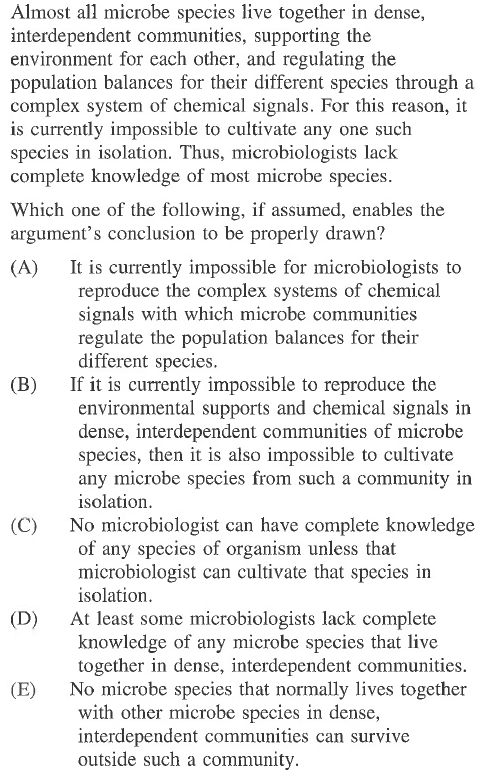
Almost all microbe species live together in dense, interdependent communities, supporting the environment for each other, and regulating the population balances for their different species through a complex system of chemical signals. For this reason, it is currently impossible to cultivate any one such species in isolation. Thus, microbiologists lack complete knowledge of most microbe species.
Which one of the following, if assumed, enables the argument’s conclusion to be properly drawn?
A. It is currently impossible for microbiologists to reproduce the complex systems of chemical signals with which microbe communities regulate the population balances for their different species.
B. If it is currently impossible to reproduce the environmental supports and chemical signals in dense, interdependent communities of microbe species, then it is also impossible to cultivate any microbe species from such a community in isolation.
C. No microbiologist can have complete knowledge of any species of organism unless that microbiologist can cultivate that species in isolation.
D. At least some microbiologists lack complete knowledge of any microbe species that live together in dense, interdependent communities.
E. No microbe species that normally lives together with other microbe species in dense, interdependent communities can survive outside such a community.
microbe.png [ 76.15 KiB | Viewed 7319 times ]
Which one of the following, if assumed, enables the argument’s conclusion to be properly drawn?
A. It is currently impossible for microbiologists to reproduce the complex systems of chemical signals with which microbe communities regulate the population balances for their different species.
B. If it is currently impossible to reproduce the environmental supports and chemical signals in dense, interdependent communities of microbe species, then it is also impossible to cultivate any microbe species from such a community in isolation.
C. No microbiologist can have complete knowledge of any species of organism unless that microbiologist can cultivate that species in isolation.
D. At least some microbiologists lack complete knowledge of any microbe species that live together in dense, interdependent communities.
E. No microbe species that normally lives together with other microbe species in dense, interdependent communities can survive outside such a community.
Attachment:
microbe.png [ 76.15 KiB | Viewed 7319 times ]
 08 Apr 2011, 07:47
Kudos
Bookmarks
The last two sentence provide the main conclusion of the argument. Hence in answer choice look for assumptions based on them.
1.) Assumption does not help conclusion completely
2.) Out of scope or false
3.) Fits the conclusion in the last two sentences
4.) Even if true, does not help the conclusion
5.) False
1.) Assumption does not help conclusion completely
2.) Out of scope or false
3.) Fits the conclusion in the last two sentences
4.) Even if true, does not help the conclusion
5.) False
08 Apr 2011, 09:19
Kudos
Bookmarks
IEsailor
My doubt about C is that,Do a microbiologists needs to experiment it PERSONALLY to have the complete knowledge about any species of organism.Means can't some other microbiologist(s) do the research and publish the result to others to gain the knowledge?
Option E says "No microbiologists can have the complete knowledge of any species of organism unless that microbiologist can cultivate that species in isolation".
Why B is OOS or false. OOS is the easiest reason I have seen to avoid an option. No personal offence to you IEsailor.

 But OA is C only.