Events & Promotions
|
|

GMAT Club Daily Prep
Thank you for using the timer - this advanced tool can estimate your performance and suggest more practice questions. We have subscribed you to Daily Prep Questions via email.
Customized
for You
Track
Your Progress
Practice
Pays
Not interested in getting valuable practice questions and articles delivered to your email? No problem, unsubscribe here.
 May 05
10:00 AM PDT
-11:00 AM PDT
GMAT Inequalities is a high-frequency topic in GMAT Quant, but many students struggle because the concepts behave differently from standard algebra. Understanding the right rules, patterns, and edge cases can significantly improve both speed and accuracy. May 06
12:30 AM EDT
-01:30 AM EDT
GMAT 615 to 715 in Just 15 Days! Riya’s 100-pt Improvement Strategy- May 06
08:30 AM PDT
-09:30 AM PDT
In Episode 3 of our GMAT Ninja Critical Reasoning series, we tackle Discrepancy, Paradox, and Explain an Oddity questions. You know the feeling: the passage gives you two facts that seem completely contradictory....  May 07
01:00 AM EDT
-02:00 AM EDT
Learn how Keshav, a Chartered Accountant, scored an impressive 705 on GMAT in just 30 days with GMATWhiz's expert guidance. In this video, he shares preparation tips and strategies that worked for him, including the mock, time management, and.....- May 08
08:00 AM PDT
-08:30 AM PDT
Join the special YouTube live-stream for selecting the winners of GMAT Club MBA Scholarships sponsored by Juno live. Watch who gets these coveted MBA scholarships offered by GMAT Club and Juno.  May 08
08:00 PM PDT
-09:00 PM PDT
Free- full-length test + 15 concept videos + 150+ short videos + study plan!

 29 Oct 2023, 10:45
Kudos
Bookmarks


C
Be sure to select an answer first to save it in the Error Log before revealing the correct answer (OA)!
Difficulty:
 85%
(hard)
85%
(hard)
Question Stats:
58% (02:28) correct 42%
(02:38)
wrong
based on 1083
sessions
42%
(02:38)
wrong
based on 1083
sessions
History
Date
Time
Result
Not Attempted Yet
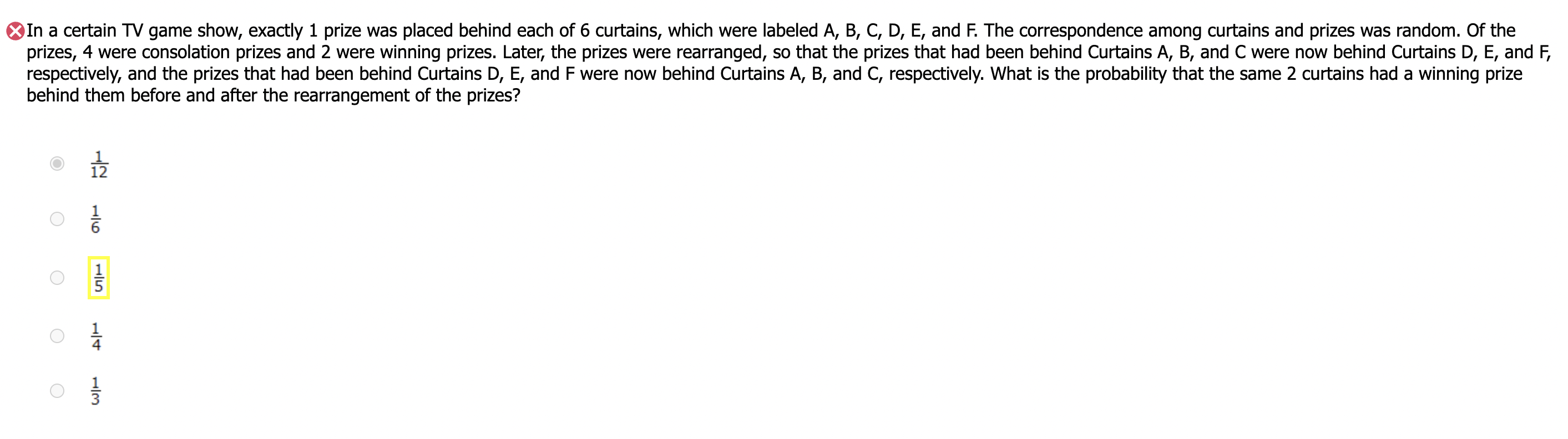
In a certain TV game show, exactly 1 prize was placed behind each of 6 curtains, which were labeled A, B, C, D, E, and F. The correspondance among curtains and prizes was random. Of the prizes, 4 were consolation prizes and 2 were winning prizes. Later, the prizes were rearranged, so that the prizes that had been behind Curtains A, B, and C were now behind Curtains D, E, and F, respectively, and the prizes that had been behind Curtains D, E, and F were now behind Curtains A, B, and C, respectively. What is the probability that the same 2 curtains had a winning prize behind them before and after the rearrangement of the prizes?
A. \(\frac{1}{12}\)
B. \(\frac{1}{6}\)
C. \(\frac{1}{5}\)
D. \(\frac{1}{4}\)
E. \(\frac{1}{3}\)
Screenshot 2024-02-24 at 16.12.04.png [ 612.22 KiB | Viewed 20768 times ]
A. \(\frac{1}{12}\)
B. \(\frac{1}{6}\)
C. \(\frac{1}{5}\)
D. \(\frac{1}{4}\)
E. \(\frac{1}{3}\)
Attachment:
Screenshot 2024-02-24 at 16.12.04.png [ 612.22 KiB | Viewed 20768 times ]
Trying to understand why the right answer is right?
GMAT Club Tests explanations walk through concepts, shortcuts, and common traps on many questions.
See how →
 29 Oct 2023, 12:20
Kudos
Bookmarks
yrozenblum
Let's assume the prizes are indicated as shown below -
Winning Prize = \(W_1\) & \(W_2\)
Consolidation Prize = \(C_1, C_2, C_3,\) & \(C_4\)
Note: The prizes are identical.
Only when two curtains that are being swapped have winning prizes before the swap, will the curtains have winning prizes after the swap. For example, if there is a winning prize behind curtain A, and curtain D before the swap, there will be a winning prize behind the two curtains after the swap. In all other possibilities, the type of prize will not be retained.
Let's assume curtain A and curtain D have the winning prize.
The number of ways of arranging two winning prizes and four consolidation prizes in a single row = \(\frac{6!}{2!*4!} = 15\)
Of the 15 arrangements only one arrangement indicates that curtain A and curtain D have the winning prize (shown below)-
| Curtain A | Curtain B | Curtain C | Curtain D | Curtain E | Curtain F |
| Winning | Consolation | Consolation | Winning | Consolation | Consolation |
The same analysis holds true to calculate the probability of curtain B and curtain E having the winning prize and of curtain C and curtain F having the winning prize.
The probability of (curtain B and curtain E having the winning prize) = \(\frac{1}{15}\)
The probability of (curtain C and curtain F having the winning prize) = \(\frac{1}{15}\)
Total Probability = The probability of (curtain A and curtain D having the winning prize) OR The probability of (curtain B and curtain E having the winning prize) OR The probability of (curtain C and curtain F having the winning prize)
Total Probability = \(\frac{1}{15} * 3 = \frac{1}{5}\)
Option C
 29 Oct 2023, 13:08
Kudos
Bookmarks
Both prizes need to be behind a pair being switched both before and after the switch.
Further, the prizes are indistinguishable from one another.
Put one prize behind one door.
The probability that the 2nd prize is placed behind the paired door is therefore
1/5
Another way:
Number of ways to select 2 doors behind which to place the prizes:
6!/2!4! = 15
The number of door pairs that match the swapping condition:
3
Probability of a swapping door pair being selected from all possible door pairs:
3/15 = 1/5
Posted from my mobile device
Further, the prizes are indistinguishable from one another.
Put one prize behind one door.
The probability that the 2nd prize is placed behind the paired door is therefore
1/5
Another way:
Number of ways to select 2 doors behind which to place the prizes:
6!/2!4! = 15
The number of door pairs that match the swapping condition:
3
Probability of a swapping door pair being selected from all possible door pairs:
3/15 = 1/5
Posted from my mobile device