Events & Promotions
| Last visit was: 14 Sep 2026, 10:26 |
It is currently 14 Sep 2026, 10:26 |
|
|

GMAT Club Daily Prep
Thank you for using the timer - this advanced tool can estimate your performance and suggest more practice questions. We have subscribed you to Daily Prep Questions via email.
Customized
for You
Track
Your Progress
Practice
Pays
Not interested in getting valuable practice questions and articles delivered to your email? No problem, unsubscribe here.
 Sep 15
07:00 PM EDT
-09:00 PM EST
Elite scores are possible when you enroll in a powerful GMAT course, taught live online + 6 months access to TTP OnDemand video courses included! Class starts Tues/Thurs Sept. 15, 2026 - Nov. 15, 2027, 7:00pm-9:00pm EST Sep 18
08:00 PM PDT
-09:00 PM PDT
Video explanations + diagnosis of 10 weakest areas + 150+ short videos + study plan! Sep 21
07:00 PM EDT
-10:00 PM EDT
Boost your GMAT score in less than one month in a live online class + 6 months access to TTP OnDemand video courses included! Class starts Mon, Tues, Wed, Thur, Fri Sept. 21, 2026 - Oct. 9, 2027, 7:00pm-10:00pm EST

metallicafan
Retired Moderator
Joined: 04 Oct 2009
Last visit: 26 Aug 2020
Posts: 754
Given Kudos: 109
Status:2000 posts! I don't know whether I should feel great or sad about it! LOL
Location: Peru
Concentration: Finance, SMEs, Developing countries, Public sector and non profit organizations
Schools:Harvard, Stanford, Wharton, MIT & HKS (Government)
GPA: 4.0
WE 1: Economic research
WE 2: Banking
WE 3: Government: Foreign Trade and SMEs
 Updated on: 03 Aug 2021, 02:46
Originally posted by metallicafan on 04 Oct 2010, 20:27.
Last edited by Bunuel on 03 Aug 2021, 02:46, edited 3 times in total.
Last edited by Bunuel on 03 Aug 2021, 02:46, edited 3 times in total.
Renamed the topic and edited the question.
Kudos
Bookmarks


E
Be sure to select an answer first to save it in the Error Log before revealing the correct answer (OA)!
Difficulty:
 95%
(hard)
95%
(hard)
Question Stats:
39% (02:28) correct 61%
(02:22)
wrong
based on 5487
sessions
61%
(02:22)
wrong
based on 5487
sessions
History
Date
Time
Result
Not Attempted Yet
In the xy-plane, region R consists of all the points (x,y) such that \(2x + 3y\leq{6}\). Is the point (r,s) in region R?
(1) \(3r + 2s = 6\)
(2) \(r\leq{3}\) and \(s\leq{2}\)
(1) \(3r + 2s = 6\)
(2) \(r\leq{3}\) and \(s\leq{2}\)
If this question felt shaky,
try an adaptive mini quiz of similar problems in
GMAT Club Forum Quiz →. Free plan gives 5 questions per day.

 05 Oct 2010, 03:37
Kudos
Bookmarks
metallicafan
Though the solution provided by shrouded1 above is perfectly OK, it's doubtful that can be done in 2-3 minutes.
So I'd say the best way for this question would be to try boundary values.
In the xy-plane, region R consists of all the points (x, y) such that \(2x + 3y =< 6\) . Is the point (r,s) in region R?
Q: is \(2r+3s\leq{6}\)?
(1) \(3r + 2s = 6\) --> very easy to see that this statement is not sufficient:
If \(r=2\) and \(s=0\) then \(2r+3s=4<{6}\), so the answer is YES;
If \(r=0\) and \(s=3\) then \(2r+3s=9>6\), so the answer is NO.
Not sufficient.
(2) \(r\leq{3}\) and \(s\leq{2}\) --> also very easy to see that this statement is not sufficient:
If \(r=0\) and \(s=0\) then \(2r+3s=0<{6}\), so the answer is YES;
If \(r=3\) and \(s=2\) then \(2r+3s=12>6\), so the answer is NO.
Not sufficient.
(1)+(2) We already have an example for YES answer in (1) which valid for combined statements:
If \(r=2<3\) and \(s=0<2\) then \(2r+3s=4<{6}\), so the answer is YES;
To get NO answer try max possible value of \(s\), which is \(s=2\), then from (1) \(r=\frac{2}{3}<3\) --> \(2r+3s=\frac{4}{3}+6>6\), so the answer is NO.
Not sufficient.
Answer: E.
Hope it's clear.


metallicafan
Ok, the easiest way to solve this is to visualize the graph with the lines plotted on it.
2x+3y<=6, is the region below the line with X-intercept 3 and Y-intercept 2. We know it is that region, because (0,0) lies below the line and it satisfies the inequality. And all points on one side of the line satisfy the same sign of inequality. (BLUE LINE)
(1) : The line 3r+2s=6 (PURPLE LINE) represents the second line shown in the figure. It can be above or below the other line. So insufficient.
(2) : r<=3 & s<=2. Again easy to see from the graph even with that constraint, the point (r,s) may lie above or below the line in question
(1+2) : the two conditions together, only take a section of the 3r+2s=6 line as a solution, but again even with r<=3, s<=2, its not sufficient to keep solutions below the 2x + 3y =< 6 line
Answer is (e)
In questions like these, once you are comfortable with graphs, you can solve in less than 30 seconds fairly easily.
Let me know if the method isn't clear
 Updated on: 16 Apr 2018, 12:59
Originally posted by BrentGMATPrepNow on 01 Aug 2016, 07:58.
Last edited by BrentGMATPrepNow on 16 Apr 2018, 12:59, edited 1 time in total.
Last edited by BrentGMATPrepNow on 16 Apr 2018, 12:59, edited 1 time in total.
Kudos
Bookmarks
metallicafan
Target question: Is the point (r, s) in region R?
Given: Region R consists of all the points (x,y) such that 2x + 3y <6
So, what does Region R look like?
To find out, let's first graph the EQUATION, 2x + 3y = 6
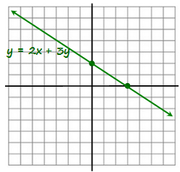
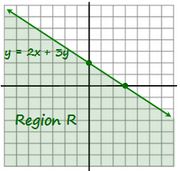
Since Region R is described as an INEQUALITY, we can choose any point on the coordinate plane to test whether or not it is in Region R. An easy point to test is (0,0).
So, does x=0 and y=0 satisfy the inequality 2x + 3y <6? YES
2(0) + (3)(0) is less than or equal to 6.
So, the point (0,0) is in Region R. More importantly, EVERY POINT on the same side of the line will also be in Region R.
Statement 1: 3r + 2s = 6
The target question refers to the point (r, s)
In other words, the x-coordinate is r and the y-coordinate is s.
So, all of the points (r, s) that satisfy the above equation can be found on the line 3x + 2y = 6
In other words, statement 1 tells us that the point (r,s) lies somewhere on the red line below.
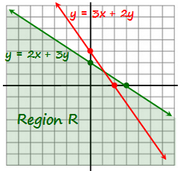
As you can see, some points are in Region R, and some points are not in Region R
Since we cannot answer the target question with certainty, statement 1 is NOT SUFFICIENT
Statement 2: r < 3 and s < 2
There are many points that satisfy this condition.
In fact, the point (r,s) can be ANYWHERE inside the red box shown below.
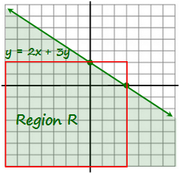
As you can see, some points are in Region R, and some points are not in Region R
Since we cannot answer the target question with certainty, statement 2 is NOT SUFFICIENT
Statements 1 and 2 combined
When we combine the statements, we are saying that the point (r,s) is on the red line (2x + 3y = 6) AND inside the red box.
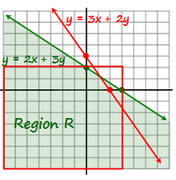
As you can see by the two blue points below, it's possible to have a point in Region R, and it's possible to have a point not in Region R
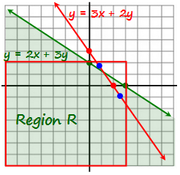
Since we cannot answer the target question with certainty, the combined statements are NOT SUFFICIENT
Answer =
Cheers,
Brent