Events & Promotions
|
|

GMAT Club Daily Prep
Thank you for using the timer - this advanced tool can estimate your performance and suggest more practice questions. We have subscribed you to Daily Prep Questions via email.
Customized
for You
Track
Your Progress
Practice
Pays
Not interested in getting valuable practice questions and articles delivered to your email? No problem, unsubscribe here.
 Sep 28
07:00 PM EDT
-10:00 PM EDT
Boost your GMAT score in less than one month in a live online class + 6 months access to TTP OnDemand video courses included! Class starts Mon, Tues, Wed, Thur, Fri Sept. 28, 2026 - Oct. 16, 2027, 7:00pm-10:00pm EST Sep 29
11:00 AM EDT
-01:00 PM EDT
" Description: Top scores are possible when you enroll in a powerful GMAT course, taught live online + 6 months access to TTP OnDemand video courses included! Class starts Tues/Thur Sept. 29, 2026 - Dec. 3, 2026, 11:00am-1:00pm EST Oct 01
07:00 AM BST
-08:00 AM GMT
Welcome to the GMAT Club's Free Interview Prep Event for Top MBA Programs! Buy tickets - Virtual series that’s all set to equip you to -excel in your MBA interviews. Oct 03
01:00 PM EDT
-04:00 PM EDT
Top scores are possible when you enroll in a powerful GMAT course, taught live online + 6 months access to TTP OnDemand video courses included! Class starts Saturdays Oct. 3, 2026 - Dec. 26, 2026, 1:00pm-4:00pm EST

 14 Feb 2024, 07:14
Kudos
Bookmarks


Required: Any nonmanagerial employees currently allowed access to Drive E are also allowed access to Drive D.
Permitted: Managerial employees, and only those, are currently allowed access to Drive E.
Be sure to select an answer first to save it in the Error Log before revealing the correct answer (OA)!
Difficulty:
 95%
(hard)
95%
(hard)
Question Stats:
34% (03:18) correct 66%
(03:36)
wrong
based on 1121
sessions
66%
(03:36)
wrong
based on 1121
sessions
History
Date
Time
Result
Not Attempted Yet
To ensure computer security, a firm has rules about access of managerial and nonmanagerial employees to various networked computer drives. In accordance with the rules, some but not all nonmanagerial employees are allowed access to both Drive B and Drive D. Some are required to have such access. Every nonmanagerial employee must have access to at least one of Drive B and Drive D. No nonmanagerial employee is allowed to have access to both Drive B and Drive E. The rules do not restrict the access of managerial employees to any of the drives mentioned.
From the following statements about computer security practices in relation to the firm's employees, select for Required the statement that, based on the information provided, describes a practice that is required by the rules, and select for Permitted the statement that describes a practice that is permitted, but NOT required, by the rules. Make only two selections, one in each column.
From the following statements about computer security practices in relation to the firm's employees, select for Required the statement that, based on the information provided, describes a practice that is required by the rules, and select for Permitted the statement that describes a practice that is permitted, but NOT required, by the rules. Make only two selections, one in each column.
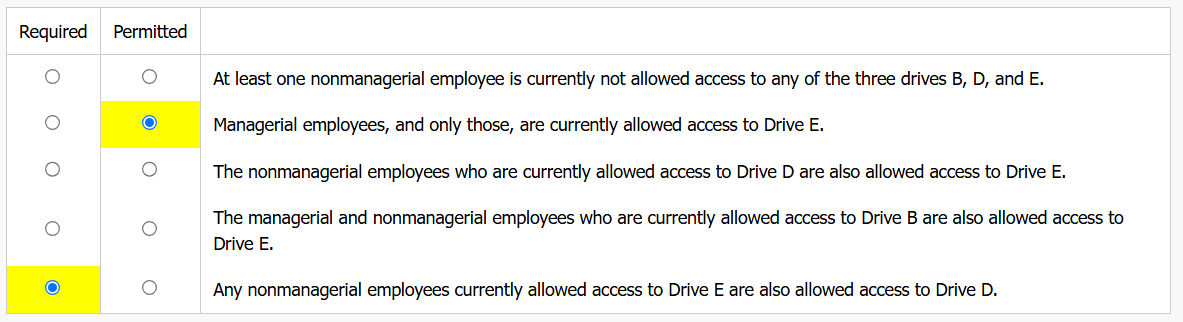
| Required | Permitted | |
| At least one nonmanagerial employee is currently not allowed access to any of the three drives B, D, and E. | ||
| Managerial employees, and only those, are currently allowed access to Drive E. | ||
| The nonmanagerial employees who are currently allowed access to Drive D are also allowed access to Drive E. | ||
| The managerial and nonmanagerial employees who are currently allowed access to Drive B are also allowed access to Drive E. | ||
| Any nonmanagerial employees currently allowed access to Drive E are also allowed access to Drive D. |
ShowHide Answer
Official Answer
Required: Any nonmanagerial employees currently allowed access to Drive E are also allowed access to Drive D.
Permitted: Managerial employees, and only those, are currently allowed access to Drive E.
ID: 700226

 20 Aug 2026, 12:32
Kudos
Bookmarks
To ensure computer security, a firm has rules about access of managerial and nonmanagerial employees to various networked computer drives. In accordance with the rules, some but not all nonmanagerial employees are allowed access to both Drive B and Drive D. Some are required to have such access. Every nonmanagerial employee must have access to at least one of Drive B and Drive D. No nonmanagerial employee is allowed to have access to both Drive B and Drive E. The rules do not restrict the access of managerial employees to any of the drives mentioned.
From the following statements about computer security practices in relation to the firm's employees, select for Required the statement that, based on the information provided, describes a practice that is required by the rules, and select for Permitted the statement that describes a practice that is permitted, but NOT required, by the rules. Make only two selections, one in each column.
Here are the rules in simple terms.
Rule 1:
“Some but not all nonmanagerial employees are allowed access to both Drive B and Drive D.”
Meaning: Some nonmanagers are allowed to have both B and D, but not every nonmanager is allowed to have both.
Rule 2:
“Some are required to have such access.”
Meaning: Some nonmanagers must have both B and D. For these employees, having only B or only D is not enough.
Rule 3:
“Every nonmanagerial employee must have access to at least one of Drive B and Drive D.”
Meaning: Every nonmanager must have:
B only, or
D only, or
both B and D.
They cannot have neither B nor D.
Rule 4:
“No nonmanagerial employee is allowed to have access to both Drive B and Drive E.”
Meaning: A nonmanager cannot have B and E together.
So if a nonmanager has E, that person cannot have B.
Rule 5:
“The rules do not restrict the access of managerial employees to any of the drives mentioned.”
Meaning: These restrictions apply only to nonmanagers. Managers can have any combination of B, D, and E.
Summary
For nonmanagers:
• Everyone must have B or D or both.
• Some are allowed to have both B and D.
• Some are actually required to have both B and D.
• Nobody can have B and E together.
• Therefore, if a nonmanager has E, that person cannot have B and consequently must have D.
For managers, there are no restrictions given.
_____________________
We need one statement that is required and one that is permitted but not required.
A. At least one nonmanagerial employee is currently not allowed access to any of B, D, and E.
This is impossible. Every nonmanager must have access to at least one of B or D. So no nonmanager can have access to none of the three.
Not Required. Not Permitted.
B. Managerial employees, and only those, are currently allowed access to Drive E.
This is possible. Managers have no restrictions, so they may have E. Nothing requires any nonmanager to have E, so it is possible that only managers have E.
But this is not required because nonmanagers may also have E, provided they do not have B.
Permitted.
C. The nonmanagerial employees who are currently allowed access to Drive D are also allowed access to Drive E.
This cannot be true for all such employees. We know some nonmanagers are required to have both B and D. Those employees have B, so they cannot also have E.
Not Required. Not Permitted.
D. The managerial and nonmanagerial employees who are currently allowed access to Drive B are also allowed access to Drive E.
This is impossible for the nonmanagers. No nonmanager is allowed to have both B and E.
Not Required. Not Permitted.
E. Any nonmanagerial employees currently allowed access to Drive E are also allowed access to Drive D.
If a nonmanager has E, that person cannot have B.
But every nonmanager must have at least B or D. Since B is impossible for that person, the person must have D.
Required.
So the selections are:
Required: E
Permitted: B

GMAT-Club-Forum-rbxfcd8x.png [ 43.92 KiB | Viewed 1023 times ]
From the following statements about computer security practices in relation to the firm's employees, select for Required the statement that, based on the information provided, describes a practice that is required by the rules, and select for Permitted the statement that describes a practice that is permitted, but NOT required, by the rules. Make only two selections, one in each column.
Here are the rules in simple terms.
Rule 1:
“Some but not all nonmanagerial employees are allowed access to both Drive B and Drive D.”
Meaning: Some nonmanagers are allowed to have both B and D, but not every nonmanager is allowed to have both.
Rule 2:
“Some are required to have such access.”
Meaning: Some nonmanagers must have both B and D. For these employees, having only B or only D is not enough.
Rule 3:
“Every nonmanagerial employee must have access to at least one of Drive B and Drive D.”
Meaning: Every nonmanager must have:
B only, or
D only, or
both B and D.
They cannot have neither B nor D.
Rule 4:
“No nonmanagerial employee is allowed to have access to both Drive B and Drive E.”
Meaning: A nonmanager cannot have B and E together.
So if a nonmanager has E, that person cannot have B.
Rule 5:
“The rules do not restrict the access of managerial employees to any of the drives mentioned.”
Meaning: These restrictions apply only to nonmanagers. Managers can have any combination of B, D, and E.
Summary
For nonmanagers:
• Everyone must have B or D or both.
• Some are allowed to have both B and D.
• Some are actually required to have both B and D.
• Nobody can have B and E together.
• Therefore, if a nonmanager has E, that person cannot have B and consequently must have D.
For managers, there are no restrictions given.
_____________________
We need one statement that is required and one that is permitted but not required.
A. At least one nonmanagerial employee is currently not allowed access to any of B, D, and E.
This is impossible. Every nonmanager must have access to at least one of B or D. So no nonmanager can have access to none of the three.
Not Required. Not Permitted.
B. Managerial employees, and only those, are currently allowed access to Drive E.
This is possible. Managers have no restrictions, so they may have E. Nothing requires any nonmanager to have E, so it is possible that only managers have E.
But this is not required because nonmanagers may also have E, provided they do not have B.
Permitted.
C. The nonmanagerial employees who are currently allowed access to Drive D are also allowed access to Drive E.
This cannot be true for all such employees. We know some nonmanagers are required to have both B and D. Those employees have B, so they cannot also have E.
Not Required. Not Permitted.
D. The managerial and nonmanagerial employees who are currently allowed access to Drive B are also allowed access to Drive E.
This is impossible for the nonmanagers. No nonmanager is allowed to have both B and E.
Not Required. Not Permitted.
E. Any nonmanagerial employees currently allowed access to Drive E are also allowed access to Drive D.
If a nonmanager has E, that person cannot have B.
But every nonmanager must have at least B or D. Since B is impossible for that person, the person must have D.
Required.
So the selections are:
Required: E
Permitted: B
Attachment:
GMAT-Club-Forum-rbxfcd8x.png [ 43.92 KiB | Viewed 1023 times ]
General Discussion


 14 Feb 2024, 09:44
Kudos
Bookmarks
Iwillget770
RULES:
1) Non-managerial
- Not every one has access to both B and D
- Some have access to both B and D
- No one has access to both B and E
- All have access to at least one of B and D.
2) Managerial
- No restrictions, all permitted
Required (a practice that is required by the rules)
Go through the options. There is only one choice that is a MUST. If a non-managerial has access to E, then he must have access to D.
One of B and D is must, and B does not go along with E. So the rule requires that E is coupled with D.
Permitted ( a practice that is permitted, but NOT required, by the rules)
- At least one nonmanagerial employee is currently not allowed access to any of the three drives B, D, and E.
- Managerial employees, and only those, are currently allowed access to Drive E.
- The nonmanagerial employees who are currently allowed access to Drive D are also allowed access to Drive E.
- The managerial and nonmanagerial employees who are currently allowed access to Drive B are also allowed access to Drive E.