Thank you for using the timer - this advanced tool can estimate your performance and suggest more practice questions. We have subscribed you to Daily Prep Questions via email.
Customized for You
we will pick new questions that match your level based on your Timer History
Track Your Progress
every week, we’ll send you an estimated GMAT score based on your performance
Practice Pays
we will pick new questions that match your level based on your Timer History
Not interested in getting valuable practice questions and articles delivered to your email? No problem, unsubscribe here.
Thank you for using the timer!
We noticed you are actually not timing your practice. Click the START button first next time you use the timer.
There are many benefits to timing your practice, including:
The Target Test Prep course represents a quantum leap forward in GMAT preparation, a radical reinterpretation of the way that students should study. Try before you buy with a 5-day, full-access trial of the course for FREE!
Prefer video-based learning? The Target Test Prep OnDemand course is a one-of-a-kind video masterclass featuring 400 hours of lecture-style teaching by Scott Woodbury-Stewart, founder of Target Test Prep and one of the most accomplished GMAT instructors
Originally posted by TargetMBA007 on 27 Dec 2019, 19:46.
Last edited by Bunuel on 11 Jun 2024, 04:30, edited 8 times in total.
11
Kudos
Add Kudos
115
Bookmarks
Bookmark this Post
Show timer
00:00
Start Timer
Pause Timer
Resume Timer
Show Answer
Hide Answer
Correct Answer
Hide
Show
History
Dropdown 1: France
Dropdown 2: Russia
Be sure to select an answer first to save it in the Error Log before revealing the correct answer (OA)!
Select the dropdowns below and click "Submit" to add this question to your Error log.
Difficulty:
55%
(hard)
Question Stats:
66%
(01:51)
correct 34%
(02:20)
wrong
based on 4136
sessions
History
Date
Time
Result
Not Attempted Yet
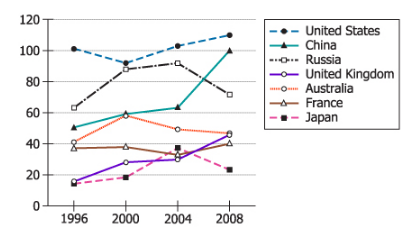
The graph shows the numbers of medals won by 7 selected countries in the Summer Olympics that were held in the years 1996, 2000, 2004, and 2008. The following statements apply only to the Summer Olympics and the countries represented in the graph.
Using the drop-down menus, create the most accurate statements based on the information provided.
The variance in the numbers of medals won is the least for .
If, for each country, the point representing the medals won in 2004 had been on the line determined by the points representing the medals won in 1996 and 2000, then the country that would have won the greatest number of medals in 2004 is .
I had difficulty deciphering the second question here gradually figured that it means that if the trends in 1996 and 2000 had continued in 2004, who would have been the winner in 2004. As Russia is trending upwards and US is trending downwards based on the trend line formed between 1996 and 2000, Russia would have the highest point on the line in 2004.
1) France - Since it is having least variation in its values 2) Russia - Since if we consider the values of 1996 & 2000 and then draw the graph further accordingly then it will have the highest values in 2004, we can check the same for other countries but logic here is to check the values for the countries which are already at top points in the graph
The second statement is a bit trickier, it say that if the trend lines (as for 1996 to 2000) of the points of medals continues the greatest number of medal won by which country.
Question 1: Look for the graph will least changes from the four options. It's obviously France.
Question 2: Now, the question is asking what if I only had the graph until 2000 and no information after that. Using that, if the graph are ONLY straight lines and no bends, then can you predict the winner of 2004? The graph with the highest slope will be answer. (If you don't understand why, mention me and I will explain it in more detail)
Now, considering the four countries in the option. United States cannot be the answer since the graph is dipping. Comparing Australia and China, we know that Australia will be higher since its slope is higher. Comparing Australia and Russia, Russia's slope is higher and hence it is the answer.
Second question is quite vague, one could assume they want us to sum the medals won in 1996 and 2000 to determine the greatest medals won in 2004. Nowhere have they used words like projection, or expected, or estimated to imply that we have to assume the trend continues.
Similar thoughts. I was confused by the idea that if that point was on the line between these 2 years (not the extension of line) then who would get the higher points. Not sure why the question language was not a bit more clear. Even something like "continued", followed the trend, or extension on the same path" would have made it clearer to understand. Looks like comprehension is a big part in these questions now similar to CR and RCs. need to be careful here for a approx 2 min answer strategy
Nikhil55
Second question is quite vague, one could assume they want us to sum the medals won in 1996 and 2000 to determine the greatest medals won in 2004. Nowhere have they used words like projection, or expected, or estimated to imply that we have to assume the trend continues.
Let's decipher the second question. The exact wordings are "If, for each country, the point representing the medals won in 2004 had been on the line determined by the points representing the medals won in 1996 and 2000." The bold portion essentially screams at us to draw a line segment connecting the points representing the number of medals won in 1996 and 2000 for every country. As a next step, after extending the line segment maintaining the same slope, only Russia and Australia are the contenders for the greatest number of medals in 2004. Note that the slope for Australia is less than that for Russia. And so, Russia wins (literally and hypothetically)! Let me know in case you have questions.
Nikhil55, they have not. But the GMAC wants test takers to comprehend precisely what they are asking. And, if you literally deconstruct the language of this part of the second question, i.e., the point representing the medals won in 2004 had been on the line determined by the points representing the medals won in 1996 and 2000, you would first visualize drawing a line segment between the points representing the medals won in 1996 and 2000. That's a line segment. The next step is to extend the line to represent a point in 2004 maintaining the same slope. This is because the point representing the medals won in 2004 MUST be on that line. How can one assume that the number of medals won in 1996 and 2000 needs to be added?
Nikhil55
Second question is quite vague, one could assume they want us to sum the medals won in 1996 and 2000 to determine the greatest medals won in 2004. Nowhere have they used words like projection, or expected, or estimated to imply that we have to assume the trend continues.
When you say "directly attacking a question", do you recommend directly reading the question statement first and skipping the context (or stimulus). Can you elaborate this a bit, how do you exactly recommend doing this?
Great question, you want to always put extra emphasis on exactly what it's asking for, and not get too lost in the other details, especially on graphs/tables/MSR/RC.
On CR, RC, and DI, I prefer to read the question statement first, so I know what it's asking for and what I need to focus on. Then, I go back to the stimulus with a more specific focus on what I need to answer the question.
On RC, it’s a bit of a personal preference whether to read the question first or the passage. It depends on your working memory and reading style. I prefer to know what the question is asking so I can emphasize those parts as I read — but others find that can distract them from absorbing the main ideas of the passage.