Events & Promotions
|
|

GMAT Club Daily Prep
Thank you for using the timer - this advanced tool can estimate your performance and suggest more practice questions. We have subscribed you to Daily Prep Questions via email.
Customized
for You
Track
Your Progress
Practice
Pays
Not interested in getting valuable practice questions and articles delivered to your email? No problem, unsubscribe here.
 Sep 21
07:00 PM EDT
-10:00 PM EDT
Boost your GMAT score in less than one month in a live online class + 6 months access to TTP OnDemand video courses included! Sep 23
12:30 AM EDT
-01:30 AM EDT
Learn how Keshav, a Chartered Accountant, scored an impressive 705 on GMAT in just 30 days with GMATWhiz's expert guidance. In this video, he shares preparation tips and strategies that worked for him, including the mock, time management, and more Sep 24
01:30 AM EDT
-01:30 AM EDT
Tejas studied hard but kept repeating the same mistakes. After 3 attempts at 645, a focused 4-week strategy helped him identify and fix what was holding him back—leading to a 695 with just 12–15 hours of study per week. Sep 26
06:00 PM PDT
-07:00 PM PDT
Free- full-length test + 15 concept videos + 150+ short videos + study plan!


3 Key Lessons Learned from My Journey from a 580 to a 740
Like most people’s GMAT experiences, my journey wasn’t a straightforward one either. When I first started the preparation, I thought I would be done in three months, but little did I know achieving my target score would take 3X the time, 3X the effort, and 3X attempts. Not an easy path, but I felt grateful for it as I have learned a lot through the process. I’d like to thank everyone in this GMAT Club community, especially bb, Bunuel, souvik101990, among many others for their tireless contribution to this much-needed peer-to-peer support system in the thorny GMAT journey.
I began my GMAT prep journey in March: in a diagnostic exam, I failed to complete both the Quant and Verbal sections on time, scoring a mere 580. After spending 3 months completing the online course by a big-name prep company (whose name you can easily find on the Google Map), I took the GMAT in July, scoring a 660 (Q47 V35 IR6)—not a bad score but quite far from my target. Disappointed but not disheartened, I knew I need to level up my game, but how? I remembered what Albert Einstein once said, "Insanity is doing the same thing over and over again and expecting different results." I decided to find a new approach to the GMAT preparation and landed on e-GMAT, a decision I never looked back. I was blown away by its (1) systematic problem-solving approach and (2) data-driven exam prep process (check out my GMAT course review here). Adopted a beginner’s mind, I started to simultaneously un-learn and re-learn GMAT. On my second GMAT attempt in early December, I scored a 720 (Q47 V42 IR4 AWA5). I was thrilled by my improvement in Verbal but I knew I could do better, so gave GMAT another shot two weeks later. I’m grateful to have received a 740 (Q49 V41 IR8 AWA6) this time.
There are many amazing detailed step-by-step exam debriefs out there on this forum, so instead of reinventing the wheel, I want to share 3 key lessons I learned from my GMAT journey:
1. Achieve conceptual mastery by “practicing one kick 10,000 times”
2. Develop a consistent problem-solving process
3. Build habits that create winning mental conditions
Each lesson consists of three parts: WHY it matters; HOW to use it to your advantage during GMAT prep; WHAT resources/tools you can leverage.
Take a second to complete a quick poll above: "What do you think is your biggest GMAT roadblock?" I'll add to this post to address the most common exam hurdles.
Like most people’s GMAT experiences, my journey wasn’t a straightforward one either. When I first started the preparation, I thought I would be done in three months, but little did I know achieving my target score would take 3X the time, 3X the effort, and 3X attempts. Not an easy path, but I felt grateful for it as I have learned a lot through the process. I’d like to thank everyone in this GMAT Club community, especially bb, Bunuel, souvik101990, among many others for their tireless contribution to this much-needed peer-to-peer support system in the thorny GMAT journey.
I began my GMAT prep journey in March: in a diagnostic exam, I failed to complete both the Quant and Verbal sections on time, scoring a mere 580. After spending 3 months completing the online course by a big-name prep company (whose name you can easily find on the Google Map), I took the GMAT in July, scoring a 660 (Q47 V35 IR6)—not a bad score but quite far from my target. Disappointed but not disheartened, I knew I need to level up my game, but how? I remembered what Albert Einstein once said, "Insanity is doing the same thing over and over again and expecting different results." I decided to find a new approach to the GMAT preparation and landed on e-GMAT, a decision I never looked back. I was blown away by its (1) systematic problem-solving approach and (2) data-driven exam prep process (check out my GMAT course review here). Adopted a beginner’s mind, I started to simultaneously un-learn and re-learn GMAT. On my second GMAT attempt in early December, I scored a 720 (Q47 V42 IR4 AWA5). I was thrilled by my improvement in Verbal but I knew I could do better, so gave GMAT another shot two weeks later. I’m grateful to have received a 740 (Q49 V41 IR8 AWA6) this time.
There are many amazing detailed step-by-step exam debriefs out there on this forum, so instead of reinventing the wheel, I want to share 3 key lessons I learned from my GMAT journey:
1. Achieve conceptual mastery by “practicing one kick 10,000 times”
2. Develop a consistent problem-solving process
3. Build habits that create winning mental conditions
Each lesson consists of three parts: WHY it matters; HOW to use it to your advantage during GMAT prep; WHAT resources/tools you can leverage.
Take a second to complete a quick poll above: "What do you think is your biggest GMAT roadblock?" I'll add to this post to address the most common exam hurdles.
I. Achieve conceptual mastery by “practicing one kick 10,000 times.”
Why?
“I fear not the man who has practiced 10,000 kicks once, but I fear the man who has practiced one kick 10,000 times.” – Bruce Lee
In our GMAT preparation, it’s easy to blindly follow a curriculum and check off the boxes as we complete each chapter of the book/course, but it turns out to be a rather ineffective way of studying. Checking off the box was exactly what I did in the first 3 months of my preparation: the first course I did has 9 sessions, each has content across Quant, Verbal, and sometimes IR & AWA. We know a balanced diet is good: you should get a bit of everything in each meal: protein, carbs, fats, etc. However, I found a balanced exam prep approach to be a slippery slope: one can easily fall into the “output over outcome” trap. I was learning lots of new concepts and problem-solving approaches left and right at the same time. “Learning so many things, I’m so productive!!” I told myself. Boy, checking off the boxes felt good! The problem did not manifest itself until I started to take mock exams: I had a hard time completing questions on time, and like an unprepared boxer I got punched in the face the moment I stepped into the ring! Little did I know I was trying to learn too many things at once—without mastering one concept, I moved on to a new one.
When you learn a new martial art, you don’t start off learning punches and kicks together—you learn and master the basics of one before taking on another. Only after you learn them separately, you combine the moves.
How?
Hopefully my premise above was convincing enough (and please feel free to comment below if you find any logical flaws or counter-premises). Now let me throw out the conclusion: to most efficiently study for the GMAT, a beginner should study one GMAT concept at a time—don’t take on a new topic until you reach a decent mastery of the previous topic. For example, in Critical Reasoning, one should learn and master assumption questions before taking on Weaken or Strengthen; in Sentence Correction, one should learn and master subject verb agreement before moving to modifiers. You probably heard of Ron Purewal, a legendary GMAT tutor who has gotten perfect scores on GMAT, GRE, and LSAT. In one of his Study Hall videos, he actually suggested one drilling method similar to this “practice one kick 10,000 times” idea: when you’re learning parallelism, quickly go through the OG SC questions and look for only parallelism errors—don’t worry about other types of errors just yet (if anyone has seen that video, please share a link below—I can’t find it now).
What?
The method Ron suggested is brilliant, but it can be time-consuming to find all relevant questions related to one topic AND more importantly track your performance so you know when to move on to the next topic. Folks at e-GMAT understand this Bruce Lee philosophy: they designed their whole course to optimize learning efficiency. Using the Sentence Correction subsection as an example (my course access doesn’t expire until the end of this month, so I want to share some screenshots to make it more real): I learned one concept at a time, and after each lesson, I took a quiz to check how well I am mastering each topic. In its Scholaranium, a dedicated platform for quizzes and mock exams, I can also use the “Skill Data” to understand my strengths and weaknesses. No matter what question banks you use to practice, it’s important to track how well you’re doing in each topic, so you know how to most efficiently allocate your study time.

Why?
“I fear not the man who has practiced 10,000 kicks once, but I fear the man who has practiced one kick 10,000 times.” – Bruce Lee
In our GMAT preparation, it’s easy to blindly follow a curriculum and check off the boxes as we complete each chapter of the book/course, but it turns out to be a rather ineffective way of studying. Checking off the box was exactly what I did in the first 3 months of my preparation: the first course I did has 9 sessions, each has content across Quant, Verbal, and sometimes IR & AWA. We know a balanced diet is good: you should get a bit of everything in each meal: protein, carbs, fats, etc. However, I found a balanced exam prep approach to be a slippery slope: one can easily fall into the “output over outcome” trap. I was learning lots of new concepts and problem-solving approaches left and right at the same time. “Learning so many things, I’m so productive!!” I told myself. Boy, checking off the boxes felt good! The problem did not manifest itself until I started to take mock exams: I had a hard time completing questions on time, and like an unprepared boxer I got punched in the face the moment I stepped into the ring! Little did I know I was trying to learn too many things at once—without mastering one concept, I moved on to a new one.
When you learn a new martial art, you don’t start off learning punches and kicks together—you learn and master the basics of one before taking on another. Only after you learn them separately, you combine the moves.
How?
Hopefully my premise above was convincing enough (and please feel free to comment below if you find any logical flaws or counter-premises). Now let me throw out the conclusion: to most efficiently study for the GMAT, a beginner should study one GMAT concept at a time—don’t take on a new topic until you reach a decent mastery of the previous topic. For example, in Critical Reasoning, one should learn and master assumption questions before taking on Weaken or Strengthen; in Sentence Correction, one should learn and master subject verb agreement before moving to modifiers. You probably heard of Ron Purewal, a legendary GMAT tutor who has gotten perfect scores on GMAT, GRE, and LSAT. In one of his Study Hall videos, he actually suggested one drilling method similar to this “practice one kick 10,000 times” idea: when you’re learning parallelism, quickly go through the OG SC questions and look for only parallelism errors—don’t worry about other types of errors just yet (if anyone has seen that video, please share a link below—I can’t find it now).
What?
The method Ron suggested is brilliant, but it can be time-consuming to find all relevant questions related to one topic AND more importantly track your performance so you know when to move on to the next topic. Folks at e-GMAT understand this Bruce Lee philosophy: they designed their whole course to optimize learning efficiency. Using the Sentence Correction subsection as an example (my course access doesn’t expire until the end of this month, so I want to share some screenshots to make it more real): I learned one concept at a time, and after each lesson, I took a quiz to check how well I am mastering each topic. In its Scholaranium, a dedicated platform for quizzes and mock exams, I can also use the “Skill Data” to understand my strengths and weaknesses. No matter what question banks you use to practice, it’s important to track how well you’re doing in each topic, so you know how to most efficiently allocate your study time.
 27 Dec 2020, 15:16
Kudos
Bookmarks
II. Develop a consistent problem-solving process
Why?

It’s important to know that conceptual mastery isn’t all it takes to ace the GMAT. Process matters. A fitness enthusiast, I can easily do 15+ pull-ups; however, for the longest time, I couldn’t do a single muscle-up (as shown in the gif above). Strength wasn’t the problem—what’s missing was the technique. After watching some calisthenics tutorial videos, I experimented with a few methods and eventually learned the specific way to move my body and rotate my wrist as I pull myself up. With these techniques, I finally could perform muscle-ups. My strength didn’t change; what changed was how I applied my strength.
How?
Similarly, in the GMAT we need to learn how to effectively apply our knowledge to solve questions. A consistent problem-solving process is especially important when we’re operating under time pressure. For each GMAT question type, it’s important to not only know but also consistently follow a proven step-by-step problem-solving process. Our brains can process information differently, so a “proven” process may not be the most popular one—it needs to be proven by no one but you. Through experimentation, you will be able to answer the following questions for yourself: what process feels most natural? What process helps me to avoid “silly mistakes”? What process helps me to declutter the mind to better decode the information? The first GMAT course I took also taught processes, but I failed to internalize them. My problem-solving process was not consistent until I took e-GMAT’s course, which has dedicated modules and quizzes on process skills. Perhaps that’s why I didn’t truly internalize process skills the first time around—they were taught but not sufficiently quizzed. Benjamin Franklin would probably concur, as he once said “Tell me and I forget. Teach me and I remember. Involve me and I learn.”
What?
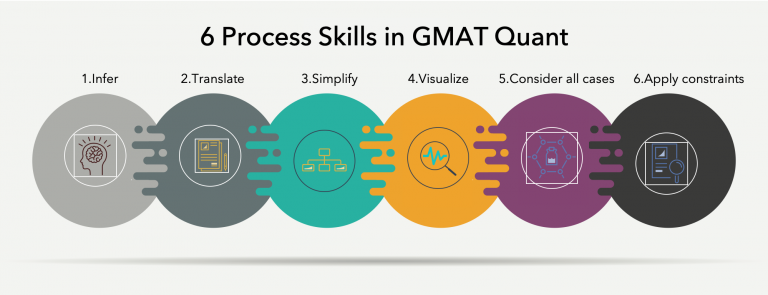
The following are the processes that I now follow every time before I evaluate answer choices to eliminate four wrong ones. They helped me tremendously. If you know some other processes that work like a charm, comment below to share with the GMAT Club community!
● Sentence Correction:
Why?
It’s important to know that conceptual mastery isn’t all it takes to ace the GMAT. Process matters. A fitness enthusiast, I can easily do 15+ pull-ups; however, for the longest time, I couldn’t do a single muscle-up (as shown in the gif above). Strength wasn’t the problem—what’s missing was the technique. After watching some calisthenics tutorial videos, I experimented with a few methods and eventually learned the specific way to move my body and rotate my wrist as I pull myself up. With these techniques, I finally could perform muscle-ups. My strength didn’t change; what changed was how I applied my strength.
How?
Similarly, in the GMAT we need to learn how to effectively apply our knowledge to solve questions. A consistent problem-solving process is especially important when we’re operating under time pressure. For each GMAT question type, it’s important to not only know but also consistently follow a proven step-by-step problem-solving process. Our brains can process information differently, so a “proven” process may not be the most popular one—it needs to be proven by no one but you. Through experimentation, you will be able to answer the following questions for yourself: what process feels most natural? What process helps me to avoid “silly mistakes”? What process helps me to declutter the mind to better decode the information? The first GMAT course I took also taught processes, but I failed to internalize them. My problem-solving process was not consistent until I took e-GMAT’s course, which has dedicated modules and quizzes on process skills. Perhaps that’s why I didn’t truly internalize process skills the first time around—they were taught but not sufficiently quizzed. Benjamin Franklin would probably concur, as he once said “Tell me and I forget. Teach me and I remember. Involve me and I learn.”
What?
The following are the processes that I now follow every time before I evaluate answer choices to eliminate four wrong ones. They helped me tremendously. If you know some other processes that work like a charm, comment below to share with the GMAT Club community!
● Sentence Correction:
- 1. Read to understand what the original sentence is trying to tell me.
2. Look for logical and/or grammar errors.
- 1. Read to understand what the short passage is trying to say
2. Visualize the conclusion: if I need to write down “premise --> conclusion”, what goes to each side of the arrow?
3. Pre-think: the answer choices are meant to confuse test takers, so before looking at them, think about possible assumptions/strengtheners/weakeners. (For Boldface questions, pre-think RRR: each BF part’s Role in the argument, Relationship to each other, Relationship to the conclusion).
- 1. Read to understand each sentence: what’s the main point and why the author included it in the passage? Read till I feel a bit information overloaded, take brief notes on what I read and then try to predict what could be written next.
2. After reading each paragraph: write few words to summarize what this paragraph is all about.
3. For main purpose questions, before looking at answer choices, which can be confusing, read my notes and pre-think: how would I summarize the whole passage?