Events & Promotions
|
|

GMAT Club Daily Prep
Thank you for using the timer - this advanced tool can estimate your performance and suggest more practice questions. We have subscribed you to Daily Prep Questions via email.
Customized
for You
Track
Your Progress
Practice
Pays
Not interested in getting valuable practice questions and articles delivered to your email? No problem, unsubscribe here.
 Sep 02
01:00 PM EDT
-11:59 PM EDT
Take 30% off all study plans with code COURSEWORK - Expires on Monday 9/7 Sep 04
10:00 AM PDT
-11:00 AM PDT
What does test anxiety really look like on the GMAT? For many test takers, it does not look like a panic attack. Instead, it shows up as brain fog, rereading, negative comparisons, mental noise.... Sep 06
09:30 AM EDT
-12:30 PM EST
Top scores are possible when you enroll in a powerful EA course, taught live online + 6 months access to TTP OnDemand video courses included! Perfect class schedule and easy course access for working professionals. Class starts Sundays Sept. 6, 2026.- Sep 07
12:01 AM PDT
-11:59 PM PDT
On the 7th, GMAT Club Tests will be Free! Including all the Quizzes, Questions, and Tests. 12 AM - 11:59 PM PDT - Sep 07
10:00 AM PDT
-11:00 AM PDT
A complete walkthrough of GMAT Club’s free 12-week GMAT study plan: what you study each week, how progress and goals are tracked, how the error log works, and how your practice unlocks paid tools at no cost. - Sep 09
07:00 AM PDT
-10:00 AM PDT
Meet AdComs and explore top Master’s programs - MiM, MiF, MSc, MSBA and more. - Application Fee Waivers - Free 1-Week of GMAT Club Tests: - Master's Application Toolkit - Grand Prize Giveaway - Sep 09
10:00 AM PDT
-11:00 AM PDT
Three MBA applications. Three rejections. No interview invites. A year later, Aman was admitted to Cambridge Judge, SMU, and IMD. In this episode of MBA Admit Stories, Aman shares how he rebuilt his MBA application...  Sep 15
07:00 PM EDT
-09:00 PM EST
Elite scores are possible when you enroll in a powerful GMAT course, taught live online + 6 months access to TTP OnDemand video courses included! Class starts Tues/Thurs Sept. 15, 2026 - Nov. 15, 2027, 7:00pm-9:00pm EST Sep 21
08:00 PM EDT
-10:00 PM EDT
Boost your GMAT score in less than one month in a live online class + 6 months access to TTP OnDemand video courses included! Class starts Mon, Tues, Wed, Thur, Fri Sept. 21, 2026 - Oct. 9, 2027, 7:00pm-10:00pm EST


 18 Oct 2023, 11:47
Kudos
Bookmarks
Would anyone smart be able to tell me how GMAT Focus is planning to make a huge PIVOT in Percentiles while using the exactly same questions on the test?
Looking for Conversion Percentiles from GMAT Focus to Classic GMAT - they are here
I have overlaid percentiles for the Quant section: GMAT Focus with the GMAT Classic percentiles and ended up with this interesting chart for Quant. I am just trying to understand how they were able to chop off the top and spread it so nicely? Any ideas? To me the new percentiles are either unreliable or the scoring is really going to be extremely different... I have been pondering about this for a week now
Note: the scale for GMAT Classic (6-51) was condensed to fit into the new more compact scale of GMAT Focus (60-90)
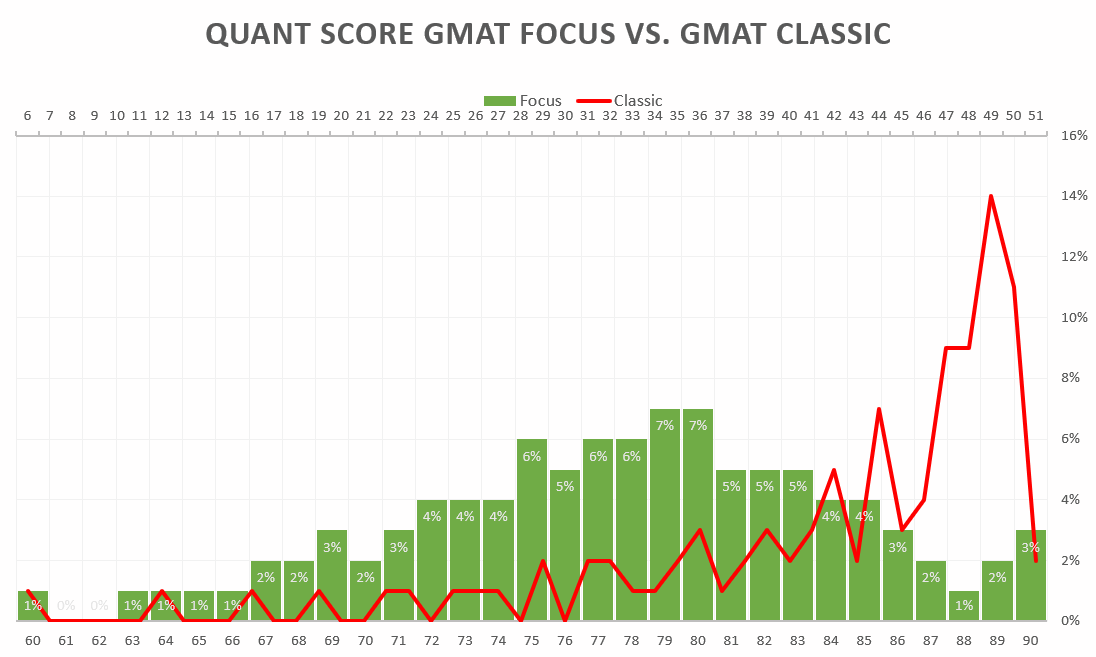
focs-vs-classis-percentiles.gif [ 37.95 KiB | Viewed 10510 times ]
Verbal Percentiles:
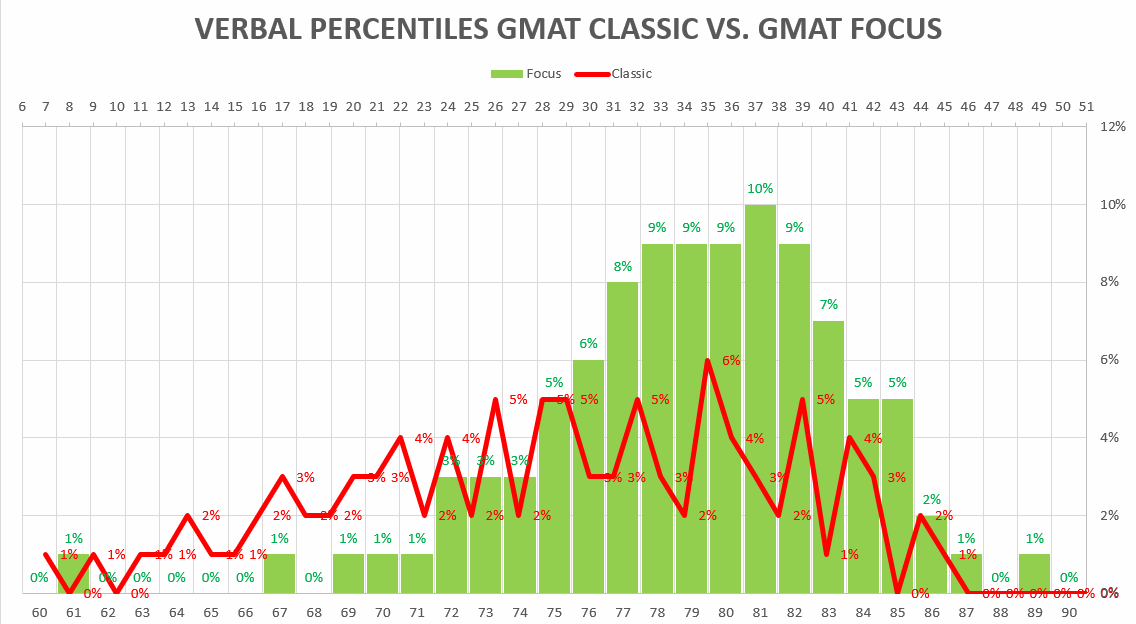
I found it interesting that on VERBAL, the percentiles are being bunched together. Look at the distribution of the Standard Deviation interval (hopefully calculated correctly)
Lots of people will end up with Verbal Scores between 78 and 82. I feel this is due to the score being more driven by mistakes rather than the position of the mistakes in the test (though mistakes in the test should still have an impact as the test is adaptive but just not as profound)
Looking for Conversion Percentiles from GMAT Focus to Classic GMAT - they are here
I have overlaid percentiles for the Quant section: GMAT Focus with the GMAT Classic percentiles and ended up with this interesting chart for Quant. I am just trying to understand how they were able to chop off the top and spread it so nicely? Any ideas? To me the new percentiles are either unreliable or the scoring is really going to be extremely different... I have been pondering about this for a week now
Note: the scale for GMAT Classic (6-51) was condensed to fit into the new more compact scale of GMAT Focus (60-90)
Attachment:
focs-vs-classis-percentiles.gif [ 37.95 KiB | Viewed 10510 times ]
Verbal Percentiles:
I found it interesting that on VERBAL, the percentiles are being bunched together. Look at the distribution of the Standard Deviation interval (hopefully calculated correctly)
- Classic: V20.5 - 37.5, that's 39% of the total scale (6 - 51)
- Focus: V74.3 - 83.3, that's 32% of the total scale... maybe not such a big deal (
Lots of people will end up with Verbal Scores between 78 and 82. I feel this is due to the score being more driven by mistakes rather than the position of the mistakes in the test (though mistakes in the test should still have an impact as the test is adaptive but just not as profound)

NaveenGJ
Joined: 26 Sep 2023
Last visit: 02 May 2025
Posts: 131
Given Kudos: 18
Location: India
Schools: Tuck '27 (II) LBS '26 (D) Ross '27 (II) Tepper '27 (D) Judge '26 (D) Said '27 (D) Anderson '27 (I) Yale '27 (S) Darden '27 (D) Fuqua '27 (D) Johnson '27 (S)
GMAT Focus 1: 695 Q90 V82 DI82 
GPA: 7.6
Schools: Tuck '27 (II) LBS '26 (D) Ross '27 (II) Tepper '27 (D) Judge '26 (D) Said '27 (D) Anderson '27 (I) Yale '27 (S) Darden '27 (D) Fuqua '27 (D) Johnson '27 (S)
GMAT Focus 1: 695 Q90 V82 DI82
Posts: 131
18 Oct 2023, 12:07
Kudos
Bookmarks
I have plotted scattered plot of the classic vs GMAT FE. The scatter plot for the Quant section of the Old GMAT and the GMAT FE do reveal some noteworthy differences that can provide insights into the "toughness" level of the tests and how they distinguish between test-takers. Here are some key points to consider:
Scoring Mechanics and Distinguishing Toppers:
Old GMAT : The percentile jumps significantly within a narrow score range (especially around scores 48-51). This implies that the Old GMAT Quant section may not effectively distinguish between toppers, as many end up clustered around the same percentile. It might also suggest that scoring incrementally higher becomes increasingly challenging.
GMAT FE : The percentile appears to increase more linearly with the Quant score, which suggests a more uniform distribution of test-takers across percentiles. This makes it easier to differentiate between high scorers, as the percentile more accurately reflects the score.
Insights into Toughness:
Uniformity in GMAT FE: The more linear and uniform percentile distribution in the GMAT FE suggests that the test might be designed to be more balanced across its scoring range. This could mean that it's less "tough" to move from a low percentile to a moderately high percentile.
High-Scoring Zone: Given that the Old GMAT had a clustering effect at the top percentiles, it might have been more difficult to break into the very top percentiles due to the finer granularity of scores within that range. On the other hand, the GMAT FE, with its more linear percentile distribution, may offer a clearer path to achieving a high percentile, provided one can secure the corresponding high score.
Ceiling Effect: The Old GMAT exhibits a strong ceiling effect, where a slight increase in score could result in a large percentile jump. This could make it "tougher" to score high as you would need to clear a higher bar to distinguish yourself. The GMAT FE seems to mitigate this issue to some extent.
Differential Scoring Impact: In the Old GMAT, given the tight clustering of top percentiles, even a one-point increase could have a disproportionately high impact. In the GMAT FE, a more balanced scoring system might mean that each point increase has a more uniform impact on your percentile ranking.
Final Thoughts:
The GMAT FE seems to provide a more balanced and differentiated scoring system, potentially making it "easier" to distinguish yourself if you are a high scorer. However, the term "toughness" could be relative; the GMAT FE might be less forgiving of mistakes for those aiming for the very top percentiles, given the more linear percentile-to-score relationship.
Scoring Mechanics and Distinguishing Toppers:
Old GMAT : The percentile jumps significantly within a narrow score range (especially around scores 48-51). This implies that the Old GMAT Quant section may not effectively distinguish between toppers, as many end up clustered around the same percentile. It might also suggest that scoring incrementally higher becomes increasingly challenging.
GMAT FE : The percentile appears to increase more linearly with the Quant score, which suggests a more uniform distribution of test-takers across percentiles. This makes it easier to differentiate between high scorers, as the percentile more accurately reflects the score.
Insights into Toughness:
Uniformity in GMAT FE: The more linear and uniform percentile distribution in the GMAT FE suggests that the test might be designed to be more balanced across its scoring range. This could mean that it's less "tough" to move from a low percentile to a moderately high percentile.
High-Scoring Zone: Given that the Old GMAT had a clustering effect at the top percentiles, it might have been more difficult to break into the very top percentiles due to the finer granularity of scores within that range. On the other hand, the GMAT FE, with its more linear percentile distribution, may offer a clearer path to achieving a high percentile, provided one can secure the corresponding high score.
Ceiling Effect: The Old GMAT exhibits a strong ceiling effect, where a slight increase in score could result in a large percentile jump. This could make it "tougher" to score high as you would need to clear a higher bar to distinguish yourself. The GMAT FE seems to mitigate this issue to some extent.
Differential Scoring Impact: In the Old GMAT, given the tight clustering of top percentiles, even a one-point increase could have a disproportionately high impact. In the GMAT FE, a more balanced scoring system might mean that each point increase has a more uniform impact on your percentile ranking.
Final Thoughts:
The GMAT FE seems to provide a more balanced and differentiated scoring system, potentially making it "easier" to distinguish yourself if you are a high scorer. However, the term "toughness" could be relative; the GMAT FE might be less forgiving of mistakes for those aiming for the very top percentiles, given the more linear percentile-to-score relationship.
18 Oct 2023, 15:40
Kudos
Bookmarks
Thank you NaveenGJ, interesting first post. Is this a copy paste from somewhere?