Events & Promotions
|
|

GMAT Club Daily Prep
Thank you for using the timer - this advanced tool can estimate your performance and suggest more practice questions. We have subscribed you to Daily Prep Questions via email.
Customized
for You
Track
Your Progress
Practice
Pays
Not interested in getting valuable practice questions and articles delivered to your email? No problem, unsubscribe here.
 Sep 24
01:30 AM EDT
-01:30 AM EDT
Tejas studied hard but kept repeating the same mistakes. After 3 attempts at 645, a focused 4-week strategy helped him identify and fix what was holding him back—leading to a 695 with just 12–15 hours of study per week. Sep 23
12:30 AM EDT
-01:30 AM EDT
Learn how Keshav, a Chartered Accountant, scored an impressive 705 on GMAT in just 30 days with GMATWhiz's expert guidance. In this video, he shares preparation tips and strategies that worked for him, including the mock, time management, and more Sep 26
01:00 PM EDT
-04:00 PM EDT
Top scores are possible when you enroll in a powerful GMAT course, taught live online + 6 months access to TTP OnDemand video courses included. Class starts Saturdays Sept. 26, 2026 - Dec. 19, 2026, 1:00pm-4:00pm ES Sep 26
06:00 PM PDT
-07:00 PM PDT
Free- full-length test + 15 concept videos + 150+ short videos + study plan! Sep 29
11:00 AM EDT
-01:00 PM EDT
" Description: Top scores are possible when you enroll in a powerful GMAT course, taught live online + 6 months access to TTP OnDemand video courses included! Class starts Tues/Thur Sept. 29, 2026 - Dec. 3, 2026, 11:00am-1:00pm EST Oct 01
07:00 AM BST
-08:00 AM GMT
Welcome to the GMAT Club's Free Interview Prep Event for Top MBA Programs! Buy tickets - Virtual series that’s all set to equip you to -excel in your MBA interviews.


 08 Nov 2023, 00:21
Kudos
Bookmarks


C
Be sure to select an answer first to save it in the Error Log before revealing the correct answer (OA)!
Difficulty:
 95%
(hard)
95%
(hard)
Question Stats:
46% (02:41) correct 54%
(02:27)
wrong
based on 859
sessions
54%
(02:27)
wrong
based on 859
sessions
History
Date
Time
Result
Not Attempted Yet
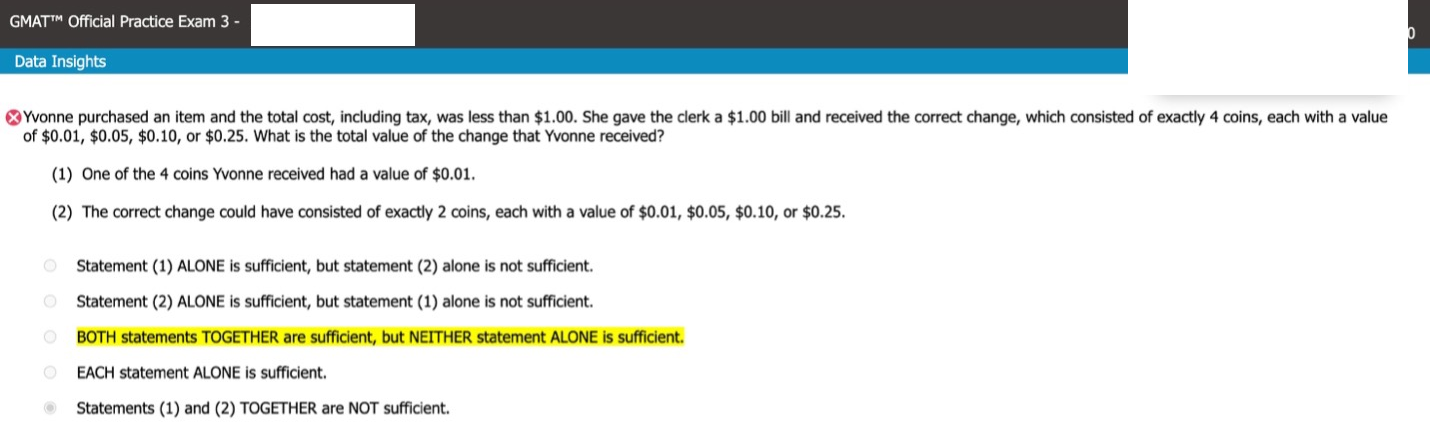
Yvonne purchased an item and the total cost, including tax, was less than $1. She gave the clerk a $1 bill and received the correct change, which consisted of exactly 4 coins, each with a value of $0.01, $0.05, $0.10 or $0.25. What is the total value of the change that Yvonne received?
(1) One of the 4 coins that Yvonne received had a value of $0.01.
(2) The correct change could have consisted of exactly 2 coins, each with a value of $0.01, $0.05, $0.10 or $0.25.
(A) Statement 1 alone is sufficient, but statement 2 alone is not.
(B) Statement 2 alone is sufficient, but statement 1 alone is not.
(C) Both statements together are sufficient, but neither alone is sufficient.
(D) Each statement alone is sufficient.
(E) Neither statement is sufficient, even when combined.
GMAT-Club-Forum-rjn7af3l.png [ 198.74 KiB | Viewed 6827 times ]
(1) One of the 4 coins that Yvonne received had a value of $0.01.
(2) The correct change could have consisted of exactly 2 coins, each with a value of $0.01, $0.05, $0.10 or $0.25.
(A) Statement 1 alone is sufficient, but statement 2 alone is not.
(B) Statement 2 alone is sufficient, but statement 1 alone is not.
(C) Both statements together are sufficient, but neither alone is sufficient.
(D) Each statement alone is sufficient.
(E) Neither statement is sufficient, even when combined.
Attachment:
GMAT-Club-Forum-rjn7af3l.png [ 198.74 KiB | Viewed 6827 times ]
Need more Tests to Practice?
GMAT Club Tests give expert solutions for every question in full and sectional GMAT Focus mocks.
Learn more →


 08 Nov 2023, 04:54
Kudos
Bookmarks
MrWhite
I would say it is slightly tricky and more of logic than any calculation.
To ease the calculation, I would multiply each by 100 or I would deal in cents.
So, the amounts are 1, 5, 10 and 25, and the total cost is less than 100.
(1) One of the 4 coins that Yvonne received had a value of $0.01 or 1.
Many possibilities.
Insufficient
(2) The correct change could have consisted of exactly 2 coins, each with a value of 1, 5, 10 or 25($0.01, $0.05, $0.10 or $0.25).
let us analyze the statements
The total cost could be paid in TWO coins or FOUR coins.
Ways:
(a) Possibility of each of two coins being divisible in two parts, for example 10+10=(5+5)+(5+5)
(b) Possibility of one of the two coins being divisible in three parts and the second remaining, for example 25+10=(10+10+5)+(10)
Insufficient
Combined
as 1 can not be divided into two parts, we have to have the second of two coins being divided in three parts.
Now, none of 1, 5 or 10 can be divided in three parts with the lower value coins. Thus, the other coin is 25.
Total is 26 or ($0.01 + $0.25) = $0.26 = $0.01 + $0.05 + $0.10 + $0.10
Sufficient
C
 06 Mar 2024, 04:12
Kudos
Bookmarks
I marked and approached this question incorrectly in the mock, and came for looking answers and realised how to approach it. Anyways, here is my take on it :
(1) Insufficient as the values of other three coins can range from anything to anything.
(2) Okay lets see, we have 4 values - 0.01, 0.05, 0.10, 0.25. So the possible sum of 2 values: 0.26 (0.25 + 0.01), 0.11, 0.15, 0.06, 0.30, 0.35. Now values which can be represented as a sum of 4 values received by Yvonne - 0.26 (0.01+0.10+0.10+0.5), 0.30(0.10+0.10+0.5+0.5) and 0.35 (0.10+0.10+0.10+0.5).
Three possible combinations, so insufficient.
(1)+(2)
One value has to be 0.01 and that is only found in the sum of 0.26, we cant have the value in 0.30 or 0.35 and make the sum as required.
Answer - C
Please let me know if I did any mistake or missed out on something because this is my first time replying to a question on the gmat forum. Thank You!
(1) Insufficient as the values of other three coins can range from anything to anything.
(2) Okay lets see, we have 4 values - 0.01, 0.05, 0.10, 0.25. So the possible sum of 2 values: 0.26 (0.25 + 0.01), 0.11, 0.15, 0.06, 0.30, 0.35. Now values which can be represented as a sum of 4 values received by Yvonne - 0.26 (0.01+0.10+0.10+0.5), 0.30(0.10+0.10+0.5+0.5) and 0.35 (0.10+0.10+0.10+0.5).
Three possible combinations, so insufficient.
(1)+(2)
One value has to be 0.01 and that is only found in the sum of 0.26, we cant have the value in 0.30 or 0.35 and make the sum as required.
Answer - C
Please let me know if I did any mistake or missed out on something because this is my first time replying to a question on the gmat forum. Thank You!







