Events & Promotions
|
|

GMAT Club Daily Prep
Thank you for using the timer - this advanced tool can estimate your performance and suggest more practice questions. We have subscribed you to Daily Prep Questions via email.
Customized
for You
Track
Your Progress
Practice
Pays
Not interested in getting valuable practice questions and articles delivered to your email? No problem, unsubscribe here.
 Sep 23
12:30 AM EDT
-01:30 AM EDT
Learn how Keshav, a Chartered Accountant, scored an impressive 705 on GMAT in just 30 days with GMATWhiz's expert guidance. In this video, he shares preparation tips and strategies that worked for him, including the mock, time management, and more Sep 24
01:30 AM EDT
-01:30 AM EDT
Tejas studied hard but kept repeating the same mistakes. After 3 attempts at 645, a focused 4-week strategy helped him identify and fix what was holding him back—leading to a 695 with just 12–15 hours of study per week. Sep 26
06:00 PM PDT
-07:00 PM PDT
Free- full-length test + 15 concept videos + 150+ short videos + study plan!

punit2020
Joined: 20 Mar 2020
Last visit: 02 Jul 2024
Posts: 35
Given Kudos: 64
Location: India
Schools: IESE '26 (D) Oxford Said'25 Judge '25 (D) Emory Goizueta (S) Marshall (II) HEC Jan'24 Intake (D) IE Sep'24 intake Kelley '26 (II) ESADE'26 (D) Imperial'25 Broad'26 (II) NUS '26 (D) Simon '26 (S) Owen '26 IMD (D) Fisher '26
GMAT Focus 1: 665 Q84 V84 DI81 
GMAT 1: 710 Q49 V38
GPA: 4
Schools: IESE '26 (D) Oxford Said'25 Judge '25 (D) Emory Goizueta (S) Marshall (II) HEC Jan'24 Intake (D) IE Sep'24 intake Kelley '26 (II) ESADE'26 (D) Imperial'25 Broad'26 (II) NUS '26 (D) Simon '26 (S) Owen '26 IMD (D) Fisher '26
GMAT Focus 1: 665 Q84 V84 DI81
GMAT 1: 710 Q49 V38
Posts: 35
 30 Dec 2023, 13:47
Kudos
Bookmarks


C
Be sure to select an answer first to save it in the Error Log before revealing the correct answer (OA)!
Difficulty:
 55%
(hard)
55%
(hard)
Question Stats:
68% (02:14) correct 32%
(02:27)
wrong
based on 1617
sessions
32%
(02:27)
wrong
based on 1617
sessions
History
Date
Time
Result
Not Attempted Yet
Scientists seeking evidence that there is a significant similarity between the perceptual and cognitive skills developed through musical training and those used in some kinds of spatial reasoning tested a group of people on various kinds of spatial reasoning tasks before and after three years of music lessons. Participants' overall scores improved only slightly. Therefore, the study failed to provide strong evidence to support the scientists' hypothesis.
Which of the following, if true, most seriously weakens the argument?
(A) Another study obtained similar results with different kinds of spatial reasoning tasks.
(B) The musical training given to the participants was not specifically designed to develop complex spatial skills.
(C) On some of the kinds of tasks presented, no improvement was found, but on certain others, the improvement of all participants was marked.
(D) Among those participants who had music instruction once every two weeks, ratings on the spatial reasoning tasks were comparable to those received by participants who had instruction each week.
(E) There was no significant difference in the development of spatial reasoning skills between those participants who made the most progress in their musical studies and those who made the least.
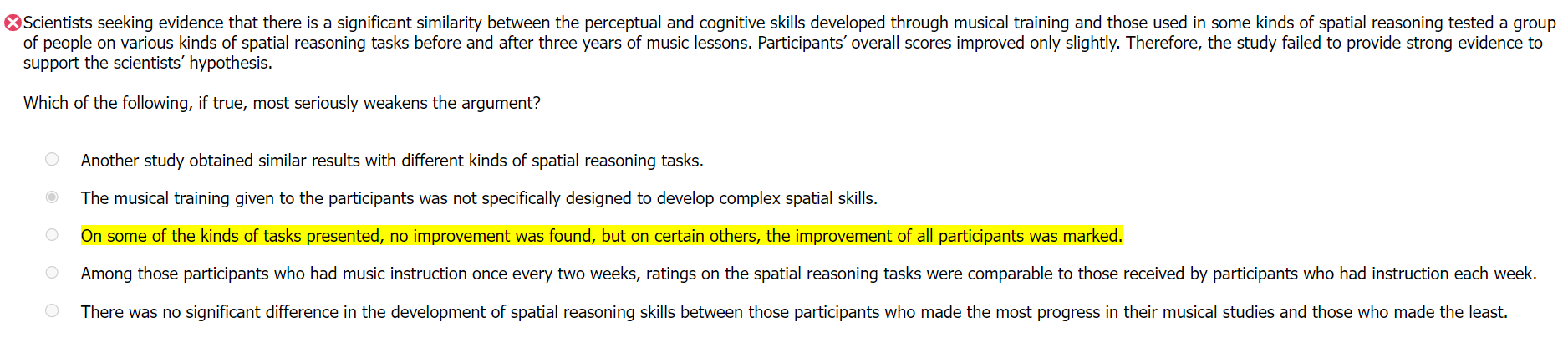
GMAT-Club-Forum-hnahfyjj.png [ 106.6 KiB | Viewed 5886 times ]
Which of the following, if true, most seriously weakens the argument?
(A) Another study obtained similar results with different kinds of spatial reasoning tasks.
(B) The musical training given to the participants was not specifically designed to develop complex spatial skills.
(C) On some of the kinds of tasks presented, no improvement was found, but on certain others, the improvement of all participants was marked.
(D) Among those participants who had music instruction once every two weeks, ratings on the spatial reasoning tasks were comparable to those received by participants who had instruction each week.
(E) There was no significant difference in the development of spatial reasoning skills between those participants who made the most progress in their musical studies and those who made the least.
Attachment:
GMAT-Club-Forum-hnahfyjj.png [ 106.6 KiB | Viewed 5886 times ]
Trying to understand why the right answer is right?
GMAT Club Tests explanations walk through concepts, shortcuts, and common traps on many questions.
See how →
 Updated on: 26 Apr 2026, 17:14
Originally posted by MartyMurray on 30 Dec 2023, 15:11.
Last edited by MartyMurray on 26 Apr 2026, 17:14, edited 2 times in total.
Last edited by MartyMurray on 26 Apr 2026, 17:14, edited 2 times in total.
Kudos
Bookmarks
Explanation
Scientists seeking evidence that there is a significant similarity between the perceptual and cognitive skills developed through musical training and those used in some kinds of spatial reasoning tested a group of people on various kinds of spatial reasoning tasks before and after three years of music lessons. Participants' overall scores improved only slightly. Therefore, the study failed to provide strong evidence to support the scientists' hypothesis.
The conclusion of the argument is the following:
the study failed to provide strong evidence to support the scientists' hypothesis
The argument uses the following premises to support the conclusion:
Scientists ... tested a group of people on various kinds of spatial reasoning tasks before and after three years of music lessons.
Participants' overall scores improved only slightly.
We see that the author has reasoned that, since the study participants' overall spatial reasoning scores improved only slightly after three years of music lessons, it can be concluded that the study did not provide evidence that there is a significant similarity between the perceptual and cognitive skills developed through musical training and those used in some kinds of spatial reasoning.
A key detail to notice is that the argument is supported by evidence involving "overall" scores. While attempting to "prethink" an answer is likely a waste of time, it still could be helpful to notice this detail since we could reason that, even though the "overall" scores don't support the hypothesis, the study still did somehow provide some evidence that there is a similarity between the perceptual and cognitive skills developed through musical training and those used in some kinds of spatial reasoning.
Which of the following, if true, most seriously weakens the argument?
The correct answer will cast doubt on or weaken the support for the conclusion.
(A) Another study obtained similar results with different kinds of spatial reasoning tasks.
This choice doesn't have any effect on the argument.
After all, the conclusion is simply that the specific study mentioned in the passage did not provide evidence to support the hypothesis.
So, information about the results of another study has no bearing on the conclusion since the conclusion is about only the results of the study mentioned in the passage.
Remember, we aren't trying to show that the hypothesis itself is correct or incorrect. The argument is solely about what the results of the study mentioned in the passage show.
Eliminate.
(B) The musical training given to the participants was not specifically designed to develop complex spatial skills.
This choice is a little tricky to eliminate. After all, we might reason that, if the musical training given to the participants was not specifically designed to develop complex spatial skills, then perhaps if the musical training given to the participants had been specifically designed to develop complex spatial skills, the study would have shown that there is a similarity between the perceptual and cognitive skills developed through musical training and those used in some kinds of spatial reasoning.
So, we might select this choice if we didn't keep the conclusion clear in our minds.
The key thing to notice is that this choice does not cast doubt on the conclusion of this particular argument. That conclusion is simply that the study did not provide strong evidence to support the scientists' hypothesis.
The conclusion is not that the hypothesis is incorrect. That's a different conclusion.
Regardless of what type of training was given or what might have happened if a different type of training had been given, it still follows from the evidence that the study, AS IT WAS DONE, failed to provide evidence to support the hypothesis. Maybe it could have provided evidence if it had been done in a different way, but it wasn't. So, it didn't.
Thus, this choice has no effect on the strength of the support for the conclusion.
Eliminate.
(C) On some of the kinds of tasks presented, no improvement was found, but on certain others, the improvement of all participants was marked.
Notice that the reasoning of the argument is that, because the "overall" scores "improved only slightly, the study provided no evidence to support the hypothesis.
So, what if what this choice says is true? What if we broke down the data that went into the calculation of the "overall" scores and found that, on some of the kinds of tasks presented, the improvement of all participants was marked. In that case, we would have reason to believe that the musical training did cause the participants to become stronger in at least some kinds of spatial reasoning.
Of course, in that case, the study would have provided evidence that there is a significant similarity between the perceptual and cognitive skills developed through musical training and those used in "some kinds" of spatial reasoning.
So, this choice is reason to believe the conclusion that the study failed to provide such evidence is incorrect. In other words, it weakens the case for the conclusion.
Keep.
(D) Among those participants who had music instruction once every two weeks, ratings on the spatial reasoning tasks were comparable to those received by participants who had instruction each week.
If anything, this choice strengthens the support for the conclusion. After all, it shows that not only did the participants' overall scores not serve to support the hypothesis but also even a comparison of scores of participants who received instruction more and less often provided no evidence of any effect of musical instruction.
After all, if receiving instruction more often, and thus likely developing more musical skill, didn't make a difference, then we have even more reason to believe that there is not a similarity between the perceptual and cognitive skills developed through musical training and those used in some kinds of spatial reasoning.
Eliminate.
(E) There was no significant difference in the development of spatial reasoning skills between those participants who made the most progress in their musical studies and those who made the least.
If anything, this choice strengthens the support for the conclusion. After all, it shows that not only did the participants' overall scores not serve to support the hypothesis but also even a comparison of scores of participants who made the most progress in their musical studies and those of the participants who made the least provided no evidence of any effect of musical instruction.
After all, if making more progress in developing musical skill didn't make a difference, then we have even more reason to believe that there is not a similarity between the perceptual and cognitive skills developed through musical training and those used in some kinds of spatial reasoning.
Eliminate.
Correct Answer
Scientists seeking evidence that there is a significant similarity between the perceptual and cognitive skills developed through musical training and those used in some kinds of spatial reasoning tested a group of people on various kinds of spatial reasoning tasks before and after three years of music lessons. Participants' overall scores improved only slightly. Therefore, the study failed to provide strong evidence to support the scientists' hypothesis.
The conclusion of the argument is the following:
the study failed to provide strong evidence to support the scientists' hypothesis
The argument uses the following premises to support the conclusion:
Scientists ... tested a group of people on various kinds of spatial reasoning tasks before and after three years of music lessons.
Participants' overall scores improved only slightly.
We see that the author has reasoned that, since the study participants' overall spatial reasoning scores improved only slightly after three years of music lessons, it can be concluded that the study did not provide evidence that there is a significant similarity between the perceptual and cognitive skills developed through musical training and those used in some kinds of spatial reasoning.
A key detail to notice is that the argument is supported by evidence involving "overall" scores. While attempting to "prethink" an answer is likely a waste of time, it still could be helpful to notice this detail since we could reason that, even though the "overall" scores don't support the hypothesis, the study still did somehow provide some evidence that there is a similarity between the perceptual and cognitive skills developed through musical training and those used in some kinds of spatial reasoning.
Which of the following, if true, most seriously weakens the argument?
The correct answer will cast doubt on or weaken the support for the conclusion.
(A) Another study obtained similar results with different kinds of spatial reasoning tasks.
This choice doesn't have any effect on the argument.
After all, the conclusion is simply that the specific study mentioned in the passage did not provide evidence to support the hypothesis.
So, information about the results of another study has no bearing on the conclusion since the conclusion is about only the results of the study mentioned in the passage.
Remember, we aren't trying to show that the hypothesis itself is correct or incorrect. The argument is solely about what the results of the study mentioned in the passage show.
Eliminate.
(B) The musical training given to the participants was not specifically designed to develop complex spatial skills.
This choice is a little tricky to eliminate. After all, we might reason that, if the musical training given to the participants was not specifically designed to develop complex spatial skills, then perhaps if the musical training given to the participants had been specifically designed to develop complex spatial skills, the study would have shown that there is a similarity between the perceptual and cognitive skills developed through musical training and those used in some kinds of spatial reasoning.
So, we might select this choice if we didn't keep the conclusion clear in our minds.
The key thing to notice is that this choice does not cast doubt on the conclusion of this particular argument. That conclusion is simply that the study did not provide strong evidence to support the scientists' hypothesis.
The conclusion is not that the hypothesis is incorrect. That's a different conclusion.
Regardless of what type of training was given or what might have happened if a different type of training had been given, it still follows from the evidence that the study, AS IT WAS DONE, failed to provide evidence to support the hypothesis. Maybe it could have provided evidence if it had been done in a different way, but it wasn't. So, it didn't.
Thus, this choice has no effect on the strength of the support for the conclusion.
Eliminate.
(C) On some of the kinds of tasks presented, no improvement was found, but on certain others, the improvement of all participants was marked.
Notice that the reasoning of the argument is that, because the "overall" scores "improved only slightly, the study provided no evidence to support the hypothesis.
So, what if what this choice says is true? What if we broke down the data that went into the calculation of the "overall" scores and found that, on some of the kinds of tasks presented, the improvement of all participants was marked. In that case, we would have reason to believe that the musical training did cause the participants to become stronger in at least some kinds of spatial reasoning.
Of course, in that case, the study would have provided evidence that there is a significant similarity between the perceptual and cognitive skills developed through musical training and those used in "some kinds" of spatial reasoning.
So, this choice is reason to believe the conclusion that the study failed to provide such evidence is incorrect. In other words, it weakens the case for the conclusion.
Keep.
(D) Among those participants who had music instruction once every two weeks, ratings on the spatial reasoning tasks were comparable to those received by participants who had instruction each week.
If anything, this choice strengthens the support for the conclusion. After all, it shows that not only did the participants' overall scores not serve to support the hypothesis but also even a comparison of scores of participants who received instruction more and less often provided no evidence of any effect of musical instruction.
After all, if receiving instruction more often, and thus likely developing more musical skill, didn't make a difference, then we have even more reason to believe that there is not a similarity between the perceptual and cognitive skills developed through musical training and those used in some kinds of spatial reasoning.
Eliminate.
(E) There was no significant difference in the development of spatial reasoning skills between those participants who made the most progress in their musical studies and those who made the least.
If anything, this choice strengthens the support for the conclusion. After all, it shows that not only did the participants' overall scores not serve to support the hypothesis but also even a comparison of scores of participants who made the most progress in their musical studies and those of the participants who made the least provided no evidence of any effect of musical instruction.
After all, if making more progress in developing musical skill didn't make a difference, then we have even more reason to believe that there is not a similarity between the perceptual and cognitive skills developed through musical training and those used in some kinds of spatial reasoning.
Eliminate.
Correct Answer
General Discussion
 29 Jul 2024, 22:29
Kudos
Bookmarks
To solve this question, let us deploy IMS's four-step technique.
STEP #1 -> IDENTIFY THE QUESTION TYPE
Let us read the question stem to identify the question type.
STEP #2 -> X-RAY THE ARGUMENT
In a weakening question, it is a must to x-ray the argument and deconstruct it by figuring out the conclusion and the premise. Let us therefore read the argument first and deconstruct it soon after.
PREMISE: Participants' overall scores improved only slightly.
STEP #3 -> FRAME A SHADOW ANSWER
To frame a shadow answer, we need to know what the correct answer should do. In this question, the correct answer must cast doubt on the author's conclusion. We need the right answer to simply indicate that the study did not fail to provide strong evidence to support the scientists' hypothesis.
SHADOW ANSWER: Any situation that, having taken the premise into consideration, leads us to believe that the study did provide strong evidence to support the hypothesis that there is a significant similarity between the perceptual and cognitive skills developed through musical training and those used in some kinds of spatial reasoning.
STEP #4 -> ELIMINATE INCORRECT OPTIONS
Options that do not match the shadow answer can be eliminated.
(A) Another study obtained similar results with different kinds of spatial reasoning tasks. | NOT A MATCH | We need an answer option that leads us to believe that the study under discussion did provide strong evidence to support the scientists' hypothesis; this option, however, speaks of a different study, and therefore, it does not impact the argument at hand. | ELIMINATE
(B) The musical training given to the participants was not specifically designed to develop complex spatial skills. | NOT A MATCH | If the musical training given to the participants was not specifically designed to develop complex spatial skills, do we have a reason to believe that the study under discussion did provide strong evidence to support the scientists' hypothesis? No! | ELIMINATE
(C) On some of the kinds of tasks presented, no improvement was found, but on certain others, the improvement of all participants was marked. | MATCHES THE SHADOW ANSWER | If what is stated in this option is true, it means there is strong evidence that indicates that there is a significant similarity between the perceptual and cognitive skills developed through musical training and those used in some kinds of spatial reasoning. Notice that this option says on some of the kinds of tasks presented, no improvement was found, but on certain others, the improvement of all participants was marked. The author's conclusion that the study failed to provide strong evidence to support the scientists' hypothesis is clearly weakened. | KEEP
(D) Among those participants who had music instruction once every two weeks, ratings on the spatial reasoning tasks were comparable to those received by participants who had instruction each week. | NOT A MATCH | If what is stated is true, it means an increased frequency of music instruction had no impact as far as ratings on spatial reasoning tasks were concerned; this option therefore strengthens the author's argument. We are nonetheless looking to cast doubt on the author's conclusion. | ELIMINATE
(E) There was no significant difference in the development of spatial reasoning skills between those participants who made the most progress in their musical studies and those who made the least. | NOT A MATCH | If there was actually no significant difference in the development of spatial reasoning skills between those participants who made the most progress in their musical studies and those who made the least, we have a reason to believe that the study conducted by scientists did perhaps fail to provide strong evidence to support their hypothesis. Again, we are looking for an option that weakens the conclusion, not one that strengthens it. | ELIMINATE
Hence, (C) is the correct answer.
STEP #1 -> IDENTIFY THE QUESTION TYPE
Let us read the question stem to identify the question type.
Quote:
The stem indicates a weakening question.
STEP #2 -> X-RAY THE ARGUMENT
In a weakening question, it is a must to x-ray the argument and deconstruct it by figuring out the conclusion and the premise. Let us therefore read the argument first and deconstruct it soon after.
Quote:
CONCLUSION: The study (conducted by scientists) failed to provide strong evidence to support the scientists' hypothesis.
PREMISE: Participants' overall scores improved only slightly.
STEP #3 -> FRAME A SHADOW ANSWER
To frame a shadow answer, we need to know what the correct answer should do. In this question, the correct answer must cast doubt on the author's conclusion. We need the right answer to simply indicate that the study did not fail to provide strong evidence to support the scientists' hypothesis.
SHADOW ANSWER: Any situation that, having taken the premise into consideration, leads us to believe that the study did provide strong evidence to support the hypothesis that there is a significant similarity between the perceptual and cognitive skills developed through musical training and those used in some kinds of spatial reasoning.
STEP #4 -> ELIMINATE INCORRECT OPTIONS
Options that do not match the shadow answer can be eliminated.
(A) Another study obtained similar results with different kinds of spatial reasoning tasks. | NOT A MATCH | We need an answer option that leads us to believe that the study under discussion did provide strong evidence to support the scientists' hypothesis; this option, however, speaks of a different study, and therefore, it does not impact the argument at hand. | ELIMINATE
(B) The musical training given to the participants was not specifically designed to develop complex spatial skills. | NOT A MATCH | If the musical training given to the participants was not specifically designed to develop complex spatial skills, do we have a reason to believe that the study under discussion did provide strong evidence to support the scientists' hypothesis? No! | ELIMINATE
(C) On some of the kinds of tasks presented, no improvement was found, but on certain others, the improvement of all participants was marked. | MATCHES THE SHADOW ANSWER | If what is stated in this option is true, it means there is strong evidence that indicates that there is a significant similarity between the perceptual and cognitive skills developed through musical training and those used in some kinds of spatial reasoning. Notice that this option says on some of the kinds of tasks presented, no improvement was found, but on certain others, the improvement of all participants was marked. The author's conclusion that the study failed to provide strong evidence to support the scientists' hypothesis is clearly weakened. | KEEP
(D) Among those participants who had music instruction once every two weeks, ratings on the spatial reasoning tasks were comparable to those received by participants who had instruction each week. | NOT A MATCH | If what is stated is true, it means an increased frequency of music instruction had no impact as far as ratings on spatial reasoning tasks were concerned; this option therefore strengthens the author's argument. We are nonetheless looking to cast doubt on the author's conclusion. | ELIMINATE
(E) There was no significant difference in the development of spatial reasoning skills between those participants who made the most progress in their musical studies and those who made the least. | NOT A MATCH | If there was actually no significant difference in the development of spatial reasoning skills between those participants who made the most progress in their musical studies and those who made the least, we have a reason to believe that the study conducted by scientists did perhaps fail to provide strong evidence to support their hypothesis. Again, we are looking for an option that weakens the conclusion, not one that strengthens it. | ELIMINATE
Hence, (C) is the correct answer.






