Events & Promotions
|
|

GMAT Club Daily Prep
Thank you for using the timer - this advanced tool can estimate your performance and suggest more practice questions. We have subscribed you to Daily Prep Questions via email.
Customized
for You
Track
Your Progress
Practice
Pays
Not interested in getting valuable practice questions and articles delivered to your email? No problem, unsubscribe here.
 Sep 24
01:30 AM EDT
-01:30 AM EDT
Tejas studied hard but kept repeating the same mistakes. After 3 attempts at 645, a focused 4-week strategy helped him identify and fix what was holding him back—leading to a 695 with just 12–15 hours of study per week. Sep 24
08:00 AM EDT
-08:30 AM EDT
Meet Tuck at an informal student or staff-hosted coffee chat in a city near you! Sep 23
12:30 AM EDT
-01:30 AM EDT
Learn how Keshav, a Chartered Accountant, scored an impressive 705 on GMAT in just 30 days with GMATWhiz's expert guidance. In this video, he shares preparation tips and strategies that worked for him, including the mock, time management, and more Sep 26
01:00 PM EDT
-04:00 PM EDT
Top scores are possible when you enroll in a powerful GMAT course, taught live online + 6 months access to TTP OnDemand video courses included. Class starts Saturdays Sept. 26, 2026 - Dec. 19, 2026, 1:00pm-4:00pm ES Sep 26
06:00 PM PDT
-07:00 PM PDT
Free- full-length test + 15 concept videos + 150+ short videos + study plan! Sep 29
11:00 AM EDT
-01:00 PM EDT
" Description: Top scores are possible when you enroll in a powerful GMAT course, taught live online + 6 months access to TTP OnDemand video courses included! Class starts Tues/Thur Sept. 29, 2026 - Dec. 3, 2026, 11:00am-1:00pm EST Oct 01
07:00 AM BST
-08:00 AM GMT
Welcome to the GMAT Club's Free Interview Prep Event for Top MBA Programs! Buy tickets - Virtual series that’s all set to equip you to -excel in your MBA interviews.

 08 Jan 2024, 01:56
Kudos
Bookmarks


A
Be sure to select an answer first to save it in the Error Log before revealing the correct answer (OA)!
Difficulty:
 75%
(hard)
75%
(hard)
Question Stats:
54% (01:40) correct 46%
(02:04)
wrong
based on 1692
sessions
46%
(02:04)
wrong
based on 1692
sessions
History
Date
Time
Result
Not Attempted Yet
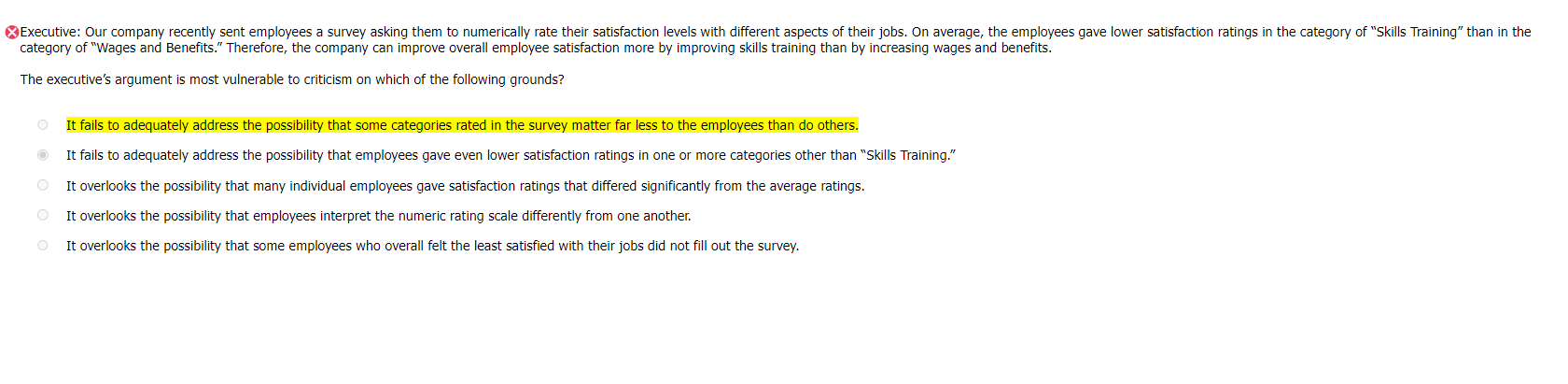
Executive: Our company recently sent employees a survey asking them to numerically rate their satisfaction levels with different aspects of their jobs. On average, the employees gave lower satisfaction ratings in the category of "Skills Training" than in the category of "Wages and Benefits." Therefore, the company can improve overall employee satisfaction more by improving skills training than by increasing wages and benefits.
The executive's argument is most vulnerable to criticism on which of the following grounds?
A. It fails to adequately address the possibility that some categories rated in the survey matter far less to the employees than do others.
B. It fails to adequately address the possibility that employees gave even lower satisfaction ratings in one or more categories other than "Skills Training."
C. It overlooks the possibility that many individual employees gave satisfaction ratings that differed significantly from the average ratings.
D. It overlooks the possibility that employees interpret the numeric rating scale differently from one another.
E. It overlooks the possibility that some employees who overall felt the least satisfied with their jobs did not fill out the survey.
The executive's argument is most vulnerable to criticism on which of the following grounds?
A. It fails to adequately address the possibility that some categories rated in the survey matter far less to the employees than do others.
B. It fails to adequately address the possibility that employees gave even lower satisfaction ratings in one or more categories other than "Skills Training."
C. It overlooks the possibility that many individual employees gave satisfaction ratings that differed significantly from the average ratings.
D. It overlooks the possibility that employees interpret the numeric rating scale differently from one another.
E. It overlooks the possibility that some employees who overall felt the least satisfied with their jobs did not fill out the survey.
Why is the answer here A?
CR - 3.png [ 42.05 KiB | Viewed 13666 times ]
Attachment:
CR - 3.png [ 42.05 KiB | Viewed 13666 times ]
Need more Tests to Practice?
GMAT Club Tests give expert solutions for every question in full and sectional GMAT Focus mocks.
Learn more →

 Updated on: 22 Jan 2026, 06:19
Originally posted by MartyMurray on 09 Jan 2024, 21:22.
Last edited by MartyMurray on 22 Jan 2026, 06:19, edited 3 times in total.
Last edited by MartyMurray on 22 Jan 2026, 06:19, edited 3 times in total.
Kudos
Bookmarks
Explanation
Executive: Our company recently sent employees a survey asking them to numerically rate their satisfaction levels with different aspects of their jobs. On average, the employees gave lower satisfaction ratings in the category of "Skills Training" than in the category of "Wages and Benefits." Therefore, the company can improve overall employee satisfaction more by improving skills training than by increasing wages and benefits.
The author has concluded the following:
the company can improve overall employee satisfaction more by improving skills training than by increasing wages and benefits
The support for the conclusion is the following:
On average, the employees gave lower satisfaction ratings in the category of "Skills Training" than in the category of "Wages and Benefits."
We see that the author has reasoned that, by improving what employees are less satisfied with, the company can do more to improve employee satisfaction than it would if it improved what employees are more satisfied with.
The executive's argument is most vulnerable to criticism on which of the following grounds?
The correct answer will highlight a flaw in the argument. In other words it will highlight a flaw in the support for the conclusion.
A. It fails to adequately address the possibility that some categories rated in the survey matter far less to the employees than do others.
This choice highlights a flaw in the argument. It brings up the fact that, by jumping from the "ratings" employees gave in different categories to a conclusion about how best to improve employee satisfaction, it has failed to address the possibility that there may be another factor that affects how improvements affect employee satisfaction, and that factor is what matters to employees.
After all, it could be the case that, an aspect of their jobs that employees rated poorly is also an aspect that the employees don't really care about anyway. So, improving that aspect may not do as much to improve employee satisfaction as improving another aspect would.
Keep
B. It fails to adequately address the possibility that employees gave even lower satisfaction ratings in one or more categories other than "Skills Training."
It's true that the argument does not address the possibility that employees gave even lower satisfaction ratings in one or more categories other than "Skills Training." At the same time, the fact that the argument does not address that possibility is not a flaw.
After all, the conclusion is about the effect of improving skills training versus the effect of increasing wages and benefits. So, how employees rated other aspects of their jobs is irrelevant.
Eliminate.
C. It overlooks the possibility that many individual employees gave satisfaction ratings that differed significantly from the average ratings.
The conclusion is about what can be done to improve "overall employee satisfaction." In other words, it's about what can be done to improve "average" satisfaction.
So, "the possibility that many individual employees gave satisfaction ratings that differed significantly from the average ratings" doesn't matter since, regardless of whether many employees did so, it could still be the case that, by improving the aspects of the company that employees rated the lowest, the company would do the most to improve overall employee satisfaction.
Eliminate.
D. It overlooks the possibility that employees interpret the numeric rating scale differently from one another.
Notice that, even if employees interpret the numeric rating scale differently from one another, they still gave lower satisfaction ratings in the category of "Skills Training" than in the category of "Wages and Benefits" on average.
In other words, while they may not all have rated "Skills Training" or "Wages and Benefits" in the same way, they did still rate one higher than the other.
For example, one employee could have rated "Skills Training" 5/10 and "Wages and Benefits" 7/10 while another gave the two categories ratings of 4/10 and 6/10 respectively, and we'd still have lower ratings for "Skills Training" from both employees.
Eliminate.
E. It overlooks the possibility that some employees who overall felt the least satisfied with their jobs did not fill out the survey.
As long as a large majority of the employees filled out the survey, the information it provides should indicate what the company can do to improve "overall employee satisfaction."
So, even if "some employees" who felt the least satisfied did not fill out the survey, the argument still works.
Eliminate.
Correct answer: A
Executive: Our company recently sent employees a survey asking them to numerically rate their satisfaction levels with different aspects of their jobs. On average, the employees gave lower satisfaction ratings in the category of "Skills Training" than in the category of "Wages and Benefits." Therefore, the company can improve overall employee satisfaction more by improving skills training than by increasing wages and benefits.
The author has concluded the following:
the company can improve overall employee satisfaction more by improving skills training than by increasing wages and benefits
The support for the conclusion is the following:
On average, the employees gave lower satisfaction ratings in the category of "Skills Training" than in the category of "Wages and Benefits."
We see that the author has reasoned that, by improving what employees are less satisfied with, the company can do more to improve employee satisfaction than it would if it improved what employees are more satisfied with.
The executive's argument is most vulnerable to criticism on which of the following grounds?
The correct answer will highlight a flaw in the argument. In other words it will highlight a flaw in the support for the conclusion.
A. It fails to adequately address the possibility that some categories rated in the survey matter far less to the employees than do others.
This choice highlights a flaw in the argument. It brings up the fact that, by jumping from the "ratings" employees gave in different categories to a conclusion about how best to improve employee satisfaction, it has failed to address the possibility that there may be another factor that affects how improvements affect employee satisfaction, and that factor is what matters to employees.
After all, it could be the case that, an aspect of their jobs that employees rated poorly is also an aspect that the employees don't really care about anyway. So, improving that aspect may not do as much to improve employee satisfaction as improving another aspect would.
Keep
B. It fails to adequately address the possibility that employees gave even lower satisfaction ratings in one or more categories other than "Skills Training."
It's true that the argument does not address the possibility that employees gave even lower satisfaction ratings in one or more categories other than "Skills Training." At the same time, the fact that the argument does not address that possibility is not a flaw.
After all, the conclusion is about the effect of improving skills training versus the effect of increasing wages and benefits. So, how employees rated other aspects of their jobs is irrelevant.
Eliminate.
C. It overlooks the possibility that many individual employees gave satisfaction ratings that differed significantly from the average ratings.
The conclusion is about what can be done to improve "overall employee satisfaction." In other words, it's about what can be done to improve "average" satisfaction.
So, "the possibility that many individual employees gave satisfaction ratings that differed significantly from the average ratings" doesn't matter since, regardless of whether many employees did so, it could still be the case that, by improving the aspects of the company that employees rated the lowest, the company would do the most to improve overall employee satisfaction.
Eliminate.
D. It overlooks the possibility that employees interpret the numeric rating scale differently from one another.
Notice that, even if employees interpret the numeric rating scale differently from one another, they still gave lower satisfaction ratings in the category of "Skills Training" than in the category of "Wages and Benefits" on average.
In other words, while they may not all have rated "Skills Training" or "Wages and Benefits" in the same way, they did still rate one higher than the other.
For example, one employee could have rated "Skills Training" 5/10 and "Wages and Benefits" 7/10 while another gave the two categories ratings of 4/10 and 6/10 respectively, and we'd still have lower ratings for "Skills Training" from both employees.
Eliminate.
E. It overlooks the possibility that some employees who overall felt the least satisfied with their jobs did not fill out the survey.
As long as a large majority of the employees filled out the survey, the information it provides should indicate what the company can do to improve "overall employee satisfaction."
So, even if "some employees" who felt the least satisfied did not fill out the survey, the argument still works.
Eliminate.
Correct answer: A
General Discussion
 09 Jan 2024, 08:06
Kudos
Bookmarks
The conclusion of the argument is that the company can improve overall employee satisfaction more by improving skills training than by increasing wages and benefits. This is based on the fact that skills training received lower average satisfaction ratings than did wages and benefits.
Why is (A) the correct asnwer choice?
Why is (A) the correct asnwer choice?