Events & Promotions
|
|

GMAT Club Daily Prep
Thank you for using the timer - this advanced tool can estimate your performance and suggest more practice questions. We have subscribed you to Daily Prep Questions via email.
Customized
for You
Track
Your Progress
Practice
Pays
Not interested in getting valuable practice questions and articles delivered to your email? No problem, unsubscribe here.
 Sep 15
07:00 PM EDT
-09:00 PM EST
Elite scores are possible when you enroll in a powerful GMAT course, taught live online + 6 months access to TTP OnDemand video courses included! Class starts Tues/Thurs Sept. 15, 2026 - Nov. 15, 2027, 7:00pm-9:00pm EST Sep 21
07:00 PM EDT
-10:00 PM EDT
Boost your GMAT score in less than one month in a live online class + 6 months access to TTP OnDemand video courses included! Class starts Mon, Tues, Wed, Thur, Fri Sept. 21, 2026 - Oct. 9, 2027, 7:00pm-10:00pm EST

 13 Apr 2011, 11:16
Kudos
Bookmarks


C
Be sure to select an answer first to save it in the Error Log before revealing the correct answer (OA)!
Difficulty:
 45%
(medium)
45%
(medium)
Question Stats:
67% (02:10) correct 33%
(02:33)
wrong
based on 246
sessions
33%
(02:33)
wrong
based on 246
sessions
History
Date
Time
Result
Not Attempted Yet
A glass is shaped like a right circular cylinder with a half sphere at the bottom. The glass is 7cm deep and has a diameter of 6cm, measured on the inside. If the glass is filled to the rim with apple cider, how much cider is in the glass? The formula for the volume a sphere is \(\frac{4}{3}*\pi*r^3\).
A. 18\(\pi\)
B. 36\(\pi\)
C. 54\(\pi\)
D. 81\(\pi\)
E. 108\(\pi\)
I'm confusing about the part "If the glass is filled to the rim with apple cider..." , how do we understand this problem?
cup.png [ 1.2 KiB | Viewed 7329 times ]
Attachment:
cup.png [ 1.2 KiB | Viewed 7329 times ]
 13 Apr 2011, 12:35
Kudos
Bookmarks
yvonne0923
I don't understand the meaning of this expression. Assuming it's trying to say "filled up to the brim" (fully filled).
And the volume of the sphere is:
\(\frac{4}{3}*\pi*r^3\)
The glass looks something like the one in the attached figure.
Attachment:
glass_with_cider.PNG [ 9.17 KiB | Viewed 20388 times ]
All we need to do is find the volume of the glass, which is volume of the hemispherical base+volume of the cylindrical top.
Volume of hemisphere = 1/2*(Volume of sphere) \(= \frac{1}{2}*\frac{4}{3}*\pi*r^3\), where r=radius of hemisphere
Volume of cylinder \(= \pi*r^2*h\), where r=radius of cylinder & h=height of cylinder
From the figure, we can see that Radius of cylinder=Radius of hemisphere
Also, the total depth of the glass= Radius of hemisphere+height of cylinder
glass has a diameter of 6cm
\(r=3 cm\)
glass is 7cm deep
\(r+h=7\)
\(3+h=7\)
\(h=4cm\)
Total Volume of the glass= Volume of hemisphere+Volume of cylinder
\(V=\frac{1}{2}*\frac{4}{3}*\pi*r^3+\pi*r^2*h\)
\(V=\frac{2}{3}*\pi*3^3+\pi*3^2*4\)
\(V=18\pi+36\pi=54\pi\)
Ans: "C"
13 Apr 2011, 15:35
Kudos
Bookmarks
fluke
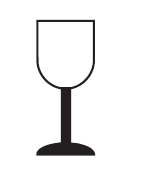
I understand how to solve the problem if there is no image attached, but the image shown on the book is like a shape of glass wine below.
Attachment:
Glass_Cider.jpg [ 1.87 KiB | Viewed 20054 times ]
So if in this case, I believe that the cider is impossible to reach the holder of the glass, and I supposed to substract the height of the holder from the total height of glass of 7cm. However, how can we know the height of the holder? Also, in this case, the information of sphere volume is not really necessary here according to this image.


 I see that you made a genuine point here. I should have been more cautious.