Last visit was: 25 Apr 2026, 22:30 It is currently 25 Apr 2026, 22:30
Close
GMAT Club Daily Prep
Thank you for using the timer - this advanced tool can estimate your performance and suggest more practice questions. We have subscribed you to Daily Prep Questions via email.

Customized
for You

we will pick new questions that match your level based on your Timer History

Track
Your Progress

every week, we’ll send you an estimated GMAT score based on your performance

Practice
Pays

we will pick new questions that match your level based on your Timer History
Not interested in getting valuable practice questions and articles delivered to your email? No problem, unsubscribe here.
Close
Request Expert Reply
Confirm Cancel
User avatar
Bunuel
User avatar
Math Expert
Joined: 02 Sep 2009
Last visit: 25 Apr 2026
Posts: 109,830
Own Kudos:
Given Kudos: 105,886
Products:
Expert
Expert reply
Active GMAT Club Expert! Tag them with @ followed by their username for a faster response.
Posts: 109,830
Kudos: 811,302
 [12]
Kudos
Add Kudos
12
Bookmarks
Bookmark this Post
User avatar
u1983
User avatar
Current Student
Joined: 24 Aug 2016
Last visit: 06 Jun 2021
Posts: 700
Own Kudos:
873
 [2]
Given Kudos: 97
GMAT 1: 540 Q49 V16
GMAT 2: 680 Q49 V33
Products:
GMAT 2: 680 Q49 V33
Posts: 700
Kudos: 873
 [2]
Kudos
Add Kudos
2
Bookmarks
Bookmark this Post
avatar
viveknegi
Joined: 31 Mar 2018
Last visit: 11 Feb 2020
Posts: 16
Own Kudos:
Given Kudos: 2
Posts: 16
Kudos: 2
Kudos
Add Kudos
Bookmarks
Bookmark this Post
User avatar
EgmatQuantExpert
User avatar
e-GMAT Representative
Joined: 04 Jan 2015
Last visit: 02 Apr 2024
Posts: 3,657
Own Kudos:
20,885
 [3]
Given Kudos: 165
Expert
Expert reply
Posts: 3,657
Kudos: 20,885
 [3]
Kudos
Add Kudos
3
Bookmarks
Bookmark this Post

Solution


Given:
• The circumference of the circle given is 20π

To find:
• The maximum possible are of the rectangle inscribed in the circle

Approach and Working:
• If the radius of the circle is r, then 2πr = 20π
    o Or, radius r = 10
• Hence, the diameter of the circle = 2r = 20 = the diagonal of the rectangle

Now, for a rectangle inscribed within a circle, the area will be maximum when all the sides are equal (basically it is a square)
• Therefore, the diagonal length of the square with side a = a√2 = 20
    o Hence, a = 10√2
• So, the area = 10√2 * 10√2 = 200

Hence, the correct answer is option B.

Answer: B
User avatar
EgmatQuantExpert
User avatar
e-GMAT Representative
Joined: 04 Jan 2015
Last visit: 02 Apr 2024
Posts: 3,657
Own Kudos:
20,885
 [3]
Given Kudos: 165
Expert
Expert reply
Posts: 3,657
Kudos: 20,885
 [3]
3
Kudos
Add Kudos
Bookmarks
Bookmark this Post
viveknegi
Dear u1983.
Why are you considering it as square?
In question, rectangle is given. Could you explain this?

Posted from my mobile device

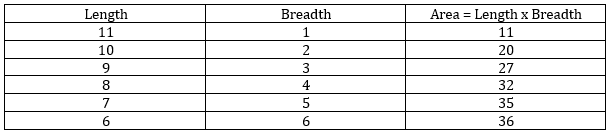
Let us consider a rectangle with perimeter 24 units.
Now if perimeter is 24, the length and breadth of the rectangle can have possible values as (11, 1), (10, 2), (9, 3), (8, 4), (7, 5), (6, 6)
If we calculate the area in every individual case, we can see the following:


You can see, keeping the perimeter constant, the area of a rectangle will be maximum when the side lengths are equal, or it denotes a square
User avatar
KarishmaB
Joined: 16 Oct 2010
Last visit: 23 Apr 2026
Posts: 16,441
Own Kudos:
79,413
 [1]
Given Kudos: 485
Location: Pune, India
Expert
Expert reply
Active GMAT Club Expert! Tag them with @ followed by their username for a faster response.
Posts: 16,441
Kudos: 79,413
 [1]
1
Kudos
Add Kudos
Bookmarks
Bookmark this Post
Bunuel

In the figure above, the circumference of the circle is 20π. Which of the following is the maximum possible area of the rectangle?


(A) 80

(B) 200

(C) 300

(D) \(100 \sqrt{2}\)

(E) \(200 \sqrt{2}\)


Attachment:
The attachment Inside.jpg is no longer available

Think about it - what is the constraint on a rectangle inside a fixed circle?

It can have very very little area (say the blue rectangle). Then we can start expanding it till it becomes the yellow rectangle (which is actually a square). If we try to expand it any more, its area will start decreasing again till it becomes very very small again (the green rectangle).

Attachment:
Screenshot%202021-10-21%20at%2011.42.34.png
Screenshot%202021-10-21%20at%2011.42.34.png [ 163.32 KiB | Viewed 3056 times ]

Hence, there is no minimum area of the rectangle but there is a maximum possible area (when it is a square) dependent on the value of the radius.

If the radius of the circle is 10 and diameter is 20, the area of the rectangle will be maximum when it is a square and each side of square will be \(\frac{20}{\sqrt{2}}\) (since diagonal of square = diameter of circle) and hence the area of the square will be 200.

Answer (B)
User avatar
youcouldsailaway
Joined: 08 Nov 2022
Last visit: 07 Feb 2024
Posts: 63
Own Kudos:
Given Kudos: 57
Location: India
Concentration: Finance, Entrepreneurship
GMAT 1: 590 Q37 V34
GMAT 2: 660 Q40 V40
GPA: 3
GMAT 2: 660 Q40 V40
Posts: 63
Kudos: 54
Kudos
Add Kudos
Bookmarks
Bookmark this Post
I solved this using the Pythagoras theorem and got the area to be 192 sq. units. I considered diagonal, 20, to be the hypotenuse and derived the other two lengths through the Pythagorean triplet pairs of 3-4-5 (i.e, 12, 16 and 20 in this case). I approximated based on the answer above that since the answer is closest to 200, option B is correct.

Can anyone help me understand if my approach is wrong, why so?
User avatar
KarishmaB
Joined: 16 Oct 2010
Last visit: 23 Apr 2026
Posts: 16,441
Own Kudos:
Given Kudos: 485
Location: Pune, India
Expert
Expert reply
Active GMAT Club Expert! Tag them with @ followed by their username for a faster response.
Posts: 16,441
Kudos: 79,413
Kudos
Add Kudos
Bookmarks
Bookmark this Post
youcouldsailaway
I solved this using the Pythagoras theorem and got the area to be 192 sq. units. I considered diagonal, 20, to be the hypotenuse and derived the other two lengths through the Pythagorean triplet pairs of 3-4-5 (i.e, 12, 16 and 20 in this case). I approximated based on the answer above that since the answer is closest to 200, option B is correct.

Can anyone help me understand if my approach is wrong, why so?

Every right triangle with hypotenuse 20 will not be 12-16-20 triangle. Pythagorean triplets only give us the triangles with integer sides. But actually the other two sides could take infinite other values. e.g.
1, sqrt(399), 20
2. sqrt(396), 20
etc.

You are assuming that the rectangle with the greatest area is the one in which the two triangles are 3-4-5 triangles. That is not correct. The rectangle with the greatest area will be the square inside the circle.

Check this video explaining acute, obtuse and right triangles: https://www.youtube.com/watch?v=y05XIAWgAT0
User avatar
youcouldsailaway
Joined: 08 Nov 2022
Last visit: 07 Feb 2024
Posts: 63
Own Kudos:
Given Kudos: 57
Location: India
Concentration: Finance, Entrepreneurship
GMAT 1: 590 Q37 V34
GMAT 2: 660 Q40 V40
GPA: 3
GMAT 2: 660 Q40 V40
Posts: 63
Kudos: 54
Kudos
Add Kudos
Bookmarks
Bookmark this Post
Thank you KarishmaB, that helps explain it better!
User avatar
EyeSeaMe
Joined: 19 May 2021
Last visit: 08 Jan 2026
Posts: 7
Own Kudos:
Given Kudos: 214
Location: India
GMAT 1: 570 Q42 V27
WE:Operations (Transportation)
GMAT 1: 570 Q42 V27
Posts: 7
Kudos: 2
Kudos
Add Kudos
Bookmarks
Bookmark this Post
This question can be solved just by using the 45 - 45 - 90 theorem.

Since the rectangle is inscribed in the circle, the diagonal of the rectangle will be the diameter of the circle.

Circumference of Circle =20 π = π d. Therefore d = 20.

Since the figure is a rectangle, all 4 vertices of the rectangle will be 90 degrees.

A diagonal in a rectangle

- connects the opposite vertices of the rectangle
- it also bisects the 90 degrees at the vertice into 2 equal angles of 45 degrees, and
- it divides the rectangle into 2 equal right-angled triangles.

Consider one such right-angled triangle -

We have one angle of 90 degrees which corresponds to the diameter/ diagonal of the rectangle = 20.

The other 2 angles are 45 degrees from opposite vertices, thereby giving us a 45 - 45 - 90 Right Angles Triangle.

Using the ratio of x √2 = 20, we get x = 10√2 after rationalizing.

Since we know that a rectangle is actually a square, we take the area of the rectangle/square -

L x B = Side x Side = 10√2 x 10√2 = 200.

Option B
Moderators:
Math Expert
109830 posts
Tuck School Moderator
852 posts