Last visit was: 24 Apr 2026, 07:12 It is currently 24 Apr 2026, 07:12
Close
GMAT Club Daily Prep
Thank you for using the timer - this advanced tool can estimate your performance and suggest more practice questions. We have subscribed you to Daily Prep Questions via email.

Customized
for You

we will pick new questions that match your level based on your Timer History

Track
Your Progress

every week, we’ll send you an estimated GMAT score based on your performance

Practice
Pays

we will pick new questions that match your level based on your Timer History
Not interested in getting valuable practice questions and articles delivered to your email? No problem, unsubscribe here.
Close
Request Expert Reply
Confirm Cancel
User avatar
eybrj2
Joined: 31 Oct 2011
Last visit: 02 Oct 2013
Posts: 196
Own Kudos:
8,900
 [59]
Given Kudos: 18
Posts: 196
Kudos: 8,900
 [59]
2
Kudos
Add Kudos
57
Bookmarks
Bookmark this Post
Most Helpful Reply
User avatar
Bunuel
User avatar
Math Expert
Joined: 02 Sep 2009
Last visit: 24 Apr 2026
Posts: 109,814
Own Kudos:
Given Kudos: 105,871
Products:
Expert
Expert reply
Active GMAT Club Expert! Tag them with @ followed by their username for a faster response.
Posts: 109,814
Kudos: 811,000
 [19]
12
Kudos
Add Kudos
7
Bookmarks
Bookmark this Post
General Discussion
User avatar
boomtangboy
Joined: 06 Jan 2012
Last visit: 05 Jun 2021
Posts: 162
Own Kudos:
2,923
 [3]
Given Kudos: 33
Status:May The Force Be With Me (D-DAY 15 May 2012)
Location: India
Concentration: General Management, Entrepreneurship
Products:
2
Kudos
Add Kudos
1
Bookmarks
Bookmark this Post
User avatar
reynaldreni
Joined: 07 May 2015
Last visit: 02 Nov 2022
Posts: 73
Own Kudos:
144
 [3]
Given Kudos: 152
Location: India
Schools: Darden '21
GPA: 4
Schools: Darden '21
Posts: 73
Kudos: 144
 [3]
3
Kudos
Add Kudos
Bookmarks
Bookmark this Post
eybrj2
What is the number of integers that are common to both set S and set T ?

(1) The number of integers in S is 7, and the number of integers in T is 6.
(2) U is the set of integers that are in S only or in T only or in both, and the number of integers in U is 10.

DS41402.01


Clearly, statements 1 or 2 are not sufficient on their own.
Let S = elements only in Set S
Let X = elements in both S & T
Let T = elements only in Set T
Combining the statement together, we get
S+X = 7 &
T+X = 6
S+T+2X = 13 --(1)

U = 10
U = S+T+X
S+T+X = 10 --(2)

(1) - (2), we get
X = 3

OA <- C


User avatar
TestPrepUnlimited
Joined: 17 Sep 2014
Last visit: 30 Jun 2022
Posts: 1,223
Own Kudos:
1,138
 [2]
Given Kudos: 6
Location: United States
GMAT 1: 780 Q51 V45
GRE 1: Q170 V167
Expert
Expert reply
GMAT 1: 780 Q51 V45
GRE 1: Q170 V167
Posts: 1,223
Kudos: 1,138
 [2]
2
Kudos
Add Kudos
Bookmarks
Bookmark this Post
eybrj2
What is the number of integers that are common to both set S and set T ?

(1) The number of integers in S is 7, and the number of integers in T is 6.
(2) U is the set of integers that are in S only or in T only or in both, and the number of integers in U is 10.


DS41402.01

Combined:

If S and T have all unique integers, then the combined set U should have 6 + 7 = 13 integers. However according to (2) we only have 10 integers, this is because some of them must be shared. Since we have 3 less than 13, this means those 3 numbers were shared. Thus there are 3 integers common between S and T.

Ans: C
User avatar
omavsp
Joined: 20 Aug 2017
Last visit: 28 Jan 2024
Posts: 34
Own Kudos:
Given Kudos: 191
Products:
Posts: 34
Kudos: 15
Kudos
Add Kudos
Bookmarks
Bookmark this Post
TestPrepUnlimited
eybrj2
What is the number of integers that are common to both set S and set T ?

(1) The number of integers in S is 7, and the number of integers in T is 6.
(2) U is the set of integers that are in S only or in T only or in both, and the number of integers in U is 10.


DS41402.01

Combined:

If S and T have all unique integers, then the combined set U should have 6 + 7 = 13 integers. However according to (2) we only have 10 integers, this is because some of them must be shared. Since we have 3 less than 13, this means those 3 numbers were shared. Thus there are 3 integers common between S and T.

Ans: C


in B it states: "in both" - aren't these the common integers? can you please help me understand?
User avatar
Pritishd
User avatar
UNC Kenan Flagler Moderator
Joined: 18 Jul 2015
Last visit: 05 Jul 2025
Posts: 230
Own Kudos:
313
 [2]
Given Kudos: 120
GMAT 1: 530 Q43 V20
WE:Analyst (Consumer Packaged Goods)
GMAT 1: 530 Q43 V20
Posts: 230
Kudos: 313
 [2]
2
Kudos
Add Kudos
Bookmarks
Bookmark this Post
eybrj2
What is the number of integers that are common to both set S and set T ?

(1) The number of integers in S is 7, and the number of integers in T is 6.
(2) U is the set of integers that are in S only or in T only or in both, and the number of integers in U is 10.

DS41402.01
Let,
\(x\) \(=\) Elements in S only
\(y\) \(=\) Elements in T only
\(z\) \(=\) Elements in both S and T (The question asks us to find the value of \(z\))

Statement - I (Insufficient)
1. \(x + z = 7\) and \(y + z = 6\)
2. We cannot solve for \(z\) since the we have \(2\) equations and \(3\) variables

Statement - II (Insufficient)
1. \(x + y + z = 10\)
2. Again, we cannot solve for \(z\) since the we have \(1\) equation and \(3\) variables

Combined (Sufficient)
1. Add the \(2\) equations from statement-I -> \(x + y + 2z = 13\)
2. From the equation from statement-II we have \(x + y = 10 - z\)
3. Plugging in \(2\) into \(1\) -> \(10 - z + 2z = 13\) -> \(z = 3\)

Ans. C
User avatar
Pritishd
User avatar
UNC Kenan Flagler Moderator
Joined: 18 Jul 2015
Last visit: 05 Jul 2025
Posts: 230
Own Kudos:
Given Kudos: 120
GMAT 1: 530 Q43 V20
WE:Analyst (Consumer Packaged Goods)
GMAT 1: 530 Q43 V20
Posts: 230
Kudos: 313
Kudos
Add Kudos
Bookmarks
Bookmark this Post
omavsp
TestPrepUnlimited
eybrj2
What is the number of integers that are common to both set S and set T ?

(1) The number of integers in S is 7, and the number of integers in T is 6.
(2) U is the set of integers that are in S only or in T only or in both, and the number of integers in U is 10.

DS41402.01

Combined:

If S and T have all unique integers, then the combined set U should have 6 + 7 = 13 integers. However according to (2) we only have 10 integers, this is because some of them must be shared. Since we have 3 less than 13, this means those 3 numbers were shared. Thus there are 3 integers common between S and T.

Ans: C


in B it states: "in both" - aren't these the common integers? can you please help me understand?

Not sure if I completely understand your doubt but we need a unique value of the number of integers common to both S and T. Even though B mentions 'in both' it does not give you the value for the same.

In other words S only + T only + Both = 10. Do you think we can get a unique value for Both from this equation?
avatar
Basim2016
Joined: 20 Sep 2018
Last visit: 22 Sep 2024
Posts: 120
Own Kudos:
Given Kudos: 1,714
GMAT 1: 590 Q47 V25
GMAT 1: 590 Q47 V25
Posts: 120
Kudos: 29
Kudos
Add Kudos
Bookmarks
Bookmark this Post
Respected Bunuel,

I got it wrong as I thought that it is nowhere mentioned that Set U has all the elements of S and T. So,consequently, U has 3 elements of S and all remaining 7 from set T. SO, I marked it E.

PLEASE guide.

Regards.

Posted from my mobile device
User avatar
MHIKER
Joined: 14 Jul 2010
Last visit: 24 May 2021
Posts: 939
Own Kudos:
Given Kudos: 690
Status:No dream is too large, no dreamer is too small
Concentration: Accounting
Posts: 939
Kudos: 5,814
Kudos
Add Kudos
Bookmarks
Bookmark this Post
Bunuel
What is the number of integers that are common to both set S and set T?

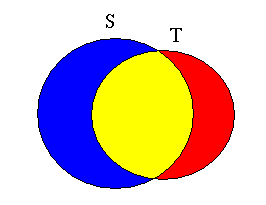
Look at the diagram:
Attachment:
Sets.PNG
We are asked to find the intersection of the sets, the # of integers that are both in S and T (yellow area).

(1) The number of integers in S is 7, and the number of integers in T is 6. There can be from 0 to 6 common integers in sets S and T. Not sufficient,

(2) U is the set of integers that are in S only or in T only or in both, and the number of integers in U is 10. U=10 is the sum of blue, yellow or red areas. Not sufficient.

(1)+(2) Now, Total={S}+{T}-{Both} --> 10=7+6-{Both} --> {Both}=3. Sufficient.

Answer: C.

As I understand 10 is the sum of the Total. So, will not the formula be Total = S+T-Both+Neither. Can we determine both if we don't have the "Neither."?
User avatar
achloes
Joined: 16 Oct 2020
Last visit: 19 May 2025
Posts: 244
Own Kudos:
221
 [1]
Given Kudos: 2,382
GMAT 1: 460 Q28 V26
GMAT 2: 550 Q39 V27
GMAT 3: 610 Q39 V35
GMAT 4: 650 Q42 V38
GMAT 5: 720 Q48 V41
GMAT 5: 720 Q48 V41
Posts: 244
Kudos: 221
 [1]
1
Kudos
Add Kudos
Bookmarks
Bookmark this Post
avigutman chetan2u Bunuel

I'm confused about the use of "or" in statement 2 because it creates 3 possible scenarios with different outcomes each.

For example, if we consider the case that U is the set of integers that are in S only, how can we conclude anything about the remaining 3 integers in set U? What if those fall in the "neither" bucket?
User avatar
avigutman
Joined: 17 Jul 2019
Last visit: 30 Sep 2025
Posts: 1,285
Own Kudos:
Given Kudos: 66
Location: Canada
GMAT 1: 780 Q51 V45
GMAT 2: 780 Q50 V47
GMAT 3: 770 Q50 V45
Expert
Expert reply
GMAT 3: 770 Q50 V45
Posts: 1,285
Kudos: 1,908
Kudos
Add Kudos
Bookmarks
Bookmark this Post
achloes
If we consider the case that U is the set of integers that are in S only
But that’s not a case, achloes. If I say that I want to travel to either Europe or Africa, it would be wrong to say that I only want to travel to Europe.
The statement tells us that if we count all the integers in the three groups (T but not S, S but not T, and both S and T) we’ll see 10 of them.

Posted from my mobile device
User avatar
chetan2u
User avatar
GMAT Expert
Joined: 02 Aug 2009
Last visit: 24 Apr 2026
Posts: 11,229
Own Kudos:
Given Kudos: 335
Status:Math and DI Expert
Location: India
Concentration: Human Resources, General Management
GMAT Focus 1: 735 Q90 V89 DI81
Products:
Expert
Expert reply
GMAT Focus 1: 735 Q90 V89 DI81
Posts: 11,229
Kudos: 45,007
Kudos
Add Kudos
Bookmarks
Bookmark this Post
achloes
avigutman chetan2u Bunuel

I'm confused about the use of "or" in statement 2 because it creates 3 possible scenarios with different outcomes each.

For example, if we consider the case that U is the set of integers that are in S only, how can we conclude anything about the remaining 3 integers in set U? What if those fall in the "neither" bucket?


Hi

It means that if you pick up an integer from that set, it will fall in any of the three categories and vice versa, meaning the number of integers in the set will be equal to the number of integers in all three categories added together.
User avatar
TargetMBA007
Joined: 22 Nov 2019
Last visit: 20 Mar 2026
Posts: 258
Own Kudos:
Given Kudos: 216
Schools: Stanford (S)
GPA: 4.0
Schools: Stanford (S)
Posts: 258
Kudos: 385
Kudos
Add Kudos
Bookmarks
Bookmark this Post
I did this using the formula

(AorB) = A + B - (A&B).
(A&B) = A + B - (AorB).
(A&B) = 7+6-10 = 3

and it got me the right answer

But, I found the wording a bit confusing, so I wasn't sure, if this is the right formula to use here.
When it says "U is the set of integers that are in S only or in T only or in both, and the number of integers in U is 10."
For me the A or B part, should only "S Only or T only" - is the (AorB) element of the formula - "or in both - This is the bit that confused me, as this is the part that we are solving for, so I wonder how this can be part of the "AorB" element?

KarishmaB
User avatar
KarishmaB
Joined: 16 Oct 2010
Last visit: 23 Apr 2026
Posts: 16,442
Own Kudos:
79,401
 [3]
Given Kudos: 485
Location: Pune, India
Expert
Expert reply
Active GMAT Club Expert! Tag them with @ followed by their username for a faster response.
Posts: 16,442
Kudos: 79,401
 [3]
2
Kudos
Add Kudos
1
Bookmarks
Bookmark this Post
TargetMBA007
I did this using the formula

(AorB) = A + B - (A&B).
(A&B) = A + B - (AorB).
(A&B) = 7+6-10 = 3

and it got me the right answer

But, I found the wording a bit confusing, so I wasn't sure, if this is the right formula to use here.
When it says "U is the set of integers that are in S only or in T only or in both, and the number of integers in U is 10."
For me the A or B part, should only "S Only or T only" - is the (AorB) element of the formula - "or in both - This is the bit that confused me, as this is the part that we are solving for, so I wonder how this can be part of the "AorB" element?

KarishmaB

(A or B) is the same as (A union B) which is (A U B) - basically it includes all elements that are in A only, all elements that are in B only and all elements that are in both A and B.

Basically, when we look at the Venn diagram discussed in the video below, it is the blue, yellow and green region together.
https://youtu.be/HRnuURqGhmg

Hence, this formula works: (AorB) = A + B - (A&B)

If you are unsure why we are subtracting (A&B), it is because it is double counted in A + B so we need to subtract it out once so that it is counted once only.
Check out the YT video above.
User avatar
bumpbot
User avatar
Non-Human User
Joined: 09 Sep 2013
Last visit: 04 Jan 2021
Posts: 38,972
Own Kudos:
Posts: 38,972
Kudos: 1,117
Kudos
Add Kudos
Bookmarks
Bookmark this Post
Automated notice from GMAT Club BumpBot:

A member just gave Kudos to this thread, showing it’s still useful. I’ve bumped it to the top so more people can benefit. Feel free to add your own questions or solutions.

This post was generated automatically.
Moderators:
Math Expert
109814 posts
498 posts
212 posts