Events & Promotions
|
|

GMAT Club Daily Prep
Thank you for using the timer - this advanced tool can estimate your performance and suggest more practice questions. We have subscribed you to Daily Prep Questions via email.
Customized
for You
Track
Your Progress
Practice
Pays
Not interested in getting valuable practice questions and articles delivered to your email? No problem, unsubscribe here.
 Sep 04
10:00 AM EDT
-11:59 PM EDT
We’ve worked incredibly hard to build TTP into the best test prep experience possible, and it would mean a lot to us to win Newsweek’s 2026 Readers’ Choice Award for Best Test Prep. If TTP has helped you, we’d be incredibly grateful for your vote. Sep 08
12:30 AM EDT
-01:30 AM EDT
Looking for your GMAT motivation to break through the score plateau? Pragati improved her score by massive 160 points with strategic guidance and hard-work! Find out how personalized mentorship and a strong mindset can turn GMAT struggles into success. Sep 09
07:00 AM PDT
-10:00 AM PDT
Meet AdComs and explore top Master’s programs - MiM, MiF, MSc, MSBA and more. - Application Fee Waivers - Free 1-Week of GMAT Club Tests: - Master's Application Toolkit - Grand Prize Giveaway- Sep 09
10:00 AM PDT
-11:00 AM PDT
Three MBA applications. Three rejections. No interview invites. A year later, Aman was admitted to Cambridge Judge, SMU, and IMD. In this episode of MBA Admit Stories, Aman shares how he rebuilt his MBA application...  Sep 10
01:00 AM EDT
-02:00 AM EDT
Learn how Keshav, a Chartered Accountant, scored an impressive 705 on GMAT in just 30 days with GMATWhiz's expert guidance. In this video, he shares preparation tips and strategies that worked for him, including the mock, time management, and more. Sep 10
08:00 PM PDT
-09:00 PM PDT
Free- full-length test + 15 concept videos + 150+ short videos + study plan!


 16 Sep 2014, 01:51
Kudos
Bookmarks


C
Be sure to select an answer first to save it in the Error Log before revealing the correct answer (OA)!
Difficulty:
 75%
(hard)
75%
(hard)
Question Stats:
51% (02:57) correct 49%
(02:31)
wrong
based on 49
sessions
49%
(02:31)
wrong
based on 49
sessions
History
Date
Time
Result
Not Attempted Yet
A circle is inscribed in an equilateral triangle, such that the two figures touch at exactly 3 points, one on each side of the triangle. Which of the following is closest to the percent of the area of the triangle that lies within the circle?
A. 50%
B. 55%
C. 60%
D. 65%
E. 70%
A. 50%
B. 55%
C. 60%
D. 65%
E. 70%
16 Sep 2014, 01:51
Kudos
Bookmarks
Official Solution:
A circle is inscribed in an equilateral triangle, such that the two figures touch at exactly 3 points, one on each side of the triangle. Which of the following is closest to the percent of the area of the triangle that lies within the circle?
A. 50%
B. 55%
C. 60%
D. 65%
E. 70%
First, draw a picture of the circle and triangle and make up good labels for all points.

We should add one more point: the center of the circle, which will also be the center of the triangle. Let's call that point O.
In order to deal with the area of the circle, we'll need a radius (with circles, it should always be your first instinct to draw in a radius). We'll put in OZ.

Now, because both equilateral triangles and circles are regular, symmetrical figures, and because they're lined up perfectly in this scenario, we can take advantage of "symmetry arguments." For instance, it should be obvious that each of the points X, Y, and Z are the midpoints of their respective sides. You don't need to prove this, nor do you want to under time constraints. Rather, on the exam you should look for regular, symmetrical figures to behave symmetrically, and points that seem like midpoints can actually be proven to be just that. Likewise, we can draw in AO, and we know that this line cuts angle BAC perfectly in half. If you've drawn the figure carefully, this conclusion should be apparent. (We almost have the Deathly Hallows here, for you Harry Potter fans).

Now, since any angles in an equilateral triangle are \(60^\circ\), \(\angle OAZ = \frac{60^\circ}{2} = 30^\circ\). Moreover, angle AZO is \(90^\circ\) (a radius that touches a tangent line will form a right angle).
Thus, we know AOZ is \(60^\circ\), and we have a 30-60-90 triangle. Let's redraw that triangle by itself:
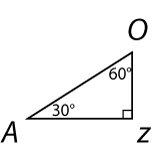
Now, let's make up a convenient radius. Say \(OZ = 1\). We quickly get the dimensions of triangle AOZ:

We can now compute the areas of each figure. First, the circle is \(\pi r^2 = \pi(1)^2 = \pi\).

The triangle is a little harder, but we're almost there. Since \(AZ = \sqrt{3}\), and Z is the midpoint of AC, we know that \(AC = 2 \sqrt{3}\).

If you know the formula for the area of an equilateral triangle in terms of its side length, you can plug in right now -- or you can figure out the height. Let's take the latter approach.
Since we know \(AO = 2\), and \(OY = 1\), we know that \(AY = 3\) (again, we don't need or want a rigorous proof that they form a straight line. Regular figures behave nicely!)

And again by symmetry, this tells us that \(BZ = 3\) as well:
Now we can calculate the area of the triangle, which equals \(\frac{1}{2}bh = (\frac{1}{2})(2 \sqrt{3})(3) = 3 \sqrt{3}\). (Incidentally, the area of an equilateral triangle in terms of its side length \(s\) is \(\frac{s^2 \sqrt{3}}{4}\), which in this case gives \(\frac{(2 \sqrt{3})^2 \sqrt{3}}{4} = \frac{12 \sqrt{3}}{4} = 3 \sqrt{3}\))
Finally, we compute the ratio of the areas:
\(\frac{\text{Area of circle}}{\text{Area of triangle}} = \frac{\pi}{3 \sqrt{3}}\). We approximate: \(\pi \approx 3.1\) and \(\sqrt{3} \approx 1.7\), so we get \(\frac{3.1}{3(1.7)} = \frac{3.1}{5.1} \approx \frac{3}{5} = 60%\).
(Excel gives the ratio as 60.46% to a couple more decimal places, so our approximation didn't create much of an error).
If you get completely stuck on this problem, of course learn the method above. But a scrappy method that's really not too bad is to draw the picture carefully and try to eyeball the answer. Since the answers only differ by 5%, this might only help you eliminate extremes, but that's better than nothing. And incidentally, if you must guess at random on such a problem, in which you have to estimate a ratio of areas or lengths that you can draw reasonably approximately, guess toward the middle of the pack. The question writers will have a sequential lineup of answers, and it's unlikely that the writers would put all the wrong answers on one side of the right answer, because you would be able to knock out the extreme wrong answer or answers more easily. In this case, you'd be unlikely to see the answers as (A) 60% (B) 65% (C) 70% (D) 75% (E) 80% or as (A) 40% (B) 45% (C) 50% (D) 55% (E) 60%.
Answer: C
A circle is inscribed in an equilateral triangle, such that the two figures touch at exactly 3 points, one on each side of the triangle. Which of the following is closest to the percent of the area of the triangle that lies within the circle?
A. 50%
B. 55%
C. 60%
D. 65%
E. 70%
First, draw a picture of the circle and triangle and make up good labels for all points.
We should add one more point: the center of the circle, which will also be the center of the triangle. Let's call that point O.
In order to deal with the area of the circle, we'll need a radius (with circles, it should always be your first instinct to draw in a radius). We'll put in OZ.
Now, because both equilateral triangles and circles are regular, symmetrical figures, and because they're lined up perfectly in this scenario, we can take advantage of "symmetry arguments." For instance, it should be obvious that each of the points X, Y, and Z are the midpoints of their respective sides. You don't need to prove this, nor do you want to under time constraints. Rather, on the exam you should look for regular, symmetrical figures to behave symmetrically, and points that seem like midpoints can actually be proven to be just that. Likewise, we can draw in AO, and we know that this line cuts angle BAC perfectly in half. If you've drawn the figure carefully, this conclusion should be apparent. (We almost have the Deathly Hallows here, for you Harry Potter fans).
Now, since any angles in an equilateral triangle are \(60^\circ\), \(\angle OAZ = \frac{60^\circ}{2} = 30^\circ\). Moreover, angle AZO is \(90^\circ\) (a radius that touches a tangent line will form a right angle).
Thus, we know AOZ is \(60^\circ\), and we have a 30-60-90 triangle. Let's redraw that triangle by itself:
Now, let's make up a convenient radius. Say \(OZ = 1\). We quickly get the dimensions of triangle AOZ:
We can now compute the areas of each figure. First, the circle is \(\pi r^2 = \pi(1)^2 = \pi\).
The triangle is a little harder, but we're almost there. Since \(AZ = \sqrt{3}\), and Z is the midpoint of AC, we know that \(AC = 2 \sqrt{3}\).
If you know the formula for the area of an equilateral triangle in terms of its side length, you can plug in right now -- or you can figure out the height. Let's take the latter approach.
Since we know \(AO = 2\), and \(OY = 1\), we know that \(AY = 3\) (again, we don't need or want a rigorous proof that they form a straight line. Regular figures behave nicely!)
And again by symmetry, this tells us that \(BZ = 3\) as well:
Now we can calculate the area of the triangle, which equals \(\frac{1}{2}bh = (\frac{1}{2})(2 \sqrt{3})(3) = 3 \sqrt{3}\). (Incidentally, the area of an equilateral triangle in terms of its side length \(s\) is \(\frac{s^2 \sqrt{3}}{4}\), which in this case gives \(\frac{(2 \sqrt{3})^2 \sqrt{3}}{4} = \frac{12 \sqrt{3}}{4} = 3 \sqrt{3}\))
Finally, we compute the ratio of the areas:
\(\frac{\text{Area of circle}}{\text{Area of triangle}} = \frac{\pi}{3 \sqrt{3}}\). We approximate: \(\pi \approx 3.1\) and \(\sqrt{3} \approx 1.7\), so we get \(\frac{3.1}{3(1.7)} = \frac{3.1}{5.1} \approx \frac{3}{5} = 60%\).
(Excel gives the ratio as 60.46% to a couple more decimal places, so our approximation didn't create much of an error).
If you get completely stuck on this problem, of course learn the method above. But a scrappy method that's really not too bad is to draw the picture carefully and try to eyeball the answer. Since the answers only differ by 5%, this might only help you eliminate extremes, but that's better than nothing. And incidentally, if you must guess at random on such a problem, in which you have to estimate a ratio of areas or lengths that you can draw reasonably approximately, guess toward the middle of the pack. The question writers will have a sequential lineup of answers, and it's unlikely that the writers would put all the wrong answers on one side of the right answer, because you would be able to knock out the extreme wrong answer or answers more easily. In this case, you'd be unlikely to see the answers as (A) 60% (B) 65% (C) 70% (D) 75% (E) 80% or as (A) 40% (B) 45% (C) 50% (D) 55% (E) 60%.
Answer: C
 29 Jan 2016, 02:21
Kudos
Bookmarks
Bunuel
Hi Bunuel,
Is there any alternative solution for this one, as well?
Best Regards