Events & Promotions
|
|

GMAT Club Daily Prep
Thank you for using the timer - this advanced tool can estimate your performance and suggest more practice questions. We have subscribed you to Daily Prep Questions via email.
Customized
for You
Track
Your Progress
Practice
Pays
Not interested in getting valuable practice questions and articles delivered to your email? No problem, unsubscribe here.
 Sep 13
12:30 AM EDT
-01:30 AM EDT
Struggling to find the right strategies to score a 99 %ile on GMAT Focus? Riya (GMAT 715) boosted her score by 100-points in just 15 days! Discover how the right mentorship, tailored strategies, and an unwavering mindset can transform your GMAT prep. Sep 13
01:30 AM EDT
-02:30 AM EDT
At one point, she believed GMAT wasn’t for her. After scoring 595, self-doubt crept in and she questioned her potential. But instead of quitting, she made the right strategic changes. The result? A remarkable comeback to 695. Check out how Saakshi did it. Sep 15
07:00 PM EDT
-09:00 PM EST
Elite scores are possible when you enroll in a powerful GMAT course, taught live online + 6 months access to TTP OnDemand video courses included! Class starts Tues/Thurs Sept. 15, 2026 - Nov. 15, 2027, 7:00pm-9:00pm EST Sep 21
07:00 PM EDT
-10:00 PM EDT
Boost your GMAT score in less than one month in a live online class + 6 months access to TTP OnDemand video courses included! Class starts Mon, Tues, Wed, Thur, Fri Sept. 21, 2026 - Oct. 9, 2027, 7:00pm-10:00pm EST


A
Be sure to select an answer first to save it in the Error Log before revealing the correct answer (OA)!
Difficulty:
 55%
(hard)
55%
(hard)
Question Stats:
65% (02:04) correct 35%
(02:17)
wrong
based on 3943
sessions
35%
(02:17)
wrong
based on 3943
sessions
History
Date
Time
Result
Not Attempted Yet
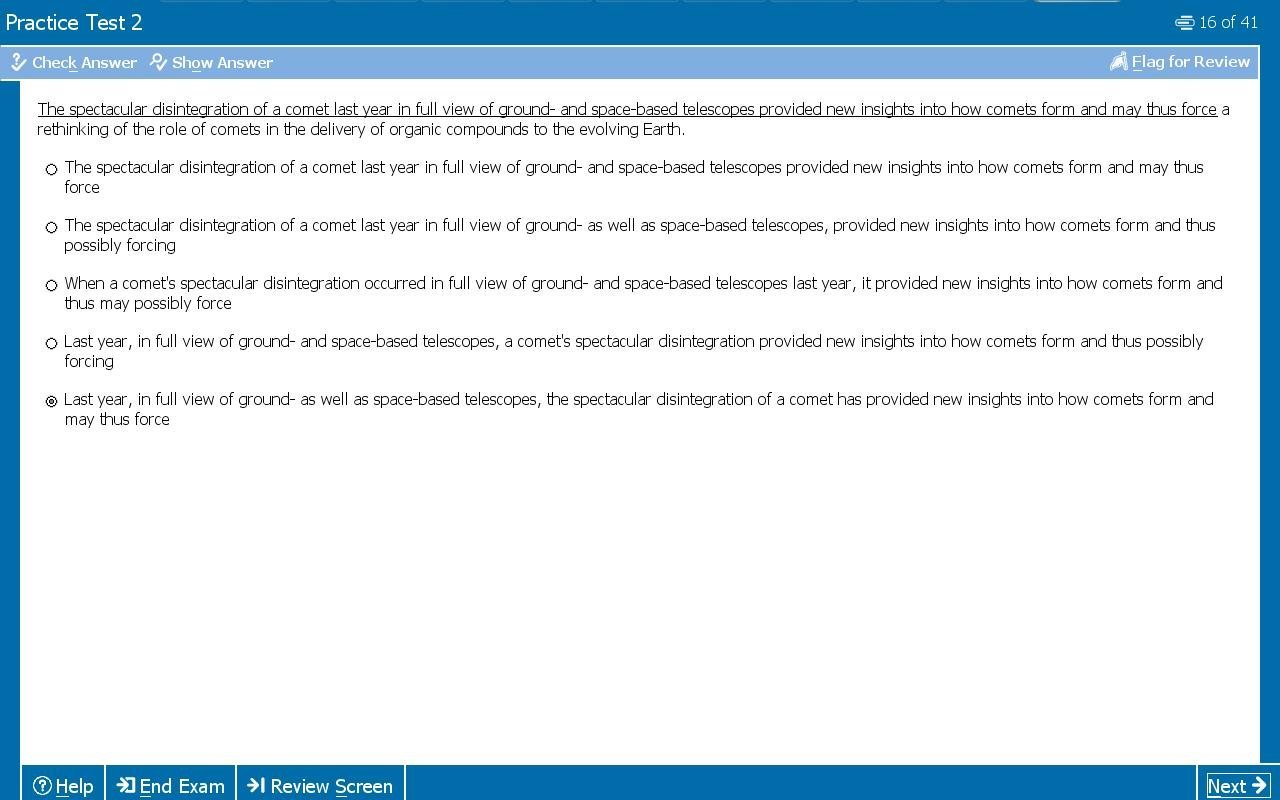
The spectacular disintegration of a comet last year in full view of ground- and space-based telescopes provided new insights into how comets form and may thus force a rethinking of the role of comets in the delivery of organic compounds to the evolving Earth.
(A) The spectacular disintegration of a comet last year in full view of ground- and space-based telescopes provided new insights into how comets form and may thus force
(B) The spectacular disintegration of a comet last year in full view of ground- as well as space-based telescopes, provided new insights into how comets form and thus possibly forcing
(C) When a comet's spectacular disintegration occurred in full view of ground- and space-based telescopes last year, it provided new insights into how comets form and thus may possibly force
(D) Last year, in full view of ground- and space-based telescopes, a comet's spectacular disintegration provided new insights into how comets form and thus possibly forcing
(E) Last year, in full view of ground- as well as space-based telescopes, the spectacular disintegration of a comet has provided new insights into how comets form and may thus force
The Spectacular.jpg [ 108.27 KiB | Viewed 32754 times ]
(A) The spectacular disintegration of a comet last year in full view of ground- and space-based telescopes provided new insights into how comets form and may thus force
(B) The spectacular disintegration of a comet last year in full view of ground- as well as space-based telescopes, provided new insights into how comets form and thus possibly forcing
(C) When a comet's spectacular disintegration occurred in full view of ground- and space-based telescopes last year, it provided new insights into how comets form and thus may possibly force
(D) Last year, in full view of ground- and space-based telescopes, a comet's spectacular disintegration provided new insights into how comets form and thus possibly forcing
(E) Last year, in full view of ground- as well as space-based telescopes, the spectacular disintegration of a comet has provided new insights into how comets form and may thus force
Attachment:
The Spectacular.jpg [ 108.27 KiB | Viewed 32754 times ]

 22 Dec 2010, 00:12
Kudos
Bookmarks
I agree with daagh that the use of "and" here necessitates a verb in the first part of the sentence. Notice that there is no verb at all in the non-underlined portion, so you need a verb in the underlined portion. But the underlined portion says "A and thus B"--so A and B need to be parallel, and they must both contain verbs. As daagh says, that knocks off B, C, and D.
I also agree that the meaning shifts in E, but I have a different (grammatical) reason for losing E. There is a verb split between A and E-- "provided" versus "has provided." What might help us distinguish which of these options is incorrect? Both sentences use the phrase "last year," but you cannot use the present perfect tense (has/have + past participle) if you name the specific point in the past when that action happened.
Last year, I ate 10 pizzas. CORRECT
Last year, I have eaten 10 pizzas. INCORRECT
In 1998, I owned twenty pairs of shoes. CORRECT
In 1998, I have owned twenty pairs of shoes. INCORRECT
One thing to be careful of when applying this rule is the word "since"--"since 1998" means...in the period of time between 1998 and leading up to the present," so you *can* use a specific date with "since" and the present perfect.
Since 1998, I have been to Paris four times. CORRECT
In 1998, I went to Paris four times. CORRECT (but different meaning)
In 1988, I have gone to Paris four times. INCORRECT.
E incorrectly uses the present perfect, so A is our answer.
I also agree that the meaning shifts in E, but I have a different (grammatical) reason for losing E. There is a verb split between A and E-- "provided" versus "has provided." What might help us distinguish which of these options is incorrect? Both sentences use the phrase "last year," but you cannot use the present perfect tense (has/have + past participle) if you name the specific point in the past when that action happened.
Last year, I ate 10 pizzas. CORRECT
Last year, I have eaten 10 pizzas. INCORRECT
In 1998, I owned twenty pairs of shoes. CORRECT
In 1998, I have owned twenty pairs of shoes. INCORRECT
One thing to be careful of when applying this rule is the word "since"--"since 1998" means...in the period of time between 1998 and leading up to the present," so you *can* use a specific date with "since" and the present perfect.
Since 1998, I have been to Paris four times. CORRECT
In 1998, I went to Paris four times. CORRECT (but different meaning)
In 1988, I have gone to Paris four times. INCORRECT.
E incorrectly uses the present perfect, so A is our answer.
 31 Oct 2013, 01:41
Kudos
Bookmarks
Note:
(1) "and" is a very important PARALLEL marker. Two parts before and after "and" must be parallel.
(2) Verb+ed modifier always modifies preceding NOUN
The spectacular disintegration of a comet last year in full view of ground- and space-based telescopes provided new insights into how comets form and thus may force a rethinking of the role of comets in the delivery of organic compounds to the evolving earth.
A. The spectacular disintegration of a comet last year in full view of ground- and space-based telescopes provided new insights into how comets form and thus may force
Correct. Good structure: X provided.... and thus may force......
B. The spectacular disintegration of a comet last year in full view of ground- and space-based telescopes, provided new insights into how comets form and thus possibly forcing
Wrong. Modifier problem. Verb+ed modifier always modifies preceding NOUN. "provided" modifies "telescopes" <-- wrong.
C. When a comet's spectacular disintegration occured in full view of ground- and space-based telescopes last year, it provided new insights into how comets form and thus possibly forcing
Wrong. Parallelism problem. Past tens vs. Verb-ing modifier
D. Last year, in full view of ground- and space-based telescopes, a comet's spectacular disintegration provided new insights into how comets form and thus possibly forcing
Wrong. Parallelism problem. Past tens vs. Verb-ing modifier
E. Last year, in full view of ground- and space-based telescopes, the spectacular disintegration of a comet has provided new insights into how comets form and may thus force
Wrong. Tense problem. Present perfect never goes with "Last year".
Hope it helps.
(1) "and" is a very important PARALLEL marker. Two parts before and after "and" must be parallel.
(2) Verb+ed modifier always modifies preceding NOUN
The spectacular disintegration of a comet last year in full view of ground- and space-based telescopes provided new insights into how comets form and thus may force a rethinking of the role of comets in the delivery of organic compounds to the evolving earth.
A. The spectacular disintegration of a comet last year in full view of ground- and space-based telescopes provided new insights into how comets form and thus may force
Correct. Good structure: X provided.... and thus may force......
B. The spectacular disintegration of a comet last year in full view of ground- and space-based telescopes, provided new insights into how comets form and thus possibly forcing
Wrong. Modifier problem. Verb+ed modifier always modifies preceding NOUN. "provided" modifies "telescopes" <-- wrong.
C. When a comet's spectacular disintegration occured in full view of ground- and space-based telescopes last year, it provided new insights into how comets form and thus possibly forcing
Wrong. Parallelism problem. Past tens vs. Verb-ing modifier
D. Last year, in full view of ground- and space-based telescopes, a comet's spectacular disintegration provided new insights into how comets form and thus possibly forcing
Wrong. Parallelism problem. Past tens vs. Verb-ing modifier
E. Last year, in full view of ground- and space-based telescopes, the spectacular disintegration of a comet has provided new insights into how comets form and may thus force
Wrong. Tense problem. Present perfect never goes with "Last year".
Hope it helps.