Last visit was: 22 Apr 2026, 01:59 It is currently 22 Apr 2026, 01:59
Close
GMAT Club Daily Prep
Thank you for using the timer - this advanced tool can estimate your performance and suggest more practice questions. We have subscribed you to Daily Prep Questions via email.

Customized
for You

we will pick new questions that match your level based on your Timer History

Track
Your Progress

every week, we’ll send you an estimated GMAT score based on your performance

Practice
Pays

we will pick new questions that match your level based on your Timer History
Not interested in getting valuable practice questions and articles delivered to your email? No problem, unsubscribe here.
Close
Request Expert Reply
Confirm Cancel
User avatar
EgmatQuantExpert
User avatar
e-GMAT Representative
Joined: 04 Jan 2015
Last visit: 02 Apr 2024
Posts: 3,657
Own Kudos:
20,861
 [59]
Given Kudos: 165
Expert
Expert reply
Posts: 3,657
Kudos: 20,861
 [59]
1
Kudos
Add Kudos
58
Bookmarks
Bookmark this Post
Most Helpful Reply
User avatar
EgmatQuantExpert
User avatar
e-GMAT Representative
Joined: 04 Jan 2015
Last visit: 02 Apr 2024
Posts: 3,657
Own Kudos:
20,861
 [17]
Given Kudos: 165
Expert
Expert reply
Posts: 3,657
Kudos: 20,861
 [17]
1
Kudos
Add Kudos
15
Bookmarks
Bookmark this Post
General Discussion
User avatar
abhimahna
User avatar
Board of Directors
Joined: 18 Jul 2015
Last visit: 06 Jul 2024
Posts: 3,481
Own Kudos:
5,779
 [1]
Given Kudos: 346
Status:Emory Goizueta Alum
Products:
Expert
Expert reply
Posts: 3,481
Kudos: 5,779
 [1]
1
Kudos
Add Kudos
Bookmarks
Bookmark this Post
avatar
kritikalal
Joined: 20 Oct 2017
Last visit: 07 Jul 2021
Posts: 27
Own Kudos:
Given Kudos: 158
Posts: 27
Kudos: 8
Kudos
Add Kudos
Bookmarks
Bookmark this Post
EgmatQuantExpert
Solution

Hey Everyone,

Please find below the solution of the given problem.

We see that each factor has a power greater than 1.

We just need to keep in mind that the process is exactly the same: The wavy line passes through the zero point if the power of the corresponding factor is odd. The wavy line bounces back from the zero point if the power of the corresponding factor is even.

(x-6) is the only factor with an even power in the given expression and so the wavy line should bounce back at x = 6.

Plotting the zero points and drawing the wavy line:
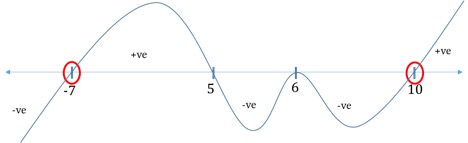


Required Range:

-7 < x < 5 or x > 10

Correct Answer: Option A


For x=6 the answer is zero. Sho should the correct answer then be split into:
1) 6 < x < 10
2) 5 < x < 6
3) x < -7
User avatar
Hero8888
Joined: 29 Dec 2017
Last visit: 14 Apr 2019
Posts: 299
Own Kudos:
348
 [1]
Given Kudos: 273
Location: United States
Concentration: Marketing, Technology
GMAT 1: 630 Q44 V33
GMAT 2: 690 Q47 V37
GMAT 3: 710 Q50 V37
GPA: 3.25
WE:Marketing (Telecommunications)
GMAT 3: 710 Q50 V37
Posts: 299
Kudos: 348
 [1]
1
Kudos
Add Kudos
Bookmarks
Bookmark this Post
kritikalal
EgmatQuantExpert
Solution

Hey Everyone,

Please find below the solution of the given problem.

We see that each factor has a power greater than 1.

We just need to keep in mind that the process is exactly the same: The wavy line passes through the zero point if the power of the corresponding factor is odd. The wavy line bounces back from the zero point if the power of the corresponding factor is even.

(x-6) is the only factor with an even power in the given expression and so the wavy line should bounce back at x = 6.

Plotting the zero points and drawing the wavy line:


Required Range:

-7 < x < 5 or x > 10

Correct Answer: Option A


For x=6 the answer is zero. Sho should the correct answer then be split into:
1) 6 < x < 10
2) 5 < x < 6
3) x < -7

We have to find (+) not (-), in this case x = 6 has no meaning for us, since range -7 < x < 5 or x > 10 doesn't include x=6.
avatar
sakshi.2sep
Joined: 29 May 2016
Last visit: 12 May 2019
Posts: 5
Given Kudos: 2
Posts: 5
Kudos: 0
Kudos
Add Kudos
Bookmarks
Bookmark this Post
EgmatQuantExpert
Solution

Hey Everyone,

Please find below the solution of the given problem.

We see that each factor has a power greater than 1.

We just need to keep in mind that the process is exactly the same: The wavy line passes through the zero point if the power of the corresponding factor is odd. The wavy line bounces back from the zero point if the power of the corresponding factor is even.

(x-6) is the only factor with an even power in the given expression and so the wavy line should bounce back at x = 6.

Plotting the zero points and drawing the wavy line:

Required Range:

-7 < x < 5 or x > 10

Correct Answer: Option A


Hi Payal,

Can you please explain why the exclusion holes are marked at 10 and -7 instead of 5 and 6(following the same strategy as in question 4 and in concepts for wavy line)?

TIA

Thanks,
Sakshi
User avatar
EgmatQuantExpert
User avatar
e-GMAT Representative
Joined: 04 Jan 2015
Last visit: 02 Apr 2024
Posts: 3,657
Own Kudos:
20,861
 [1]
Given Kudos: 165
Expert
Expert reply
Posts: 3,657
Kudos: 20,861
 [1]
1
Kudos
Add Kudos
Bookmarks
Bookmark this Post
Hey sakshi.2sep,

We have explained this in detail in our article.
We suggest you go through it once.

Here is the link for the article:
Wavy Line Method Application: https://gmatclub.com/forum/wavy-line-met ... 24319.html

If you still have any doubt, please let us know.
We will be more than happy to resolve your doubt.

Regards,
Ashutosh
e-GMAT
avatar
sakshi.2sep
Joined: 29 May 2016
Last visit: 12 May 2019
Posts: 5
Given Kudos: 2
Posts: 5
Kudos: 0
Kudos
Add Kudos
Bookmarks
Bookmark this Post
Hi Ashuhtosh,

Appreciate your quick reply.

After going through the article once more, I understand why -7 and 10 are excluded from the solution set but still doubtful if 5 and 6 should also be excluded as they are in the denominator and we should never consider cases where the denominator becomes zero. Please explain why did we not exclude 5 and 6?

Thanks and regards,
Sakshi
User avatar
EgmatQuantExpert
User avatar
e-GMAT Representative
Joined: 04 Jan 2015
Last visit: 02 Apr 2024
Posts: 3,657
Own Kudos:
Given Kudos: 165
Expert
Expert reply
Posts: 3,657
Kudos: 20,861
Kudos
Add Kudos
Bookmarks
Bookmark this Post
Hey sakshi.2sep,

I have 1 question.

Can we multiply both sides of the inequality by \((x-5)^10(x-6)^8\) in the above fraction?
If you do this then inequality will become \({(x-10)^3 (x+7)^5}{(x-5)^5 (x-6)^4} > 0\)

Now, you can solve the inequality.
Hope this helps you.

Regards,
Ashutosh
avatar
sakshi.2sep
Joined: 29 May 2016
Last visit: 12 May 2019
Posts: 5
Given Kudos: 2
Posts: 5
Kudos: 0
Kudos
Add Kudos
Bookmarks
Bookmark this Post
Hey Ashutosh,

Thank you. I do get this question in both the forms: denominator and multiplying by square. Just got confused with the holes (exclusions) marked for 2 points(-7,10) of the solution set and NOT marked for other 2 points (5,6) of the solution set in the wavy line representation. However, the answer mentioned as Required Range: -7 < x < 5 or x > 10 has no doubt.

Regards,
Sakshi
User avatar
manasveek
Joined: 18 Jun 2017
Last visit: 02 Jan 2021
Posts: 40
Own Kudos:
Given Kudos: 78
Posts: 40
Kudos: 247
Kudos
Add Kudos
Bookmarks
Bookmark this Post
hey EgmatQuantExpert,

You have given great explanation and practice problems.
but I am getting totally confused with starting points of drawing curve.
for above problem, I drew curve starting from top left.
and considered positive parts. where answer is different.

this must be something obvious. but pls help me to get there.
thanks in advance!
User avatar
EgmatQuantExpert
User avatar
e-GMAT Representative
Joined: 04 Jan 2015
Last visit: 02 Apr 2024
Posts: 3,657
Own Kudos:
Given Kudos: 165
Expert
Expert reply
Posts: 3,657
Kudos: 20,861
Kudos
Add Kudos
Bookmarks
Bookmark this Post
manasveek
hey EgmatQuantExpert,

You have given great explanation and practice problems.
but I am getting totally confused with starting points of drawing curve.
for above problem, I drew curve starting from top left.
and considered positive parts. where answer is different.

this must be something obvious. but pls help me to get there.
thanks in advance!

Hey manasveek,
you need to start drawing the curve from the top right portion.
I am quoting a part of the article that explains the method:

Quote:

How to draw the wavy line?

1. How to start: Once you draw the number line and mark the zero points on the number line, it’s time to draw the wavy line. Start from the top right most portion. Be ready to alternate (or not alternate) the region of the wave based on how many times a point is root to the given expression.

2. How to alternate:
if the power of a term is odd, then the wave simply passes through the corresponding point (root) into the other region (to –ve region if the wave is currently in the positive region and to the +ve region if the wave is currently in the negative region).

I will suggest you go through the whole article: Wavy Line Method Application - Complex Algebraic Inequalities

Also, read our new article about solving inequalities: Solving inequalities- Number Line Method

User avatar
manasveek
Joined: 18 Jun 2017
Last visit: 02 Jan 2021
Posts: 40
Own Kudos:
Given Kudos: 78
Posts: 40
Kudos: 247
Kudos
Add Kudos
Bookmarks
Bookmark this Post
thank you EgmatQuantExpert for such a quick reply.
I tried going through new article and totally understood concept and why is that we start drawing curve from top right.
a very useful article as always by E-gmat.
Thank you very much!


Regards,
Manasvee.
avatar
kriskramesh
Joined: 10 Apr 2016
Last visit: 11 Jun 2023
Posts: 4
Own Kudos:
Given Kudos: 26
Location: Singapore
GMAT 1: 640 Q49 V28
GMAT 2: 680 Q47 V36
GMAT 2: 680 Q47 V36
Posts: 4
Kudos: 6
Kudos
Add Kudos
Bookmarks
Bookmark this Post
EgmatQuantExpert
Solution

Hey Everyone,

Please find below the solution of the given problem.

We see that each factor has a power greater than 1.

We just need to keep in mind that the process is exactly the same: The wavy line passes through the zero point if the power of the corresponding factor is odd. The wavy line bounces back from the zero point if the power of the corresponding factor is even.

(x-6) is the only factor with an even power in the given expression and so the wavy line should bounce back at x = 6.

Plotting the zero points and drawing the wavy line:


Required Range:

-7 < x < 5 or x > 10

Correct Answer: Option A

Dear Ms. Tandon,

Thank you for all your replies. I've gone through them, but yet I have one question about the inclusion and exclusion of '6' in the solution if the question was presented differently.

\(\frac{(x-10)^3 (x+7)^5 (x-6)^4}{(x-5)^5} > 0\)
\(\frac{(x-10)^3 (x+7)^5 (x-6)^4}{(x-5)^5} >= 0\)

May I know if x=6 will be included in both of the scenarios?
User avatar
bumpbot
User avatar
Non-Human User
Joined: 09 Sep 2013
Last visit: 04 Jan 2021
Posts: 38,957
Own Kudos:
Posts: 38,957
Kudos: 1,117
Kudos
Add Kudos
Bookmarks
Bookmark this Post
Automated notice from GMAT Club BumpBot:

A member just gave Kudos to this thread, showing it’s still useful. I’ve bumped it to the top so more people can benefit. Feel free to add your own questions or solutions.

This post was generated automatically.
Moderators:
Math Expert
109740 posts
Tuck School Moderator
853 posts



