Last visit was: 31 Aug 2026, 15:34 It is currently 31 Aug 2026, 15:34
Close
GMAT Club Daily Prep
Thank you for using the timer - this advanced tool can estimate your performance and suggest more practice questions. We have subscribed you to Daily Prep Questions via email.

Customized
for You

we will pick new questions that match your level based on your Timer History

Track
Your Progress

every week, we’ll send you an estimated GMAT score based on your performance

Practice
Pays

we will pick new questions that match your level based on your Timer History
Not interested in getting valuable practice questions and articles delivered to your email? No problem, unsubscribe here.
Close
Request Expert Reply
Confirm Cancel
User avatar
hugogva
Joined: 28 Aug 2023
Last visit: 05 Feb 2024
Posts: 5
Own Kudos:
506
 [151]
Location: Switzerland
Posts: 5
Kudos: 506
 [151]
16
Kudos
Add Kudos
135
Bookmarks
Bookmark this Post
Most Helpful Reply
User avatar
Bunuel
User avatar
Math Expert
Joined: 02 Sep 2009
Last visit: 31 Aug 2026
Posts: 113,036
Own Kudos:
Given Kudos: 111,233
Products:
Expert
Expert reply
Active GMAT Club Expert! Tag them with @ followed by their username for a faster response.
Posts: 113,036
Kudos: 838,209
 [27]
12
Kudos
Add Kudos
15
Bookmarks
Bookmark this Post
User avatar
rakman123
Joined: 13 Jun 2023
Last visit: 16 Feb 2025
Posts: 24
Own Kudos:
1,493
 [13]
Given Kudos: 726
Posts: 24
Kudos: 1,493
 [13]
4
Kudos
Add Kudos
9
Bookmarks
Bookmark this Post
General Discussion
User avatar
gmatophobia
User avatar
Quant Chat Moderator
Joined: 22 Dec 2016
Last visit: 30 Aug 2026
Posts: 3,174
Own Kudos:
12,292
 [62]
Given Kudos: 1,860
Location: India
Concentration: Strategy, Leadership
Posts: 3,174
Kudos: 12,292
 [62]
41
Kudos
Add Kudos
21
Bookmarks
Bookmark this Post
hugogva
What is the sum of the different values of \(x\) such that \(|x+2| = 2|x-2|\)

A. \(4\)

B. \(\frac{16}{3}\)

C. \(6\)

D. \(\frac{20}{3}\)

E. \(8\)
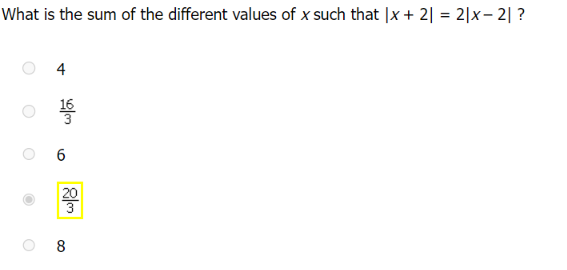
\(|x+2| = 2|x-2|\)

Squaring both sides of the equation

\((x+2)^2 = 4(x-2)^2\)

\(x^2 + 4 + 4x = 4(x^2 + 4 - 4x)\)

\(x^2 + 4 + 4x = 4x^2 + 16 - 16x\)

\(3x^2 - 20x + 12 = 0\)

In a quadratic equation represented by \(ax^2 + bx + c\), the sum of roots is given by \(\frac{-b}{a}\)

Sum of roots = \(\frac{20}{3}\)

Option D
User avatar
Adrian_D
Joined: 16 Nov 2023
Last visit: 08 Jan 2024
Posts: 1
Own Kudos:
8
 [8]
Posts: 1
Kudos: 8
 [8]
6
Kudos
Add Kudos
2
Bookmarks
Bookmark this Post
rakman123
Simple Method;

Must note; when you come across an absolute value question like this, always remember that you must test the value, in this case 'x', for both a positive side and a negative side. Here's what I mean;

Positive: |x+2|=2|x−2| ---> x+2=2(x-2) ---> x+2=2x-4 ----> x=6 , this is the value for the positive.
Negative: |x+2|=2|x−2| ---> -x-2=2(x-2) ---> -x-2=2x-4 ---> 3x=2 ---> x=2/3 , this is the value for the negative.

Sum 6+2/3= 20/3.

Voila.

---------
^ Why did you only test a positive and negative for the left side of the equation, given there is an absolute value sign on both sides?
User avatar
SergejK
Joined: 22 Mar 2024
Last visit: 02 May 2025
Posts: 150
Own Kudos:
Given Kudos: 73
Posts: 150
Kudos: 1,107
Kudos
Add Kudos
Bookmarks
Bookmark this Post
Bunuel
Adrian_D
rakman123
What is the sum of the different values of \(x\) such that \(|x+2| = 2|x-2|\)

A. \(4\)

B. \(\frac{16}{3}\)

C. \(6\)

D. \(\frac{20}{3}\)

E. \(8\)

Simple Method;

Must note; when you come across an absolute value question like this, always remember that you must test the value, in this case 'x', for both a positive side and a negative side. Here's what I mean;

Positive: |x+2|=2|x−2| ---> x+2=2(x-2) ---> x+2=2x-4 ----> x=6 , this is the value for the positive.
Negative: |x+2|=2|x−2| ---> -x-2=2(x-2) ---> -x-2=2x-4 ---> 3x=2 ---> x=2/3 , this is the value for the negative.

Sum 6+2/3= 20/3.

Voila.

---------
^ Why did you only test a positive and negative for the left side of the equation, given there is an absolute value sign on both sides?

The key point is that when expanding the absolute values, the pair |x + 2| and |x − 2| can be expanded with either the same sign (where '+' and '+' or '−' and '−' will yield the same expression) or with opposite signs (where '+' and '−' will result in the same expression as '−' and '+').

Thus, |x + 2| = 2|x - 2| can lead to either x + 2 = 2(x - 2) when expanding with the same sign, or x + 2 = -2(x - 2) when expanding with opposite signs.

    x + 2 = 2(x - 2) yields x = 6. Substituting x = 6 back into |x + 2| = 2|x - 2| satisfies the equation, confirming this value as valid.
    x + 2 = -2(x - 2) yields x = 2/3. Substituting x = 2/3 back into |x + 2| = 2|x - 2| also satisfies the equation, confirming this value as well.

The sum of these values, 6 + 2/3 = 18/3 + 2/3 = 20/3.

Answer: D.
­

But as x<-2 and hence x<2 would result in x=6 we can discard this answer choice as it is clearly not less than -2, correct? Additionally as C4 of x<-2 and x>= 2 together doen't make sense, we are left with 2 cases: C1: x>=2, h>=-2 and C2: x>=-2 and x<2. Is my understanding correct?­
User avatar
pisker
Joined: 01 May 2024
Last visit: 24 Sep 2025
Posts: 5
Own Kudos:
Posts: 5
Kudos: 2
Kudos
Add Kudos
Bookmarks
Bookmark this Post
Why do you not test the second equation with a negative? Shouldn't this result in 4 scenarios?
User avatar
Bunuel
User avatar
Math Expert
Joined: 02 Sep 2009
Last visit: 31 Aug 2026
Posts: 113,036
Own Kudos:
838,209
 [1]
Given Kudos: 111,233
Products:
Expert
Expert reply
Active GMAT Club Expert! Tag them with @ followed by their username for a faster response.
Posts: 113,036
Kudos: 838,209
 [1]
1
Kudos
Add Kudos
Bookmarks
Bookmark this Post
pisker
Why do you not test the second equation with a negative? Shouldn't this result in 4 scenarios?

Your doubt is addressed here: https://gmatclub.com/forum/what-is-the- ... l#p3310573

Hope this helps.
User avatar
pisker
Joined: 01 May 2024
Last visit: 24 Sep 2025
Posts: 5
Own Kudos:
Posts: 5
Kudos: 2
Kudos
Add Kudos
Bookmarks
Bookmark this Post
Bunuel
pisker
Why do you not test the second equation with a negative? Shouldn't this result in 4 scenarios?

Your doubt is addressed here: https://gmatclub.com/forum/what-is-the- ... l#p3310573

Hope this helps.
Thanks, I read that but that isn't quite the problem I'm having trouble understanding. Why are we not testing these 4 scenarios since we have 2 different absolute value equations:

x+2=2(x-2)
x+2=-2(x-2)
-(x+2)=2(x-2)
-(x+2)=-2(x-2)
User avatar
pisker
Joined: 01 May 2024
Last visit: 24 Sep 2025
Posts: 5
Own Kudos:
Posts: 5
Kudos: 2
Kudos
Add Kudos
Bookmarks
Bookmark this Post
Nevermind - I see it now thanks!
User avatar
Gaurav07
Joined: 15 May 2021
Last visit: 15 Aug 2026
Posts: 58
Own Kudos:
Given Kudos: 63
Location: India
Schools: Smith (A)
GPA: 4
Schools: Smith (A)
Posts: 58
Kudos: 4
Kudos
Add Kudos
Bookmarks
Bookmark this Post
Hey, can you explain. Didn't quite understadn why didn't we add up all the 4 values
pisker
Nevermind - I see it now thanks!
User avatar
Venu01298
Joined: 17 Sep 2024
Last visit: 11 Apr 2025
Posts: 30
Own Kudos:
13
 [1]
Given Kudos: 9
Location: India
GMAT Focus 1: 695 Q86 V84 DI82
GPA: NA
1
Kudos
Add Kudos
Bookmarks
Bookmark this Post
I think its because you end up with the same 2 values as solutions for the additional two scenarios

|x+2| = 2|x-2| - original

assuming LHS positive RHS negative

x+2 = -2(x-2)

assuming LHS negative RHS positive

-(x+2) = 2(x-2)

as you can see both are the same, so you would get same solutions for x

Similarly both negatives and both positives yield the same solution
Gaurav07
Hey, can you explain. Didn't quite understadn why didn't we add up all the 4 values
pisker
Nevermind - I see it now thanks!
User avatar
BrushMyQuant
Joined: 05 Apr 2011
Last visit: 09 Aug 2026
Posts: 2,286
Own Kudos:
2,760
 [9]
Given Kudos: 100
Status:Tutor - BrushMyQuant
Location: India
Concentration: Finance, Marketing
Schools: XLRI (A)
GMAT 1: 700 Q51 V31
GPA: 3
WE:Information Technology (Computer Software)
Expert
Expert reply
Schools: XLRI (A)
GMAT 1: 700 Q51 V31
Posts: 2,286
Kudos: 2,760
 [9]
4
Kudos
Add Kudos
5
Bookmarks
Bookmark this Post
We need to find what is the sum of the different values of x such that |x+2| = 2|x-2|

As we have two absolute values so we will have three cases and he number line will be divided into three points by equating following equations to 0

x + 2 =0 and x - 2 = 0
=> x = 2 and x = -2

Number line is divided into three parts x ≤ 3, 3 ≤ x ≤ 20, x ≥ 20
-Case 1: x -2

Now when x -2 then both x + 2 and x - 2 will be non-positive
=> | x+2| = -(x+2) and |x-2| = -(x-2)
=> -(x+2) = 2*-(x-2)
=> x + 2 = 2*(x-2)
=> x + 2 = 2x - 4
=> x = 6

But the range was x -2 and 6 is NOT ≤ -2
=> NO SOLUTION in this case
-Case 2: -2 ≤ x ≤ 2

Now when -2 ≤ x ≤ 2 then x + 2 will be non-negative and x - 2 will be non-positive
=> | x+2| = x+2 and |x-2| = -(x-2)
=> x+2 = 2*-(x-2)
=> x + 2 = -2x + 4
=> 3x = 2
=> x = 2/3 ~ 0.67

But the range was -2 ≤ x ≤ 2 and -2 ≤ 0.67 ≤ 2
=> x = 2/3 is a SOLUTION
Case 3: x ≥ 2

Now when x ≥ 2 then both x + 2 and x - 2 will be non-negative
=> | x+2| = x+2 and |x-2| = x-2
=> x+2 = 2*(x-2)
=> x + 2 = 2*(x-2)
=> x + 2 = 2x - 4
=> x = 6

But the range was x ≥ 2 and 6 ≥ 2
=> x = 6 is a SOLUTION

=> Sum of different values of x = 2/3 + 6 = 20/3

So, Answer will be D
Hope it helps!

Watch the following video to MASTER Inequality + Absolute value Problems

User avatar
KarishmaB
Joined: 16 Oct 2010
Last visit: 31 Aug 2026
Posts: 16,630
Own Kudos:
81,087
 [4]
Given Kudos: 488
Location: Pune, India
Expert
Expert reply
Active GMAT Club Expert! Tag them with @ followed by their username for a faster response.
Posts: 16,630
Kudos: 81,087
 [4]
2
Kudos
Add Kudos
2
Bookmarks
Bookmark this Post
hugogva
What is the sum of the different values of \(x\) such that \(|x+2| = 2|x-2|\)

A. \(4\)

B. \(\frac{16}{3}\)

C. \(6\)

D. \(\frac{20}{3}\)

E. \(8\)

Attachment:
The attachment 2023-12-04_21-00-05.png is no longer available

When both sides of the = sign are surrounded by absolute values, the easiest approach usually is to square both sides. (even if it is an inequality because both sides are non negative)

That method is shown by gmatophobia above so not repeating it.

Those inclined to following visual approach of "distance on number line", note that
\(|x+2| = 2|x-2|\) means "distance from -2 is equal to twice the distance from 2"

Attachment:
Screenshot 2024-10-19 at 7.54.03 PM.png
Screenshot 2024-10-19 at 7.54.03 PM.png [ 36.58 KiB | Viewed 18762 times ]


Distance between -2 and 2 is 4 which is split in the ratio 2:1 which means that x is at 2 - 4/3 = 2/3
Distance between -2 and 2 is 4 which is doubled to give another point where the ratio of distances is 2:1 which means x is at 2 + 4 = 6
Hence x takes 2 values: 6 and 2/3 and their sum is 20/3

Answer (D)

Concept of absolute values as distance is discussed here: https://youtu.be/oqVfKQBcnrs
User avatar
anushree01
Joined: 06 Apr 2024
Last visit: 31 Aug 2026
Posts: 251
Own Kudos:
90
 [1]
Given Kudos: 179
Products:
Posts: 251
Kudos: 90
 [1]
1
Kudos
Add Kudos
Bookmarks
Bookmark this Post
Tip : Whenever you see |a|=|b| type Question : SOLVE it by Squaring both sides
User avatar
SwethaReddyL
Joined: 28 Nov 2023
Last visit: 30 Aug 2026
Posts: 186
Own Kudos:
Given Kudos: 271
Location: India
Posts: 186
Kudos: 37
Kudos
Add Kudos
Bookmarks
Bookmark this Post
Bunuel, we are testing only for same signs(+ or -) and opposite sides BECAUSE it's a pair? as in |x+2| and |x-2|? if the absolute value wasn't like this, we should test for 4 possible cases as we do?


Bunuel


The key point is that when expanding the absolute values, the pair |x + 2| and |x − 2| can be expanded with either the same sign (where '+' and '+' or '−' and '−' will yield the same expression) or with opposite signs (where '+' and '−' will result in the same expression as '−' and '+').

Thus, |x + 2| = 2|x - 2| can lead to either x + 2 = 2(x - 2) when expanding with the same sign, or x + 2 = -2(x - 2) when expanding with opposite signs.


x + 2 = 2(x - 2) yields x = 6. Substituting x = 6 back into |x + 2| = 2|x - 2| satisfies the equation, confirming this value as valid.
x + 2 = -2(x - 2) yields x = 2/3. Substituting x = 2/3 back into |x + 2| = 2|x - 2| also satisfies the equation, confirming this value as well.

The sum of these values, 6 + 2/3 = 18/3 + 2/3 = 20/3.

Answer: D.
User avatar
Bunuel
User avatar
Math Expert
Joined: 02 Sep 2009
Last visit: 31 Aug 2026
Posts: 113,036
Own Kudos:
Given Kudos: 111,233
Products:
Expert
Expert reply
Active GMAT Club Expert! Tag them with @ followed by their username for a faster response.
Posts: 113,036
Kudos: 838,209
Kudos
Add Kudos
Bookmarks
Bookmark this Post
SwethaReddyL
Bunuel, we are testing only for same signs(+ or -) and opposite sides BECAUSE it's a pair? as in |x+2| and |x-2|? if the absolute value wasn't like this, we should test for 4 possible cases as we do?


The reason is not that these two expressions form a special “pair.” The reason is that the equation has the form \(|A| = |B|\). In such cases, only two relative-sign cases are needed: \(A = B\) or \(A = -B\). We do not need four separate cases because the same-sign cases are equivalent to each other, and the opposite-sign cases are also equivalent to each other.
User avatar
egmat
User avatar
e-GMAT Representative
Joined: 02 Nov 2011
Last visit: 31 Aug 2026
Posts: 6,260
Own Kudos:
33,877
 [2]
Given Kudos: 715
GMAT Date: 08-19-2020
Expert
Expert reply
Active GMAT Club Expert! Tag them with @ followed by their username for a faster response.
Posts: 6,260
Kudos: 33,877
 [2]
2
Kudos
Add Kudos
Bookmarks
Bookmark this Post
Hi SwethaReddyL,

Yes, your instinct is exactly right, and let me make it precise.

You're reacting to Venu01298's point that the "both positive" and "both negative" versions give the same solutions, as do the two "opposite sign" versions. Here's why that happens.

Why 4 collapses to 2

Your equation has an absolute value on both sides - it's the form |A| = |B|, where here A = x+2 and B = 2(x-2). Lay out all four sign choices:

- (+, +): A = B
- (-, -): -A = -B -> multiply both sides by -1 -> A = B (same as the first)
- (+, -): A = -B
- (-, +): -A = B -> multiply both sides by -1 -> A = -B (same as the third)

So the four cases fold into just two: A = B or A = -B. The reason is exactly the "pair" you spotted - because both sides are wrapped in absolute values, flipping both signs is the same equation. That's the general rule:

|A| = |B| is true exactly when A = B or A = -B.

Your second question

If the structure were different, the collapse can fail. The clean trick only works when the whole equation is one absolute value equal to another. If you had something like |x+2| = 2|x-2| + 5 (an extra loose term), negating the whole equation no longer reproduces it, so the cases stay separate - there you'd fall back to the number-line region method (the one BrushMyQuant used: split at the critical points and test each interval).

Lock it in

Try the simpler |x| = |x - 4|:
- x = x - 4 -> no solution
- x = -(x - 4) -> 2x = 4 -> x = 2

Write out the other two sign versions and you'll see they reproduce these same two - never anything new. The pairing always does the collapsing for you.

Answer: D

SwethaReddyL
Bunuel, we are testing only for same signs(+ or -) and opposite sides BECAUSE it's a pair? as in |x+2| and |x-2|? if the absolute value wasn't like this, we should test for 4 possible cases as we do?


User avatar
tanvi0915
Joined: 01 Oct 2025
Last visit: 31 Aug 2026
Posts: 33
Own Kudos:
Given Kudos: 7
Posts: 33
Kudos: 21
Kudos
Add Kudos
Bookmarks
Bookmark this Post
|x + 2| = |2x -4|
Squaring both sides and using a^2-b^2 formula
(x+2+2x-4)(x+2-2x+4) = 0
(3x-2)(6-x) = 0
x = 2/3 and x = 6
adding both we get 20/3
Moderator:
Math Expert
113036 posts