Events & Promotions
| Last visit was: 08 May 2026, 11:40 |
It is currently 08 May 2026, 11:40 |
|
|
Customized
for You
Track
Your Progress
Practice
Pays
03:00 PM PDT
-04:00 PM PDT
08:00 AM PDT
-08:30 AM PDT
10:00 AM EDT
-11:00 AM EDT
05:00 PM PDT
-06:00 PM PDT
| FROM Accepted.com Blog: London Business School Executive MBA Essay Tips & Deadlines [2022 – 2023] |
![]() ![]() The 2 application essay questions, although quite different, both ask you to discuss how you’ll connect with the LBS EMBA program, classmates, and community. And this emphasis in turn underscores LBS’s values of collaboration, contribution, and engagement. I suggest keeping these values on the radar screen as you conceive and draft these two essays. And these questions can overlap a bit, so read both and think through your answers to ensure you make the best use of this space to make your case. London Business School Executive MBA application essays LBS Executive MBA essay #1 Please provide a personal statement explaining how you will contribute to the experience of others on the programme, and how the Executive MBA programme will benefit you. (600 words maximum) How interesting that the question starts not with you and your goals, but with what you will contribute to your classmates’ experience. Be guided by that priority. That doesn’t mean you have to start your essay with that point, but, rather, be substantive. When you are allocating space to different components of the discussion, do not shortchange this contribution point. Rather, provide thoughtful examples rooted in experience, and specify how it might be helpful or worthwhile to others in the program – it’s an opportunity to spotlight your understanding of the LBS EMBA cohort. The part of the essay discussing how the program will benefit you should contain your career goals (you may emphasize immediate, short-term, intermediate, or long-term, but I suggest keeping most focus and detail on immediate through intermediate goals) – what are the learning needs these goals engender, and how will the program meet those needs? You can also address anticipated personal growth benefits of attending the program. << READ: SAMPLE EMBA APPLICATION ESSAY >> LBS Executive MBA essay #2 Describe what it would mean to you personally to be an alumnus of London Business School, what you believe membership of the community represents, and how you would give back to London Business School in the future. (600 words maximum) This question is also about your connection to the program; its focus is fit, your fit with the program. And it’s really 3 questions, so let’s look at each separately.
What’s next? You’ve worked so hard to get to where you are in life. Now that you’re ready for your next achievement, make sure you know how to present yourself to maximum advantage in your executive MBA applications. In a hotly competitive season, you’ll want a member of Team Accepted in your corner, guiding you with expertise tailored specifically for you. For professional guidance with your LBS Executive MBA application, check out Accepted’s MBA Application Package, which includes advising, editing, interview coaching, and a resume edit for the LBS EMBA application. London Business School EMBA deadlines for January 2023 intake Deadline 125 August 2022Deadline 222 September 2022Deadline 313 October 2022Deadline 410 November 2022 Source: London Business School EMBA website ***Disclaimer: Information is subject to change. Please check with individual programs to verify the essay questions, instructions and deadlines.*** ![]() Cindy Tokumitsu has advised hundreds of successful applicants, helping them gain acceptance to top MBA and EMBA programs in her 20 years with Accepted. She would love to help you too. Want Cindy to help you get Accepted? Click here to get in touch! ![]() Related Resources:
|
| FROM Accepted.com Blog: Accepted Announces Partnership with B-Speak! English |

![]() ![]() For more than 25 years, Accepted has been committed to helping our clients succeed in achieving their educational and career goals. Primarily, we have done this through our top-notch admissions consulting, but when we believe our clients can benefit from complementary services, we have suggested those services to them. Now, we have another such opportunity that we are excited to share with you. Many international clients who are not native English speakers require some coaching in English language skills to perform optimally as grad school applicants, but these services might involve a class here, a tutor there–nothing that was “one-stop shopping.” This is why we were so pleased to discover B-Speak! English, the only English-language program created for international applicants to U.S. business graduate programs. Initially designed for international students at Darden in 2014, the coaches at B-Speak! English help clients strengthen the skills they will need most when applying to business/graduate school applicants around the world. These include: building confidence, storytelling and interview prep, improving spoken and written English (grammar, pronunciation), and building vocabulary and everyday, conversational English abilities. Check out the B-Speak! service for Accepted clients B-Speak! not only partners with top business schools as their students prepare for the challenges of the graduate school classroom, but also works with individuals applying to schools – or to their dream jobs. How does B-Speak! English help international applicants?
Our partnership with B-Speak! English will entitle our clients to discounted rates – another great benefit to working with Accepted. It’s never too early to bolster your English communication skills, and if grad school applications are on the horizon, why not check out B-Speak! English’s services right now? Check out Linda Abraham’s Podcast with Christina Ball, founder of B-Speak! English >> Together, Accepted and B-Speak! help international applicants present their best selves to their top schools! Check out the B-Speak! service for Accepted clients What B-Speak! clients say: “My instructor is very professional. My ultimate goal is to improve my speaking skills during interviews. The coaching sessions indeed have proven to be very valuable for my ultimate goal.” – Jinkai Liu, Admitted to Duke-Fuqua “The lessons are great…I wish I’d started them in the summer. I highly recommend B-Speak! I feel much more confident about my English, thanks to these lessons.” – Lior Pardess, admitted to Duke-Fuqua “I was able to land a full-time job after several B-Speak! coaching sessions. I would say that B-Speak is not just an English language coaching session. It is about how you can better understand business culture and the MBA life in the American or global context. I think that international students should consider B-Speak coaching before MBA because it will help them to better understand the American culture, to learn what they will expect in business school and to get better prepared for the upcoming MBA life.” – Yuan W., Darden MBA graduate ”I had a great experience at B-Speak! My teacher was awesome! It was very personalized to my needs. I’ve been studying English for 22 years, and this one was, by far, my best experience.” – Mariano S. admitted to Darden. “B-Speak! is an English course that is very relevant for MBA students looking to improve their communication or written skills for any business needs, whether it is for interviewing or school. I think there are a lot of English courses out there, but there are not many with coaches who understand the life of an MBA student, the challenges they are facing, and their priorities. I would say B-Speak! is one of those that can accommodate our needs exactly.” – Nydia Tumalewa, admitted to Darden MBA. ![]() For 25 years, Accepted has helped business school applicants gain acceptance to top programs. Our outstanding team of MBA admissions consultants features former business school admissions directors and professional writers who have guided our clients to admission at top MBA, EMBA, and other graduate business programs worldwide including Harvard, Stanford, Wharton, Booth, INSEAD, London Business School, and many more. Want an MBA admissions expert to help you get Accepted? Click here to get in touch! The post Accepted Announces Partnership with B-Speak! English appeared first on Accepted Admissions Blog. |
| FROM Accepted.com Blog: Kellogg EMBA Application Essay Tips and Deadlines [2022 – 2023] |
![]() ![]() Kellogg’s two required EMBA application essay questions present a paradox: they’re straightforward and complex. Together, they draw out a fully rounded view of you as a person and as a professional, what you’ve done and how you think and perceive the world. To the extent possible, ground your essays in detail and concrete experience, and use reflection as the thread weaving those details and experiences into a vivid whole. Essays 1 and 2 together should amplify and resonate with each other. They should be neither redundant nor discordant. Before or while drafting them, consider them as a whole. While they must each succeed as a separate statement, to do you the most justice they also should work together as parts of a dynamic whole. ![]() Kellogg EMBA 2022-23 Application Essays Kellogg EMBA essay #1 What are your short-term and long-term career goals? What have you already done to get there and how do you think Kellogg can help you? (450 word maximum) In presenting your goals, frame them with “why” you want to pursue that path and the impact you hope to have. Clarifying this motivation will animate the essay and engage the reader. Also, of course, support this vision by describing your goals in specific terms: likely positions, which company or industry, desired location, and some related context, e.g. anticipated challenges you or your organization may face, your take on industry trends and how they affect your goals, and so forth. Then connect the dots: explain how this stated path will enable you to deliver the desired impact. In asking what you have already done to pursue these goals, the adcom is essentially seeking evidence that you are truly committed to this career path. Answering this part allows you to show that you are proactive, strategic, and resourceful. Don’t cite everything you’ve done in this regard, but rather identify the 2-3 most important experiences – and what you gained from them. In explaining why Kellogg must be the next step on that path, link the resources of the Kellogg EMBA to the specific learning and professional needs arising from your planned path. Kellogg EMBA essay #2 Define what community means to you. Share an example of how you contribute to a community and how that contribution is impacting that community. (450 word maximum) This question aims right at the heart of what Kellogg cares about (and always has). Kellogg’s sense of community is a central value of the business school and reflects its core identity. To define what community means to you, be concrete. There are many communities in your life, and probably they overlap. Your work, your neighborhood and the broader region, your friends from various areas of your life, any organizations or groups you belong to or participate in, cultural or religious groups, etc. When you describe what community means to you, give examples referencing your communities — your definition should encompass different communities. To address the “contribute” part, present a straightforward story about one of your community contributions. Identify and describe what community you are referring to. Clarify why it’s meaningful to you, and briefly summarize your history with and roles in the community. Next, action: what did you do to contribute. I.e., what need did you recognize and what did you do in response? What was the outcome of your action(s), what changed as a result? Kellogg EMBA essay #3 (Optional) If needed, use this section to briefly describe any extenuating circumstances (e.g. unexplained gaps in work experience, choice of recommenders, inconsistent or questionable academic performance, etc.). This question explicitly limits the potential topics to extenuating circumstances, so don’t use it to further market yourself by presenting new material to enhance your application. If you do not have extenuating circumstances, do not write the essay. If you do need to provide such information, do it succinctly and straightforwardly. You’ve worked so hard to get to this point in your journey. Now that you’re ready for your next achievement, make sure you know how to present yourself to maximum advantage in your Kellogg EMBA application. Get a member of Team Accepted in your corner, guiding you with expertise tailored specifically for you. Check out our flexible consulting packages today! Kellogg Executive MBA application deadlines for January 2023 and September 2023 start dates January 2023 Start DateSeptember 2023 Start DateRound 1August 17, 2022April 19, 2023Round 2October 5, 2022June 7, 2023 Source: Kellogg website ***Disclaimer: Information is subject to change. Please check with individual programs to verify the essay questions, instructions and deadlines.*** ![]() ![]() Cindy Tokumitsu has advised hundreds of successful applicants, helping them gain acceptance to top MBA and EMBA programs in her 20 years with Accepted. She would love to help you too. Want Cindy to help you get Accepted? Click here to get in touch! Related Resources:


|
| FROM Accepted.com Blog: University of Michigan's Ross MBA program: Everything You Need to Know |
![]() ![]() What’s new at Michigan Ross? [Show Summary] Taya Sapp, Senior Associate Director of Admissions, shares all of the latest updates including a new dean, new testing policy, and a new essay question. Interview with Taya Sapp, Senior Associate Director of Admissions at Michigan Ross School of Business [Show Notes] Welcome to the 479th episode of Admissions Straight Talk. Thanks for listening. You’ve seen the stats that most people have a great return on their MBA investment, but what about you? Are you going to see that return? And how much will it be? We’ve created a tool that will help you assess whether the MBA is likely to be a good investment for you individually. Just go to accepted.com/mbaroicalc, complete the brief questionnaire, and you will not only get an assessment but also the opportunity to calculate different scenarios. And it’s all free. It gives me great pleasure to have on Admissions Straight Talk for the first time Taya Sapp, Senior Associate Director of Admissions at Michigan Ross School of Business. Taya practically bleeds Michigan blue. She graduated from the University of Michigan with a bachelor’s degree in American Culture in 2003 and then worked as an Admissions Counselor at another college for several years before returning to Michigan. She joined the admissions staff at Michigan Ross in 2011, rose through the ranks, and today is the Senior Associate Director of Admissions. Could you start with a basic overview of Ross’s full-time MBA program for listeners who may not be that familiar with it, focusing on its more distinctive elements? [2:09] I think the one thing that we are really known for is learning by doing. I always like to tell people if you learn best by doing, there’s no better place to be than Michigan Ross. I can give a couple of examples of that. The cornerstone is MAP which stands for Multidisciplinary Action Projects. It’s a seven-week consulting project that every single student does at the end of their first year at Ross. This past year we had projects with Blue Origin, a social responsibility project with Amazon, and we also had nonprofit students analyzing data sets to help design fundraising campaigns. There’s a pretty big variety in the projects. It’s a huge differentiator for us because students spend a full seven weeks doing it and then get to do their internship. A lot of times, people think of it as almost two internships. It’s also a great opportunity for travel. We did start sending people internationally again this year, and the nice thing is the sponsor covers all travel expenses. Can you tell us a little more about what’s new in the Ross MBA program? [3:33] We have a new Dean starting on August 1st. We are really excited to have her come to Ross and see her vision for leading our community here. There are a few other things I’m excited about. We started something called the Business+Tech initiative this past year which is a hub for everything tech. They launched a tech literacy week, which is basically a bunch of workshops to help people orient themselves to different areas of tech. It covers everything from how a lack of diversity can impact artificial intelligence to boot camps and machine learning and different programs like Python and Blockchain. They’re really helping prepare students for not just the recruiting aspect but also the actual knowledge in tech. We have seven different student investment funds at Ross, and the newest one just started this year. It’s called the Michigan Clean Venture, and it’s focused on clean tech investments. I think it’s really exciting that our students saw a need for that, and we were able to launch it this past year. I’m really excited to see both of those growing. [youtube2]figure> [/youtube2] Is the focus of the statement of academic readiness mostly on quantitative skills? [7:14] The focus is mostly on quantitative skills. We have other ways that we’re going to be assessing different skills as well. What do you look for besides stats as you are evaluating an application? [8:00] It all boils down to people. Like I said earlier, we have this environment of learning by doing, and we want to find people who are going to thrive in that environment and have qualities that demonstrate they’re comfortable with ambiguity and adaptable. These are things that are important when you’re in environments of learning by doing. It’s not just one or two traits we’re looking for. We want diversity in the class. We want to know that everybody is bringing their own unique qualities. The other side is we want to know who applicants are at 10:00 AM when they’re working, but also at 10:00 PM too. We want to know who they’re going to be in the community and how they’re going to be involved. How do people present these qualities? [8:50] The most common way is in essays. Our essays are written to dive into some of those traits. We ask things like, “I was challenged when…”, “I was humbled when…”, “I want people to know that…” And that’s where we get to know who they are, what they care about, what their passions are, when they’ve taken risks, and how they’ve built resilience. Not everybody has to demonstrate the same exact traits, but I think understanding those things that are important to them or that really stand out for them, in particular, helps us. What are the essay requirements at Ross for this cycle? Can you share the changes that were made in the required essays? [9:33] We kept some things the same and changed a few things. We have a couple of short answer sections. In the first set, students get to choose between a couple of prompts. You get to write two essays. For the first one, applicants choose from: “I want people to know that…”, “I made a difference when…”, or “I was aware that I was different when…” For the second one, the choices are: “I was out of my comfort zone when…”, “I was humbled when…”, or “I was challenged when…” They get to pick one question from each of those, and that’s the same as it was last year. We love those essays. We really do think they help us understand the traits that stand out about them and how that aligns with some of the values that we have at Ross. The new one this year is we’re asking people to tell us one thing about their resume. It’s a variety of things that people can choose from, but we just wanted to give them a chance to dive a little bit deeper into something on their resumes. The resume is really important to us. It’s something we spend a lot of time on in the admissions review. Sometimes there’s more of a story that you want to tell beyond what you can fit in a bullet point. I would say, quite often, I’ve read a recommendation where they tell me a whole story about something I saw on the resume and I would’ve liked to hear that from the candidate, too but I recognize they just didn’t have enough space or a place to put that. It’s brand new and we’re excited to see what kinds of things people choose to write about this year. We also have the career goal essay. It’s basically the same as it was before, but we just split it up this year. We really focus on the short-term career goal in particular. We don’t ask about the long term. Right now, we’re already preparing people for recruiting and just know that recruiting happens really fast, and we know people change their minds but splitting out exactly what your career goal is helps people focus. In some essays, it was getting lost for some people, and we just want to give them a chance to pull it out and say, “This is exactly what it is, and this is the why.” One of the interesting things about the Ross application is that you don’t ask anywhere, “Why Ross?”. Do you care about why applicants choose Ross or do you just evaluate the suitability of the Ross program given the person’s background and goals? [13:12] We care about that and we did ask that a long time, but we ended up taking it out. It just felt like people were copying and pasting from the website. It didn’t come across as authentic. We care most about what your goals are at this stage, and then in the interview, we’re going to ask more about why you chose Ross and how you want to be involved. Have you talked to any of our students? What kinds of clubs are you interested in? We give people a chance to do that in the interview when they can be a little bit more authentic about it. What happens to the application after the applicant hits submit? [14:42] The main thing that we start with is figuring out if you’re ready academically because that’s easy to tell from everything that you’re submitting on paper before we have the interview. That’s the first step. Obviously, there are a lot of people who have that and might not get the interview invitation too, so we’re looking beyond that. We read all the applications and do an initial review to assess whether their professional background seems to be competitive. How many people review the applications? [15:40] Before the interview, we do it twice. Then once the interview happens, we do another full read and then talk about it in committee. What do you do if you have a split between decisions in the admissions committee? [16:16] We talk about it as a team usually. The other thing is we look at them relative to our whole pool. What can applicants expect if they’re lucky enough to interview? Are you interviewing now on campus, in person, or virtually? [16:34] We are doing all of our interviews virtually and all will be with alumni. We decided it was just the best way to keep things equitable so we’re going to stick with that this year. The other thing to keep in mind is these aren’t like “gotcha” interviews. We’re genuinely trying to get to know you and your background better. People can always expect to be asked, “Why Ross?”, “Why an MBA?”, and “Why an MBA now?”. After doing this for 11 years at Ross, what’s a common mistake that you see applicants make in this process? [17:23] Honestly, one of them is overlooking the importance of the resume. That’s the first thing I look at when I open an application, and it’s the snapshot of your whole professional career. I’ve seen a lot of people kind of assume they’ve already done it and don’t need to worry about it and instead, they focus on the essays. I think it’s important to realize this should not be the same resume that you might have used to apply for your current job because it might include a lot of technical jargon that is only appropriate for your particular career path. I think earlier in our careers, we’re more often thinking about what our responsibilities are and need to be shifting into the impact. I see a lot of resumes where it doesn’t seem like people have stopped and really spent time thinking about how they want to be representing their professional career and what that looks like. We asked listeners recently what they would ask admissions directors if they could. We had a wonderful response, and here is the first of some of their questions: What surprises Michigan Ross MBA students the most when they actually start at Michigan Ross? [19:06] That is an interesting question. It’s ironic because a lot of people choose to come to Ross because of the community, but I can’t tell you how many students say, “I heard it was great, but once I got here, I really experienced it and it was even better than I thought.” People really do share interview questions and help people out, even though you’re recruiting for the same jobs. We do a lot as a school to help facilitate building community too. We have events like Food, Friends, and Culture, where each month there’s a different cultural club that holds an event that talks about something related to a specific culture or how they grew up and then they share native food. There’s an event called, Look Who’s Coming to Dinner, where you sign up and you have no idea who else is going to be at your dinner and you just get to meet other people within your section. The other thing is being in Ann Arbor. Most people move here and don’t know anybody else in Ann Arbor, whereas, in other larger cities, you may have friends who might be there. Here, you’re really getting to know your classmates and building a strong network. It’s funny because the community is a big reason, something why people choose Ross, but I think a lot of times they don’t realize just how great it is. The next listener question is, “What advice do you have for applicants who applied in the 2021-2022 application cycle, but who were denied and want to reapply to Michigan Ross this year?” [20:55] I just did a webinar on this a couple of weeks ago so this is top of mind for me. We admit re-applicants every year. Quite honestly, a lot of times, it’s more of a function of the pool than the individual applicant. I think it’s sometimes more of an us problem than the applicant’s issue, which doesn’t always feel good. The other thing I would say if I’m actually giving advice to a re-applicant is to spend time reflecting on how you could strengthen your application or what you could do differently because that is an opportunity to demonstrate that you have self-awareness. Most applicants don’t get to do that so easily and that’s something we really value. When I get to see that, and somebody really nails it, I think that’s an incredible trait to be showing. What advice would you give to someone thinking ahead to a 2023 application? [22:27] I like your advice about the resume. I think the other thing is to really take time to think about why you want to do this. Think about different careers you might want to do and look people up on LinkedIn and see what their paths look like. The one thing I would say is don’t focus so much on the application process. Think about what types of stretch projects you can do at work or how you can be improving your resume. Think about the things that are going to take a longer time to do. What types of projects can you take on at work? What does this look like that might turn into a bullet point for your resume? I think if you are planning that early, you have time to do that. Think about taking on some things that are really going to challenge you that you might be able to write about in an essay or make as a bullet point. ![]() There’s one question I forgot to ask earlier and I’m going to circle back to it. Whom would you recommend writing the statement of academic readiness, and whom would you recommend taking the test? [23:32] With the statement of academic readiness, I would say, if you do not have strong quantitative skills or a strong way to demonstrate that, you should definitely take the test. That’s how you can demonstrate it if you don’t have that in your background. If you think you can do well on a test, take a test if you have access to it. It’s hard to do well on a test, and that’s one way to stand out in your application. There are a lot of ways, but having a great test score is one way to stand out. If you think you can do well and take it, then by all means do that. But if for some reason you have barriers, and you’re not able to take the test but you have these things that are strong examples that you will do well in the quantitative courses at Ross, then go ahead and do the statement of academic readiness. With the test waiver, we admitted some really great candidates, and we’re looking forward to continuing to do that going forward. How are the students who were admitted with test waivers doing academically? [25:04] We’ve obviously been tracking that because we want to make sure we’re setting people up to be successful. They’ve done well academically. This summer we have people doing internships at all the MBB consulting companies. We have a few different people in investment banking roles at the big banks. They’ve been able to be successful in both recruiting and in classes, but that’s because they have quantitative skills. We wouldn’t award the test waiver if we didn’t see that evidence. Is there anything you would have liked me to ask you that I haven’t asked? [25:47] We just did our 30th year of MAP so it’s something that has been around a long time and it’s truly incredible. When I ask alumni what they love about Ross, it’s either the community or MAP. It’s a reason a lot of people come to Ross, and it’s something that really stands out. I just want to emphasize how incredible of an experience it is. It is a big differentiator for us. I’d also encourage all of your listeners to be talking to student ambassadors. We have over 300 student ambassadors on our website and alumni as well. The great thing about MAP is since it’s required, every single person can tell you about their own experience. Where can listeners and potential applicants learn more about the Michigan Ross full-time MBA program? [26:47] You can go to our website at michiganross.umich.edu. ![]() Related links:
Related shows:
Subscribe: ![]() ![]() ![]() Podcast Feed The post University of Michigan’s Ross MBA Program: Everything You Need to Know [Episode 479] appeared first on Accepted Admissions Blog. |
| FROM Accepted.com Blog: Test-Optional MBA Programs: Everything You Need to Know in 2022-23 |
![]() ![]() As students enjoy in-person instruction and interaction with classmates, admissions offices are still deciding which COVID adaptations to keep and which to discard. From test-waivers to virtual interviews, things will probably never look quite the same as they did pre-pandemic. What about testing? Can you safely skip taking an admissions exam? Which programs require which test? Do they require it all? The situation is very fluid. Several prominent MBA programs in 2020 and 2021 went test-optional or offered test waivers. Many of them are continuing with this policy for the 2022-23MBA admissions cycle. Admissions offices are increasingly skeptical as to whether all MBA applicants need a GMAT/GRE score to predict that they will be successful in business school. Other programs are allowing applicants to submit the shorter Executive Assessment as an alternative to the GMAT or GRE, and some schools are accepting other tests like the MCAT or LSAT. Potential for success is predictable without GMAT/GRE Most business schools use a holistic approach to admissions and view standardized test scores as just one part of a bigger picture. According to Katie Lloyd, associate dean of full-time and evening MBA programs at Georgia Tech Scheller College of Business, “We can predict a candidate’s potential for success in and beyond the MBA program without reliance on the GMAT or GRE. Basing a decision on previous academic experience, work history, and interview evaluations has been an effective admissions approach for our Evening MBA program, which began accepting candidates without a test score in 2018.” Here are the MBA programs that don’t insist on a GMAT, as well as what they do want to see. Full-time MBA programs that don’t require the GMAT SchoolAre Waiver Requests Reviewed?Accepts GMATAccepts GREAccepts EAAccepts LSATAccepts MCAT CMU TepperYesYesYesYes Cornell JohnsonYesYesYes Emory GoizuetaYes, under certain circumstances.YesYesYesYes Georgia State University (Robinson)*A GMAT or GRE score is not required. Georgia Tech SchellerYesYesYesYes (Supplemental)Yes (Supplemental)Yes (Supplemental) Michigan RossYesYesYesYesYes Indiana Kelley*Yes. Candidates applying for a waiver must submit other evidence of academic potential.YesYes MIT SloanYes, should the applicant’s circumstances prevent them from safely accessing the exam.YesYes New York Institute of TechnologyGMAT is not required for admissions, but may be submitted if your undergrad GPA is below the requirement.Yes Northwestern KelloggNoYesYes NYU SternYes, for MBA applicants who prove strong academic readiness. Dual-degree applicants may not request waivers.YesYesYesYesYes Pace LubinYes. In addition, GMAT/GRE is not required in certain situations.YesYes UCLA AndersonNoYesYesCurrent graduate students at the UCLA School of LawCurrent graduate students at the UCLA David Geffen School UNC Kenan-FlaglerYesYesYesStrong scores can be used to build a case for a GMAT/GRE waiverStrong scores can be used to build a case for a GMAT/GRE waiverStrong scores can be used to build a case for a GMAT/GRE waiver University of Delaware Lerner*YesYesYes University of Texas McCombs YesYesYesYes UVA Darden*YesYesYesYesYesYes Vanderbilt OwenYesYesYesYes *Not confirmed for the 2022-23 application cycle Disclaimer: Information is subject to change. Please check with individual programs to verify. If you know of other MBA programs that are accepting tests other than the GMAT or the GRE, let us know! Please email the information to [email protected] with a source that we can confirm. One implication of reduced reliance on test scores is increased reliance on other elements of your application including your essays, resume, short answer responses, and interview. With or without test scores, your top-choice MBA is within your reach. Just as we have helped hundreds of applicants get into the MBA program of their dreams, Accepted can help you, too, through professional assessment of your profile, expert honing of your application, and confidence-boosting, targeted interview prep. Check out our MBA Services Packages to get the personalized, one-on-one attention you need to GET ACCEPTED! ![]() For 25 years, Accepted has helped business school applicants gain acceptance to top programs. Our outstanding team of MBA admissions consultants features former business school admissions directors and professional writers who have guided our clients to admission at top MBA, EMBA, and other graduate business programs worldwide including Harvard, Stanford, Wharton, Booth, INSEAD, London Business School, and many more. Want an MBA admissions expert to help you get Accepted? Click here to get in touch! ![]() Related Resources:
|
| FROM Accepted.com Blog: Vanderbilt Owen MBA Essay Tips and Deadlines [2022-2023] |
|
[img]https://blog.accepted.com/wp-content/uploads/2022/08/Vanderbilt_Owen_MBA_2022-2023_essay_tips.jpeg[/img] [url=https://blog.accepted.com/resources/mba-admissions/mba-essay-tip-posts/][img]https://blog.accepted.com/wp-content/uploads/2022/08/Vanderbilt_Owen_MBA_2022-2023_essay_tips.jpeg[/img][/url] [url=https://business.vanderbilt.edu/mba/]Vanderbilt’s MBA program[/url] is small, collegial, collaborative, and very close-knit. The school has been called a “hidden gem” because it ranks in the top 5% to 10% of all business schools in the world but is often overlooked in favor of the M7 schools. However, those who do some research may find that this is the right place for them. Candidates applying to Vanderbilt often want a small program where the curriculum can be tailored to their needs. It is a place where you truly will know everyone from those in your class, the faculty and staff, and even students in other schools at Vanderbilt, such as law and medicine. [url=https://blog.accepted.com/different-dimensions-diversity-episode-193/]The school values diversity in all forms[/url] and wants students who will be engaged and have an impact on society. The school lists eight core values but these are the most important: [list][*]We are competitive, not cutthroat.[/*][*]We solve problems collaboratively.[/*][*]We lead with ideas, not egos.[/*][*]We challenge the status quo.[/*][/list] Keep these in mind when writing your application statements and also during the interview. You can find a lot of very interesting and revealing facts about Vanderbilt by [url=https://business.vanderbilt.edu/our-school/by-the-numbers/]visiting the website[/url]. Vanderbilt Owen prides itself on its excellent [url=https://business.vanderbilt.edu/mba/leadership-development/]Leadership Development Program[/url] (LDP), which has been in existence for over 16 years. Every student can participate in this innovative program which uses the Hogan assessment as a first tool to understand personality characteristics. The LDP staff go over the results of the Hogan with students on an individual basis and then recommend one of the three tracks offered to work on leadership skills. The school employs over 37 professional executive coaches to work with students –and alumni. [b]In this post:[/b] [list][*][url=https://blog.accepted.com/category/mba-admissions/feed#h-owen-graduate-school-of-management-2022-23-mba-application-tips]Application tips[/url][/*][*][url=https://blog.accepted.com/category/mba-admissions/feed#essay_tips]Essay tips[/url][/*][*][url=https://blog.accepted.com/category/mba-admissions/feed#profile]Class profile[/url][/*][*][url=https://blog.accepted.com/category/mba-admissions/feed#timeline]Application deadlines[/url][/*][/list] Owen Graduate School of Management 2022-23 MBA application tips The application has been slightly modified this year and is one of the more “user-friendly” applications in that the essays are very short yet designed to get to know who you are. In an effort to clarify the whole process, Vanderbilt has prepared [url=https://business.vanderbilt.edu/mba/admissions/]The Ultimate Guide to the MBA Admissions Process[/url], a free, downloadable booklet that removes some of the mystery from the process. The required elements of the application are test scores, academic transcripts, , letter of recommendation, two statements, and one video response. Test scores Vanderbilt accepts ether the GMAT, GRE or the Executive Assessment (EA), and in many cases will grant a test waiver. There is a simple form to complete to request a test waiver before you submit your application. However, if your undergrad grades are weak, you would be advised to send in a test score to improve your chances, especially to show that you can do the quant work. International candidates must submit either TOEFL, IELTS or Duolingo unless they meet the exemption requirements. [Read: [url=https://blog.accepted.com/test-optional-mba-programs-everything-you-need-to-know/]Test-Optional MBA Programs: Everything You Need to Know[/url]] Letter of recommendation Only one letter of recommendation is required, and it should be from a current or recent direct supervisor. The recommender may complete either the Vanderbilt form or use the GMAT Common Letter of Recommendation form. It is not wise to submit a letter from a former professor– Admissions wants to know more about your work experience and interaction with others. They can see your academic prowess from your transcripts! Academic transcripts Copies of academic transcripts from each university attended must be included with proof of a four-year bachelor’s degree or the equivalent. If you are admitted, you would then need to provide official transcripts to the school. Owen written statements (short essays) This year there are only two required written statements of 150 words each: [list][*]What are your short-term career goals after obtaining your MBA and what functional area do you plan to study while in the MBA program? What are some specific skills that you want to develop during your time in business school that will help you achieve your career goals? [/*][*]Please highlight something about yourself that isn’t already captured in the application. [/*][/list] In responding to Statement 1, be as specific as possible as to industry (consulting, finance, manufacturing, marketing, etc.), and functional area (i.e., operations, brand management, commercial banking, human resources, etc.). They want to see that [url=https://blog.accepted.com/why-mba-the-winning-ingredients-of-a-dynamic-mba-goals-essay/]you have really given this some thought[/url] and have examined their program to see which specific courses or Research Centers will help you achieve your goals. Also think about what skills you have already developed, what other skills you need to acquire to change or advance in your chosen career path, or what weaknesses you want to strengthen. Mention specific courses that will help you do this. That said, they will not hold you to this goal, because they know that there will be many new opportunities for you to consider. But you do need to have a general idea because companies start recruiting in person about the second week of school and the time flies past. The essay is short because they want to see if you can produce a precise and meaningful statement, not one full of fluff. Brevity is a plus in business communication – show them you can do that by thinking of this as your written “60-second elevator pitch”. What they are asking in Statement 2 should be evident, but many candidates veer off into [url=https://blog.accepted.com/how-much-should-i-draw-on-my-cv-resume-in-my-sop/]repeating the accomplishments on their resume[/url] or from one of the optional statements. That is not what they are asking! They want to know something about you that is NOT in the application. This can be crafted as a very short story about something that is important to you, an event that shaped who you are or a challenge you overcame. It is not a reiteration of your job skills or why you want an MBA. Optional explanatory statement There is an optional statement, and it is truly optional. This gives you the chance to explain low grades in undergrad, or why you are not using your current supervisor as a recommender, or why you have any gaps in employment. Don’t use this section to whine about your test score. It is what it is, and if you didn’t bother to retake the test to try and improve your score, then that says a lot. Optional interesting fact Finally, there is an [url=https://blog.accepted.com/short-and-sweet-tips-for-writing-mini-mba-essays-2/]optional statement of 400 characters[/url]: ”Share an interesting or fun fact about yourself.” Again, this is to get to know you better and it should be something fun! Like “I’ve visited every major league baseball stadium in the US.” Or “I wanted to be doctor when I was a child and destroyed all my sister’s dolls while practicing surgery.” You get the idea? [url=https://cta-redirect.hubspot.com/cta/redirect/58291/9bb31be0-3cf6-45f0-be3d-3791cc1bd9bd][img]https://no-cache.hubspot.com/cta/default/58291/9bb31be0-3cf6-45f0-be3d-3791cc1bd9bd.png[/img][/url] Video Response[b] [/b] The last component is the Video Response. These are easy questions, designed to gauge your personality, creativity, and communication style. You can have three attempts to record your response, but each attempt will present a different question. You have 30 seconds to prepare your answer and 90 seconds to record it. As with all videos remember: have good lighting, test your video and audio, dress appropriately (business casual). Try to record in front of a bare wall, not your messy bedroom, and lock the door so your roommate won’t walk through after a shower! The Interview Interviews are by invitation and are granted after a preliminary review of your entire application. You will be given access to a calendar to schedule a date that is convenient for you, but you must complete the interview within the dates given for each Application Round. The interviews are “blind”, meaning that your interviewer will have only your resume. They will not have seen the rest of your application, essays, tests scores, etc. This is to give everyone a level playing field to start with. During the school year, interviews are generally done by second-year students who have been extensively trained to do this. During breaks, summer, or in cities outside of Nashville, one of the admissions staff will do the interview. Vanderbilt does not use alumni interviewers at this time. The questions are primarily behavioral in nature. Don’t take this lightly – prepare for the interview by knowing your resume, have stories that highlight your skills, personality and impact, be able to coherently discuss your goals, and why Vanderbilt is the place for you. You really must evidence knowledge of the school, the curriculum, and student clubs and how each will play a part in your development. Vanderbilt-Owen has several [url=https://business.vanderbilt.edu/our-school/centers/]research centers[/url], and if one happens to be in your area of interest, you should check it out and be ready to talk about it during your interview. These are: – The Financial Markets Research Center – The Center for entrepreneurship – The Center for Healthcare Market Innovation – The Turner Family Center for Social Ventures – The Insights Lab To conclude, [url=https://blog.accepted.com/encore-focus-on-fit-in-admissions-episode-334/]your “fit” with the school[/url] is probably the most important criteria that will be evaluated because this is a small program and as they say, one bad apple can ruin the whole barrel. They obviously care about your academic preparation too, and offer pre-term activities to prepare you for the rigorous quantitative classes in the first semester. Vanderbilt Owen at a glance [b]Class size: [/b]182 [b]Age Range: [/b]23-40 [b]Average years work experience: [/b]5.7 [b]Average GMAT score: [/b]690 [b]Median Undergraduate GPA:[/b] 3.3 [b]Class of 22 Internship Offers: [/b]100% [b]U[/b][b].S. News Ranking 2022:[/b] #23 See more about Vanderbilt’s rankings [url=https://business.vanderbilt.edu/mba/vanderbilt-advantage/mba-rankings/]here[/url] and Career Statistics [url=https://business.vanderbilt.edu/mba/vanderbilt-advantage/exceptional-outcomes/]here[/url]. [url=https://www.accepted.com/mba/selectivity-index]Check out the B-School Selectivity Index for more stats about top MBA programs.[/url] [b]For expert guidance with your Vanderbilt MBA application, check out Accepted’s [url=https://www.accepted.com/mba/services/application-packages?utm_campaign=Blog&utm_medium=vanderbilt_mba_essay_tips&utm_source=blog]MBA Application Packages[/url], which include comprehensive guidance from an experienced admissions consultant. We’ve helped hundreds of applicants get accepted to top MBA programs and look forward to helping you too![/b] Vanderbilt Owen 2022-23 MBA application timeline Application deadlines are similar to other schools, except that Vanderbilt does offer a 4th round in May. RoundDeadlineDecisions ReleasedDeposit Deadline1Oct. 11, 2022Dec. 16, 2022Jan. 19, 20232*Jan. 9, 2023Mar. 24, 2023Apr. 18, 20233*Mar. 31, 2023May 5, 2023May 19, 20234May 10, 2023RollingRolling [b]Source:[/b] [url=https://business.vanderbilt.edu/mba/admissions/]Vanderbilt website[/url] [b]Stay on top of MBA deadlines with the [url=https://www.accepted.com/calendar]MBA Admissions Calendar[/url]![/b] [[url=https://calendar.google.com/calendar/b/2?cid=ZWdybWVsZ3IzZTZtczUxYzMwOGY0MGxiODhAZ3JvdXAuY2FsZW5kYXIuZ29vZ2xlLmNvbQ]Click here[/url] to add the calendar to your Google calendar; or [url=https://calendar.google.com/calendar/ical/egrmelgr3e6ms51c308f40lb88%40group.calendar.google.com/public/basic.ics]here[/url] to add the calendar to another app.] ***Disclaimer: Information is subject to change. Please check with individual programs to verify the essay questions, instructions and deadlines.*** More resources for Owen applicants Not sure if Owen is the place for you? If you are in the research stage, these resources can help guide you: [list][*][url=https://www.accepted.com/mba/selectivity-index]The MBA Selectivity Index[/url] [/*][*][url=https://blog.accepted.com/busting-2-mba-myths/]Top 10 or Bust: Dispelling 2 MBA Myths[/url] [/*][*][url=https://blog.accepted.com/m7-mba-programs-everything-you-need-to-know/]M7 MBA Programs: Everything You Need to Know[/url] [/*][*][url=https://blog.accepted.com/which-mba-program-is-right-for-me-the-ultimate-guide-to-choosing-an-mba-program/]Which MBA Program is Right for Me? The Ultimate Guide to Choosing an MBA Program[/url][/*][/list] [b]Wherever you decide to apply, you will need a stand-out application, extraordinary essays, and incredible interview skills. Our expert admissions consultants will work with you one-on-one to make sure you present your best self. Check out our [url=https://www.accepted.com/mba/services/application-packages?utm_campaign=Blog&utm_medium=vanderbilt_mba_essay_tips&utm_source=blog]MBA Services Packages[/url] and get on the road to being ACCEPTED![/b] [url=https://cta-redirect.hubspot.com/cta/redirect/58291/a921552d-3588-4837-b48b-f2b386f0a230][img]https://no-cache.hubspot.com/cta/default/58291/a921552d-3588-4837-b48b-f2b386f0a230.png[/img][/url] [img]https://blog.accepted.com/wp-content/uploads/2022/08/Christie-St-John.jpeg[/img] Dr. Christie St-John has over 25 years of experience as MBA admissions director, career coach and Chief Military Recruiter at Vanderbilt University and Tuck School of Business, consultant at Université de Nice, and adjunct faculty at Vanderbilt. Christie has a deep knowledge of MBA and graduate admissions. [url=https://www.accepted.com/experts/christie-st-john?utm_campaign=Blog&utm_medium=blog_bio_christie&utm_source=blog#open-form][b]Want Christie to help you get Accepted? Click here to get in touch![/b][/url] The post [url=https://blog.accepted.com/vanderbilt-owen-mba-essay-tips-and-deadlines/]Vanderbilt Owen MBA Essay Tips and Deadlines [2022-2023][/url] appeared first on [url=https://blog.accepted.com]Accepted Admissions Blog[/url]. |
| FROM Accepted.com Blog: How to Get Accepted to UCLA Anderson |
|
[img]https://blog.accepted.com/wp-content/uploads/2022/08/Alex_Lawrence_July_2022.jpg[/img] [url=https://media.blubrry.com/admissions_straight_talk/p/www.accepted.com/hubfs/Podcast_audio_files/Podcast/484_Alex-Lawrence_2022.mp3][img]https://blog.accepted.com/wp-content/uploads/2022/08/Alex_Lawrence_July_2022.jpg[/img][/url] Everything you need to know about the UCLA Anderson MBA program [Show Summary] Alex Lawrence, UCLA Anderson’s Assistant Dean for MBA Admissions [url=https://media.blubrry.com/admissions_straight_talk/p/www.accepted.com/hubfs/Podcast_audio_files/Podcast/484_Alex-Lawrence_2022.mp3]explores the hallmarks of the program and discusses what makes a competitive application[/url]. Interview with Alex Lawrence, Asst. Dean of MBA Admissions and Financial Aid at UCLA Anderson School of Management [Show Notes] Welcome to the 484th episode of Admissions Straight Talk, Accepted’s podcast. Thanks for tuning in. Before we get to our wonderful guest, I want to invite you to take advantage of a fantastic tool at Accepted, the MBA Admissions Quiz. Are you ready to apply to your dream MBA programs? Are you competitive at those programs? Accepted’s [url=https://accepted.com/mbaquiz]MBA Admissions Quiz[/url] can give you a quick reality check. Just complete the quiz, which should only take about five minutes, and you’ll not only get an assessment but also tips on how to actually improve your qualifications. Plus, it’s all free. [url=https://cta-redirect.hubspot.com/cta/redirect/58291/a7004604-d7d1-4d1f-98ef-a0ec53d7e590][img]https://no-cache.hubspot.com/cta/default/58291/a7004604-d7d1-4d1f-98ef-a0ec53d7e590.png[/img][/url] It gives me great pleasure to have back on Admissions Straight Talk Alex Lawrence, Assistant Dean of MBA Admissions and Financial Aid at UCLA Anderson School of Management, which just happens to be where I earned my MBA. Alex is a fellow Anderson alum who earned his MBA in 1999. Prior to that, he earned a bachelor’s in Electrical Engineering. After earning his MBA, he worked in management consulting for four years and then returned to UCLA Anderson as Director of the Riordan Program. In 2012, he became first the director and then the Assistant Dean for MBA Admissions. Can you give an overview of the Anderson full-time MBA program for those listeners who aren’t that familiar with it, focusing on its more distinctive element? [2:15] The [url=https://blog.accepted.com/ucla-anderson-mba-essay-tips-deadlines/]UCLA Anderson MBA[/url] is obviously near and dear to my heart, being an alumnus of the program and now running the admission side of things. My relationship with the school goes back over 25 years. It’s a two-year program that balances the opportunity to go through the traditional core elements while also taking what you learn in the classroom to actually participate in a number of different experiential or practicum types of activities. We actually started school yesterday and today is day two for the class of 2024. One of the things I think shows how we’re always innovating in our program is that beyond traditional summer internships, more and more of our students are doing academic internships. Part of the graduation requirements is to satisfy a global requirement. Our students have been taking on some of those different opportunities for almost 10 years now, where they do a consulting project with a global company or perhaps they travel overseas. We’re a smallish class size of around 330 students. We don’t necessarily look at students with just a business background. It’s really diverse domestically, internationally, and across genders also career interests as well. We have students who go to a lot of different areas, not just consulting and finance, but real estate, entertainment, and more. We’re always trying to push the envelope, and we added a course in ethics to the core classes students need to take in order to graduate. Students have to participate in that. In our career services, there’s a required class as well that our students have to take. There are a lot of different elements. Once you peel back the layers and [url=https://anderson.ucla.edu/fulltimemba]learn more about Anderson[/url], there’s a lot to find out. I hope we’ll get a chance to talk about a lot of that and more. How does the Anderson course in ethics differ from traditional corporate social responsibility courses? [5:08] Many times ethics are woven into some other elements of the curriculum like elective courses or case studies. Before the pandemic, we were working with students, who we always work hand-in-hand with to innovate our curriculum, and they wanted to create an all-day conference on ethics that would include a case competition at the end. That really showcased the interests of not just the current students but also this wave of interest of even prospective candidates in the topic itself. The faculty got together with the administration, and while it took a while to make this part of the core, students now have ten weeks to get a bit deeper into the foundation elements of ethics. Like most MBA programs, on the first day of school, students will sign a code of conduct spanning accountability inside and outside the classroom. Some of the other things that I think show the innovation of building up this ethics course are case studies and the opportunity to do practicum around it as well. Of course, there are featured speakers. These are all things that students can take into their summer internship and even after they graduate. It’s an opportunity that resonates with our students who are looking to change the experience, including grade non-disclosure and things of that nature. All of these things are connected to the idea and topic of ethics that we’ve been teaching throughout different courses in the past, but now it’s a main focal point of one particular class as part of the graduation requirements. Can you touch on internships, the Applied Management Research program, and the option to launch a business during the MBA? [7:12] The Applied Management Research program gives students an opportunity to basically do a mini consulting project. You create your own teams. You bid on one of over a hundred different projects that span a number of different industries. For those like myself, who was a career switcher and wanted to go the management consulting, it’s a really great opportunity to work with a company that has a real business challenge. That basically starts with you creating your own team at the end of the first year, and you actually have a deliverable in the middle of the second year. Another option for students, especially if you’re focused more on the entrepreneurial sort of roadmap, is called the Business Creation Project, or BCP. You get an opportunity to work with our Price Center for Entrepreneurship, one of our eight research centers. You get to leverage our venture accelerator, one of our eight incubators on the UCLA campus. And in that sense, you build out your plan and get access, depending on what you need, to funding, board members, etc. You get exposed to a lot of those different partners. There’s more now than just the AMR and the BCP, but you can also be a part of the Anderson Strategy Group. It’s a partnership model, and all students get a chance to pick the type of projects they want to work on either on the UCLA campus or outside. You can do asset management by being part of the Student Investment Fund, where you manage over a million dollars of the school’s funds. There are a lot of different ways to now satisfy that graduation requirement that was really just sort of singular in nature when you and I were in school. And the internship is totally separate? [9:41] That’s totally separate. We see over 70% of our current students participating in some type of engagement. While the Parker Career Management Center does support our students, it’s not necessarily a graduation requirement. Some start that opportunity because they’re career switchers, and they see the opportunity that they need to transform their resume. Some start that opportunity as early as the winter quarter of their first year, so January. Some I’ve heard have done up to five different academic internships during the course of two years. That might be in an area like entertainment media where they know that the recruiting process is definitely different than financial services or consulting. They know that getting the opportunity to do these short-term projects, getting their name out there, and doing some networking are benefits that will help them make the career switch. It’s become a great phenomenon where some of these opportunities get handed down from second-year students to first-year students because the so-called clients or some of these engagements have had such a great experience. Maybe some of these groups aren’t necessarily looking for something as long-term as a summer internship and they need a short-term academic firepower. How has COVID affected the global graduation requirement and the global immersion courses and experiences at Anderson? Have you been able to resume those? [11:31] Yes, we have. An email came through yesterday about an opportunity for students to travel to India in December, and they’re taking applications for that. In September, students are going to be visiting the Czech Republic. A number of students went on a trip to Dubai in December 2021. It’s definitely in full swing. Of course, we make sure our students and faculty travel safely. We’re taking all the necessary precautions, but our students are right back on track exploring all these great opportunities on and off the Anderson campus. What don’t people know about Anderson that you would like them to know? [12:35] That’s a great question. As much travel as I’ve been doing before the pandemic and afterward, what I see is that few have taken the opportunity to come to the UCLA Anderson campus. I understand it. One of the things that people should know about is the work-life balance. I’m going to put all of the beaches and sunshine aside, but being in a part of the country that’s not only the entertainment media capital of the world but also has Silicon Beach, which is great for those who are focused on a career in tech. You can definitely go up to the Bay Area as well. We are very vibrant and have great career opportunities in the finance arena up and down the West Coast. You can still make that transition back to the East Coast. I would mention our Parker Career Management Center, which is a top-ranked career management center, especially as it pertains to boosting the ROI. I think that’s something that’s always on people’s minds to stage the value of the MBA. Do you see Anderson accepting the Executive Assessment for the full-time program or other aptitude tests in addition to the GMAT and the GRE, or perhaps issuing test waivers or going test-optional? [14:19] I won’t say no, because we are constantly talking about what we need for our applicants. The old model that many of the schools, including Anderson, have leveraged is a standardized test and transcripts. When different testing vehicles have been released, our history shows that we have adjusted to the market. [url=https://blog.accepted.com/should-you-take-the-gre-or-gmat-for-test-optional-mba-programs/]We accepted the GRE[/url] like other schools many years ago. Again, we’re looking at evaluating the EA. Some of the other programs under the UCLA Anderson portfolio suite do accept the EA, in particular, our part-time MBA program. I’m not going to say no because we’re looking at that. We’re not providing test waivers, but we’re talking. We’re talking with all our partners, including current students to try to understand some of the challenges of applying to business school. That includes the financial burden that some of the students are coming to the program with. Right now, in the short term, we’re not providing test waivers or looking at other different types of testing vehicles, but we’re talking about it. We’re looking at all of our so-called competitors in the market to see which ones are providing those resources and which ones are not. One of my major concerns, and I think it’s shared throughout UCLA Anderson, is that when we’re looking to bring people onto our campus, we want to make sure that they are going to be successful inside and outside the classroom. We don’t pride ourselves at all on admitting people and not having them finish. That’s why throughout the application process and even before that, we’re communicating and letting people know what they’re going to be up against. It’s not an easy process. We’re trying to collect as many data points and pieces of evidence from an individual to make sure that once they are put in a group of very talented individuals with different backgrounds, they are going to be successful. Of course, there are going to be moments when there will be challenges. Everybody’s going to have some moments where they stumble a little bit throughout the MBA experience, but we don’t want anybody to have that experience from the beginning until graduation. [url=https://blog.accepted.com/ucla-anderson-mba-essay-tips-deadlines/][b]Check our our UCLA Anderson MBA Essay Tips >>[/b][/url] Anderson is very admirably clear about what it values, which is people who share success, think fearlessly, and drive change. How can applicants convey that they share those values via their application? [18:47] Great question. When you look at all of the different materials that people need to submit, there are some natural parts in that real estate where people can put those things down. For example, the resume is a great place to put hobbies and interests. You can obviously share that in your essays as well. There’s a lot of control around that, and that’s where we really want to know who you are as a person. We want to know you have a plan about getting an MBA. Another area is [url=https://blog.accepted.com/preparing-for-your-mba-interview-questions/]the interview itself[/url]. That’s a great way to have a conversation with a current MBA student who facilitates the interview. In that sense, the interviewer, who’s been trained, is going to be looking for those qualities. They’re going to be asking you not only why you want to get an MBA but also why you want to get an MBA from Anderson. That’s a great way for a candidate to showcase their knowledge about the program, their interests, or plans on how they’re going to make an impact on the campus. The transcripts and standardized test score are going to show us your ability to do well academically and, if you had an academic challenge in your undergrad, it will show us how you have rebounded. [url=https://blog.accepted.com/mba-recommendation-letters-10-tips-for-writing-them-right/]The letters of recommendation[/url] are another way to demonstrate from a third person how you respond in certain situations, your highest level of qualities, and what you did in the workplace or community organization. There are a lot of different ways to be strategic about showing UCLA Anderson it’s a community you want to be a part of. Many schools talk about how they have very smart people who are changing the world. Anderson values that too, but we really believe we own that third piece, the shared success model. Like I mentioned before, in all those areas, there are just different ways that you can showcase that and say, “I’m part of a community. I made it better. [url=https://blog.accepted.com/4-ways-show-you-will-contribute-future/]Now, I’m going to do the same thing[/url] at Anderson.” [youtube2]figure> [/youtube2] For students thinking ahead to a 2023 or 2024 application, what is the one thing they should do now to prepare to apply? [37:30] Do the research. What does that mean? We put so much time and effort into our website. There’s so much information on there about how to get started. If you’re like, “Wow, that’s a lot of work. I’d rather talk to somebody,” that’s possible too. You can go to our events webpage and see if there is something coming to your town where you can speak with an admissions officer, an alumnus, or even a current student. I know that dialogue is important. Maybe sometimes just being in the room with somebody who is applying now and hearing their journey can help you understand what you need to do. [url=https://anderson.ucla.edu/fulltimemba]Go to the website[/url] because then it’ll connect you with the type of resource you may need at that time, whether it be a person or some type of context about a timeline or even an information session hosted by myself or one of my team members or even alumni of the program. What would you have liked me to ask you? [39:41] I think you asked a lot of great questions, and I snuck it in there earlier when you asked what people don’t know. I always throw in the Parker Career Management Center piece. Our research shows that one of the top two reasons you’re probably going to get an MBA is career related. If career services is going to be a critical part of that process for you, then looking at a school’s services in that area is going to be important. Our Parker Career Management Center voted each year in the top three for career services in terms of student satisfaction. They have so many resources available that many students can even take advantage of everything, but I mentioned some earlier. You have to take a class in order to graduate, where they’ll talk about how to negotiate your offer and how to interview. They’ll do days on the job events. You not only get a counselor who has industry experience and works with you one-on-one, but you also have a second-year student who can be a TA and can talk about the process of a specific industry. The thing I love about the Parker Career Management Center is that I see the relationships and the care and the dedication that each one of those individuals puts into our students to help them understand the opportunity. It’s a partnership. They put you in the best position to succeed. They keep that continuum going, and they’re going to put you in a great position for you to close the deal. Many times the happy challenge or problem that our students have is that not only did I get my dream job, but I’ve got a couple of other offers that I wasn’t considering before. Now which one do I take? I think that’s a great position to be in. Where can listeners and potential applicants learn more about Anderson’s full-time MBA program? [41:58] You can go to [url=https://anderson.ucla.edu/fulltimemba]anderson.ucla.edu/fulltimemba[/url] and learn more. Of course, you can always email me or my team. We would love to hear from you and share more about the opportunity in our program. [url=https://media.blubrry.com/admissions_straight_talk/p/www.accepted.com/hubfs/Podcast_audio_files/Podcast/484_Alex-Lawrence_2022.mp3][img]https://blog.accepted.com/wp-content/uploads/2021/12/ListenToTheShow.png[/img][/url] [b]Related links:[/b] [list][*][url=https://www.anderson.ucla.edu/degrees/full-time-mba]UCLA Anderson Full-time MBA[/url][/*][*][url=https://blog.accepted.com/ucla-anderson-mba-essay-tips-deadlines/]UCLA Anderson MBA Essay Tips and Deadlines [2022-2023][/url][/*][*][url=https://blog.accepted.com/ucla-anderson-executive-mba-application-essay-tips-deadlines/]UCLA Anderson Executive MBA Application Essay Tips & Deadlines[/url][/*][*][url=https://blog.accepted.com/how-an-mba-from-anderson-helped-this-career-switcher/]How an MBA from Anderson Helped this Career Switcher[/url][/*][*][url=https://blog.accepted.com/b-school-for-good/]B-School for Good: Pursuing Social Impact Through UCLA Anderson’s Fully Employed MBA[/url][/*][*][url=https://www.accepted.com/mba/services?utm_campaign=Blog&utm_medium=podcast_episode_484_alex_lawrence_ucla_anderson&utm_source=blog]Accepted’s MBA Admissions Consulting Services[/url][/*][/list] [b]Related shows:[/b] [list][*][url=https://blog.accepted.com/mba-life-as-an-international-student-at-ucla-anderson-episode-380/]Expert Advice for Applicants and an Inside Look at UCLA Anderson from an Intl MBA[/url][/*][*][url=https://blog.accepted.com/ucla-anderson-school-of-management-mba-program-now-stem-certified/]UCLA Anderson School of Management MBA Program Now STEM-Certified[/url][/*][*][url=https://blog.accepted.com/university-of-michigans-ross-mba-program-everything-you-need-to-know-episode-479/]University of Michigan’s Ross MBA Program: Everything You Need to Know[/url][/*][*][url=https://blog.accepted.com/empowering-international-students-with-the-financing-for-grad-ed-episode-475/]Empowering International Students with the Financing for Grad Ed[/url][/*][*][url=https://blog.accepted.com/transitioning-from-the-military-to-an-mba-at-stanford-gsb-episode-471/]Transitioning from the Military to an MBA at Stanford GSB[/url][/*][/list] [b]Subscribe:[/b] [url=https://www.accepted.com/stitcher][img]https://blog.accepted.com/wp-content/uploads/2018/06/admissions-straight-talk-stitcher.png[/img][/url] [url=https://subscribeonandroid.com/blog.accepted.com/feed/podcast/][img]https://assets.blubrry.com/soa/BadgeLarge.png[/img][/url] [url=https://cta-redirect.hubspot.com/cta/redirect/58291/a7004604-d7d1-4d1f-98ef-a0ec53d7e590][img]https://no-cache.hubspot.com/cta/default/58291/a7004604-d7d1-4d1f-98ef-a0ec53d7e590.png[/img][/url] [url=https://blog.accepted.com/feed/podcast/][b]Podcast Feed[/b][/url] The post [url=https://blog.accepted.com/how-to-get-accepted-to-ucla-anderson-episode-484/]How to Get Accepted to UCLA Anderson [Episode 484][/url] appeared first on [url=https://blog.accepted.com]Accepted Admissions Blog[/url]. |
| FROM Accepted.com Blog: Full Scholarships Based on Financial Need Now Available at HBS |
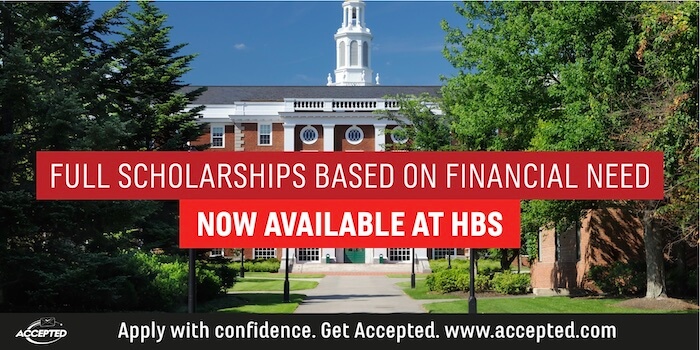
![]() ![]() Harvard Business School is now offering full scholarships based on financial need for approximately 10% of its MBA candidates, according to an August 16 article in the Wall Street Journal. The article also quoted Accepted founder and CEO Linda Abraham, who noted that scholarships covering the entire cost of tuition and fees for the neediest of students are “highly unusual,” and few top MBA programs offer them. Many MBA students at top-ranked schools must apply for loans to cover part of the cost of their education, but with a cost of more than $150,000 (plus living costs), the price of an HBS MBA has become prohibitive for many, depressing application volume among the more socioeconomically and ethnically diverse applicant pool that HBS (and many other MBA programs) want to attract. The scholarships will be worth nearly $76,000 in tuition and fees, but students must still cover their own living costs, estimated at roughly $35,000 in and around the Boston area. This fall, about 200 first and second-year HBS students receive the full scholarships. “HBS is one of the few top MBA programs with need-based (as opposed to merit-based) financial aid,” Linda observed in a LinkedIn post about the HBS scholarship announcement. “Stanford Graduate School of Business and Columbia Business School give financial aid based on need. University of Virginia Darden School of Business also has a need-based program for its MBA students called AccessDarden.” The WSJ article also quoted Insik Kim, a co-president of Harvard Business School’s club for first-generation and low-income students, who noted that “tuition is definitely the number one priority” as qualified applicants choose their target schools. Linda adds “I believe other programs will increasingly offer need-based aid to a small slice of their classes in the future.” Are you applying to HBS or another top MBA program? Work one-on-one with an MBA admissions consultant to assure that your application strategy is on track and help you gain acceptance to your dream school! ![]() By Judy Gruen, former Accepted admissions consultant. Judy holds a Master’s in Journalism from Northwestern University. She is the co-author of Accepted’s first full-length book, MBA Admission for Smarties: The No-Nonsense Guide to Acceptance at Top Business Schools. Want an admissions expert help you get accepted? Click here to get in touch! Related Resources:
|
| FROM Accepted.com Blog: Optional and Open-Ended Essay Questions: What’s the Best Strategy? |
![]() ![]() Many business schools ask open-ended questions, many of which are variations of, “I wish the admissions committee had asked me…” or, “What is a question that you wish we had asked?” The most common among these open-ended questions is the optional essay, where you really have free rein to discuss anything you feel is important and that you have not had an opportunity to address anywhere else in your application. Clients are often uncertain about how best to use these spaces, which are excellent opportunities to round out your profile. In this post we will offer advice on dealing with different types of open-ended questions. How many open-ended essay questions do you have? To figure out how to maximize these spaces, see if the application offers both an optional essay space as well as another open-ended question? Or do you only have one? Let’s say you only have the optional essay to write about a topic of your choice. And let’s say that the school has not asked you to explain any weakness or inconsistency in any other area of the application. If you do have a noticeable weakness, such as that your grades plummeted during your sophomore year in college, your GMAT is low for the average accepted applicant at this school, or you had an employment gap of six months or longer, there are ways to deal with them effectively using this space. Explain the circumstances simply and directly: perhaps you underwent surgery, had a death in the family, or had taken on too many extracurricular activities or work responsibilities. You don’t want to leave the admissions committee guessing or assuming the worst, but you also need to keep perspective. There is no need to explain away a single C+ grade from your freshman year. You don’t have to justify the fact that you hadn’t started your own nonprofit organization by the age of 19. You don’t have to apologize for the fact that you didn’t spend your undergrad years at an Ivy League school. When using this essay to address a weakness, keep it short. Present the relevant background surrounding the facts, and what you learned or did subsequently to improve or change the outcome to the extent possible. Whether there were circumstances beyond your control, or you hadn’t used the best judgment, your goal is to provide context for events that may not reflect well on you. Do not make excuses. Show that the circumstances that had impeded your performance no longer exist, or that you have learned how to handle those circumstances should a similar situation arise in the future. Remember, this question almost always comes right at the end of the essay portion of the application — it will probably be the last thing the adcom reads, so if at all possible, use it to give them something positive to remember you by. How the optional essay helps you highlight your well-rounded personality Since MBA application essays often focus exclusively on work examples, your career goals, and/or why you are interested in attending a particular school, the optional is a great place to add dimensionality and present yourself as a whole, well-rounded individual. You may drift out of the adcom’s minds pretty quickly if you simply come across as “the project manager with the 740 GMAT,” and since the adcom has already gained a sense of your leadership chops, don’t use the optional to write about a secondary leadership role–even if you’re very proud of it. Instead, use the optional essay to really stand out as “the project manager who used skydiving as a team-building exercise,” “the investment banker who teaches salsa dancing to senior citizens,” or “the marketing manager who taught herself five languages in her spare time.” Now that is an application to remember! What about the question, “I wish the admissions committee had asked me…” Let’s start with how not to answer this question. Do not use it to discuss bland “catch-all” topics such as, “I wish the admissions committee had asked me how I achieve excellence in everything I do.” Believe it or not, some applicants will want to use this approach, but it’s a big mistake. Not only will those types of answers usually end up being way too generic, but they will make you sound self-absorbed and even arrogant. Assuming that you’ve presented your professional/leadership experiences compellingly in your other essays, you can definitely take a more lighthearted (though not frivolous) approach here. Choose to write about an aspect of yourself that is uniquely, distinctively, memorably, YOU. This picture will round out the adcom’s perception of you. It will promote your “human interest” factor, your potential to contribute something to the incoming class and the teams you will work with, beyond your work experience and academic abilities. Harvard Business School has a single, entirely open-ended question. They ask, “As we review your application, what more would you like us to know as we consider your candidacy for the Harvard Business School MBA program?” We work with clients all the time who are very intimidated by this question, but by the end of the process we have convinced them that this question is really a gift, though it is one you must use wisely. By providing 900 words (a/o the 2022-23 application cycle) to answer this question, Harvard is hoping to learn a few things about their successful admits:
Some other schools may also word this question in an open-ended way as Harvard does, but if the question pointedly asks you what you wish they had asked, you need to answer honestly: What do you wish they had asked you? ”Keeping in mind your goal to add a fuller, more personal dimension to you as an applicant, it could be any of the following: “What do I do for fun?” “How did I come to develop the goals that I have?” “What have I learned about life from playing the flute?” “Why was Cheryl Strayed’s memoir, Wild, life-changing for me?” The open-ended questions in your MBA application are wonderfully valuable opportunities for you to round out your application. You can directly explain any deficiencies in your candidacy while showing how you have addressed them, as well as introduce the adcom to a more personally interesting aspect of yourself that will make you stand out for all the right reasons! Do you need help answering these questions or any other MBA application questions? Check out Accepted’s MBA Admissions Consulting & Editing Services and work one-on-one with an admissions pro who will answer your questions and help you get ACCEPTED. By Judy Gruen, former Accepted admissions consultant. Judy holds a Master’s in Journalism from Northwestern University. She is the co-author of Accepted’s first full-length book, MBA Admission for Smarties: The No-Nonsense Guide to Acceptance at Top Business Schools. Want an admissions expert help you get accepted? Click here to get in touch! ![]() Related Resources:
|
| FROM Accepted.com Blog: How Does a New College Grad Find a First Job? |
![]() ![]() Searching for that first job after graduating college is hard work. In general, college grads tend to fall into two broad categories. One is the group that knows exactly what they are after, often heading toward a professional track such as engineering, accounting, law, medicine, or something else requiring a postgraduate degree or other training and certification. The second group is likely to have graduated with a liberal arts degree and isn’t at all sure of their career direction. Advice for grads who know their next step Those on a defined professional track may be considering a future master’s degree or are following up on targeted job listings from their university. If this describes you, it’s important to keep several things in mind when applying for your first job. Primarily, know that you are a blank slate to the recruiter. It is up to you to let them know your abilities, accomplishments, and goals. Read the job description carefully before applying with your resume and carefully crafted cover letter. In your cover letter, focus on addressing their needs, not yours. How can you add value to this organization? Highlight any experiences you may have had that align with the job description. You don’t want to “brag” but you do want to describe your accomplishments in a plain-spoken, specific, non-jargony way. It’s relevant to mention your career goals and how this job will help you gain the skills and experiences to achieve them, but that should not be the primary focus of the letter. If appropriate, you can also indicate that you are open to learning about additional career paths. Advice for grads who aren’t sure what’s next What about those of you who are unsure of what you want to do? That’s fine–a majority of college grads don’t necessarily know their career path with certainty at this stage of their lives. This is a time of exploration, so think of your first job as a way to learn what you enjoy and where you excel. Just as importantly, your first job may teach you what you are not suited for and what you would rather not repeat in a subsequent position. Because your experiences may be more diverse than those of your friends who have a clearer career focus, it can be more challenging to respond to a job listing. However, similar to those on a defined professional track, you still need to address the employer’s explicitly stated requirements, such as skills, knowledge, and personality traits. Think about your accomplishments from classroom projects, internships, or extracurricular activities that relate to the position–those could be strong selling points. Information interviews Job listings are a good first step in your search, but don’t stop there. Take advantage of your alumni network, LinkedIn, or other networking apps to speak with others who are in a field that interests you. Contact individuals working in these fields and ask if you can interview them briefly about their work. If they are open to an email dialogue or conversation, these are good questions to ask:
These “information interviews” or “coffee chats” will help you develop a larger network. Always write a thank you note afterward, making sure to mention something specific that you learned or appreciated about the conversation or communication exchange. Create a category of career contacts in your email program and keep in touch with those you feel a connection to. When you land your first job, email them with the good news and thank them again for their help in guiding you in your career launch. No matter the job market, there is always movement in an organization. People move away, take other jobs, or go into business for themselves. Your network will remember you if you have developed a relationship. While you wait Your job search may take longer than you wish, and there are things you can do to ease any stress while also strengthening your job candidate profile. One example would be to volunteer for an organization a few hours each week. You’ll develop additional experiences and skills, perform a good deed that may well “pay it forward,” and just possibly, meet people who just may have a connection you need. Exploring career options? Deciding on possible grad school programs? Coping with on-the-job issues? We can match you with one of our highly experienced career coaches who can guide you as you navigate your next step. Don’t go it alone! Check out our Career Coaching and Advising services here! ![]() ![]() With 30 years of career and admissions experience at four universities, including Cornell’s College of Engineering and Johnson Business School, Dr. Karin Ash facilitated students’ entry into the world’s best companies. As a member of the adcom she also evaluated applications; she knows what schools and employers seek. Want Karin to help you get Accepted? Click here to get in touch! Related resources:
|
| FROM Accepted.com Blog: London Business School Master’s in Management (MiM) Essay Questions, Tips and Deadlines [2022 – 2023], Class Profile |
![]() ![]() Everything you need to know about the LBS MiM Program
Overview of the program The Master’s in Management (MiM) is London Business School’s longest running Early Careers (EC) programme. The first to be introduced to the EC portfolio in 2009, it has been developed in partnership with LBS’ world-renowned faculty and the recruiters who budding business practitioners aim to work for. It focuses on an applied learning approach, combining theory and practice so that students “learn how different business activities function and areas work together to deliver value”. This is all underpinned by the ethos that learning in a diverse environment (diversity extending to nationality, academic background, professional experience, interests) creates that all-important global perspective. The MiM offers a flexible programme with exit points at 12-16 months. While some students will choose to complete the degree in three terms, those wishing to go on an International Exchange or take additional electives can opt to continue with a fourth term (additional fee required). Regardless of exit point, all students are required to take 15 modules across terms 1 and 2 along with online pre-programme courses. Alongside the core curriculum, students are required to select 3 electives from a selection of 80 elective options across the subject areas Accounting, Economics, Finance, Management Science & Operations, Marketing, Organisational Behaviour, and Strategy & Entrepreneurship. Electives are held across programmes and give students a unique opportunity to work alongside MBAs, EMBAs, and other degree programme students. The cross-generational learning element is carried across to other aspects of the programme, such as with the mentorship scheme whereby MiMs can be mentored by MBA and MiF students and alumni. In addition to the core curriculum and electives that develop hard academic skills, MiMs also focus time on developing the “soft skills that will enable you to build relationships, influence outcomes, and negotiate terms with self-awareness and confidence”. Through the Skills Programme, students work on understanding and honing the skills that employers expect, including interpersonal skills as well as numerical and digital literacy. Experiential learning is a key aspect of the MiM experience and the programme allows students “to explore the real world of international business through hands-on experience”. During terms 2 and 3, MiMs participate in LondonLAB, an 8-10 week business project that tasks students to work in teams to solve challenges for a range of businesses from start-ups to multinationals across a variety of sectors. Past clients have included the BBC, Unicef, Salesforce, and Depop. And for one week across terms 1, 2 or 3, students have the chance to participate in one of the programme’s Global Experience courses. Along with other Early Career, MBA, and Leadership programme peers, students work with faculty, corporations, micro-entrepreneurs, and alumni to “interact meaningfully with members of the local business ecosystem and gain an in-depth view of a country’s business culture”. Course themes and destinations are subject to change depending on travel restrictions due to Covid-19 but past experiences have included: sustainability developments in Dubai; examining Austin’s role as a breakthrough technologies hub; and examining what is unique about the venture capital and business ecosystem of San Francisco and Silicon Valley. What is all of this academic theory and experiential learning leading to? For 96% of the MiM2021 class (within three months of graduation), their degree led to a job. Specifically, pre-experience and graduate scheme roles across consulting (45%), financial services (27%), technology (18%), and diversified industries (10%). LBS’ Career Centre and its sector specialists and career coaches provide students with opportunities to engage with employers and “develop the skills and confidence to effectively communicate [their] value to employers”. How do they do this? Through a combination of activities such as: the Career Skills Programme; Personal Development Programme; Business Treks; and company engagements, including the Early Careers Recruitment Evening. While there is focus on helping MiMs to plan and navigate their recruitment journey, care is given to helping students develop the skills needed to network with LBS alumni and future employers, understand how to approach problem-solving and technical challenges at interviews, and how to find roles that match their skills, interests and aspirations. Application essay tips LBS MiM essay #1 After several years with its mainstay ‘how will the programme support your academic and professional goals’ question, the MiM switched gears slightly last year and introduced a new essay 1 (and reduced word count): What learning outcomes are you aiming to achieve as part of your Masters in Management programme? What challenge(s) might you encounter? (500 words) While a different approach to the previous essay prompt, this question still tasks applicants to reflect on what they want to get out of the programme. In thinking of learning outcomes, this can be viewed as academic outcomes or professional outcomes, though this should all be underpinned by how the programme’s resources will support those outcomes. In addressing academic learning outcomes, it would be wise to touch on the knowledge gaps you’re expecting the MiM to fill. Perhaps you come from a business/management background, but your undergraduate degree didn’t offer particular courses you need to achieve your career aims or took a more theoretical approach. Or you come from the sciences or the arts and need general management tuition to help launch your business. You may also need to understand certain concepts for your post-MFA career, or you might be interested in learning more about a subject area that you only touched on briefly during your undergrad. Here you want to discuss a few of the academic components that will support your learning and fill the outlined gaps. But steer clear of providing a list; this is where you want to show research and that you have a solid understanding of how the academic resources will fulfil your individual learning needs. So you need to discuss not just the ‘what’, but also the ‘why’. Also, avoid incorporating LBS resources here. This question is specifically about the MiM. Learning outcomes can also extend to the professional. A large piece of the MiM curriculum revolves around skills development. Think about whether you need to hone any interpersonal skills to confidently present presentations to clients or to attend networking events with recruiters. Perhaps you need to scrub up on your modelling skills to achieve your consulting aims. This would be a good place to touch on how the Skills Programme and Career Centre will support those professional learning outcomes. A brief reminder of your career aims here is fine but keep it concise as these aims are already discussed in the application form. The second half of the question – ‘what challenges might you encounter’ – was previously asked in the application form, so it’s not entirely new. But its presence as a standalone essay question indicates the adcom’s interest in understanding your level of self-awareness. This question really requires some introspection. While you may want to touch on the challenges that may arise with achieving the aforementioned learning aims, such as adapting to a new type of study environment or teaching method, it’s fine to also mention any personal challenges. After all, you’re a person. Perhaps you’ll need to employ time management and organisational tools to cope with the hectic schedule and pace, or you’ll need to switch gears in how you approach study in a grad school environment. A brief word on your ability to overcome these challenges to succeed in achieving your learning aims would make for a nice close to this essay. ![]() LBS MiM essay #2 If essay 1 is about what you have to gain, essay 2 is about what you have to give back and remains with a focus on the wider school community: During your time as a Master’s in Management student, how will you contribute to the School community? (400 words) The idea of being communal is an essential value at LBS (more on that below). This question gives you a chance to showcase your achievements and how your past successes will allow you to impact the LBS community. In thinking about how you can add value and contribute, start by reflecting on your experience – academic (undergraduate studies), professional (internships), and personal (extracurricular engagements). Think about where you’ve achieved success and how you can apply learnings or skills from those experiences to contribute. Presenting 3-4 ideas is advisable, but you may find you want to dedicate more word space to 1 or 2 ideas. And make sure these ideas are concrete; writing your international experience will support the learning experience of your peers doesn’t say anything. This is your chance to set yourself apart and show that you’ve not only done your research and understand what the community has to offer, but that you’ve put thought into how you can enhance the community around you. Admissions requirements To be eligible for the MiM, applicants must have less than two years of postgraduate work experience (only postgraduate work experience is considered towards the two-year limit; internships taken during your studies don’t count). MiMs come from a variety of undergraduate study backgrounds and while there’s no degree requirement, applicants must have achieved or expect to achieve a bachelor’s degree result equivalent to a UK 2:1 minimum / GPA 3.3 or above. Along with a strong undergraduate degree, GMAT or GRE is required and must be taken prior to applying. While there is no minimum score, it is recommended applicants apply with a 600+. As with other degree programmes, the MiM now requires only one reference, which must be submitted via the school’s online reference system. It is recommended applicants select a previous or current employer, though an academic referee will suffice so long as they can speak to the applicant’s character and abilities. Along with reference, GMAT/GRE score, and undergraduate degree, applicants are required to submit a one page CV/resume, proof of English, and pay an application fee. Along with all of this comes a number of short answer questions in the application form. As these questions sit in the application form there’s sometimes thought that they’re not as important as the long form essays. Not true! The short answers, which ask questions around your interests, programme/school research, international experience, and career aims are key as they give the adcom an insight into who you are outside of your stats, what motivates you, and what you want to achieve. So do spend time crafting answers to these questions. The programme runs a staged admissions process. Applicants can apply at any one of the four stages, though early application is advised as competition becomes more intense in the final months. Deadlines for the August 2023 (MiM 2024) intake are: Deadline 1October 3, 2022Deadline 2January 9, 2023Deadline 3March 15, 2023Deadline 4May 15, 2023 Source: LBS MiM website ***Disclaimer: Information is subject to change. Please check with individual programs to verify the essay questions, instructions and deadlines.*** LBS MiM class of 2022 profile Students: 282 Nationalities: 51 Women: 56% International students: 95% Alumni: 48,000+ MiM 2022 undergraduate study discipline
MiM 2022 nationalities by region Europe (excl. UK): 35% South East/East Asia: 34% South Asia: 17% United Kingdom: 6% North America: 5% Africa/Middle East: 2% Central/South America: 1% ![]() Who gets accepted to the LBS MiM program The MiM is aimed at driven early career business practitioners who have graduated within the last two years, and with a maximum of two years of postgraduate work experience. While work experience isn’t required – some students will join immediately following their undergraduate degree – most students will have completed some type of professional work experience, whether an internship or full-time role. Work experience is as varied as undergraduate study discipline and students may have worked in MNCs, start-ups, or family businesses. Brand doesn’t necessarily mean everything; the adcom wants to understand why you’ve made the academic and professional choices that you have (connect the dots for them!), skills developed, and learning outcomes, all of which will support your learning experience, and that of your cohort, once on the programme. While students will be educated on the types of industries and roles they may target post-programme, and where their skillset can be best utilised, all students are expected to be ready to build a foundation for a career in business. What does this mean? That they’ll have thought about their career aims and be able to demonstrate an understanding of their intended path through the application process. The adcom wants to see ambitious individuals who want to make an impact in the world around them. And they want to see individuals who have already achieved success and impacted those around them, be it at school or at work, and seek students who can demonstrate “a track record of excellence, achievement, and leadership potential”. Acceptance rate While data for Freedom of Information (FOI) requests may be found online, LBS, like many of its European counterparts, does not commonly supply information on acceptance or retention rates. But being LBS, it’s safe to assume that competition is fierce. MiMs are just as talented and driven as their more senior counterparts across other degree programmes and there are a lot of big fish looking to make a splash in a relatively small pond. That said, the MiM admissions process should be considered a selection process. They’re keen to understand applicant journeys and that all important (and rather intangible) fit. This is done primarily through the interview process. While an interview does not guarantee an offer, it’s a sign that the adcom sees something interesting in you that it wants to further explore. Life at LBS Community is one of the most important aspects of life at LBS – for students, alumni, faculty, and staff alike. This can be seen early from the application stage, where most degree programmes have at least one question in the application about the community and about how an applicant will add value to it. To be sure, the school doesn’t require, or indeed even expect every student to take a leadership position in a club or lead a trek. But it wants individuals on-campus who are communal in nature; those who participate, who enjoy peer-to-peer learning and teaching, who thrive in collaborative environments. More than 80 student clubs run more than 1,000 events every year, including social, professional, and cultural clubs. Students play a key role in developing and running student-led events such as the Women in Business Conference, EUROUT and China Business Forum. Whether participating as an organiser or spectator, these events give students the chance to network with one another as well as industry or subject-area experts and engage in discussion and debate about the most important issues facing business. And community members jump at the chance to socialise outside of the classroom and professional interest clubs or business treks. Whether the annual Tattoo, which celebrates the school’s diversity through food, dance and entertainment, or the fortnightly Sundowners, where students, alumni, faculty, and staff can meet and network, LBSers never miss a chance to celebrate being part of the community. Get professional guidance with your LBS MiM application! Check out Accepted’s MiM Application Packages, which include advising, editing, interview coaching, and a resume edit for the LBS MiM application. ![]() Jamie Wright has more than eight years of recruitment and admissions experience at London Business School, and is the former Admissions Director for Early Career Programmes at LBS. Originally from the U.S., Jamie is now based in London. Want Jamie to help you get accepted? Click here to get in touch with Jamie Wright. ![]() Related Resources:
|
| FROM Accepted.com Blog: The Consortium Application: Tips for Your CGSM Essays [2022 – 2023] |
|
[img]https://blog.accepted.com/wp-content/uploads/2022/09/Consortium_Tips_2022-2023.jpg[/img] [url=https://blog.accepted.com/resources/mba-admissions/mba-essay-tip-posts/][img]https://blog.accepted.com/wp-content/uploads/2021/09/Consortium_Tips_2022-2023.jpg[/img][/url] Are you committed to increasing diversity and inclusion of underrepresented populations in education and business? If so, [url=https://blog.accepted.com/applying-for-your-mba-through-the-consortium-best-deal-in-town/]applying to MBA programs through The Consortium of Graduate Study in Management[/url] might be for you. Besides the opportunity to receive a full-tuition scholarship to one of the top MBA programs, Consortium fellows get to enjoy the benefits of a strong network with other Consortium students and alumni from not one but 22 top MBA programs. Other benefits include having to pay one application fee and submitting all applications in one convenient deadline, reducing considerably the cost and anxiety that comes with applying to business school. While you have to write a few more essays, CGSM’s essay questions are short and straightforward. I will focus on The Consortium essays in this post. The Consortium for Graduate Study in Management 2022-2023 application essays The Consortium core essay #1 Please describe your short- and long-term goals post-MBA. How has your professional experience shaped these goals and influenced your decision to pursue an MBA degree? (2,000 characters) This is a standard [url=https://reports.accepted.com/mba/guide/why-mba]goals essay[/url]. In 2,000 characters max, or roughly 400 words, you need to state clearly what your short-term and long-term goals are, and how your experience to date has shaped those goals. While you can briefly discuss how you got here, it’s important that you avoid going into excessive detail about your past experience and instead focus on your post-MBA plans. Additionally, you need to write about why you think an MBA is the right degree for you given those goals. You need to be specific and realistic, stating goals that are aligned with your career thus far and that an MBA will help you achieve. [url=https://cta-redirect.hubspot.com/cta/redirect/58291/9bb31be0-3cf6-45f0-be3d-3791cc1bd9bd][img]https://no-cache.hubspot.com/cta/default/58291/9bb31be0-3cf6-45f0-be3d-3791cc1bd9bd.png[/img][/url] The Consortium core essay #2 (optional) Is there any other information you would like to share with us that is not presented elsewhere in your application? (1,000 characters) Although this is an [url=https://blog.accepted.com/i-wish-the-admissions-committee-had-asked-me/]optional essay[/url], I always recommend answering it. You can use this essay to share anything that you believe needs to be explained: a gap in your work experience, a [url=https://blog.accepted.com/so-youre-applying-to-business-school-with-a-low-gpa-or-gmat-score/]low GPA or GMAT[/url], a sudden drop in your grades. In fact, the Consortium asks that if you answered ‘yes’ to any of the questions in the Personal Certification/Signature section, you must provide an explanation, and this is the perfect place to do so. If there is not anything in particular that you need to explain, you can use this essay to write about something not already shared on the required essays. For example, an experience from an extracurricular activity, a special hobby, or a unique story that would help you stand out. Given the tight word limit in all the essays, this is a great opportunity for you to share a part of you that they would not otherwise see. The Consortium mission essay Our mission, through the strength of our growing alliance and extended network, is to enhance diversity and inclusion in global business education and leadership by striving to reduce the significant underrepresentation of African Americans, Hispanic Americans and Native Americans in both our Member Schools’ enrollments and the ranks of global management across the following sectors: for-profit corporations, nonprofit corporations, government agencies and contractors, and entrepreneurial ventures in both for-profit and nonprofit environments. *Please address the three questions noted below. Please use specific examples pertaining to our target populations and clearly articulate your involvement, actions and results. 1. What have you done pre-MBA in your business, personal or academic life to demonstrate commitment to this mission? (2,000 characters) The most important of the three questions, this is your chance to show evidence that what you have done in the past aligns well with the Consortium’s mission. Maybe you were part of the diversity group at your company and spearheaded an initiative that increased the number of underrepresented minorities in your firm. Or maybe you mentored inner-city kids and helped them improve their grades. Whatever that activity was, this is the right place to give details, sharing not only what you did, but also what motivated you to get involved. It is also important that you share the impact that your actions had on these groups. 2. What will you do while enrolled in your MBA program to demonstrate your commitment to the mission? (2,000 characters) As The Consortium clearly states, its mission is to enhance the [url=https://blog.accepted.com/writing-the-diversity-essay/]diversity and inclusion[/url] of underrepresented populations in business. Focus your essay on demonstrating your commitment to this mission by providing specific examples of how you plan to advance that mission during your MBA experience. Examine what your target schools already do to enhance diversity, and share how you plan to contribute to their existent initiatives or add new ones. Rather than writing a laundry list of activities or clubs, think about your talents and experience thus far and how that can be placed at the service of the school, particularly in their diversity efforts. 3. What will you do post-MBA with respect to community service and leadership involvement to demonstrate your continued commitment to The Consortium’s missions of diversity and inclusion? (1,000 characters) The Consortium would like to see that its members are not only committed to diversity and inclusion during their MBA program, but that they also have a vision for the future. How will you contribute to increasing the numbers of underrepresented minorities in business education? What are some of the initiatives you envision that you believe would have the greatest impact? Once again, more than a list of activities or organizations, it’s important that you write about how you envision supporting these groups, both professionally and personally. School-specific essays You will be required to write at least one school-specific essay for each school to which you plan to apply. Schools only see their individual essays. To complete these essays, navigate to each school’s supplemental page within your core applications. Text boxes with specified word limitations will be provided for the membership essay and all school-specific essays. Just as you would if you weren’t applying through the Consortium, make sure that you “study” the schools well before writing their essays. You will need to pay just as much attention to these essays as you would to The Consortium ones, since the schools – and not The Consortium – ultimately make the admissions decisions. A great advantage of applying through The Consortium is only paying one application fee for all the schools that you are applying to via CGSM as opposed to one fee per school. However, you still need to do your research about each school so that you can [url=https://blog.accepted.com/focus-fit-episode-162/]show fit in the school-specific essays[/url]. [url=https://blog.accepted.com/applying-for-your-mba-through-the-consortium-best-deal-in-town/]The benefits of applying through The Consortium[/url] are many. First, you have the possibility of a full-tuition scholarship for the two-year MBA program, a once-in-a-lifetime opportunity. Second, even if you do not get a full ride but are accepted to be a member of the Consortium, you become part of a valuable network, one that will benefit you throughout your career. If you have actively worked to increase diversity of underrepresented minorities in business, applying to business school through the Consortium is the right step for you. [b]As a former Associate Director of Minority Affairs at the Yale School of Management with ample experience recruiting and ultimately increasing diversity in business schools, I am happy to [url=https://www.accepted.com/experts/esmeralda-cardenal?utm_campaign=Blog&utm_medium=consortium_essay_tips&utm_source=blog]offer you my help[/url] to apply to The Consortium. I have helped many applicants apply and get successfully admitted to The Consortium and its member schools. It will be my pleasure to help you do the same.[/b] The Consortium MBA 2022 – 2023 application deadlines Early Application DeadlineOctober 15, 2022Traditional Application DeadlineJanuary 5, 2023Admissions Decision and Fellowship NotificationVaries by school Source: [url=https://cgsm.org/students/prospective-students/application-instructions/]The Consortium website[/url] [b]Stay on top of MBA deadlines with the [url=https://www.accepted.com/calendar]MBA Admissions Calendar[/url]![/b] [[url=https://calendar.google.com/calendar/b/2?cid=ZWdybWVsZ3IzZTZtczUxYzMwOGY0MGxiODhAZ3JvdXAuY2FsZW5kYXIuZ29vZ2xlLmNvbQ]Click here[/url] to add the calendar to your Google calendar; or [url=https://calendar.google.com/calendar/ical/egrmelgr3e6ms51c308f40lb88%40group.calendar.google.com/public/basic.ics]here[/url] to add the calendar to another app.] ***Disclaimer: Information is subject to change. Please check with individual programs to verify the essay questions, instructions and deadlines.*** [img]https://blog.accepted.com/wp-content/uploads/2022/05/Esmeralda_Cardenal_admissions-expert-headshot.jpg[/img] Former Associate Director of Admissions at Yale SOM, Director of MBA Admissions at MSU Broad, and consultant at Cardiff Business School in the UK, Esmeralda Cardenal has guided Accepted clients to acceptance in various graduate programs since 2014, including MBA and masters in finance, business analytics, data science, sustainability, and public policy. [url=https://www.accepted.com/experts/esmeralda-cardenal?utm_campaign=Blog&utm_medium=blog_bio_esmeralda&utm_source=blog#open-form]Want Esmeralda to help you get accepted? Click here to get in touch![/url] [url=https://cta-redirect.hubspot.com/cta/redirect/58291/a921552d-3588-4837-b48b-f2b386f0a230][img]https://no-cache.hubspot.com/cta/default/58291/a921552d-3588-4837-b48b-f2b386f0a230.png[/img][/url] [b]Related Resources:[/b] [list][*][url=https://reports.accepted.com/mba/guide/why-mba]Why MBA?[/url], a guide to writing the goals essay[/*][*][url=https://blog.accepted.com/what-the-consortium-for-graduate-schools-of-management-can-do-for-mba-applicants-episode-395/]What the Consortium for Graduate Schools of Management Can Do for MBA Applicants[/url], a podcast episode[/*][*][url=https://blog.accepted.com/applying-for-your-mba-through-the-consortium-best-deal-in-town/]Applying for Your MBA Through The Consortium: Best Deal in Town[/url][/*][/list] The post [url=https://blog.accepted.com/essay-tips-for-applying-to-the-consortium/]The Consortium Application: Tips for Your CGSM Essays [2022 – 2023][/url] appeared first on [url=https://blog.accepted.com]Accepted Admissions Blog[/url]. |
| FROM Accepted.com Blog: ESADE MBA Essay Tips and Deadlines [2022-2023] |
|
[img]https://blog.accepted.com/wp-content/uploads/2022/09/Esade_MBA_Tips_2022-2023.jpg[/img] [url=https://blog.accepted.com/how-the-esade-mba-program-aspires-to-make-a-positive-impact/][img]https://blog.accepted.com/wp-content/uploads/2022/09/Esade_MBA_Tips_2022-2023.jpg[/img][/url] The ESADE (pronounced eh-SAH-day) MBA program in Barcelona, Spain, is a great option for applicants looking for a program that requires fewer than 2 years out of the job market but also provides an internship and even an international exchange option. ESADE offers a 12-month MBA, a 15-month option that includes an internship or exchange program, and an 18-month option that includes both an internship and an international exchange opportunity. Graduates do well: 90% secure a position within 3 months of graduating, increasing their salaries by an average of 113% over their pre-MBA earnings within 3 years of graduating. This really is an international student body: the 182 students in the class of 2021 hailed from 42 countries, and 85% of them choose to work outside of Spain upon graduation. Resume/CV requirement Please upload a copy of your Resume/CV. The ESADE application form does not prompt the applicant to describe his/her accomplishments in each position, but allows space for a job description for each role. Savvy applicants will make sure that their resume/CV highlights the initiatives they led and the impact they made in each role. ESADE 2022-2023 MBA application essay tips ESADE MBA essay #1 Which aspects have you improved on during your academic and professional career so far? Which tools or values have helped you achieve this? (Maximum 3000 characters including spaces) ESADE provides a transformative experience, but to benefit from it fully, students must be open to transforming. This essay provides an opportunity for you to demonstrate that you recognized areas in which you can improve, and then take action to do so. Among the most important aspects to ESADE are leadership, [url=https://blog.accepted.com/display-teamwork-in-application-essays/]teamwork[/url], and organizational skills. The second part of the question is asking for applicants to analyze what enabled them to make these improvements: personality traits, introspection, trusted mentors, and even a comprehensive professional evaluation system may be among the tools that applicants have found most useful. Sharing a story or two in this essay that show both the improvement and the tools/values at work will engage the reader and set a tone of interest for your entire application. [url=https://blog.accepted.com/how-the-esade-mba-program-aspires-to-make-a-positive-impact-episode-362/][b]Check out our podcast interview with Judith Puigbo, Associate Director of MBA Admissions >>[/b][/url] [url=https://cta-redirect.hubspot.com/cta/redirect/58291/9bb31be0-3cf6-45f0-be3d-3791cc1bd9bd][img]https://no-cache.hubspot.com/cta/default/58291/9bb31be0-3cf6-45f0-be3d-3791cc1bd9bd.png[/img][/url] ESADE MBA essay #2 How will your background, values and non work-related activities enhance the experience of other ESADE MBA students and add to the diverse culture we strive for at ESADE? (Note: The goal of this essay is to get a sense of who you are, rather than what you have accomplished) (Maximum 3000 characters including spaces) ESADE has less than 200 students in each class, so each of them must be active to create a lively campus. This essay offers applicants an opportunity to demonstrate how they have helped create community in the past – on campus, in professional and social organizations, in their neighborhood, even in their family life. If an example from a professional environment is the one that best illustrates a value, then, yes, feel free to use it. ESADE MBA essay #3 What are your motivations in pursuing a full-time MBA at this point in your life? Describe your mid-term and long-term visions for your post-MBA career path. What is it about ESADE you think will help you reach your goals? (Maximum 3000 characters including spaces) This is a standard goals question. Applicants need to demonstrate that their [url=https://reports.accepted.com/mba/guide/why-mba/]goals are ambitious but fully realizable[/url]. Anyone whose goals are not seen as reasonable cannot be accepted because they will graduate unhappy at the discovery of that reality – after losing 12-18 months of their lives and €72,000 of their hard-earned (or borrowed!) money. ESADE MBA essay #4 Complete two of the following four questions or statements: (Maximum 3000 characters including spaces) [list][*] I am most proud of…[/*][*] People may be surprised to learn that…[/*][*] What has your biggest challenge been and what did it help you learn about yourself?[/*][*] Which historical figure do you most identify with and why?[/*][/list] All of these essay prompts aim to uncover interesting aspects of your background, both professional and personal. These questions provide applicants a chance to round out the admissions committee’s understanding of who they are, what [url=https://blog.accepted.com/writing-about-overcoming-obstacles-in-your-application-essays/]obstacles they have faced[/url] in their lives, and what they’ve accomplished. These are very brief essays of approximately 180 words each, but stick to the character limits. ESADE MBA essay #5 Please provide any additional information that you would like to bring to the attention of the Admissions Committee. This may include gaps in employment, your undergraduate record, plans to retake the GMAT or any other relevant information. (Maximum 3000 characters including spaces) If you need to explain any of the standard issues – your direct manager doesn’t know you’re applying so you couldn’t ask him to write a recommendation, you completed your coursework in December but did not receive your diploma until the following May, etc. – then this is the place to make those clarifications. Even if you do not have any of these loose ends to tie up, you may use this space to add further clarification about who you are that just didn’t fit anywhere else. ESADE at a glance [b]Class size: [/b]182 [b]Average age: [/b]28.3 [b]Female: [/b]41% [b]Years of professional experience: [/b]5.5 [b]Nationalities:[/b] 42 [b]International students: [/b]96% [b]You’ve worked so hard to get to this point. Now that you[/b]‘[b]re ready for your next achievement, make sure you know how to present yourself to maximum advantage in your ESADE application. In a hotly competitive season, you[/b]‘[b]ll want a member of Team Accepted in your corner, guiding you with expertise tailored specifically for you. [url=https://www.accepted.com/mba/services/application-packages?utm_campaign=Blog&utm_medium=ESADE_mba_essay_tips&utm_source=blog]Check out our flexible consulting packages today![/url][/b] ESADE MBA application timeline for 2022 – 2023 DeadlineApplication submitted by:Feedback given by:1October 6, 2022 November 23, 2022 2November 24, 2022 January 11, 2023 3January 12, 2023 February 15, 20234February 15, 2023 March 15, 2023 5March 16, 2023 April 19, 2023 6April 20, 2023 May 17, 2023 7May 18, 2023 June 28, 2023 ExtraordinaryJune 22, 2023July 7, 2023 Source: [url=https://www.esade.edu/mba/en/programmes/full-time-mba/admissions/admission-process]ESADE website[/url] [url=https://cta-redirect.hubspot.com/cta/redirect/58291/a921552d-3588-4837-b48b-f2b386f0a230][img]https://no-cache.hubspot.com/cta/default/58291/a921552d-3588-4837-b48b-f2b386f0a230.png[/img][/url] [img]https://blog.accepted.com/wp-content/uploads/2021/12/Jennifer_Bloom_admissions-expert-headshot.jpg[/img] By Jennifer Bloom, admissions consultant at Accepted for 20 years and Certified Professional Resume Writer (CPRW). She is an expert at guiding you to produce application materials that truly differentiate you from the rest of the driven applicant pool. If you would like help with your application, Jennifer can suggest a number of options that work with any budget. [url=https://www.accepted.com/experts/jennifer-bloom?utm_campaign=Blog&utm_medium=blog_bio_jennifer&utm_source=blog#open-form][b]Want Jennifer to help you get accepted? Click here to get in touch![/b][/url] [b]Related resources:[/b] [list][*][url=https://reports.accepted.com/mba/guide/why-mba]Why MBA?[/url], a free guide to writing about your MBA goals[/*][*][url=https://blog.accepted.com/how-the-esade-mba-program-aspires-to-make-a-positive-impact/]How the ESADE MBA Program Aspires to Make a Positive Impact[/url], a podcast episode[/*][*][url=https://blog.accepted.com/early-career-management-and-european-mba-programs-with-jamie-wright/]Early Career Management and European MBA Programs with Jamie Wright[/url], a podcast episode[/*][/list] The post [url=https://blog.accepted.com/esade-mba-essay-tips-deadlines/]ESADE MBA Essay Tips and Deadlines [2022-2023][/url] appeared first on [url=https://blog.accepted.com]Accepted Admissions Blog[/url]. |
| FROM Accepted.com Blog: USC Marshall MBA Application Essay Tips & Deadlines [2022 – 2023] |
![]() ![]() Along with academic excellence, the USC Marshall MBA program is characterized by a powerful global network with special emphasis on the Pacific Rim, a close-knit and passionate community, and a strong regional presence. Your essays should show how you will both fit in and contribute to this dynamic environment, and the questions provide interesting opportunities to do so. Taken together, the questions indicate that the adcom wants to see both a clear, practical career focus and to understand the person behind those goals – that means they care about your perspective, your values, and your ability to synthesize and prioritize. USC Marshall 2022-2023 MBA application essays Marshall MBA essay question #1 What is your specific, immediate short-term career goal upon completion of your MBA? Please include an intended position, function, and industry in your response. (100 word maximum) The question specifies the information to include in the essay. Although only 100 words, it is deemed an “essay” by the adcom, and that means you should do more than provide facts. An essay moves – it goes somewhere, it has a starting point and ending point. And you will have room for a little more than the bare facts, so compose your answer in a way that includes some motivation or vision for your short-term career goal; clarify what animates it. It may be just a sentence, even a phrase, but it can make all the difference. It will make this short piece of writing an essay – and will engage the reader. Marshall MBA essay question #2 Please draft a letter that begins with “Dear Admissions Committee” (word limit: 600). This letter is meant to be your personal statement that provides the Admissions Committee with an understanding of your candidacy for Marshall beyond what is evident in other parts of your application. This essay is purposely open-ended. You are free to express yourself in whatever way you see fit. Our goal is to have an appreciation for and an understanding of each candidate in ways that are not captured by test scores, grades, and resumes. This essay question invites you to reveal and share something of yourself – and in doing so, you will necessarily reveal your perspective, what you value. After all, in deciding what to discuss and how to present it, you already, literally, are making a statement about these things! As the question indicates, there is no one formula for making this essay great. The good news is, there are many ways to do so – as many ways potentially as there are applicants. First, consider making most of the essay about non-work subjects – it’s a “personal statement.” There well may be work-related aspects that warrant discussing, but it should not be about the work issues as much as what they show about you as a person. And it’s fine not to discuss work at all if you’ve got other good things to talk about! Possible topics to consider are formative experiences, cultural influences, interests and passions (community, religious, sports, artistic, hobbies, political….), etc. I’ve seen essays of this type work that discuss two or three things, or even just one – but more than three and you risk creating a “too much stuff” blur. Be thoughtful and selective and, to a certain extent, strategic – by this last point I mean show the adcom new, relevant, and interesting aspects of you; I don’t mean trying too hard to impress the adcom by striving for topics that are superficially dramatic or exotic. Have the confidence to dig into your real life even if it may seem mundane – I recently edited a great basketball essay that vividly portrayed the applicant’s deep insight, humanity, individuality, and resourcefulness. I have no doubt the adcom that reads it will be moved and unable to put it down. That leads to my last point: don’t just relate facts; have something to say about them – show a point of view, vision, insight. Marshall MBA essay question #3 Please provide any additional information you would like the admissions committee to consider. (250 word maximum) This question allows you to both discuss points that will enhance your application and explain anything that needs explaining (e.g., gap in employment, choice of recommender, a dip in grades). For the former, if you ask the adcom to read additional material, make sure that it truly illuminates and is germane to your candidacy – since you have the personal statement to work with, do not present material that could more appropriately be addressed there. For expert guidance with your USC Marshall MBA application, check out Accepted’s MBA Application Packages, which include comprehensive guidance from an experienced admissions consultant. We’ve helped hundreds of applicants get accepted to top MBA programs and look forward to helping you too! USC Marshall 2022-2023 MBA application deadlines Round 1October 15, 2022Round 2January 5, 2023Round 3March 1, 2023Round 4April 15, 2023Round 5Rolling Admissions* *Applications received after April 15, 2023 will be considered on a space-available basis. Source: USC Marshall website Stay on top of MBA deadlines with the MBA Admissions Calendar! [Click here to add the calendar to your Google calendar; or here to add the calendar to another app.] ***Disclaimer: Information is subject to change. Please check with individual programs to verify the essay questions, instructions and deadlines.*** ![]() Cindy Tokumitsu has advised hundreds of successful applicants, helping them gain acceptance to top MBA and EMBA programs in her 20 years with Accepted. She would love to help you too. Want Cindy to help you get Accepted? Click here to get in touch! ![]() Related Resources:
The post USC Marshall MBA Application Essay Tips & Deadlines [2022 – 2023] appeared first on Accepted Admissions Blog. |
| FROM Accepted.com Blog: Chicago Booth Executive MBA Essay Tips & Deadlines [2022 – 2023] |
![]() ![]() Chicago Booth EMBA gives you just one mandatory essay, but with ample space to make your case holistically. This approach to the essay question indicates that they are looking for people who can organize their thoughts, build a credible and compelling case for their candidacy, and maintain an extended yet focused discussion. The Booth EMBA adcom clearly puts value on verbal expression for its students, both during the program and as an indicator of success later in their careers. Give yourself time to develop and refine your essay accordingly. Chicago Booth Executive MBA application essays Chicago Booth Executive MBA essay #1 Why are you seeking an MBA from Chicago Booth and what unique knowledge and experiences do you hope to contribute to the program? (maximum 2 pages, 12 pt. Times New Roman) The question zeroes in on the elements directly relevant to the adcom, and also allows you to elaborate within those parameters. Considering the pivotal role this one required essay plays in your application, the key challenge to making it shine is making good decisions about the following four elements:
Chicago Booth Executive MBA essay #2 (optional) If there is anything else you would like the Admissions Committee to know about you, please share that information here. (maximum 1 page, 12 pt. Times New Roman) This question invites you to present new material that will enhance your application, as well as to explain anything that needs explaining (e.g., gap in employment, choice of recommender if not using a direct supervisor, etc.). As far as enhancement points, there should be a clear value to the information you’re sharing – and it should not be content that more appropriately belongs in the main essay (contributions of unique knowledge and experiences). Chicago Booth Executive MBA essay #3 (reapplicants only) Please give us an update on your professional, academic, and community activities since your previous application and highlight what you have done to strengthen your application. (maximum 1 page, single spaced, 12 pt. Times New Roman) Whatever developments you discuss, for each, describe the situation/experience concretely and clarify the impact you had. Also clarify how it demonstrates growth (i.e. not just “another” achievement), and why it makes you a stronger candidate. Has this blog post helped you feel more confident about approaching your Booth EMBA application? We hope so. It’s our mission to help smart, talented applicants like you gain acceptance to your target EMBA program. With so much at stake, why not hire a consultant whose expertise and personalized guidance can help you make your dream come true? We have several flexible consulting options—click here to get started today! Chicago Booth 2022-23 Executive MBA application deadlines First DeadlineOctober 31, 2022Second DeadlineJanuary 16, 2023Third DeadlineApril 3, 2023Final DeadlineJune 12, 2023 Source: Chicago Booth website ***Disclaimer: Information is subject to change. Please check with individual programs to verify the essay questions, instructions and deadlines.*** ![]() ![]() Cindy Tokumitsu has advised hundreds of successful applicants, helping them gain acceptance to top MBA and EMBA programs in her 20 years with Accepted. She would love to help you too. Want Cindy to help you get Accepted? Click here to get in touch! Related Resources:
|
| FROM Accepted.com Blog: How to Get Accepted to Cornell Johnson MBA |
|
[img]https://blog.accepted.com/wp-content/uploads/2022/09/Eddie_Asbie_Aug_2022.jpg[/img] [url=https://media.blubrry.com/admissions_straight_talk/www.accepted.com/hubfs/Podcast_audio_files/Podcast/488_Eddie-Asbie_2022.mp3][img]https://blog.accepted.com/wp-content/uploads/2022/09/Eddie_Asbie_Aug_2022.jpg[/img][/url] Tune in to hear all that Cornell Johnson’s dynamic MBA program has to offer, and more [Show Summary] Eddie Asbie, Executive Director of Admissions and Scholarship at Cornell Johnson Graduate School of Management, [url=https://media.blubrry.com/admissions_straight_talk/www.accepted.com/hubfs/Podcast_audio_files/Podcast/488_Eddie-Asbie_2022.mp3]dives into this dynamic program that equips students for careers in finance, tech, healthcare, and more[/url]. Interview with Eddie Asbie, Executive Director of Admissions and Scholarship at Cornell Johnson Graduate School of Management [Show Notes] Welcome to the 488th episode of Admissions Straight Talk. Thanks for tuning in. Before we speak with our wonderful guest, I want to invite you to take advantage of a fantastic tool at Accepted, the MBA Admissions Quiz. Are you ready to apply to your dream MBA programs? Are you competitive at those programs? Accepted’s MBA Admissions Quiz can not only give you a quick reality check, but also tips on how to improve your qualifications. Plus, it’s all free. Use the calculator at [url=https://www.accepted.com/mba-quiz]accepted.com/mbaquiz[/url]. It gives me great pleasure to have, for the first time on Admissions Straight Talk, Eddie Asbie, Executive Director of Admissions and Scholarship at [url=https://www.johnson.cornell.edu/]Cornell Johnson Graduate School of Management[/url]. Eddie earned his bachelor’s in communications from the University at Buffalo and a masters from SUNY Buffalo in Student Personnel Administration. Between his undergraduate and graduate degrees, he worked at SUNY Buffalo and while in grad school, he served as an Admissions Advisor at the University of Buffalo. He joined the Johnson School in 2012 as an Assistant Director of Admissions and Financial Aid and became the Executive Director of Admissions and Scholarship in June 2021. Can you give an overview of the Cornell Johnson full-time MBA program, focusing on its more distinctive elements? [2:16] We’re located in Ithaca, New York, which is in central New York. Our MBA program is a general management MBA program that allows our students to really get the basic business fundamentals while also expanding personally and professionally throughout their career goals. We are known for elements of our program, such as our immersion learning program, which gives our students the opportunity to immerse themselves in their particular career paths. This happens in the spring semester of their first year. It gives students that hands-on experience while taking advanced level courses in their particular immersions so they can ultimately be able to hit the ground running with the internship itself. We also have Cornell Tech, MBA program located in New York City. If you are looking for a residential two-year program, there are opportunities for our program to collaborate with the Cornell Tech campus in New York City. There are a lot of other great features like flexibility in the program to work with other departments. Our program really gives you the opportunity to customize the program the way you best see fit. We understand it’s a business school, but we also understand the direction that our students are going into spans so many different industries, whether it is hospitality, healthcare, tech, or anything else. We have some great programs here at Cornell that allow students to be able to tap into other areas. Is there anything new at Cornell Johnson that you’d like to highlight? [4:49] I will say that within my time here at Johnson, we’ve done a pretty good job of making sure that we stay relevant with what’s happening and changes to our curriculum. One of the new exciting things that I would like to share is the opportunity to do a 1+1 program, which is a full year here in Ithaca, along with a full year at Cornell Tech. This program gives our students, who are applying to the two-year residential MBA program, the opportunity of going through the standard core in the first semester and during a tech-focused immersion experience in the second semester. Then in the second year, you would join the Cornell Tech students, focusing on their startup curriculum where you’re spending that entire second year at Cornell Tech. That’s in Manhattan on Roosevelt Island. The type of student that we’re looking for is someone who is looking to bridge the gap between business as well as the digital economy and someone with technical experience under their belt as well. You’ll start hearing more about this program in our publications and presentations. We have a group of about 15 or so second-years who are piloting this program right now. We look forward to continuing this as an option moving forward. It’s a great opportunity for students to have the best of both worlds between both campuses. Is the 1+1 program something that an applicant would apply to before being accepted to Cornell? Or is that something they decide upon while at Cornell? [6:58] Great question. For our students who started this week, it’s going to be an internal application. Once we launch the application in the summer of 2023, this will be a question on the application. Anyone who’s applying this year won’t see that in the application. [url=https://cta-redirect.hubspot.com/cta/redirect/58291/9bb31be0-3cf6-45f0-be3d-3791cc1bd9bd][img]https://no-cache.hubspot.com/cta/default/58291/9bb31be0-3cf6-45f0-be3d-3791cc1bd9bd.png[/img][/url] Can you touch on immersions, intensives, and performance learning? [8:22] We believe it’s really important for students to have hands-on experience and the opportunity to learn from business practitioners. We want you to be actually working on projects in your career path and getting feedback. That experience is a semester-long immersion. There’s an immersion in digital technology, investment banking, operations, and the list goes on. It’s a customized immersion. If you’re taking advantage of the investment banking immersion, that entire semester is focused on advanced-level courses in investment banking and a week on Wall Street, working with business practitioners so that once you get to the summer internship, you’re able to hit the ground running and capitalize on that experience. Hopefully, you’re walking away with a full-time offer. So the immersions are geared towards a particular career path and not so much an area of study? [9:52] Typically, yes. A lot of our students are very intentional when it comes to their immersion, especially if they know where they want to end up. This is really helpful for someone who’s making a career switch. Moving on to the intensives. We have three intensives: sustainable global enterprise intensive, FinTech intensive, and digital marketing intensive. The digital marketing and the FinTech intensives run for seven weeks on the Cornell Tech campus. They’re offered in the spring semester of your second year. Of course, there are a couple of required courses along with elective courses that you’re taking in these particular areas as well over those seven weeks. Once you’re done with the seven weeks of these two intensives, you have the choice to stay on the Cornell Tech campus and finish out the rest of the semester before graduating or spend the remaining seven weeks in Ithaca. When it comes to the SGE intensive, this is delivered here in Ithaca. One of the benefits of this intensive is that you have the opportunity to take this intensive either in your first year or your second year. You can actually do it twice. It really gives you the opportunity to work on various projects and take advanced-level courses. The performance learning piece is that hands-on piece. We have great world-renowned faculty members students will learn from, but we also want them out there. Students get this through the immersion, the intensive, even the experience with Cornell Tech, working on these actual projects and spending time on Wall Street, connecting with our alums and working on various projects. Having that experience provides that performance learning and that hands-on piece for our students. What do students do for the rest of the second semester after completing their seven-week intensives? [13:39] This is where students have the opportunity to customize their program. There are students who are taking courses over at the law school, the hotel school, or somewhere else. There are students who take advantage of global opportunities and will study abroad for a semester with some of our partner schools internationally. There are students who are taking advantage of the Cornell Tech campus. Where do Johnson MBA graduates get jobs both geographically and in terms of industry? [15:37] As much as we would love to keep them here in Ithaca, there are many great options for them. Our alums are going all over the world. If you go onto our website, there are career management stats on there and you will see that a lot of our students are going within the financial sector. When we talk about finance, it can be income investment banking, asset management, consulting, general management, marketing, and tech. Tech is, of course, the hot thing right now, but there are so many students who are also going into the healthcare sector and real estate. They’re entrepreneurs. Yes, there’s finance and consulting, but there are many other outcomes as well. As far as location-wise, I think our largest alumni base is located in New York City. It’s because that’s where a lot of students want to go afterward. San Francisco is a great location with alums, Boston, D.C., Minneapolis, Texas, then, of course, internationally. They’re all over the world. You’re not restricted to just one location. I have full confidence in our program and our career management center to really prepare you for whatever industry, function, or location you want to pursue. I will encourage candidates that as they go throughout this journey, to make sure they stay in touch with our students about what their recruiting path looked like and how Johnson prepared them. What don’t people know about Cornell Johnson that you would like them to know? [17:51] That’s a loaded question there. One of the myths I’ll start with is our location. I think that everyone knows Cornell the brand. It’s a global brand. But the location piece is something that some people may say, “I just don’t know about a smaller town versus a larger metropolitan city. What is there to do? The recruiters come there.” You have to keep in mind that we have some of the best of the best here between our students, faculty, administration, and, of course, our alumni base. We have such an amazing program here. I believe that recruiters know that. They know the quality of a Cornell student and what our brand brings. We always get asked, “Do companies come there?” Absolutely. Also, our alums want to give back, and this is a way for them to give back by representing their company and bringing in Johnson students. It’s also a beautiful place. It has so much to offer. I’ve already talked about what our program offers from a curriculum standpoint, but when I think about the social side, this is a true community. Ithaca and Cornell support each other from the local businesses to the location on the lake and in wine country. If you haven’t come to visit, definitely come. Another thing is there’s flexibility in the program, but I don’t think candidates know the strength of our entrepreneurial opportunities. We have strong entrepreneurial suites here, whether it is our Big Red Ventures, which is a student-run opportunity for students who are looking to further their entrepreneurial side or just connecting with some faculty members who have strengths on the entrepreneurial side of things. Keep in mind that it’s also a partnership with Cornell as a whole. I’ve seen students who have taken on opportunities and partnered with engineers here or even from the legal side. Is the school supportive of MBA students starting a business while doing their MBA? [21:01] Absolutely. Yes. It’s a good feeling knowing I work for an institution that truly supports and values the students but also will give them the tools necessary to be able to pursue their passions. Do you see Cornell Johnson accepting the Executive Assessment in the future? Who in your opinion should take the test, and who should seek a waiver? [22:23] We are not currently accepting the Executive Assessment. We may potentially in the future. Every year before the application launch, we go back and really evaluate what our processes look like and what elements in the application have been helpful versus things that we should take out. I’m sure that next year during this time, we’ll go back and reevaluate. The waiver is not for everyone. We want to have full confidence that you’re going to come into our program and that you’re going to succeed. I know that there are a lot of students who may not have a quantitative background or come from a business background or maybe they’ve been out of school for some time. When it comes to the waiver, you should be someone who’s confident in your ability. What we will look at is, of course, your academic performance. We’ll look at the type of institution that you came from, what your major was, the consistency of your grades, but also the challenging courses, especially from the quantitative side that you’ve taken that hopefully gives the admissions committee confidence that you’re going to come into the program and really succeed. We will also look at your work experience and will want to dig deeper into that experience. Hopefully, your recommenders speak on your abilities from the quantitative side, but those are some of the things that we are looking at when making a decision on granting a waiver or not. If you’re someone who struggled academically, I’m going to encourage you to take the test. It’s much more than just taking the easy way out. I actually had a conversation with a candidate the other day who was trying to tell me that they were so busy and just couldn’t take the test because of work. I told the candidate when I see that there are candidates in the military, or single parents who are working full time and taking care of their kids who are studying for the test, personally, I have no sympathy for the one saying they don’t have the time to take it. That’s just me being very transparent. If you are questioning where you are when it comes to your preparation for business school or even just the next steps, I welcome the conversation to discuss if the waiver is for you or not. We’re rooting for all of our applicants and of course, our students. We have a very competitive applicant pool for this incoming class. We enrolled a class of about 300 in this class. When you have thousands of applications for 300 spots, there are certain things and certain elements within an application that can really eliminate someone. I’m proud that we take a holistic approach, but still, that test can make or break a decision, especially if there are concerns already. If you’re an average candidate and are deciding between the test or not, I would encourage you to definitely take the test. [youtube2]figure> [/youtube2] What would you say to an applicant who’s interested in applying to Cornell Johnson this year but is also concerned about the possibility of a recession? [40:03] I think the timing is definitely important. You have to really go back and think about where you’re at. What’s most important to you? Is it getting more experience? Is it the financial side of taking two years off? Is it thinking about where you are in your career and whether it’s the lack of movement? Maybe it is opportunities that you have that will present themselves within this year or even in future years? You have to really think about if this is the right time for you and trust your instinct. Continue to attend various sessions. Learn about what’s changing within the MBA itself. You know what’s best for yourself when it comes to what you need for professional growth, whether it’s happiness, the financial side, or something else. What candidates do you not get enough of? [41:24] I would probably say it has to be specific industries. We get a lot from the financial sector. I always say that I would love to see more in the healthcare sector or even hospitality in the program. Of course, there are some coming from that area or looking to transition into that area. But from an applicant standpoint, there’s so much that’s happening in healthcare right now. There are a lot of great opportunities out there. Let’s pretend I’m an applicant thinking ahead to 2023-2024. What is the one thing you would advise me to do to prepare myself to apply? [42:21] I would say stay connected. This is a great time for you to do some self-reflecting and explore and maybe even travel to get to know different schools. I’ve heard a lot of applicants talk about friendships that they’ve made with Johnson students along the way doing their research. Of course, you can start thinking about taking the test. You can start thinking about growth within your career and taking on new initiatives, which, of course, I would encourage you all to do. Take on new leadership opportunities. But I will say just stay connected. There’s so much that changes in our program every year, whether it is the curriculum or new initiatives, and we want to make sure that when you get ready to apply or even think of applying, you’re confident that we’re a good fit for you. What would you have liked me to ask you? [43:47] Linda, you asked great questions. Something I would like to close with is I love the work that I do. I love this admissions team. I love this community. We have a community, especially within our leadership, that truly supports our students. An MBA is very expensive, and I know it’s tough to think about taking two years off, but it is worth the investment. I’ve seen many students and alums who have really been able to progress in their careers and take on new opportunities and also continue to have the support of their classmates and leadership even after they graduate. That is what I would say to any applicant thinking about Johnson. Where can listeners and potential applicants learn more about Cornell Johnson’s full-time MBA program? [45:33] [url=https://www.johnson.cornell.edu/]https://www.johnson.cornell.edu/[/url] [url=https://media.blubrry.com/admissions_straight_talk/www.accepted.com/hubfs/Podcast_audio_files/Podcast/488_Eddie-Asbie_2022.mp3][img]https://blog.accepted.com/wp-content/uploads/2021/12/ListenToTheShow.png[/img][/url] [b]Related links:[/b] [list][*][url=https://www.johnson.cornell.edu/programs/full-time-mba/]Cornell Johnson Full-time MBA[/url][/*][*][url=https://blog.accepted.com/cornell-sc-johnson-college-of-business-mba-essay-tips-deadlines/]Cornell Johnson MBA Essay Tips[/url][/*][*][url=https://www.accepted.com/mba-quiz]MBA Admissions Quiz[/url][/*][*][url=https://www.accepted.com/mba/services?utm_campaign=Blog&utm_medium=podcast_episode_488_eddie_asbie_cornell&utm_source=blog]Accepted’s MBA Admissions Consulting Services[/url][/*][/list] [b]Related shows:[/b] [list][*][url=https://blog.accepted.com/how-to-get-accepted-to-ucla-anderson-episode-484/]How to Get Accepted to UCLA Anderson[/url][/*][*][url=https://blog.accepted.com/university-of-michigans-ross-mba-program-everything-you-need-to-know-episode-479/]University of Michigan’s Ross MBA Program: Everything You Need to Know[/url][/*][*][url=https://blog.accepted.com/when-should-i-plan-to-apply-to-grad-school-now/]When Should I Plan to Apply to Grad School? NOW!!![/url][/*][*][url=https://blog.accepted.com/get-accepted-to-uws-foster-school-of-business-episode-461/]Get Accepted to UW’s Foster School of Business[/url][/*][/list] [b]Subscribe:[/b] [url=https://www.accepted.com/stitcher][img]https://blog.accepted.com/wp-content/uploads/2018/06/admissions-straight-talk-stitcher.png[/img][/url] [url=https://subscribeonandroid.com/blog.accepted.com/feed/podcast/][img]https://assets.blubrry.com/soa/BadgeLarge.png[/img][/url] [url=https://cta-redirect.hubspot.com/cta/redirect/58291/a7004604-d7d1-4d1f-98ef-a0ec53d7e590][img]https://no-cache.hubspot.com/cta/default/58291/a7004604-d7d1-4d1f-98ef-a0ec53d7e590.png[/img][/url] [url=https://blog.accepted.com/feed/podcast/][b]Podcast Feed[/b][/url] The post [url=https://blog.accepted.com/how-to-get-accepted-to-cornell-johnson-mba-episode-488/]How to Get Accepted to Cornell Johnson MBA [Episode 488][/url] appeared first on [url=https://blog.accepted.com]Accepted Admissions Blog[/url]. |
| FROM Accepted.com Blog: University of Michigan Ross Executive MBA Essay Tips & Deadlines [2022 – 2023] |
![]() ![]() Taken together, the two mandatory Ross EMBA essays provide both a macro forest-level (essay 2, goals) and close-up, tree-level (professional achievement) view of your career. Each question gives a specific lens through which to focus your approach and shape your answer. Thus, while you address the two questions’ points and nuances, keep in mind the larger picture of your career and your character that they portray together. Also, since question 2 refers specifically to the Michigan Model of Leadership, ensure that the story you present in essay 1 is consistent with the model’s underlying values and character. Michigan Ross Executive MBA application essays Ross EMBA essay #1 What is your proudest professional achievement? (maximum 400 words) Although this essay asks you to discuss your proudest professional achievement, it also, indirectly, is personal, because what is important to you in any area of your life reflects your values, your concerns, your interests, your passions. Accordingly, even though the question doesn’t ask it, I suggest clarifying WHY the chosen achievement is your proudest. It might just be a phrase or sentence, but “why” is what will ultimately make it resonate. Select a more recent achievement, if there is one that can rise to the superlative (proudest) level, as it’s a chance to show the reader your impact in a higher-level context that you’ll also be bringing to the “EMBA table.” If it’s an older experience, it should be truly pivotal, and perhaps add a sentence about how the experience has influenced you going forward. With only 400 words, keep the structure simple – start with the story and tell it directly, with perhaps a brief concluding reflection. ![]() Ross EMBA essay #2 Adopted by thousands of businesses and leaders around the world, and recognized by the Financial Times as one of the 40 most important management frameworks in history, the Michigan Model of Leadership underlies all leadership research and teaching at Michigan Ross. Please describe your personal leadership goals and how the Michigan Model of Leadership and the EMBA leadership development curriculum will help in the achievement of those goals. (maximum 400 words) First, to state the obvious, familiarize yourself with the Michigan Model of Leadership (MMoL). To encapsulate, I quote from an article on MMoL by Ross professors and others: “At the centre of the MMoL is a core purpose: to make a positive difference in the world” and “The Michigan Model of Leadership enables leaders to recognise and effectively manage competing tensions in organisational life. Leaders who utilise the process of Mindful Engagement learn to balance these tensions and make an impact in a world where there are no easy answers. We need leaders with empathy, drive, integrity, and courage … whose core purpose is to make a positive difference in the lives of others.” With that as a context, discuss your goals, spotlighting the leadership component. That means what you will do in terms of position, industry/company, AND how your envisioned impact aligns with the MMoL AND how in the specific positions you will employ leadership consistent with MMoL. Give more detail about the roles immediately post-EMBA and the several years following. Longer-term goals need less detail, but they should present a clear direction, building on the earlier roles. In both short- and long-term goals, present them through the MMoL lens – i.e., discuss things such as the difference you want to make, the likely tensions and conflicts that you’ll face, the ambiguity you’ll have to navigate, and how you intend to employ MMoL-based leadership in managing these factors. In discussing how the MMoL approach and Ross’s leadership development curriculum will benefit you, again be specific: describe where you are as a leader and where you need to improve, and how the program meets those needs. Ross EMBA essay #3 (optional statement) This section should only be used to convey information not addressed elsewhere in your application, for example, completion of supplemental coursework, employment gaps, academic issues, etc. Feel free to use bullet points where appropriate. This is your opportunity to fill in any information gaps, clarify any issues for context, and explain specific relevant points (e.g., why you aren’t using a supervisor for a recommendation) that are necessary for an accurate understanding of your candidacy. Do not veer from this focus. Be as succinct as possible. For expert guidance with your Michigan Ross Executive MBA application, check out Accepted’s MBA Application Packages, which include comprehensive guidance from an experienced admissions consultant. We’ve helped hundreds of applicants get accepted to top EMBA programs and look forward to helping you too! Michigan Ross EMBA 2023 application deadlines Round 1December 15, 2022Round 2February 1, 2023Round 3March 15, 2023Round 4May 1, 2023 ***Disclaimer: Information is subject to change. Please check with individual programs to verify the essay questions, instructions and deadlines.*** Source: Michigan Ross EMBA website ![]() ![]() Cindy Tokumitsu has advised hundreds of successful applicants, helping them gain acceptance to top MBA and EMBA programs in her 20 years with Accepted. She would love to help you too. Want Cindy to help you get Accepted? Click here to get in touch! Related Resources:
The post University of Michigan Ross Executive MBA Essay Tips & Deadlines [2022 – 2023] appeared first on Accepted Admissions Blog. |
| FROM Accepted.com Blog: Cornell EMBA Application Essay Tips & Deadlines [2022 – 2023] |
![]() ![]() The Cornell Executive MBA Program has three required essay questions, and the word count for all three is short. While no one is going to be counting individual words, the short word count guideline is a clear indicator that you should work on clarity of thought with all of your answers. Cornell interviews every applicant to its program, so if you are concerned that the essay format doesn’t give you enough opportunity to share everything you want to share, rest assured you will have the opportunity to discuss more in the interview. Cornell EMBA application essays Cornell EMBA essay #1 In a concise statement, tell us why you are seeking an MBA. Specifically, what are your short and long-term career goals? And how will an MBA earned through an Executive MBA program at Cornell University help you achieve your goals? (400 words max) You first want to identify why you need an MBA, linking your past/current career experience with your short and long term goals and what about an MBA degree will allow you to achieve them. Then you need to relay “Why Cornell?” and “Why EMBA?” For the former, be convincing about the reasons Cornell is the best choice for you, and show you have done your homework – “location” and “reputation” won’t cut it. The admissions committee wants to know what you anticipate the program will be like, what you will get out of it, how the program fits with your career vision, and what the entire experience means to you as a person. For the latter, by making the choice to apply to an Executive MBA program, you are of course signaling you will keep your job while going to school. Indicate why that format is the best fit. Cornell EMBA essay #2 Describe your first experience as a leader in a professional setting, and your current leadership role. Explain how your first experience in a leadership position influenced your style and how you act as a leader today. (400 words) This essay wants you to showcase how you have grown as a leader, built upon strengths, and learned from mistakes. Perhaps your leadership style was influenced by a mentor or someone you admire, or perhaps it came from seeing someone lead with a style you were determined NOT to emulate. Explain what you learned from that very first experience, what you decided to continue doing as you moved forward in leadership roles, what you decided to stop doing, and how you evolved your style over time. You don’t need to have direct reports to successfully answer this question – leadership comes in many forms in a professional setting, and no doubt you have had the chance to exhibit it at some point – so don’t worry if that is the case. Cornell EMBA essay #3 What else would you like us to know? Please use this statement to address potential concerns such as gaps in employment or prior academic difficulties. You can also use this statement to highlight any achievements or significant life events that are not included elsewhere in the application. (250 words) If there are flaws in your application, they will be noticed. You want to be in control of the narrative surrounding those blemishes rather than letting admissions committee members draw their own conclusions – they are much easier to address upfront than in an interview situation. Be as honest and direct as possible. Keep in mind the admissions committee members are human, too, and they have flaws as well! If you opt to share additional accomplishments, make sure they truly add to your application and the type of student you will be, so that the additional information enhances your candidacy rather than comes across as bragging. For expert guidance with your Cornell EMBA application, check out Accepted’s MBA Application Packages, which include comprehensive guidance from an experienced admissions consultant. We’ve helped hundreds of applicants get accepted to top MBA and EMBA programs and look forward to helping you too! Cornell Executive MBA Americas Fall deadlineNovember 15, 2022Priority considerationJanuary 15, 2023Expedited decisionMarch 15, 2023Final submissionMay 15, 2023 *After May 15, applications will be accepted on a rolling and space-available basis. Cornell Executive MBA Metro NY Fall deadlineNovember 15, 2022Priority considerationJanuary 5, 2023Expedited decisionMarch 15, 2023Regular submissionMay 15, 2023Rolling submissionJune 15, 2023 EMBA/MS in Healthcare Leadership Fall deadlineNovember 15, 2022Priority considerationJanuary 5, 2023Expedited decisionMarch 15, 2023Regular submissionMay 15, 2023Rolling submissionJune 15, 2023 Source: Cornell Johnson EMBA website ***Disclaimer: Information is subject to change. Please check with individual programs to verify the essay questions, instructions and deadlines.*** ![]() Jen Weld is a former Accepted admissions consultant and Assistant Director of Admissions at Cornell’s EMBA program. She has an additional 10 years of experience in higher ed and corporate marketing. Want an admissions expert help you get accepted? Click here to get in touch! ![]() Related Resources:
|
| FROM Accepted.com Blog: NYU Stern Executive MBA Essay Tips and Deadlines [2022 – 2023] |
![]() ![]() Reflecting the character of the university at large, NYU Stern has always sought applicants who bring not just requisite accomplishment, but also intellectual energy and engagement with the world – people who have a point of view and are willing to express it. Stern’s EMBA essay questions are consistent with these values. While they cover the standard concerns, they also draw out your ability to self-reflect and to understand yourself in relation to others and to the world. The key to acing these essays is to present a point of view, a message, a distinctive perspective that will enrich the EMBA community at NYU Stern. NYU Stern Executive MBA application essays Applicants are required to respond to essay prompts 1 and 2. The essay questions give you the opportunity to more fully present yourself to the Admissions Committee and to provide insight into your experiences, goals, and thought processes. Your essays should be written entirely by you. There is an optional essay if you wish to provide additional information. All essays have a 500 word limit, double spaced. Word limits apply to the total essay question. For example, your response to Essay 2 should answer all parts. NYU Stern EMBA essay #1 Describe your short- and long-term career goals and how the NYU Stern Executive MBA program will help you accomplish them. One simple, straightforward, and effective way to structure this essay is to start with a recent achievement that reflects where you are in your career now. This opening sets the context and conveys a bit about your current situation, emphasizing what is impressive and/or distinctive about it. Then discuss how the EMBA education will enable you to achieve your immediate goals in your current role and later your intermediate and longer-term goals, which should logically build on this present role. In describing your goals, clarify why you want to take that step or assume that role. Add more detail for your short-term and intermediate goals. In discussing how the program will benefit you, describe the skills and knowledge you need to acquire and how the program provides them. Also refer to the structure, curriculum, and/or special features of the program, noting how you will benefit from them. Finally, resist the temptation to detail your career progress — limit yourself to points relevant to your goals. ![]() NYU Stern EMBA essay #2 NYU Stern is committed to helping students develop a deeper set of professional skills, and a broader perspective of the role of business in the world. a. What is a significant contemporary issue on which you, as a business leader, would like to have an impact? b. Why is it important to you? c. How could you leverage your skills and resources to address the issue? The most important advice here: select an issue that you truly care about (and are knowledgeable about). You may research some fine points, but responses to this question that are entirely constructed of research on a topic will seem like an academic exercise rather than an expression of engagement. A simple and effective strategy for this essay is to follow the a-b-c structure set out in the question. First talk about the issue in personal as well as objective terms, i.e., how you came to learn and/or care about it, perhaps what experience you’ve had with it if relevant – make it anecdotal if possible. Take a stand; avoid being bland or abstract. Then describe how as a business leader you can address this issue in concrete terms. This last part will vary greatly from person to person – for some your work will directly address this issue; for others work will be divorced from it, and you will indirectly use your business leadership role as a bully pulpit, as a prominent and influential community leader/volunteer, etc. However, don’t make the mistake of just talking about your ideas and plans. Take this opportunity to weave in some actual experiences here to make or substantiate your points. NYU Stern EMBA essay #3 (optional) Provide any additional information for the Admissions Committee. This may include additional details on your academic/quantitative preparation for MBA coursework through educational or professional experience, further explanation of academic history, current or past gaps in employment, or any other information relevant to your application. This question’s wording indicates that you can use it not just to explain a problem but also to present new material that you think will enhance your application. However, if you are making the adcom read more than is required, there should be a darn good reason – not just a nice-to-know. First, succinctly explain any points that need explaining. Then, if there is something you feel is important that you haven’t had a chance to discuss elsewhere, write about it, noting why it’s essential to a full understanding of your candidacy. For expert guidance with your NYU Stern Executive MBA application, check out Accepted’s MBA Application Packages, which include comprehensive guidance from an experienced admissions consultant. We’ve helped hundreds of applicants get accepted to NYU Stern’s Executive MBA program and look forward to helping you too! NYU Stern Executive MBA application deadlines for 2022 – 2023 Class Start First Deadline Final DeadlineAugustMarch 1June 1JanuaryOctober 1November 1 Rolling admissions: Applications are reviewed on a rolling basis once they are complete. Candidates should ensure that the Admissions Committee has received all parts of their application by the earliest possible deadline. Source: NYU Stern website ***Disclaimer: Information is subject to change. Please check with individual programs to verify the essay questions, instructions and deadlines.*** ![]() Cindy Tokumitsu has advised hundreds of successful applicants, helping them gain acceptance to top MBA and EMBA programs in her 20 years with Accepted. She would love to help you too. Want Cindy to help you get Accepted? Click here to get in touch! ![]() Related resources:
|
| FROM Accepted.com Blog: Approaching Your MBA Application |
![]() ![]() Expert tips on how to approach your MBA application [Show Summary] What’s the right way to approach an MBA application? Like a productivity challenge? A jigsaw puzzle? A to-do list? Linda Abraham weighs in and shares her expert tips to master this process. Linda Abraham, Founder and CEO of Accepted, shares her insights into how best to approach your MBA application [Show Notes] Welcome to the 487th episode of Admissions Straight Talk. Thanks for joining me. Today is going to be a solo show where I answer common questions while also providing information on how to approach your MBA application. If you’re not applying for an MBA, there’s still going to be a lot for you to learn from this episode, specifically from its strategic approach to the application process and its focus on using every element of the application to your advantage, not to mention thinking about where you want to end up after you get the degree. For you, MBAs, when you finish listening to this episode, you’re invited to take a free six-question quiz at Accepted.com/MapMBA to see how well you’ve absorbed the lessons in this show. You’ll also gain access to other relevant resources, both free and paid, that you can use as you attempt to incorporate the advice contained in this podcast into your strategy for a successful MBA application. I realize it is an enormous effort to apply successfully to an MBA program, especially if you’re applying to top MBA programs with acceptance rates like 6%, 10%, and 20%. That means they reject the overwhelming majority of applicants who submit applications. Indeed, the elite programs reject many, if not most, admissible candidates. You have a challenge, even if you have good stats, and that challenge is even greater if you don’t. Actually, it’s really a few challenges:
Those are the questions I’m going to address. Listen in. There’s a lot to cover here. How to choose the right schools [2:47] The foundation of any effective application process is choosing the right schools to apply to. In order to determine what those schools are, you must have professional direction, defined for MBAs as having a preferred industry in which you want to work and a function you would like to perform. Note that this is not necessarily what you want to study. It’s different. The basic question is, where do you want to end up? What’s your goal for the MBA? Because that goal, or direction, becomes your north star in the application process and when you arrive on campus. You also need competitive academic qualifications. You’re going to have to show through your application that you can handle both the communications and quantitative demands of a top MBA program. These qualifications are usually revealed via your transcript and your test score, but they can also be revealed via certifications and work experience, your application itself, your writing, and your interview. The third thing you’re going to need is a sense of what’s important to you in an MBA program. It might be location. This can also be a part of your professional direction. For example, you may want to work in London or you might want to work on Wall Street or you might want to work in Silicon Valley. Those are more professional, goal-oriented location questions. What I’m talking about is just personal preference. Do you prefer being in a small city or a big city? Do you prefer a warm climate or a cold climate? Do you have a significant other whose work and preferences you need to account for? Do you prefer to be close to your family or far from your family? You’ll also have to consider instructional focus and curriculum: case versus experiential learning versus a combination of case, experience, and lecture. What do you prefer? You’re going to want to apply to programs that support your goals and meet your needs and where you’re competitive based on a realistic evaluation of your qualifications and what schools are looking for. One to two aspirational schools are fine. But unless you are very open to the possibility of rejection or reapplication, most of the programs that you apply to should be those where you are competitive. Unless you’re limited geographically, I recommend applying to four to six schools. Fewer schools if you are highly competitive and limited geographically. More schools if you are aiming high or have some serious blemishes on your record. Applying to appropriate schools is step number one to applying effectively. Again, you start with your goal, your assessment of your qualifications, and then you choose the right schools. How do you know what are the right schools? Well, you need to research them. Start with the obvious, the websites of the schools. That should help you narrow down your list of ten to twelve schools that you’re considering. Attend events for the schools that you’re most interested in. You need to learn about the programs beyond the website to confirm your initial inclination to apply to certain schools and also to apply effectively. If you want to learn about the schools more in-depth than just the information provided on the website, attend the Admissions Committee events, either live events or recorded events, because those events will provide you with insight and confirm your decision to apply to certain schools, or perhaps help you decide not to apply to certain schools. They will ultimately help you gain acceptance because you’ll be more informed and they may even help you decide where to attend in the event of multiple acceptances. Attending those events and getting information will also help you respond to essay questions, short answer questions, and hopefully, interview questions. It’s also a form of demonstrating interest in specific schools. Some schools definitely weigh the amount of demonstrated interest they see from you, whether it’s attending events in your city, possibly visiting the school, which is less and less common due to COVID, or participating in online events. Those are all really important. Also, follow schools on social media. Doing all of this is really important because schools provide a lot of information about their programs as well as advice on completing applications. Take advantage of what they provide to ensure that you are making a wise investment in your MBA application and also to improve your chances of acceptance. How to choose where to apply [7:15] Now that you’ve done this research, what criteria should you use to decide where you should apply? There are four criteria I think that you should use.
These four points are fairly easy for me to list but it might not be so easy to implement them. Check out these three resources to help with the process.
[youtube2]figure> [/youtube2] ![]() Related links:
Related shows:
Subscribe: ![]() ![]() ![]() Podcast Feed The post Approaching Your MBA Application [Episode 487] appeared first on Accepted Admissions Blog. |
Success stories and strategies from high-scoring candidates.