Last visit was: 23 Apr 2026, 00:30 It is currently 23 Apr 2026, 00:30
Close
GMAT Club Daily Prep
Thank you for using the timer - this advanced tool can estimate your performance and suggest more practice questions. We have subscribed you to Daily Prep Questions via email.

Customized
for You

we will pick new questions that match your level based on your Timer History

Track
Your Progress

every week, we’ll send you an estimated GMAT score based on your performance

Practice
Pays

we will pick new questions that match your level based on your Timer History
Not interested in getting valuable practice questions and articles delivered to your email? No problem, unsubscribe here.
Close
Request Expert Reply
Confirm Cancel
User avatar
Accepted.com
User avatar
Major Poster
Joined: 20 Apr 2003
Last visit: 18 Dec 2022
Posts: 6,466
Own Kudos:
Given Kudos: 92
Location: Los Angeles CA
Posts: 6,466
Kudos: 859
Kudos
Add Kudos
Bookmarks
Bookmark this Post
User avatar
Accepted.com
User avatar
Major Poster
Joined: 20 Apr 2003
Last visit: 18 Dec 2022
Posts: 6,466
Own Kudos:
Given Kudos: 92
Location: Los Angeles CA
Posts: 6,466
Kudos: 859
Kudos
Add Kudos
Bookmarks
Bookmark this Post
User avatar
Accepted.com
User avatar
Major Poster
Joined: 20 Apr 2003
Last visit: 18 Dec 2022
Posts: 6,466
Own Kudos:
Given Kudos: 92
Location: Los Angeles CA
Posts: 6,466
Kudos: 859
Kudos
Add Kudos
Bookmarks
Bookmark this Post
User avatar
Accepted.com
User avatar
Major Poster
Joined: 20 Apr 2003
Last visit: 18 Dec 2022
Posts: 6,466
Own Kudos:
Given Kudos: 92
Location: Los Angeles CA
Posts: 6,466
Kudos: 859
Kudos
Add Kudos
Bookmarks
Bookmark this Post
FROM Accepted.com Blog: Get Ready for the New GRE
[img]https://blog.accepted.com/wp-content/uploads/2023/08/Get-Ready-for-the-New-GRE.png[/img]

[img]https://blog.accepted.com/wp-content/uploads/2023/08/Get-Ready-for-the-New-GRE.png[/img]

The GRE has been a staple in graduate school admissions for more than 75 years, but big changes are coming to the test beginning on September 22, 2023. In this post, we’ll cover what you need to know.

The new GRE will be considerably streamlined and updated; the four-hour window to complete the exam will be cut in half, to just shy of two hours. The basic structure of the test will remain unchanged and maintain the same three sections it has always had: Verbal Reasoning, Quantitative Reasoning, and Analytical Writing. However, each section will be shortened considerably.  

The scoring scale will not change, which should be a relief to both applicants and admissions officers who are already very familiar with it. The Verbal Reasoning and Quantitative Reasoning sections will be scored from 130 to 170, and the Analytical Writing section will be scored on a scale from zero to six. Though the test will be shorter, the price to take it will stay the same, reflecting the new technology and investment involved in creating the new exam.

On a recent [url=https://www.youtube.com/watch?v=CRXlON8uycI]Admissions Straight Talk podcast[/url], Accepted founder Linda Abraham spoke with[b] [/b]Rohit Sharma, senior vice president of Global Higher Education and Workskills at ETS, about the changes. The ETS organizes and administers the test, and Sharma noted that the updated GRE will continue to provide the same reliable measures of a candidate’s skills and abilities in each area as the previous version of the test, while easing the stress on test takers. 

Cuts to the exam have been made across each section. The ETS has abbreviated the unscored section of the exam, revised and limited the number of questions in Verbal and Quantitative Reasoning, and eliminated one of the two essay questions. Because the new test will take only two hours, there will no longer be a ten-minute break in the middle. Sharma also pointed out that while the GMAT removed the AWA (Analytical Writing Assessment), making it impossible for schools to assess a test taker’s writing skills by comparing their exam against their application essays, the GRE has retained its analytical writing section, allowing for such comparison.    

Why the GRE Still Matters

[list]
[*]The GRE has always been and will remain valuable to admissions officers in evaluating applicants and will continue to serve as a common measuring stick for winnowing a large and diverse applicant pool. While your application essays and résumé help you distinguish yourself as an individual, the GRE allows admissions officers to assess your capacity to succeed in their program.
[/*]

[*]Historically, the GRE has done a pretty good job of predicting one’s success in graduate school. Someone with a low GRE score might still excel in the classroom, while some high scorers might struggle in the team environment that’s common in many graduate programs. But in general, if your GRE score is below the median range for the school(s) you’re applying to, you could have a tough time with that particular program’s coursework, and that would be a disservice to you and the school both.
[/*]

[*]The GRE is a reasoning exam, not an IQ test, as some believe. Indeed, the test makers refer to the math sections of the GRE as Quantitative Reasoning and the verbal sections as Verbal Reasoning. Strong reasoning skills are important in higher education, and doing well on the GRE helps prove to admissions officers that you possess those requisite skills.
[/*]

[*]In a way, the GRE is a stress test, too. [url=https://blog.accepted.com/how-to-overcome-gre-test-anxiety-and-perform-at-your-best/]Do standardized tests such as the GRE make you feel anxious?[/url] That’s okay. Normal, even. But can you control that anxiety and still perform your best under test-day pressure? That’s part of what you’re trying to demonstrate by doing well on the GRE. A high score shows not just that you possess the necessary quantitative and verbal skills that schools are looking for but also that you can master your nerves and think clearly when the stakes are high. If you can do this on the GRE, you’ll be able to do it when you have to deliver your first case study, take your first midterm, or defend your thesis.
[/*]

[*]Taking the GRE affirms your commitment to graduate school. Most people have to work hard to prepare for it. In fact, many admissions officers take a positive view of people who take the GRE more than once, because it shows a higher level of dedication and care. If you took the exam multiple times, the adcom knows that you went back to the drawing board, studied, improved, maybe even took a [url=https://www.dominatethegre.com/gre-prep-courses-online/full-gre-course/]GRE prep course[/url], worked to mitigate your weaknesses, and overcame your challenges. Those are traits that schools appreciate. By taking the GRE and doing well, you show schools that you have the chops to go after what you want.[/*]
[/list]

So, should you wait to take the shorter exam on or after September 22 or go ahead and take the current version before then? Because the content sections will be the same, only condensed, if you feel well prepared now, there’s no reason to wait. If, however, you’re just starting to prepare, you might want to opt for the new, much shorter test. 

In recent years, the GRE has become the most broadly accepted assessment tool across many disciplinary fields in arts, sciences, business school, law school, and even PhD programs. It can be valuable for candidates who are considering a double major or maybe even thinking about changing their focus. And a person’s scores are valid for five years. 

If you haven’t yet begun to prepare to take the GRE, start by taking a practice test to get a baseline of your readiness for it. Using your practice test results, focus on strengthening your weak areas. Make a schedule for your study sessions, and stick to it.  

For more information on the new GRE and to learn about about free and paid resources for test prep, go to [url=https://www.ets.org/gre/test-takers/general-test/prepare.html]ets.org/gre/prepare[/url].   

[img]https://blog.accepted.com/wp-content/uploads/2013/07/Judy-Gruen.jpg[/img]

By Judy Gruen, a former Accepted admissions consultant. Judy holds a master’s in journalism from Northwestern University and is the co-author of Accepted’s first full-length book, MBA Admission for Smarties: The No-Nonsense Guide to Acceptance at Top Business Schools. [url=https://www.accepted.com/services?utm_campaign=Blog&utm_medium=blog_bio_Judy&utm_source=blog]Want an admissions expert help you get accepted? Click here to get in touch![/url]

[b]Related Resources:[/b]

[list]
[*][url=https://blog.accepted.com/all-you-need-to-know-about-the-new-shorter-gre-episode-531/]All You Need to Know About the New, Shorter GRE[/url], podcast Episode 531[/*]

[*][url=https://blog.accepted.com/how-to-eliminate-test-anxiety-episode-427/]How to Eliminate Test Anxiety,[/url] podcast Episode 427[/*]

[*][url=https://blog.accepted.com/should-you-take-the-gre-or-gmat-for-test-optional-mba-programs/]Should You Take the GMAT, the GRE, or Seek a Test-Optional Program?[/url][/*]
[/list]

The post [url=https://blog.accepted.com/why-the-gre-matters-and-what-it-means-for-your-prep/]Get Ready for the New GRE[/url] appeared first on [url=https://blog.accepted.com]Accepted Admissions Blog[/url].
This Blog post was imported into the forum automatically. We hope you found it helpful. Please use the Kudos button if you did, or please PM/DM me if you found it disruptive and I will take care of it. -BB
User avatar
Accepted.com
User avatar
Major Poster
Joined: 20 Apr 2003
Last visit: 18 Dec 2022
Posts: 6,466
Own Kudos:
Given Kudos: 92
Location: Los Angeles CA
Posts: 6,466
Kudos: 859
Kudos
Add Kudos
Bookmarks
Bookmark this Post
FROM Accepted.com Blog: 20 Do’s And Don’ts For Your Application Resume


Your application resume is usually the first opportunity admissions readers have to get to know you and learn about your experience and skills. Because of the number of other application components they need to review, though, most admissions committee readers will give your resume only a quick glance. So, not only do you have to make a great first impression – you have to do it fast!

Fortunately, there are many ways to craft an application resume that strategically highlights your skills and makes you stand out from the crowd. The following do’s and don’ts will help you develop a dynamic resume that will allow you to sail through the admissions committee initial screening process and earn your outstanding qualifications the closer look they deserve.


Ten Application Resume Do’s

Follow these tips when crafting your application resume:

1. Include a “professional profile” or “qualifications” section in your resume’s prime time space, at the top of your resume, under your name and contact information.

This will give the admissions readers a quick and concrete summary of your achievements and skills. Write this section after the rest of your resume is complete and you’ve already focused on highlighting your strongest qualifications.

2. Select resume categories based on your experience.

If you have experience in different career fields, create separate categories. For example, if you worked in social services before moving into marketing, your first category could be Marketing Experience, and your second category could be Human Services Experience

Other potential categories include Publications, Patents, Presentations, Honors, Athletic Experience, Community Service, Languages, Professional Licenses, and Certifications. If you are applying to doctoral programs, you might have a Research Experience category. Tailor your sections to your specific background.

3. Be thoughtful about the order of your resume sections.

If you have been in the workforce for more than five years, put experience first. If you are a recent graduate, or if the degree you earned is more relevant to your future field of study than your experience, put education first. 

Positions are listed in reverse chronological order within each category, but you can order your categories so that the most relevant category is at the top. This is particularly helpful for those whose most recent experience is not relevant to their intended field of study.

4. Give the most weight to your most recent professional position if it is relevant to your intended field of study.

The section of the resume for your most recent position should contain more bulleted accomplishments than your previous positions do. For each position, list the accomplishments in order of decreasing relevance to the field to which you are applying. Remember that specific accomplishments are more impressive than descriptions of routine job duties.

5. Quantify your impact on organizations you have worked for.

If you increased services to clients, say by how much. If you reduced expenses or increased profits, reveal by what percentage. If you supervised a project, note how many people were on your team. Always ask yourself how you helped the organization, and insert numbers that demonstrate your impact. Including information on the scale and scope of your accomplishments will strengthen your resume.

6. Start each statement on your resume with an action verb.

Your bulleted statements should provide an overview of your responsibilities as well as enough detail and specifics to convey a full picture of your accomplishments. Write concise, results-focused statements.

7. Be as judicious about what you leave out as you are about what you include.

Look critically at each experience on your resume. Does including it contribute to your overall narrative? List short-term jobs or summer jobs only if they relate to your intended field of study and you do not have full-time positions that are more important.

For recent graduates, cocurricular (aka extracurricular) activities can demonstrate leadership, initiative, and team-building skills. Internships relevant to your field should be included; remember that the “experience” category can include both paid and unpaid work.

8. Pay as much attention to your resume’s design as you do to its content.

Use bullets or other appropriate symbols, and use a 10- to 12-point conservative font for the text of the resume. Aim for one-inch margins. (If your target school provides any formatting guidelines, follow them.)

Be cautious if using a resume template. Some resume templates can limit customization, and your resume might end up not looking original.

9. Use a two-page resume, if appropriate.

Two-page resumes are fine (and in some cases, preferable) if you have been in the workforce for more than ten years or have particularly impressive work experience. Depending on your field and the degree you’re targeting, you might have a longer resume with a detailed list of publications and the like. (Once again, if your target school limits the page count of your application resume, follow its rules, not ours.)

10. Edit, proofread, and proofread again. 

Edit your resume to reduce fluff and make every word count. Set your resume aside for a few days and then come back to it again with “fresh eyes.” Misspelled words and grammatical mistakes are the proverbial kiss of death in a resume. Eliminate them. Once you have what you believe is the final version, show it to a mentor or friend to get a second opinion. 

Ten Application Resume Don’ts

Here are things you should absolutely NOT do in your resume:

1. Don’t make things up!

This includes inflating your accomplishments, level of responsibility, skills, or education.

2. Don’t confuse your resume with your autobiography.

The primary purpose of your resume is to focus on aspects of your experience that are relevant to your application for admission. You’ll have the rest of your application to highlight your life’s most important stories.

3. Don’t use personal pronouns (“me,” “mine,” “ours”), articles (“a” or “the”) or the word “I.”

This detracts from your resume.

4. Don’t provide personal data.

Marital status, date of birth, height/weight, and similar non-work-related information can be used to illegally discriminate against applicants, and they rarely add anything of value to your qualifications. Don’t include a photograph unless the school’s application specifically requests it.

5. Don’t repeat the same action words throughout the resume.

Rather than repeatedly using the verb developed or led, pull out your thesaurus and mix in terms like accelerated, delivered, directed, established, or initiated.

6. Don’t use the wrong verb tense.

Your action verbs should be in present tense for the position you currently hold (create, analyze, supervise). Use the past tense (directed, designed, chaired) for former positions.

7. Don’t leave out dates.

Even if you choose the functional resume format to minimize frequent job changes or a lack of experience, include your dates of employment somewhere on your resume (usually at the end).

8. Don’t use more detail than you need to convey your accomplishments.

Dense, paragraph-sized bullet points make for tough reading. A good rule of thumb is to limit each bullet to one or two lines of text, with three to six accomplishments for each position. Write concisely. Avoid using the phrase “responsible for.”

9. Don’t use clichés such as dynamic and self-starting.

Let the details of your resume convince the admissions committee reader that you have these qualities without your having to state them outright.

10. Don’t overdo color or graphics on your resume.

Keep your design simple and streamlined.

Do you need help putting together a stand-out resume? Or do you have a professional resume and need help transforming it into one suitable to submit with your application? Browse our Admissions Resume Services and work one-on-one with an expert advisor who will help you create a resume that will get you noticed by the admissions committee at your target program.


By Alice Diamond, former associate dean for career and community service at Lesley University. Alice has a BA from Colgate University, an MA from Bryn Mawr College, and an MS from Cornell University. She has more than 35 years of experience in career and admissions advising for undergraduate and graduate candidates. Alice’s clients have been accepted to top programs in a wide range of fields. Want Alice to help you get accepted? Click here to get in touch!

Related Resources:

The post 20 Do’s And Don’ts For Your Application Resume appeared first on Accepted Admissions Blog.
This Blog post was imported into the forum automatically. We hope you found it helpful. Please use the Kudos button if you did, or please PM/DM me if you found it disruptive and I will take care of it. -BB
User avatar
Accepted.com
User avatar
Major Poster
Joined: 20 Apr 2003
Last visit: 18 Dec 2022
Posts: 6,466
Own Kudos:
Given Kudos: 92
Location: Los Angeles CA
Posts: 6,466
Kudos: 859
Kudos
Add Kudos
Bookmarks
Bookmark this Post
FROM Accepted.com Blog: The Consortium MBA Essay Tips and Deadlines [2023-2024]


Are you committed to increasing diversity and the inclusion of underrepresented populations in education and business? If so, applying to MBA programs through The Consortium of Graduate Study in Management (CGSM) might be for you. In addition to having the opportunity to receive a full-tuition scholarship to a top MBA program, Consortium fellows enjoy the benefits of a strong network with other Consortium students and alumni from 23 leading MBA programs. Other benefits include having to pay only one application fee and submitting all applications by one convenient deadline, reducing considerably the cost and anxiety that comes with applying to business school. Although you have to write a few more essays, The CGSM’s essay questions are short and straightforward. I focus on these essay prompts in this post.

Ready to get to work on your application for The Consortium? Read on. 


The Consortium application essay tips

The Consortium core essay #1

Please describe your short- and long-term goals post-MBA. How has your professional experience shaped these goals and influenced your decision to pursue an MBA degree? (2,000 characters)

This is a standard goals essay. In 2,000 characters max, or roughly 400 words, you need to state clearly what your short-term and long-term goals are and how your career to date has influenced those goals. Although you can briefly discuss how you got here, it’s important that you avoid going into excessive detail about your past experience and instead focus on your post-MBA plans. Additionally, you need to write about why you think an MBA is the right degree for you, given your goals. You must be specific and realistic, stating goals that are aligned with your career thus far and that an MBA will help you achieve.

The Consortium core essay #2 (optional)

Is there any other information you would like to share with us that is not presented elsewhere in your application? (1,000 characters)

Although this is an optional essay, I always recommend answering it. You can use this essay to share anything that you believe needs to be explained: a gap in your work experience, a , a sudden drop in your grades. In fact, The Consortium notes that if you answered “yes” to any of the questions in the Personal Certification/Signature section, you must provide an explanation, and this is the perfect place to do so. If there is nothing in particular that you need to explain, you can use this essay to write about something you think is important and have not already shared in the required essays, such as an experience from an extracurricular activity, a special hobby, or a unique story that would help you stand out. Given the tight word limit for all the essays, this is a great opportunity for you to share a part of you that the admissions committees would not otherwise see. 

The Consortium mission essay

Our mission, through the strength of our growing alliance and extended network, is to enhance diversity and inclusion in global business education and leadership by striving to reduce the significant underrepresentation of African Americans, Hispanic Americans and Native Americans in both our Member Schools’ enrollments and the ranks of global management across the following sectors: for-profit corporations, nonprofit corporations, government agencies and contractors, and entrepreneurial ventures in both for-profit and nonprofit environments.

*Please address the three questions noted below. Please use specific examples pertaining to our target populations and clearly articulate your involvement, actions and results.

1. What have you done pre-MBA in your business, personal or academic life to demonstrate commitment to this mission? (2,000 characters)

The most important of the three questions, this is your chance to show evidence that what you have done in the past aligns well with the Consortium’s mission. 

Maybe you were part of the diversity group at your company and spearheaded an initiative that increased the number of underrepresented minorities in your firm. Or maybe you mentored inner-city kids and helped them improve their grades. Whatever that activity was, this is the place to offer details on it, sharing not only what you did but also what motivated you to get involved. It is also important that you explain the impact your actions had on the group(s) involved.

2. What will you do while enrolled in your MBA program to demonstrate your commitment to the mission? (2,000 characters)

As The Consortium clearly states, its mission is to enhance the diversity and inclusion of underrepresented populations in business. Focus your essay on showing your devotion to this goal by providing specific examples of how you plan to advance it during your MBA experience. Examine what your target schools already do to enhance diversity, and share how you anticipate contributing to existent initiatives or introducing new ones. Rather than writing a laundry list of activities or clubs, think about your talents and experience thus far and how these can be placed at the service of the school, particularly in its diversity efforts.

3. What will you do post-MBA with respect to community service and leadership involvement to demonstrate your continued commitment to The Consortium’s missions of diversity and inclusion? (1,000 characters)

The Consortium would like to see not only that its members are committed to diversity and inclusion during the MBA program, but also that they have a vision for the future. How will you contribute to increasing the number of underrepresented minorities in business education? What are some of the initiatives you envision that you believe would have the greatest impact? Once again, more than simply offering a list of activities or organizations, it’s important that you write about how you expect to support these groups, both professionally and personally.

School-specific essays

You will be required to write at least one school-specific essay for each school to which you plan to apply. Programs see only their individual essays, not any that you write for other schools. To complete these essays, navigate to each program’s supplemental page within your core application. Text boxes with specified word limits will be provided for the membership essay and all school-specific essays.

Make sure that you “study” each of your target schools well before writing their essays, just as you would if you weren’t applying through The Consortium. You need to pay just as much attention to these essays as you will to The Consortium ones, because the individual schools – not The Consortium – ultimately make the admissions decisions. You will need to do your research on each program so you can demonstrate fit in your school-specific essays

Every MBA applicant should consider applying through The Consortium. First, as we noted earlier, you are eligible for a full-tuition scholarship for a two-year MBA program, which is a once-in-a-lifetime opportunity. Second, even if you are not awarded a full ride, if you are accepted to be a member of The Consortium, you become part of a valuable network, one that will benefit you throughout your career. If you have actively worked to increase diversity of underrepresented minorities in business, applying to business school through The Consortium is likely the right step for you. 

As a former associate director of minority affairs at the Yale School of Management, with ample experience recruiting and ultimately increasing diversity in business schools, I am happy to offer you my help in applying to The Consortium. I have assisted many candidates with their applications, and they were successfully admitted to The Consortium and its member schools. It will be my pleasure to help you do the same.

The Consortium application deadlines

Early Application DeadlineOctober 15, 2023Traditional Application DeadlineJanuary 5, 2024Admissions Decision and Fellowship NotificationVaries by school
***Disclaimer: Information is subject to change. Please check with The Consortium directly to verify its essay questions, instructions, and deadlines.***

Source: The Consortium website


Former associate director of admissions at the Yale School of Management, director of MBA admissions at MSU Broad, and consultant at Cardiff Business School in the United Kingdom, Esmeralda Cardenal has guided Accepted clients to acceptance in various graduate programs since 2014, including MBA and master’s in finance, business analytics, data science, sustainability, and public policy. Want Esmeralda to help you get accepted? Click here to get in touch!


Related Resources:

The post The Consortium MBA Essay Tips and Deadlines [2023-2024] appeared first on Accepted Admissions Blog.
This Blog post was imported into the forum automatically. We hope you found it helpful. Please use the Kudos button if you did, or please PM/DM me if you found it disruptive and I will take care of it. -BB
User avatar
Accepted.com
User avatar
Major Poster
Joined: 20 Apr 2003
Last visit: 18 Dec 2022
Posts: 6,466
Own Kudos:
Given Kudos: 92
Location: Los Angeles CA
Posts: 6,466
Kudos: 859
Kudos
Add Kudos
Bookmarks
Bookmark this Post
FROM Accepted.com Blog: Are Scholarship Databases a Good Way to Find Scholarships?
[url=https://www.accepted.com/free-admissions-consultation-all][img]https://blog.accepted.com/wp-content/uploads/2023/08/Are-Scholarship-Databases-a-Good-Way-to-Find-Scholarships.png[/img][/url]

Scholarship databases are an attractive idea for most applicants – after all, who wouldn’t appreciate an easy way to find scholarships when searching can be so difficult and time-consuming? However, search databases, such as Unigo or Cappex, are only as effective as the person doing the searching. These databases work best when you have a clear understanding of your personal profile as a student and a person (your background, future goals, etc.). In this post, we offer some helpful information about what these databases are, how to use them effectively, and whether they should replace Googling in your search efforts.

[url=https://www.accepted.com/free-admissions-consultation-all][img]https://blog.accepted.com/wp-content/uploads/2020/07/general-free-consultation-button.png[/img][/url]

What types of scholarship databases exist for scholarship searching?

There are plenty of scholarship databases, and they fall into two basic categories: general and population specific. General databases have information on scholarships for every type of student, from undergraduates to graduate students to all different majors and fields of study to all different identity categories and interests. Population-specific databases focus on one single population (such as graduate students or a particular field of study). They can also include databases found on university websites that list opportunities for a particular school. 

Pro Tip

 Do some searching on the webpages for the programs to which you are applying. Sometimes, universities will have pages with funding-search resources, such as databases or scholarship listings, often with both internal resources just for that school and external resources that could be used to fund any university’s program.

For both types of databases, you will typically need to register with some profile information before you can access the database. Provide the information they ask for as thoroughly as you can because this is how the database creates your personalized list of scholarship opportunities. Often, there is also a search function within the database. I strongly recommend searching within the database rather than relying solely on the list it provides you.

A Word of Caution

Never pay to use a database, and be careful about what personal information you provide. You might wish to create a separate email account just for signing up for databases to prevent excessive spamming!

What are some examples of scholarship databases?

Here are some popular databases for scholarship searching. Some of these are general, and some are population specific:

[list]
[*][url=https://www.computerscience.org]Computer Science[/url][/*]

[*][url=https://www.cappex.com]Cappex[/url][/*]

[*][url=https://www.fastweb.com]fastweb[/url][/*]

[*][url=https://www.unigo.com/college-match]UNIGO[/url][/*]

[*][url=https://www.hsf.net]Hispanic Scholarship Fund[/url][/*]

[*][url=https://www.bestcolleges.com/resources/black-student-scholarships/]Scholarships for Black and African American Students[/url][/*]

[*][url=https://apps.grad.illinois.edu/fellowship-finder/]The Illinois Database of Grants and Fellowships for Graduate Students[/url][/*]

[*][url=https://scholarships.fatomei.com/]Nationally Coveted College Scholarships, Graduate Fellowships, and Postdoctoral Research Awards Programs[/url][/*]
[/list]

How can you be more effective in your database searching?

Evaluate your profile.

The key to being more effective in your database searching is understanding your profile. What field of study are you pursuing? What is your nationality? What is your ethnic background? What communities do you belong to? What are your future goals? Answering these questions can help you develop phrases that will be useful for both database searches and in regular internet searching. 

Pro Tip

The question of what communities you belong to is very important for scholarship searching. This can include your ethnicity, gender, sexual orientation, race, religious background, local community of origin, tribe, and other key factors. All of these can lead to scholarship opportunities, especially if you are underrepresented in your field of study.

Read carefully!

The biggest drawback to databases is that there can be a lot of smaller, contest-like listings alongside genuine, more traditional scholarship opportunities. They aren’t always a scam, but they aren’t necessarily worth your time, either. The keys to identifying the legitimacy of a scholarship opportunity are brand name recognition and the way the scholarship application is crafted. You always want to do a little research to ensure that a scholarship you’re considering is being offered by a legitimate company or organization. Check the corresponding website and see whether the scholarship is listed, whether it has been offered annually, and whether any past winners are posted. Once the organization’s legitimacy has been determined, be sure to read the application carefully. If they don’t ask for much (or any) information, and especially if they don’t ask for a personal statement, the scholarship is likely more of a contest, which means your chances of winning are very low (because anyone can enter easily). I recommend applying only for scholarships that require at LEAST one essay (and ideally a resume and letter of recommendation, too). 

Are you better off just Googling?

Ultimately, the answer is this: it depends. Population-specific databases, databases from well-known sources (such as Sallie Mae), and especially databases or listings from university webpages can be excellent resources for identifying opportunities. However, if you rely on databases without putting in the work to determine your personal profile, you might get just as many useless listings in a database as you would by Googling. The key to searching for scholarships – databases or not – is narrowing your search results by using specific search phrases that pertain to your unique identity and experiences. And above all, you will need to take time and be thorough to find the right scholarships for your needs.

[img]https://blog.accepted.com/wp-content/uploads/2022/05/Vanessa_Febo_admissions-expert-headshot.jpg[/img]

Vanessa Febo has ten years of experience teaching academic and professional writing at UCLA, with a special certification in teaching writing techniques. She has drawn on this expertise to guide clients to placements at top institutions, including Harvard, Stanford, and USC. Before joining Accepted, Vanessa coached UCLA students through the application process for graduate programs, major grants, fellowships, and scholarships, including the Fulbright, Stanford Knight-Hennessey, and the Ford Foundation Fellowship. Additionally, Vanessa has extensive experience successfully guiding clients through applications for a diverse range of programs, including those in business, humanities, social sciences, and STEM fields. [url=https://www.accepted.com/experts/vanessa-febo?utm_campaign=Blog&utm_medium=blog_bio_vanessa&utm_source=blog#open-form]Want Vanessa to help you get accepted? Click here to get in touch![/url]

[b]Related Resources:[/b]

[list]
[*][url=https://blog.accepted.com/five-tips-for-applying-to-graduate-fellowships-and-scholarships/]Five Tips for Applying to Graduate Fellowships and Scholarships[/url][/*]

[*][url=https://blog.accepted.com/five-tips-for-applying-for-stanfords-knight-hennessy-scholarship/]Five Tips for Applying for Stanford’s Knight-Hennessy Scholarship[/url][/*]

[*][url=https://blog.accepted.com/stride-funding-where-your-education-is-an-investment-and-not-a-debt-episode-495/]Stride Funding: Where Your Education Is an Investment and Not a Debt[/url], podcast Episode 495[/*]
[/list]
The post [url=https://blog.accepted.com/are-scholarship-databases-a-good-way-to-find-scholarships/]Are Scholarship Databases a Good Way to Find Scholarships?[/url] appeared first on [url=https://blog.accepted.com]Accepted Admissions Blog[/url].
This Blog post was imported into the forum automatically. We hope you found it helpful. Please use the Kudos button if you did, or please PM/DM me if you found it disruptive and I will take care of it. -BB
User avatar
Accepted.com
User avatar
Major Poster
Joined: 20 Apr 2003
Last visit: 18 Dec 2022
Posts: 6,466
Own Kudos:
Given Kudos: 92
Location: Los Angeles CA
Posts: 6,466
Kudos: 859
Kudos
Add Kudos
Bookmarks
Bookmark this Post
FROM Accepted.com Blog: Three Must-Have Elements of a Good Statement of Purpose
[img]https://blog.accepted.com/wp-content/uploads/2023/08/of-a-Good-Statement-of-Purpose.png[/img]

[url=https://www.accepted.com/free-admissions-consultation-all][img]https://blog.accepted.com/wp-content/uploads/2023/08/of-a-Good-Statement-of-Purpose.png[/img][/url]

What are the essential components of [url=https://blog.accepted.com/how-to-write-a-goal-statement-for-graduate-school/]a strong statement of purpose essay[/url]? 

Very simply, you’ll need to include your MAP: your Motivation, Aspiration, and Perspiration.

At Accepted, MAP has a double meaning for individuals writing statements of purpose and goals essays. It illustrates the road one should follow when writing one of these essays.

Here’s why MAP is critical to the components of a statement of purpose. [url=https://blog.accepted.com/4-ways-show-you-will-contribute-future/]T[/url] constitute the flow of your narrative. Ultimately, the statement of purpose is forward-looking and talks about where you’re headed. In a personal statement, you might build the story of how you got to your current location, but clear plans for the future are usually not required.

MAP the parts of your personal statement

Let’s start with the M – Motivation

What makes you tick? Why have you made the decisions you have made? Why do you want to go into your chosen field?

[b]Example:
[/b]
You’re passionate about feeding children in poverty-stricken families or communities with food insecurity. When you were growing up, one of your best friends in high school was a recent immigrant from Swaziland and told you horrific stories of seeing friends and family members die of starvation. From spending time with his family, you learned to appreciate the blessing of having had what you needed as a child. Your friend’s life experiences instilled in you a wish to learn about poverty and hunger. You learned that closer to home, in neighborhoods not far from your own, people were experiencing hunger and hardship So, in high school, you volunteered at a soup kitchen to help others and learn about individuals living with adversity and lack that you had not known. This experience brought you to a deeper realization that your purpose in life needed to be intricately involved with a cause that raised others and elevated the quality of life of those less privileged, with the aim of continuing to work toward sustenance and equity in the future.

Next, the A – Aspiration

Where is your bigger vision? What do you aspire to achieve after you complete your degree, both in the short term and the long term?

[b]Example:
[/b]
You want to feed the world. You know it’s a lofty aspiration, but you’ve already seen the benefits of baby steps through volunteering at a local soup kitchen. You[url=https://blog.accepted.com/add-detail-social-enterprisecommunity-service-goals/] have ideas – big ideas, real ideas[/url]. You want to enter the not-for-profit market and learn how to help a wider group of people gain access to healthful food in a sustainable way. You’ve worked hard to make connections with leaders in organizations that do exactly this, and you plan to bring your skills and ideas to such a place after you earn your degree.

Finally, the P – Perspiration

When and how do you really have skin in the game? How have you dedicated yourself to your cause or goal? How have you worked hard to make an impact and contribute to the well-being of others?

[b]Example:
[/b]
You’ve volunteered for four years at your local soup kitchen and also worked as a paid intern in its office one summer. You’ve seen how food insecurity and lack of access to resources weakens an already fragile family structure, making children less able to learn in school and parents less able to make good choices for themselves and their families. You worked on a fundraising campaign for the soup kitchen, out of your dedication to helping the people you had met along the way. You’ve suggested ways to lower overhead and recruited more volunteers to help, including bringing in someone to present workshops on job hunting and interviewing skills. You’ve made a difference.

MAP in your statement of purpose

These examples of MAP relate to a “goals” essay. These three elements should be part of your statement of purpose for graduate or healthcare-oriented academic programs. How did your research interests develop from your prior experiences, and why is this research important to you? 

For your aspiration, sketch out what you plan to do, including your current research goals as well as your longer-term career aspirations. Show your previous academic, research, and professional experiences. Explain how they have prepared you for graduate study.

Even in the era of app-based directional guidance, don’t begin to write your statement of purpose or MBA goals essay without the MAP strategy.

[img]https://blog.accepted.com/wp-content/uploads/2022/03/Mary_Mahoney_admissions-expert-headshot.jpg[/img]

Dr. Mary Mahoney, PhD, is the medical humanities director at Elmira College and has more than 20 years of experience as an advisor and essay reviewer for med school applicants. She is a tenured English professor with an MFA in creative writing from Sarah Lawrence College and a PhD in literature and writing from the University of Houston. For the past 20 years, Mary has served as a grad school advisor and essay reviewer for med school applicants. [url=https://www.accepted.com/experts/mary-mahoney?utm_campaign=Blog&utm_medium=blog_bio_mary&utm_source=blog#open-form][b]Want Mary to help you get Accepted? Click here to get in touch![/b][/url]

[b]Related Resources:[/b]

[list]
[*][url=https://reports.accepted.com/guide/from-example-to-exemplary-guide]From Example to Exemplary: How to Use Sample Essays to Make Your Essay Outstanding[/url], a free guide[/*]

[*][url=https://blog.accepted.com/how-to-project-professionalism-positivity-and-confidence-in-your-statement-of-purpose/]How to Project Professionalism, Positivity, and Confidence in Your Statement of Purpose[/url][/*]

[*][url=https://blog.accepted.com/how-to-write-a-goal-statement-for-graduate-school/]How to Write a Goal Statement for Graduate School[/url][/*]
[/list]

The post [url=https://blog.accepted.com/essential-components-of-mba-personal-statement/]Three Must-Have Elements of a Good Statement of Purpose[/url] appeared first on [url=https://blog.accepted.com]Accepted Admissions Blog[/url].
This Blog post was imported into the forum automatically. We hope you found it helpful. Please use the Kudos button if you did, or please PM/DM me if you found it disruptive and I will take care of it. -BB
User avatar
Accepted.com
User avatar
Major Poster
Joined: 20 Apr 2003
Last visit: 18 Dec 2022
Posts: 6,466
Own Kudos:
Given Kudos: 92
Location: Los Angeles CA
Posts: 6,466
Kudos: 859
Kudos
Add Kudos
Bookmarks
Bookmark this Post
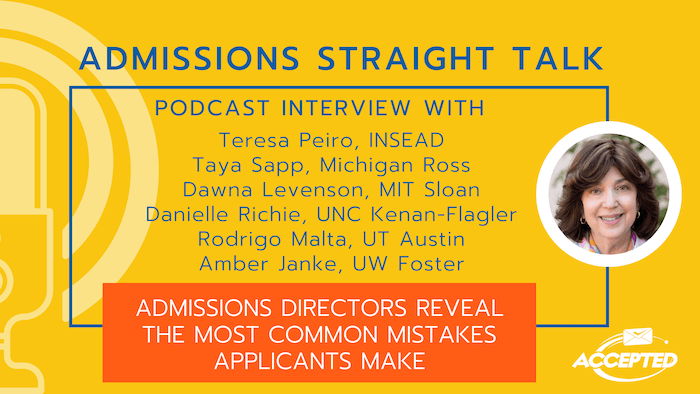
FROM Accepted.com Blog: Admissions Directors Reveal the Most Common Mistakes Applicants Make


There is tons of advice on Accepted.com and on previous episodes of Admissions Straight Talk, about what you should do when you’re applying to top MBA programs. But what about common mistakes? What about the things that you shouldn’t be doing? What are the errors that applicants like you all too frequently make on applications? 

Today you’re going to hear different admissions committee directors from around the world talk about what they think are the most common mistakes in MBA applications, and you’re invited to listen in.

Welcome to the 538th episode of Admissions Straight Talk. Before I turn to those mistakes I mentioned a second ago, I have a question for you: Are you ready to apply to your dream MBA programs? Are you competitive at your target schools? Accepted’s MBA admissions quizcan give you a quick reality check. And you’ll not only gett an assessment; you’ll also get tips on how to improve your qualifications. Plus, it’s all free. 

If you’re a regular listener to Admissions Straight Talk, you know that during most episodes of AST I interview a guest. Occasionally, I do a solo show. Frequently, the guests are admissions directors. I also have many times asked my guests, “What are the most common mistakes that you see when you’re reviewing applications?”


Today’s episode is a collection of guests’ answers to the questions, what are the most common mistakes you have seen during the MBA application process? What are the most common mistakes that you see when reviewing applications? All featured guests are admissions directors at top MBA programs sharing what you should not do when you are applying. 

The two most common mistakes were in broad categories, 

  • Lack of authenticity, a sense that you’re not really revealing yourself. 

  • And number two, sloppiness, which can come in many forms and you can learn about those forms through the admissions directors’ comments. 

There are nuances and details that the admissions committee directors provide in their comments, and you want to hear from them in their words what they are – so don’t go anywhere. Don’t just think that the two items I listed, you’re done for the day.

In addition, there were some other errors that don’t fit into those two categories and still are common and damaging to applicant’s chances. For example, one would be to not adjust in your resume for business school, but give in the technical resume that you have used in getting jobs. That’s not going to work when you’re applying to an MBA program. 

But again, you’re going to want to hear what changes you need to make and you’re going to want to hear it from the admissions’ director’s mouth. In short, to make sure that your applications shine like gems, first, remove the impurities. Those impurities are the common errors discussed in the rest of this episode. I’ve arranged the episodes in alphabetical order by school name. 

Teresa Peiro, Associate Director of Global Admissions for Degree Programs at INSEAD [3:22]

Linda Abraham: Our first speaker is INSEAD’s Teresa Peiro, Associate Director of Global Admissions for Degree Programs. 

Now, you’ve been doing this for a few years, what’s the most common mistake you see in the application?

TP: I would say lack of motivation. We know that the application process is long and it takes time, and our recruitment team is always saying  focus on the essays, focus on what you’re writing. You need to prepare. So a sloppy application is a no go.

TP: Essays that aren’t well-structured, essays that are not well-prepared, things that are mismatching, lack of consistency, that would be a killer.

And that translates to you as lack of motivation.

TP: And this is a big investment and it’s not only about money, but it’s also who you’re going to… This INSEAD will follow you for the rest of your life. We tend to say that you’ll never travel alone, for instance. So it’s something that we want to be sure that you’re really going to enjoy. I always say that we are looking for motivated candidates, engaged students, proud alumni. Candidates know that pre-selection is purely based on your application form. So it’s like your business card.

Linda Abraham: If you’re getting the impression that INSEAD really wants to understand what makes you tick, I think you’re right. It’s not the only school, but I think she’s very clear about it.

Taya Sapp, Senior Associate Director of Admission at Michigan Ross [4:53]

Linda Abraham: Taya Sapp, Senior Associate Director of Admissions at Michigan Ross, sees underestimating the importance of your resume as the biggest mistake. Learn why in this clip.

TS: I think honestly, one of them is kind of overlooking the importance of the resume. That’s the first thing I look at when I open an application, and it’s the snapshot of your whole professional career. And so I think it’s really important, and I’ve seen a lot of people kind of just assume I already have that done. I don’t need to worry about that. Let me focus on the essays. And I think it’s important to think this should not be the same resume that you might’ve just applied for your current job with and what that looks like, because it might include a lot of technical jargon that is only appropriate for your particular career path. It might not have as much, I mean, hopefully it has impact, but I think earlier in our careers, we’re more often thinking about what our responsibilities are and need to be shifting into the impact. I do see a lot of resumes that it doesn’t seem like people have stopped and really spent time on thinking about how they want to be representing their professional career and what that looks like. So that’s what I think.

Linda: I frequently tell applicants who want to start early, get your resume done, and focus on your accomplishments, not your responsibilities, that kind of stuff. So that’s a great, great input, I think. 

Dawna Levenson, Assistant Dean of Admissions at MIT Sloan [6:23]

Linda Abraham: Dawna Levenson takes a somewhat different tack. Do you want to write something shocking in your application? Something provocative for MIT Sloan? Well, Dawna, Assistant Dean of Admissions, reveals why that’s a bad idea, along with another critical error.

DL: So the most common mistake is trying to stand out in an inappropriate way. Provocative is the best word I can use on your video or perhaps in your cover letter where you talk about subject matter that has a shock factor tied to it. You use unprofessional, inappropriate language. It happens, every year there’s a handful of them. Aside from just not following instructions. I believe are very reasonable if we ask for a cover letter to be 300 words, we are not word counters. If it’s 310-ish, no big deal. If you submit a five-page essay, it raises a red flag for us.

Danielle Richie, Director of Full-Time MBA Admissions and Student Recruitment [7:14]

Linda Abraham: UNC Kenan-Flagler’s Danielle Richie, Director of Full-Time MBA Admissions and Student Recruitment, returns to the theme of authenticity and failing to reveal the human non-professional side of you in her comments. 

Linda: What are the most common mistakes that you see applicants make during the application process?

DR: Not being themselves. So I think that’s one of the first things. And then also, I mentioned that human component earlier, and I feel like that’s another thing. Everyone has a professional side. Yes, but there’s that personal side to who you are, and I feel like sometimes that’s lacking in an application, and it would be great to fully see and know a candidate throughout the application process. So bringing in that human side, bringing in that EQ is really important.

DR: So if you have extracurriculars, I mentioned earlier, I’m a soccer referee, most people wouldn’t understand what goes into that, the trainings, the thought process, that’s absolutely something I would put on my resume and talk to because in any given game, you can make between 300 and 350 decisions. And so that’s a great talking point to bring up and for someone to think on their feet. So when you have extracurriculars, maybe you’re part of a team, maybe you have volunteer experience, those types of things the committee would love to know about and see how you are outside of work too, because there’s so much more than just your job title in your career.

Rodrigo Malta, Managing Director of MBA Recruitment and Admissions at UT Austin [8:49]

Linda Abraham: UT Austin’s Rodrigo Malta, Managing Director of MBA Recruitment and Admissions, provides three common errors that he says he sees year after year. Don’t make them.

RM: I know that your listeners are awesome and they’re not going to make these mistakes because they’re listening to this podcast. So the first one seems really simple, but it’s not answering the essay prompt. So as you build your application and you focus on those essays, it is really important for you to engage with individuals within your community. If you have an opportunity to work with an admissions consultant, awesome as well. But always ask yourself and those that are reviewing your essays, if you’re appropriately answering the essay prompt.

RM: I know that applicants have a lot to share, right? And they want to share everything with us. Remember that there are a lot of different application components and opportunities for you to share who you are. The essays are a great asset to your application, but it’s only going to be one that you’re going to be able to capitalize on if you answer that essay prompt. So that’s kind of number one. And I have two other ones, if I can sneak them in, is that okay, Linda?

Linda: Absolutely. Go for it. This is great.

RM: So the second one, it’s also around essays, and it seems really basic. So I can see some of our listeners maybe rolling their eyes whenever they listen to this, but mentioning the wrong school name in the application, it’s a big no no. That happens more often than you think. So make sure to double, triple check the materials that you’re submitting with your application that you’re listing out the right school name. And the second one is a kind of a new nuance that we’ve been seeing, I would say as of the past three to five years, which is discrepancies between your resume that you submit with the application and any information that you have that have out on LinkedIn.

RM: So as part of the application here at Texas McCombs, applicants can submit their LinkedIn if they have a LinkedIn profile. If you are going to submit your LinkedIn profile with your application, and that piece of it is optional, the resume is not optional. To submit your LinkedIn profile, make sure that the LinkedIn profile matches the resume on the jobs that you’ve had, on the dates, et cetera. Because if there are discrepancies between both of them, you may raise questions from the admissions committee and you don’t want the admissions committee to have questions. You want to answer any questions that we have. So those discrepancies between resume and LinkedIn can be a little bit tricky sometimes. So be on the look for that.

Linda: Those are great insights and great input. The first two I’ve heard before, and actually I’ve many times been asked, what are schools looking for? And my first answer is they’re looking for the answer to their question. That’s why they asked the question, – they want the answer.

Amber Janke, Director of MBA Recruitment and Admissions at UW Foster [12:01]

Linda Abraham: Amber Janke, Director of MBA Recruitment and Admissions at UW Foster, shared two common mistakes and returns to the theme of insincerity, and shares a second common failing in applications.

AJ: I have a couple that I want to share. One is not being authentic in your application. I think sometimes people believe as though the admissions committee wants to hear just one thing or a certain thing. And really what we’re trying to do is get to know each individual applicant, authentically. We want to know who you are. We want to know what your goals are, your dreams are. We want to know truly who you are and what your experiences have been. And time and time again, I’ll talk with an applicant for an info interview and they say, “My friends are telling me I shouldn’t share this very lofty goal.” And I’m like, “Well, you should think about what you really want to achieve. Certainly have a plan B, but if that’s really what you want to achieve, you’re going to want to share that as part of your application.”

AJ: So that is one thing, people feeling as though they can’t be authentic in their application, and I would encourage you to do so because if you aren’t authentic, we’ll be able to see that in an interview. So that’s really important. The second really is just not doing research on the program ahead of time. We know you want an MBA, but why do you want to Foster MBA? We’re a small program, we can help you achieve certain things, and we want to know that people really want to be part of this type of program. But you got to do the research on your end as well. It’s not just about the MBA, it’s about what you are looking for in an MBA experience and doing some of the research ahead of time to learn if you think a program might be a right fit for you.

AJ: You don’t have to have figured it out yet. That’s totally fine. That’s part of the MBA application process. But start to do some of the work on your end to really understand about not just why you want an MBA, but why you want an MBA from Foster or maybe another program.

Linda: I sometimes talk to applicants and they’ll say something like, “I want to work for Microsoft.” Or, “I want to work for Amazon.” Or they’ll name some other company and some other school. Would your response to that be that’s a good reason, or would it be why do you want to work for Amazon? Or why do you want to work for Microsoft?

AJ: I mean, certainly those are part of people’s goals that they might have certain companies or roles in mind. But an MBA program is not just about what you do immediately post MBA, it’s about what the experience is for the two years that you’re here. It’s about what you want to gain, how you want to learn, how you want to grow for five years, 10 years down the line. Plus.

Linda: It’s your professional life.

AJ: Exactly. For your professional life.

Linda Abraham: So remember NOT to do the things discussed in this episode. And before you submit an application, make sure that you’ve crossed the T’s and dotted the I’s, both literally and figuratively. And of course, make sure that your application reflects the best side of you, but the real you. 

If you’d like help in presenting the best of the authentic you, please contact Accepted for guidance and presenting your best self and polishing that gem of an application. Discover how Accepted’s experts can help you and take advantage of an initial free consultation.


Related Resources:


Related Episodes:


Subscribe:


Podcast Feed

The post Admissions Directors Reveal the Most Common Mistakes Applicants Make [Episode 538] appeared first on Accepted Admissions Blog.
This Blog post was imported into the forum automatically. We hope you found it helpful. Please use the Kudos button if you did, or please PM/DM me if you found it disruptive and I will take care of it. -BB
User avatar
Accepted.com
User avatar
Major Poster
Joined: 20 Apr 2003
Last visit: 18 Dec 2022
Posts: 6,466
Own Kudos:
Given Kudos: 92
Location: Los Angeles CA
Posts: 6,466
Kudos: 859
Kudos
Add Kudos
Bookmarks
Bookmark this Post
FROM Accepted.com Blog: Five Tips for Creating a Standout MBA Resume


Your MBA resume essentially serves as a way of accentuating your career’s “greatest hits” for the adcom. On one to two pages, you have the opportunity to highlight your most impressive academic and professional experiences. For overrepresented applicants, older applicants, and applicants with other challenging circumstances (such as a criminal record), this is their first shot at grabbing the attention of top B-school admissions reps and eliminating their hesitations.


Answer these five questions to create a stunning resume that will highlight your competitive advantage and boost your chances of getting accepted:

1. Who are you?

Interview yourself and examine the jobs you’ve had, the skills you’ve acquired, and your “greatest hits” as a professional.

What are some of your most impressive skills or talents? What accomplishments are you most proud of? What have you achieved that gained you the most recognition? How have you affected your organization or influenced coworkers? What are some of your key successes?

Look through old emails that might jog your memory, read performance reviews or LinkedIn recommendations, and jot down notes chronicling your career achievements.

2. Where are you applying?

The best way to convince an adcom that you’re best for their school is to start by understanding the school’s mission, strengths, and ideals.

When putting your resume together, you’ll need to learn as much as possible about the program you’re applying to. Then, customize your resume to reflect the aspects of your background that are most relevant to your target school.

You want the language of your resume to match the school’s mission, strengths, and ideals, but be sure that you do not just parrot back what’s on the program’s website. Your goal is to internalize the school’s vision and present your complementary ideals, not to merely cut and paste or directly mimic its language.

3. What are some of your specific accomplishments?

Saying that you “led your team to success” just won’t cut it. Impact is measured in numbers, so you want to make sure that the numbers on your resume are impressive.

Details matter. Consider how much more impressive saying, “Designed $3 million IT strategy that increased revenue by 11% and attracted 7 new clients” sounds than saying, “Developed IT plan that was selected for implementation.” If you work for a private company and can’t disclose revenue figures, refer to percentage increases, or cite the improved industry ranking of the organization’s product or performance as a result of your contribution. Think of numbers and other hard details as proof that you can deliver.

4. Are you being honest?

If you dropped out of your CPA course just before finals, don’t say that you completed the course. If you were one of eight equally ranked members of a team, don’t say you were team leader. If you worked for four months at a company, don’t say you were there for a year.

You get the point.

Making up degrees, accomplishments, and other personal and professional facts is just a bad idea. Don’t do it; it’s unethical and potentially self-destructive. Schools won’t hesitate to show a student the door when they learn that their resume, or any other part of their application for that matter, is more fiction than fact.

5. Does your resume look good?

Yes, it’s important that your resume sounds good. But how does it look?

A slapdash job will portray you as a sloppy, careless person. A featureless, plain display will make you look uninteresting or boring. The solution here isn’t to use a hot pink background bordered by birds and flowers, but adding a few design elements will do wonders to spruce up your resume and show that you put some thought into your presentation.

Here are a few suggestions:

  • Instead of the traditional circle bullet or dash, use the less common diamond- or arrow-shaped bullet.

  • Use expanded text (kerning) to highlight a key term.

  • Enclose certain sections of your resume in shaded boxes.

No matter what, keep in mind that less is more; you don’t want a cluttered resume that is difficult to read. And if your target school specifies format rules (particularly regarding margins, page number, and font), be sure to follow them to a T. This might mean toning down your creative flair for design to fit the school’s standard.

For personalized advice tailored just for you, check out our MBA admissions consulting and editing services, and work one-on-one with a pro who will help you discover your competitive advantage and use it to get ACCEPTED.


As the former executive director of admissions at Carnegie Mellon’s Tepper School and assistant dean of admissions at Georgetown’s McDonough School and the University of Pittsburgh’s Katz School, Kelly Wilson has 23 years’ experience overseeing admissions committees and has reviewed more than 38,000 applications for the MBA and master’s programs in management of information systems, computational finance, business analytics, and product management.  Want Kelly to help you get accepted? Click here to get in touch!

Related Resources:


The post Five Tips for Creating a Standout MBA Resume appeared first on Accepted Admissions Blog.
This Blog post was imported into the forum automatically. We hope you found it helpful. Please use the Kudos button if you did, or please PM/DM me if you found it disruptive and I will take care of it. -BB
User avatar
Accepted.com
User avatar
Major Poster
Joined: 20 Apr 2003
Last visit: 18 Dec 2022
Posts: 6,466
Own Kudos:
Given Kudos: 92
Location: Los Angeles CA
Posts: 6,466
Kudos: 859
Kudos
Add Kudos
Bookmarks
Bookmark this Post
FROM Accepted.com Blog: Four Ways to Show How You’ll Contribute in the Future


Schools are looking for  and will actively contribute not only to their student/alumni communities but also to the greater community and society. 

Many applications include an essay question with some variation of “What would you contribute to your future campus community?” or “How will you contribute to our program?” If you are invited to interview, you’ll likely be asked how you will contribute to the school, so this a topic for which preparation is vital.

You need to present your best self, yet grandiose, declarative statements and promises to be a superlative do-gooder can be unpersuasive and even off-putting. So, how do you show you are a candidate with plenty to contribute and will be a future asset to your chosen school?


Point to the past as a forecast of the future

Most admissions committees are firm believers that past behavior reveals one’s abilities and interests and is a good predictor of the person’s future behavior.

Here are four tips for highlighting your impressive past and relaying the message that you plan on making a positive impact by contributing to your school, its community, and the world at large.

Share stories of past achievements, and quantify (if possible) the impact you had.

By showing how you’ve already contributed, you demonstrate that you have the initiative, people skills, and organizational talent to make an impact in the future. If you can select a contribution that is related to your chosen field or school, so much the better. Perhaps your past contribution is part of an ongoing project or a recurring event that you intend to continue being a part of in the future. This will show the adcom that your achievements are not one-offs; you can demonstrate your commitment while associating your worthy contributions with their school.

Discuss skills you’ve developed that will aid future contributions.

You can show the adcom that you have the skills and the tools needed to give back. Use evidence to illustrate your skill development by talking about how you’ve taken steps to build your skill set (such as by taking a course or through work experience). Analyze your success and think about how you can reveal that you are a thinking, growing, dynamic individual. And when asked about failures or setbacks, discuss what you learned from the tough times. Demonstrate a growth mind-set.

Show how your skills are transferable.

To illustrate your plans to contribute to your target school, you’ll need to show how your unique talents and experiences can be shared with your classmates, professors, and/or work colleagues. Talk about how your skills, understanding, and ethics can positively affect those around you. Even seemingly unrelated skills could be transferable to your target program; every past achievement has skill elements that can be highlighted and applied to future contributions.

Mention how your target school will help.

The adcom readers now know that you’ve got skills and are ready to share them. Next, you need to reinforce the idea that their school is THE PLACE to accelerate your upward trajectory. Highlight any overlaps in the ethos of the school or in the curriculum that will advance your skills in the future. And this works both ways: point out that just as the school will help further your skills, you, as a future contributing graduate, will become an ambassador for the school.

A good essay on your contributions will cover each of these topics: what you’ve done in the past, how you’ve developed your skills, how you plan on sharing that knowledge, and how your target school will help you effect change. Remember, the past reveals much about the future, so share the story of what you’ve done and how you’ve reached this point, and you’ll be well on your way to proving that you’ve got what it takes to contribute in the future.

[b]Are you ready to prove how you can contribute? Accepted’s expert consultants know just how to help you identify which experiences and skills you need to highlight to show what you can bring to the table. Schedule a free consultation today and speak with consultant – never a salesperson![/b]

Related Resources:

The post Four Ways to Show How You’ll Contribute in the Future appeared first on Accepted Admissions Blog.
This Blog post was imported into the forum automatically. We hope you found it helpful. Please use the Kudos button if you did, or please PM/DM me if you found it disruptive and I will take care of it. -BB
User avatar
Accepted.com
User avatar
Major Poster
Joined: 20 Apr 2003
Last visit: 18 Dec 2022
Posts: 6,466
Own Kudos:
Given Kudos: 92
Location: Los Angeles CA
Posts: 6,466
Kudos: 859
Kudos
Add Kudos
Bookmarks
Bookmark this Post
FROM Accepted.com Blog: Four Ways to Show How You’ll Contribute in the Future
[img]https://blog.accepted.com/wp-content/uploads/2023/09/Four-Ways-to-Show-How-Youll-Contribute-in-the-Future.png[/img]
[img]https://blog.accepted.com/wp-content/uploads/2023/09/Four-Ways-to-Show-How-Youll-Contribute-in-the-Future.png[/img]

Schools are looking for  and will actively contribute not only to their student/alumni communities but also to the greater community and society.

Many applications include an essay question with some variation of “What would you contribute to your future campus community?” or “How will you contribute to our program?” If you are invited to interview, you’ll likely be asked how you will contribute to the school, so this a topic for which preparation is vital.

You need to present your best self, [url=https://blog.accepted.com/how-to-project-professionalism-positivity-and-confidence-in-your-statement-of-purpose/]yet grandiose, declarative statements[/url] and promises to be a superlative do-gooder can be unpersuasive and even off-putting. So, how do you show you are a candidate with plenty to contribute and will be a future asset to your chosen school?

[url=https://www.accepted.com/free-admissions-consultation-all][img]https://blog.accepted.com/wp-content/uploads/2020/07/general-free-consultation-button.png[/img][/url]

Point to the past as a forecast of the future

Most admissions committees are firm believers that past behavior reveals one’s abilities and interests and is a good predictor of the person’s future behavior.

Here are four tips for highlighting your impressive past and relaying the message that you plan on making a positive impact by contributing to your school, its community, and the world at large.

Share stories of past achievements, and quantify (if possible) the impact you had.

By showing how you’ve already contributed, you demonstrate that you have the initiative, people skills, and organizational talent to make an impact in the future. If you can select a contribution that is related to your chosen field or school, so much the better. Perhaps your past contribution is part of an ongoing project or a recurring event that you intend to continue being a part of in the future. This will show the adcom that your achievements are not one-offs; you can demonstrate your commitment while associating your worthy contributions with their school.

Discuss skills you’ve developed that will aid future contributions.

You can show the adcom that you have the skills and the tools needed to give back. Use evidence to illustrate your skill development by talking about how you’ve taken steps to build your skill set (such as by taking a course or through work experience). Analyze your success and think about how you can reveal that you are a thinking, growing, dynamic individual. And when asked about failures or setbacks, discuss what you learned from the tough times. Demonstrate a growth mind-set.

Show how your skills are transferable.

To illustrate your plans to contribute to your target school, you’ll need to show how your unique talents and experiences can be shared with your classmates, professors, and/or work colleagues. Talk about how your skills, understanding, and ethics can positively affect those around you. Even seemingly unrelated skills could be transferable to your target program; every past achievement has skill elements that can be highlighted and applied to future contributions.

Mention how your target school will help.

The adcom readers now know that you’ve got skills and are ready to share them. Next, [url=https://blog.accepted.com/focus-fit-episode-162/]you need to reinforce the idea that their school is THE PLACE[/url] to accelerate your upward trajectory. Highlight any overlaps in the ethos of the school or in the curriculum that will advance your skills in the future. And this works both ways: point out that just as the school will help further your skills, you, as a future contributing graduate, will become an ambassador for the school.

A good essay on your contributions will cover each of these topics: what you’ve done in the past, how you’ve developed your skills, how you plan on sharing that knowledge, and how your target school will help you effect change. Remember, the past reveals much about the future, so [url=https://blog.accepted.com/5-elements-telling-attention-grabbing-story/]share the story[/url] of what you’ve done and how you’ve reached this point, and you’ll be well on your way to proving that you’ve got what it takes to contribute in the future.

[b][b]Are you ready to prove how you can contribute? Accepted’s expert consultants know just how to help you identify which experiences and skills you need to highlight to show what you can bring to the table. [/b][url=https://www.accepted.com/free-admissions-consultation-all]Schedule a free consultation[/url] today and speak with consultant – never a salesperson![/b]

[b]Related Resources:[/b]

[list]
[*][url=https://blog.accepted.com/essential-components-of-mba-personal-statement/]Three Must-Have Elements of a Good Statement of Purpose[/url][/*]

[*][url=https://reports.accepted.com/guide/how-to-fit-in-stand-out-during-the-admissions-process]Fitting In & Standing Out: The Paradox at the Heart of Admissions [/url]– a free guide[/*]

[*][url=https://blog.accepted.com/i-wish-the-admissions-committee-had-asked-me/]Optional and Open-Ended Essay Questions: What’s the Best Strategy?[/url][/*]
[/list]
The post [url=https://blog.accepted.com/4-ways-show-you-will-contribute-future/]Four Ways to Show How You’ll Contribute in the Future[/url] appeared first on [url=https://blog.accepted.com]Accepted Admissions Blog[/url].
This Blog post was imported into the forum automatically. We hope you found it helpful. Please use the Kudos button if you did, or please PM/DM me if you found it disruptive and I will take care of it. -BB
User avatar
Accepted.com
User avatar
Major Poster
Joined: 20 Apr 2003
Last visit: 18 Dec 2022
Posts: 6,466
Own Kudos:
Given Kudos: 92
Location: Los Angeles CA
Posts: 6,466
Kudos: 859
Kudos
Add Kudos
Bookmarks
Bookmark this Post
FROM Accepted.com Blog: How the Team Approach to Admissions Consulting at Accepted Benefits You
[img]https://blog.accepted.com/wp-content/uploads/2023/09/how-the-team-approach-to-admissions-consulting-at-accepted-benefits-you.png[/img]
[url=https://www.accepted.com/free-admissions-consultation-all][img]https://blog.accepted.com/wp-content/uploads/2023/09/how-the-team-approach-to-admissions-consulting-at-accepted-benefits-you.png[/img][/url]

If you are a current Accepted client, you’re likely familiar with our firm’s practice of conducting peer reviews as part of our service. Peer review is a crucial step in our process, one in which Accepted consultants seek input from their colleagues in the firm, asking them to help evaluate and enhance our clients’ essays as we approach the final stages of the application process. Whether you’ve opted for a package or hourly service, rest assured that peer review is an integral component of the service in which you’ve invested. Let’s delve into why this practice is so significant. 

[url=https://www.accepted.com/free-admissions-consultation-all][img]https://blog.accepted.com/wp-content/uploads/2020/07/general-free-consultation-button.png[/img][/url]

You gain a fresh perspective

You’ve established a close rapport with your dedicated consultant throughout the admissions journey. However, our peer review process introduces a new dimension. Just as an admissions officer would when first approaching an application, the Accepted peer reviewer forms an objective first impression of an essay you meticulously refined with your consultant over several iterations – and then shares this information with your consultant.

It emulates an author-editor relationship

The dynamic between one’s consultant and their peer reviewer – like that between an author and their editor – is pivotal to your success. This symbiotic partnership ensures that our consultants uphold a standard of excellence for each client’s benefit.

You benefit from diverse insights and continuous learning

At Accepted, our consultants bring a wealth of distinct expertise to every engagement. The peer reviewer contributes a diverse perspective, enriching the essay evaluation process. The resulting feedback is invaluable, and the exchange fosters an environment of ongoing learning and continuous improvement in our practices.

The Accepted peer review system exemplifies our commitment to delivering top-tier guidance and support throughout your admissions journey. The multifaceted insights provided by the peer reviewer, akin to those of an admissions officer, editor, and educator, collectively refine your essays and enhance the overall quality of your application. We firmly believe that this collaborative approach increases your chances of achieving the admissions success you deserve. 

[img]https://blog.accepted.com/wp-content/uploads/2022/04/Natalie_Grinblatt-Epstein_admissions-expert-headshot.jpg[/img]

By Natalie Grinblatt, former admissions dean/director at three top business schools. Natalie has reviewed more than 70,000 applications, interviewed more than 2,500 candidates, and trained nearly 700 admissions directors and alumni volunteers to select outstanding candidates for admission. Her clients gain admission to top programs, including those at Harvard, Stanford, Wharton, MIT, Cornell, Columbia, Berkeley, Chicago, Northwestern, and NYU. Natalie holds an MBA from Michigan Ross. [url=https://www.accepted.com/experts/natalie-grinblatt-epstein?utm_campaign=Blog&utm_medium=blog_bio_natalie&utm_source=blog#open-form]Want Natalie to help you get Accepted? Click here to get in touch![/url]

[b]Related Resources:[/b]

[list]
[*][url=https://blog.accepted.com/i-wish-the-admissions-committee-had-asked-me/]Optional and Open-Ended Essay Questions: What’s the Best Strategy?[/url][/*]

[*][url=https://blog.accepted.com/answering-common-application-essay-prompts/]Tips for Answering the Common Application Essay Prompts 2023-2024[/url][/*]

[*][url=https://blog.accepted.com/writing-the-diversity-essay/]Writing an Excellent Diversity Essay[/url][/*]
[/list]
The post [url=https://blog.accepted.com/how-the-team-approach-to-admissions-consulting-at-accepted-benefits-you/]How the Team Approach to Admissions Consulting at Accepted Benefits You[/url] appeared first on [url=https://blog.accepted.com]Accepted Admissions Blog[/url].
This Blog post was imported into the forum automatically. We hope you found it helpful. Please use the Kudos button if you did, or please PM/DM me if you found it disruptive and I will take care of it. -BB
User avatar
Accepted.com
User avatar
Major Poster
Joined: 20 Apr 2003
Last visit: 18 Dec 2022
Posts: 6,466
Own Kudos:
Given Kudos: 92
Location: Los Angeles CA
Posts: 6,466
Kudos: 859
Kudos
Add Kudos
Bookmarks
Bookmark this Post
FROM Accepted.com Blog: Yale SOM MBA Essay Tips and Deadlines [2023-2024], Class Profile


Yale SOM MBA Essay Tips and Deadlines [2023-2024], Class Profile

As all applicants must do when applying to the Yale SOM, you need to make the most of its single required essay, but you also need to take the time to make every box in the application a home run. Do not treat them as afterthoughts; your job descriptions and activity history are very important. Write and edit these portions carefully. Focus on achievements. Quantify when possible, and keep Yale’s commitment to “educating leaders for business and society” front and center in your responses.

Ready to get to work on your Yale SOM application? Read on.


Yale SOM application essay tips

We want to know what matters to you, and our essay question is designed to help us gain insight into your background, passions, motivations, responsibilities, ideals, identities, challenges, or aspirations, depending on where you take your response. To ensure that you’re able to write about something important to you, we offer you three essay prompts from which to choose.

Choose the prompt that speaks most strongly to you and about which you have the most enthusiasm. In answering the prompt – whichever one it is – you should think about the life experiences that have been most meaningful to you and that you most want to communicate to the committee, and pick the question that will best allow you to express that aspect of yourself. We find that the most compelling essays are the ones that are truly most important to you, so make sure that’s your guide in choosing what to write about; don’t try to guess what we’re looking for or what you think we want to hear. Importantly, regardless of which prompt you choose, you’ll want to support your essay with concrete examples.

Importantly, regardless of which prompt you choose, you’ll want to support your essay with concrete examples.

Essay option #1

Describe the biggest commitment you have ever made. Why is this commitment meaningful to you and what actions have you taken to support it?

This essay question is based not only on the premise that actions speak louder than words but also on the premise that past behavior predicts future behavior.

So, in your essay, you want to show that you are a person who follows through on commitments. Think about times when you make a significant commitment and fulfilled it. Do you tend to make big commitments? What are the results? What impact have you had as a result of your most important or consequential commitment? What was the impact on you?

An anecdotal response, in which you tell the story of the commitment you made, could be very effective. What was the challenge or problem that triggered the commitment? How did you follow up? What was the outcome, and why is it meaningful to you? Did you successfully solve the initial problem or achieve your goal(s) in meeting the challenge?

You can start with the moment of challenge or with the moment of triumph. If you choose the latter, be sure to go back, provide context, and recount your story of commitment, resolve, hurdles overcome, and challenges handled. If the impact has lasted – on you and others – succinctly include that part of the story, too.

Essay option #2

Describe the community that has been most meaningful to you. What is the most valuable thing you have gained from being a part of this community and what is the most important thing you have contributed to this community?

If you choose to respond to this prompt, start by thinking about a community you either currently belong to or belonged to in the past, and choose the one in which and from which you believe you have learned the most, or to which you contributed the most. 

This could be related to a volunteer activity you regularly participate in, a network or community of like-minded people you belong to, or even a professional organization you are part of. 

We recommend dedicating the first third of the essay to describing the community and the nature of your involvement. Then, spend the second third discussing what you have learned from your experiences in – and potentially from other members of – that community, focusing especially on the one or two most important ones. In the final third of the essay, highlight the most important contributions you have made to the community. 

Essay option #3

Describe the most significant challenge you have faced. How have you confronted this challenge and how has it shaped you as a person?

Using the SAR (Situation, Action, Results), STAR (Situation, Task, Action, Result), or CAR (Context/Challenge, Action, Result) framework, describe for the admissions committee the most important challenge you have had to address in your life, either personal or professional. In the first part of the essay, clearly describe the issue and why it was or has been difficult for you. Then, discuss how you confronted the challenge, what you specifically did to deal with and overcome it. Finish with how the experience helped shape you into the person you are today. Explain for the adcom what you learned and how you grew as a result. 

Video component

The Yale SOM application also includes a video component. The questions involved are not posted ahead of time, and they vary from applicant to applicant. The key element to preparation here is practice. Practice talking into a webcam without feedback from another human being. Practice delivering question responses within the school’s 60- to 90-second time frame. Rehearse answers to typical interview questions in this format. Consider using the SAR (Situation, Action, Results), STAR (Situation, Task, Action, Result), or CAR (Context/Challenge, Action, Result) framework to structure your answers.

The Yale adcom suggests that you practice via video chat with a friend, but if you do this, have your friend turn off their webcam and just provide feedback at the end of your response. You might also want to consider posting a smiley face somewhere near your computer’s camera you can see it as a reminder to yourself to smile.

Watch: Bruce DelMonico, assistant dean and director of admissions at Yale SOM, talks about common application mistakes.

Click here to listen to the rest of the interview.

Yale SOM application deadlines

Application deadlineAdmissions decisionRound 1September 12, 2023December 5, 2023Round 2January 4, 2024March 26, 2024Round 3April 9, 2024May 16, 2024

Source: Yale SOM website

***Disclaimer: Information is subject to change. Please check with the Yale SOM directly to verify its essay questions, instructions, and deadlines.***

Yale SOM class profile

Here is a look at the Yale SOM Class of 2024 (data taken from the Yale SOM website):

Total enrollment: 347

Women: 43%

International passport holders (includes U.S. permanent residents and dual citizens): 48% 

LGBTQ+: 12%

First-generation college students: 17%

Joint-degree students: 12%

Average years of work experience: 4.7

U.S. students of color (% of U.S. students who identify as American Indian, Alaska Native, Native Hawaiian, Other Pacific Islander, Asian American, Black/African American, or Hispanic/Latinx): 54% 

U.S. underrepresented students of color (% of U.S. students who identify as American Indian, Alaska Native, Native Hawaiian, Other Pacific Islander, Black/African American, or Hispanic/Latinx): 24% 

Median undergraduate GPA: 3.69

80% range of undergraduate GPA: 3.34-3.90

Median GMAT: 725

Middle 80% GMAT range: 690-760

Median GRE-V: 164

Middle 80% GRE-V range: 159-169

Median GRE-Q: 165

Middle 80% GRE-Q range: 160-170

Students with GRE scores: 39%

Are you a competitive applicant at your dream school? Check out the B-School Selectivity Index! >>

Countries represented: 48

Citizenship by region (based on primary and secondary citizenship):

  • North America: 62%

  • Asia Pacific: 27%

  • Mexico, Caribbean, and Latin America: 4%

  • Africa and Middle East: 3%

  • Europe: 3%

Undergraduate majors:

  • STEM: 38%

  • Business: 25%

  • Humanities and Social Sciences: 19%

  • Economics: 18%

Pre-MBA industry:

  • Financial services: 20%

  • Consulting: 19%

  • Nonprofit: 12%

  • Technology: 12%

  • Government: 9%

  • Healthcare (including products and services): 7%

  • Manufacturing: 5%

  • Energy: 4%

  • Media/Entertainment: 4%

  • Consumer packaged goods: 3%

  • Real estate: 2%

  • Retail: 2%

  • Other: 1%

Pre-MBA function:

  • Consulting: 32%

  • Other: 24%

  • Finance/Accounting: 18%

  • General management: 10%

  • Marketing/Sales: 7%

  • Operations/Logistics: 5%

  • Information technology: 3%

Pre-MBA sector:

  • For-profit: 74.6%

  • Government: 13.7%

  • Nonprofit: 11.7%


Former associate director of admissions at the Yale School of Management, director of MBA admissions at MSU Broad, and consultant at Cardiff Business School in the United Kingdom, Esmeralda Cardenal has guided Accepted clients to acceptance in various graduate programs since 2014, including MBA and master’s in finance, business analytics, data science, sustainability, and public policy. Want Esmeralda to help you get accepted? Click here to get in touch!

Related Resources:

The post Yale SOM MBA Essay Tips and Deadlines [2023-2024], Class Profile appeared first on Accepted Admissions Blog.
This Blog post was imported into the forum automatically. We hope you found it helpful. Please use the Kudos button if you did, or please PM/DM me if you found it disruptive and I will take care of it. -BB
User avatar
Accepted.com
User avatar
Major Poster
Joined: 20 Apr 2003
Last visit: 18 Dec 2022
Posts: 6,466
Own Kudos:
Given Kudos: 92
Location: Los Angeles CA
Posts: 6,466
Kudos: 859
Kudos
Add Kudos
Bookmarks
Bookmark this Post
FROM Accepted.com Blog: How to Get Into Yale SOM


How to Get Into Yale SOM [Episode 542]

Are you looking for a mission-driven school that aims to educate leaders for business and society? Would you like to know how to get into that MBA program, which happens to be at the Yale School of Management? Tune in for this interview with its Assistant Dean for Admissions, Bruce DelMonico.

Welcome to the 542nd episode of Admissions Straight Talk, thanks for tuning in. Sometimes I’m asked, “Is the MBA worth it?” And my answer is, “It depends on your individual circumstances.” But I’ve got good news, we’ve developed a toolthat will help you evaluate whether an MBA is worth it for you and your individual circumstances and it also estimates by how much. Check out how much you’re likely to benefit, or not, from taking an MBA education. Using the tool won’t set you back even one cent because it’s free.

Don’t miss Linda Abraham’s 2021 interview with Yale SOM Dean, Bruce DelMonico – full transcript below!

It gives me great pleasure to have back on Admissions Straight Talk, Bruce DelMonico, Assistant Dean of Admissions at Yale School of Management. He’s been on the admissions Team at Yale since 2004. He became the director in 2006 and the assistant dean in 2012. He was last on Admissions Straight Talk almost two years ago in November 2021. 

Bruce, welcome back to Admissions Straight Talk. [1:44]

Thank you so much, Linda. It’s great to be here

I’m so pleased to have you join me today. Now, let’s start with a basic overview of the Yale SOM MBA program for listeners who may not be that familiar with it, and if you could focus on the more distinctive or perhaps the newer elements of the program. [1:48]

Sure, happy to do that. So just briefly, we’re a two-year, full-time, in-residence MBA on the Yale campus in New Haven, Connecticut. There are some things similar to other programs, some things I think are a little bit distinctive, as you say. So when you join us at Yale for your two years, the first year is primarily our core curriculum. Then you start to take electives in the spring the first year, and your entire second year are all electives. I would say a couple of the distinctive things, first of all, our integrated curriculum in the core I think is a little bit different than what you might experience in other MBA programs, the way the material is organized. A lot of the same concepts and same material, but organized differently and presented differently, and we think it teaches you to learn and think differently.

In addition, I mentioned the electives, you could take those across Yale without limit and there are other features of the program that I think really heightened the connectivity to the larger Yale community. I think that’s one of the nice features of being in an institution like Yale, is taking advantage of all the resources that the entire university has to offer, so I think that’s another distinctive aspect of our program. I think a third thing I would point to is our global footprint. A lot of MBA programs have global programming and I think the way that we’ve assembled our Global Network for Advanced Management and the kind of opportunities that flow from that, I think are rather unique and I think do give our students a rather special global perspective in their two years with us at Yale.

That was a great summary, thank you. Now, you mentioned the Global Network. Yale was a leader in global education for its students, innovating before the pandemic, the Global Network for Advanced Management, which allowed students to take classes around the world from New Haven. It also had several study abroad programs. Now that the pandemic seems to be behind us – we’re hopeful – what are the global study options at Yale? Can you go into that a little bit more? [3:24]

Sure, happy to do that. Knock on wood about the pandemic, of course. So pre-pandemic, we had this sort of portfolio of global opportunities. You mentioned the Global Network for Advanced Management, that was probably the centerpiece of it all, but there were others as well. The pandemic obviously, understandably, caused us to sort of pull back on that. There were still some virtual opportunities that existed that continued, but the in-person pieces had to be put on hold and now those are back. So it’s really, as I mentioned, it’s kind of a menu of opportunities that exist.

We do have what we call our Global Studies requirement. So when you come to Yale for your MBA, you do need to complete at least one Global Studies opportunity that exists. Lots of students will do more than one. The idea is we want our graduates to have that global perspective, that global mindset. So again, many of these opportunities exist through the Global Network for Advanced Management, or GNAM as we call it, which is a network of 30 or so top MBA programs from around the world. We assembled these, it’s been about a decade or so at this point, and it’s now a self-running, self-sustaining entity.

The idea is that through the Global Network there are what we call more modular opportunities to experience learning and business in other countries, other regions, other parts of the world. So the idea is that in certain points in the fall and the spring, there are these week to 10 -day long opportunities to take classes at one of the other Global Network schools with students from all the other participating in Global Network schools. So it could be up to students from 30 other business schools, peer schools. The idea is to really, it’s not a one-to-one relationship like a lot of other business schools have put into place, but it’s many-to-many relationship, and the idea is that really amplifies the connections you’re able to make, the learning that happens, and the ways in which you’re really able to expand your mindset.

So those Global Network weeks are one of the Global Network opportunities. We also have the virtual opportunities through the Global Network, which I mentioned, which are similar. They’re semester-long courses that you will take virtually with students from the other Global Network schools. We also have our own international experience trips that we organize that are run, I think some other schools have this. These are, again, 10-day to two-week trips run by one of our faculty members to one or more different countries around the globe, it’s a group of about 20 or so students. You meet with business leaders, government leaders, heads of nonprofits. Again, the idea is to get a sense of the business, legal, regulatory, cultural context in which business operates in different parts of the world to get a fuller understanding of sensitivity to those differences. Those are very highly rated. Those, again, happen in between the spring, in between during spring break when classes are not in session.

We also have some experiential opportunities that are global in nature. So our Global Social Enterprise or GSE course, Global Social Entrepreneurship in India and others. Those are courses where you are academic in nature, you’re taking classes, but then part of it is consulting to social enterprises in other parts of the world or social entrepreneurs in India or elsewhere. There are other courses as well. So these are more experiential in nature. Then the final thing I would say is we have our semester-long exchanges with some key exchange partners, and that’s if you want a longer, more immersive experience, those opportunities exist as well.

So those are, again, the portfolio, the menu as it were, of options that exist. One thing I would point out is when you come to Yale, these are Global Studies requirements. So you do have to take at least one, but you can take more of these. You actually get a Global Studies account when it comes to Yale that actually helps pay for the cost of these opportunities because we didn’t feel like it made sense to make this requirement and then to not give you the ability to actually undertake them. So when you pay tuition, you actually get several thousand dollars back to be able to pay into an account to help pay for these different possible trips and opportunities.


Just back onto the network? So it is possible, I know you have many different schools, I don’t remember all of them, but let’s say you enroll in a network class, you could be taking students, there could be students from a school in France, a school in Africa, a school in Asia, a school in Canada or South America all taking the same class. [7:44]

Exactly. That’s exactly right. So it’s not just like if you go to Koç University in Turkey, you’re taking courses from faculty at Koç. But yeah, you could have students from EGADE, from FGV in Brazil, from Renmin in China, from Ashesi, from a whole host of business schools from around the world. So that’s part of I think the unique feature, I think part of the compelling aspect of this programming,

I don’t know of any other similar program, so obviously everybody participating in it participated, so it’s not unique to Yale by its nature, but it is a distinctive, if not unique program. Now, I noticed in preparing for the call that throughout the site there is an emphasis on SOM’s mission of educating leaders for business and society. How is that mission manifested in the program and the curriculum? [8:37]

This is the founding mission of the school, as you said, to educate leaders for business and society. It’s a very broad, multi-sector mission. We aspire for our graduates to have impacts, not just in the private sector but the public and nonprofit sectors, I think that’s one piece of it, and to really think about, again, not just the benefits that they can accrue to themselves, but the positive impact they can have on their organizations and their communities and the world more generally, and I think the way that manifests itself, in terms of course-related and on campus, I think the curriculum is part of it. I did touch on the integrated curriculum earlier and that is, again, the first year core curriculum, I think it is quite distinctive and the material, as I said, is organized differently than other schools organize or the traditional MBA curriculum, the way that would be organized.

Again, the idea was to break down functional silos and not teach just according to discipline, but work across functions and across disciplines to have our students think very broadly about the ways that different concepts, different functions of an organization interrelate, even different industries, different sectors. So the idea, as an example, we have sort of the heart of the first year core curriculum are our Organizational Perspectives classes, and they’re organized by key stakeholder perspectives, so the customer, the innovator, the employee, the investor, and others, there are about a dozen of them. As an example, the customer class, for example, in the Yale core curriculum would be most analogous to a marketing class in the traditional MBA curriculum. But in a marketing class, the perspective is very, very narrow. You’re looking to learn the four Ps, you’re learning how to take your product, identify the market space, and get your product in that space. It’s an important set of skills, very narrow.

The customer class includes those marketing concepts, but it really thinks more broadly about all aspects of an organization that influence the customer experience. So it’s thinking about the four Ps, but it’s also thinking about operations and accounting and technology and HR and how all those influence the customer experience, how those are all interrelated, and how you need to think as a leader, how you need to think about them all together. So all the stakeholder classes are taught like that and then we have a capstone class called Executive, where you think about all the perspectives together combined and thinking about as an executive how you need to have all these different pieces in your head and thinking about them collectively as you’re making decisions.

So I think the curriculum is really trying to teach our students to be very interdisciplinary, broad, curious thinkers and leaders, and I can talk more about certain aspects of that, so I think that’s part of it. Again, mentioning the global piece that we just talked about, very mission-aligned. The other thing I would say, again, the connection to Yale speaks to the interdisciplinary nature of the broad-mindedness we expect, the kind of a mindset approach we want our graduates to have. I think that’s all aligned with the mission. It’s very much a service-oriented approach, and as I said, thinking about the kind of positive impact you can have on the world around you and thinking very broadly about what that kind of impact can be. So I think that kind of underlies the things we’re doing both in the classroom and outside of it at Yale.

Let’s turn to the application process and admissions. Yale has an innovative and multifaceted application and it requires the GMAT, the GRE, or the EA, an essay, a resume, a video, behavioral assessment, and an interview, if lucky enough to be invited to interview. Now, the behavioral assessment is fairly new, and again, distinctive on the MBA scene. What’s the format for the behavioral assessment? What’s the reason for it, why, and how can one sign up for it? [12:23]

So the behavioral assessment, one side of clarification. So in terms of the standardized tests, the GMAT, GRE, the EA we accept for the Executive MBA, not for the full-time.

That’s just one small clarification. Behavioral assessment, it’s an additional component, there’s nothing you need to do to sign up for it. When you apply to Yale, after your initial submission, you’ll get access to the behavioral assessment as the next stage. It is part of the initial submission, but it happens after you click submit. Yeah, we’ve been, gosh, developing for probably a decade or more this instrument in conjunction with ETS, which is the organization that runs the GRE, and we’ve had it in place for maybe five or more years. The idea is I think it’s often confused for what would be considered a soft skills test or an emotional intelligence test, it’s not really that. It measures a set of intra and interpersonal competencies that we use to actually evaluate your academic preparation for the program.

Academic preparation? [13:56]

Yeah, it’s not how people think of it, but the idea is actually, and the motivation behind it, is that we have lots of great candidates who apply to Yale and some who, based on their grades and test scores, have shown certain level of academic preparation. Some people who maybe, based on the grades and scores, maybe haven’t shown as much evidence of preparation but have other aspects of their candidacy that we really are very enthusiastic about and would love to bring into the program. The behavioral assessment allows us to have additional information about their academic potential that will give us more comfort about their performance in the program above and beyond grades and scores. So it allows us actually to broaden the range of candidates we can bring into the program beyond just looking at things like grades and scores. So it is actually helping us broaden the base of our evaluation, increase the inputs, so that’s why it’s not specifically like an EQ or a soft skills. It’s actually something that informs our academic evaluation.

What the assessment actually is, it’s interesting, it is a forced choice test, which means you get 130 pairs of statements in sequence and you need to choose which pair of statements most describes you. So there might be two positive statements, two negative statements, those are tougher to say which one’s most like you, but they’re both negative. But it’s just describing behaviors like, “I like to have lots of free time” or “I like to keep a clean desk” or “I’m always on time for meetings,” different qualities. There are different descriptors and you choose which one is more like you of the pair. Then you go through 130 of those pairs, and it’s adaptive and it’ll create a profile that we then use to help, again, inform our evaluation of your academic preparation for the program. So that’s basically how it works.

It sounds almost like it’s more of a professionalism assessment. [15:55]

Well, there are lots of different dimensions that it’s assessing and we look at certain subset of those, assess. It was developed, not to get too far into the background, it was developed actually by the US military for officer development. So to this day it’s used in the professional development context most commonly. We’ve taken it and adapted it with ETS for the high stakes admissions context, but it was mostly developed and still is used in the development context, the professional development context.

Medical schools are increasingly turning towards, they call it a situational judgment test. So it doesn’t sound like it’s identical, but it sounds like it’s somewhat similar. [16:28]

I think that’s right, yeah. Medical schools tend to be, they tend to be a real interesting space for innovation in the admissions process. We talk with med schools and keep an eye on what they’re doing a lot just because it’s an interesting sort of intersection.

I actually interviewed for the podcast Dr. Kelly Dore who’s a co-founder of Acuity Insights, which provides the Casper exam, and that was I think one of the first situational judgment tests. It was fascinating talking to her, just really interesting what they’re trying to do. 

What changes have you made to the MBA application process this year? [16:55]

Yeah, we’ve made a few. Probably the biggest one, the one that’s most notable, is we did not completely change, but we expanded our essay question. For the last seven or eight years, we had a single essay question, which was, “Describe your biggest commitment.” We’ve kept that, but we’ve added two other prompts and given candidates the choice to choose which of the three prompts they want to write about. So it’s still just one essay question, but instead of everyone writing about the commitment, we’ve also added an essay question about the most meaningful community you’ve been a part of and the greatest challenge you’ve faced, those are the other two prompts.

So you get to choose which of those three you want to write about, so that’s probably the biggest change and probably the most visible change, and the motivation behind that was really we want to hear from candidates about what matters the most to them, and for some it might be the commitment, but it might be community or challenge. So we wanted to really expand the options for candidates and give them more choice in what to write about so that they can write about the thing that truly is the most meaningful to them instead of having to kind of fit it into the commitment essay and kind of force fit it. You can actually write about something maybe that more naturally aligns with one of the other prompts. So that’s the big thing.

We’ve done a few other things. We do things every year. We expanded the background information section and we asked that to get more information about the context in which you’re applying. So that’s been a thing that’s been evolving over a number of years and we did more work there this year. We continue to get lots of applicants who have some entrepreneurial experience in their background, and so we continue to expand and evolve the questions that speak to entrepreneurial backgrounds in conjunction with Kyle Jensen, who is the executive director of our Entrepreneurship Center. So those are among the things that we’ve done, probably the most notable things we’ve done with this current year application.

I was going through Yale SOM’s application guide, which is excellent. Listeners, those of you who are applying to Yale, that is absolutely mandatory reading. For non applicants to Yale, you’ll still get a lot of good advice out of it, so I recommend it highly. 

Now Bruce, it seems that you have an optional information question and a background information question and supplemental detail area. Background information is required. What’s the difference between these three elements? How would you like an applicant to use the three areas? [19:11]

Yeah, no, that’s a great question. The background information isn’t completely required, so it is optional, as is the optional information. So what we did was, and one of the things we did do this year, I guess one of the other big changes, is we did update our instructions and really tried to… I don’t know, Linda, if you’ve had a chance to take a walk through the application yet, but you’ll notice if you do that we start by each section of the application, the first thing we say is why we’re asking, because we want candidates to know why are we asking for this information? I think it’s something that a lot of applications just get straight to do this, do that, do the other thing, but we want to help you understand why we’re actually asking for the information. We did spell out in a little more detail what we’re asking for in each of these sections.

So they’re not necessarily required, but the thing that we did in the background information, the optional information, there’s also the supplemental information in the work experience sections, we try to spell out where to include which pieces of information. So for example, employment gaps and other aspects of your employment that might require additional information, we identified where to put that. Instead of the optional information being kind of a free for all of information, we wanted to divide it. Partly this is for the evaluators, partly it is to elicit information more consistently from applicants so that we’re getting this similar information in the same way, in the same place from all applicants, so to be consistent among applicants so that we can be more consistent in our review of your application, so that we’re looking at the applicants the same way across applications. Knowing where to look, what’s there, making sure we’re getting it consistently makes a big difference. So that’s a lot of why we did update things in this way for the current cycle

Say you were to look back on an application, you wanted to look or check a particular piece of information, and then you would know where to find it. [21:36]

Exactly, exactly. So it used to be just the optional information and we would have to dig into that, and sometimes it was there, sometimes it wasn’t, now we know where to look and we’re more clear about what information we’re seeking from you as an applicant so it’s easier. Hopefully easier for you as an applicant, more straightforward and less of a, what do I put here, what do I put there, do I put anything here? So the idea is to, again, make it a little more transparent, a little clearer, more straightforward.

Sounds like a great, great idea. Any tips for the video component? [22:09]

Yeah, so I guess that’s another somewhat unique, I know there are schools do this aspect of the application, like the behavioral assessment, the video is a component that happens after you click submit. So after your initial submission you get access to both the behavioral assessment and to the video questions. Those are, for those who don’t know, there are three prerecorded questions that we’ve recorded in advance. When you get access to the platform, you can do some test questions, but then you’ll be asked these three questions. They’re drawn from a pool of questions that are randomly assigned to you and you answer the questions using your webcam audio, video. They’re recorded in real time though, so they’re in the moment responses to the prompts that we have prerecorded, and then those responses are saved and added to your file and they’re part of your, again, initial submission. So we don’t start reviewing until after the behavioral assessment and the video questions have been completed, then we will start our review of your application.

In terms of tips for that, I feel like when we first rolled these out, how many ever years ago, I think people were less sure what to expect. I think now some other schools are doing, it’s a little more common, I think certainly post-pandemic I think being on Zoom and engaging by video is not a big deal anymore. So I think they might seem a little more second nature, but the idea here is we’re just trying to get a little bit of a better sense of you beyond your just written submission from the application. The questions themselves are not meant to be trick questions or to stump you, it’s just to get a little bit more of a sense of you, your goals, your interest in the MBA. Well, we change the questions every year or so, so they might be something behavioral in nature.

The key way to prepare is, if you want to prepare, which you don’t need to do much of, but just go back through your resume and think of some successes and failures, the same way you would prepare for an interview. The questions are not necessarily going to be all interview-oriented, but it’s pretty straightforward. I guess the last thing I would say is it takes, like the behavioral assessment, which takes about 20-25 minutes, that’s how long the video questions take to complete, so they don’t take a lot of time. We’re not expecting perfection. We know you’re doing these live in the moment, so they’re extemporaneous responses. You’re not recording a video essay, and so we know that they’re not going to be perfect. We’re just looking to get a little bit of a better sense of you. We use it with a light touch, as we say, I think in the application guide we might even use those words. It’s not going to be a main driver, a heavy driver in the outcome. It’s just to get a little bit of a better sense of you.

What can applicants expect if they’re lucky enough to be invited to interview? [24:51]

Yeah, so as you said, the interview’s by invitation. So everybody completes the video questions, everyone completes the behavioral assessment, and then we begin our review and we will invite, depending on the year, maybe about a third or so of applicants to interview. Interviews either come to campus, you’re invited to come to campus, or you can do a virtual interview. They’re largely with trained second years or very recent alumni who were themselves interviewed as students. Sometimes those of us who are on the admissions team, we will do the interviews, but we do fewer than the students and the recent alums. The interview itself, again, much like the video questions, they’re not stress interviews, they’re not meant to trick you or stump you or be an unpleasant experience. The idea is really to get more of a sense of typically, again, your reasons for wanting to get an MBA, the reasons for Yale, thinking about your post MBA aspirations, a little bit about your experiences to date, successes that you’ve had, maybe some ways in which you engage with others.

So it’s a typical, I think, behavioral interview format that you’ll probably see at other schools and in kind of a job context. So again, the way to prepare… It’s a 30-minute interview, I should say, so it’s pretty brisk, but hopefully we cover a good bit of ground in that, and obviously save room for you to ask questions yourself. But the way to prepare, again, is to go through your application, go through your essay, go through your resume, have examples, again, of things, accomplishments that you’re proud of or ways you’ve engaged on projects. Those are the kinds of things in the behavioral context that we’re asking about. So again, it’s meant to be not difficult, but really more of a conversation is the hope, in a way to get to know us and our community at the same time we’re getting to know you. So that’s a little bit about the interview process.

Now, when you talk about behavioral interviews, it’d be a lot of questions like, “Tell us about a time when you did X, Y, and Z,” right? [26:51]

Exactly, yes. I guess I said behavioral interview, but I didn’t say what that is, so it’s more-

I think most people know what it is, but just in case, I thought I’d clarify. Again, I agree with you, I think most people know what it is. [27:03]

Yeah, but not everybody. That’s why I think to prepare, you can think about examples of times when you did that. So it’s less how would you do this or less theoretical, and more like, “How did you handle it? Tell us about a time when you did X, Y, or Z,” exactly.

Now when we last spoke, it was almost two years ago, it was the middle of the COVID pandemic and that was the environment in which you and I talked at that time. Today’s environment has its own noteworthy developments, specifically AI and ChatGPT. Are you concerned about their impact on the essays? How would you advise applicants to use or not use ChatGPT and AI? [27:24]

Yeah, no, I was going to say $64,000 question, but I think that’s dating myself that that’s the dollar amount that I would reference. It’s still an open question. I know talking in various contexts to other schools and how they’re approaching it, and sort of seeing what’s in the popular press elsewhere, it’ll be interesting to see how it evolves. My personal take, we want to hear from you. So the main thing is hearing from you in your voice about, in the essay specifically, what matters to you, whether it’s commitment, the community, or the challenge. I don’t know. I guess the two things I’m going to say, this isn’t a writing contest, this isn’t a literature program. We want to make sure you can communicate in writing, but we’re not going to be marking you up if you’re a Hemmingway as opposed to, I don’t know what.

Write an MBA essay in Hemmingway’s style or Shakespeare’s style. [28:48]

Exactly. I mean, you could actually do that I guess with the ChatGPT, but that’s not going to earn extra points. So if the point is to have something right for you, that already exists. You could already have, I guess, programs to do that. But if the idea is to tell you what to write about, I don’t know if there’s any benefit from having a computer program tell you what matters to you, and certainly they’re not going to know what matters to you.

I don’t know, I guess I question the utility in this context, even though I’m sure people will… I guess the straightforward answer is we do tell people that the essay should be entirely their own work, so that would suggest don’t use ChatGPT or any other kind of AI enabled functionality. But also, even aside from that, I don’t know the utility of that. We want to hear from you, we care about what you have to say. Again, what some large language model has to say about you, I don’t know how relevant that is. So I guess our instructions say don’t do it, but even if you were to do something with ChatGPT, I don’t know what you would get out of it. But we’ll see, I could be wrong.

It’ll be an interesting cycle. I’ve said this before on the podcast, so listeners, forgive me if I’m repeating myself. I tried it out at one point and got absolute drivel. It was utterly worthless and it was not a reflection of anything other than what they thought people should write. It didn’t reflect anything of me. Then the other thing was one of the consultants, who happens to have a Master’s in Journalism, decided to use itto see if she could write an MBA essay with it. Now, obviously she’s a gifted writer and she knows what a good MBA essay is, and she said it took her longer to use ChatGPT to get it to a point where she’d given it enough information that it could produce an essay than it would’ve taken her to just write the essay herself. [30:07]

Yeah, I could believe that. I mean, obviously the programs are evolving quickly. I don’t know if we’re on ChatGPT 4 and then 5 is coming, and obviously there are other programs being developed elsewhere. But at the same time, yeah, I think that advice and that experience holds. Some of my team have put our essay prompt into it to see what they’ll come up with, and yeah, it requires a lot more work just to get it where you want it to be.

It might be a very good grammar checker, I don’t know, but you already have that in Word. [31:25]

Right, exactly.

What advice would you give re-applicants to Yale SOM? [31:35]

Yeah, I think the main thing, and I’m trying to remember the percentage. I think it might be about, I want to say it’s the right number, I think it might be about 10% of our applicant pool are reapplicants, so it’s not an uncommon thing. The first thing I would say is there’s no stigma or bias to reapplying. We look at reapplicants the same we look at first time applicants. If anything, you might have a little bit of a leg up because you’ve gone through the process once, you know what to expect, and maybe you’ve had a chance to refine your application from one year to the next.

I guess what I would say in terms of how to approach it is, we’re not inherently going to be looking back at your previous application, but we will have it available. So think about your subsequent application as a bit of a conversation with your previous application, in the sense that you want to build from it. You don’t want what you submit to be exactly the same as the previous one, but you also don’t want it to be so different that it looks like a completely different applicant. So it’s not as though you should… In your previous application, you wanted to be an investment banker and now you want to be a social entrepreneur, you’re going from one extreme to the other, those aren’t extremes necessarily, but going from one thing to another is not necessarily what will serve you well. So think about your previous application, maybe build from that, and think about how you might be able to refine in maybe more subtle ways or more limited ways from what you had previously submitted.

You’ve been doing this for a while. You’ve been in admissions now for almost 20 years, right? [32:59]

Yes.

What are some common mistakes that you see, you kind of wish, oh gee, are they doing that again? Can’t they not do that? [33:05]

Yeah, I mean, I’ve seen some stuff, I guess that’s true. In my years-

I’m sure you have. [33:17]

…I’ve seen some things and there are definitely some, maybe after this we can compare notes. I guess the mistakes exist on different levels. Obviously there’s the much more fine-grain, the proofreading, the attention to detail that you’ll hear often, make sure you’ve got the right school that you’re referencing in your essay and elsewhere, those are the more straightforward things. In terms of other mistakes, I think there are a few that are more common, and I want to say maybe it gets back to the ChatGPT, I don’t know.

I do feel as though we see less of this, but over my time I still see in admissions, I still see it happening that applicants will present the version of themselves that they think we care about or that we want to see. They’ll say, “Well, this school is really known for this thing, so that’s what I’m going to be to this school, and this other school is known for this other thing, so I’m going to be that thing to that school, and this third school is completely different altogether, so I’ve got this third version of myself that I’m going to present.” I have to say, again, I feel like, not based on any kind of strict analysis, but just kind of intuitively, I feel as though that kind of shading happens less now than it used to, but it still happens. I don’t know that it serves applicants well.

I think the idea behind it is to try and make your application more compelling and to stand out more. The first thing I would say is, if there’s a certain number of candidates who are trying to do that, you’re all just sounding like each other, and so that’s not the way to stand out from a game theory perspective. The other thing is I do believe, and I have a literature background and somewhat of a writing background, I do believe that when you write, you write most compellingly about things that mean something to you, that you care about, and I think that applies to the application more generally. If you’re presenting the version of yourself that is really you and that you most care about, that’s what’s going to come through, regardless of what you say you want to do after you graduate or what your academic background looks like. If you’re really being yourself and presenting what matters to you, that’s the thing that will stand out, so to the extent people deviate from that, I think that’s a big mistake.

Then one other mistake, I don’t want to go on too long, but frankly, one other mistake that people make I think is not in the application, but in not applying. I think people will still sometimes undermatch, and this happens at the undergraduate level, I think it happens at the MBA as well. I think there’s a sense that, gosh, I need to be looking at the class profile, or just thinking independent of that I need to get a perfect score, perfect grades, perfect work experience, otherwise I’m not going to be competitive. Everybody has strengths or weaknesses, and I think there’s no harm if you have a school that you’re interested in, but you’re looking at the class profile like, oh gosh, I’m not above it on every front. Well, nobody is, so that’s one thing, but I think there’s a little bit of self-selection out more than there should be at this stage. So that’s not about a mistake in the application process, but that’s a mistake in not applying.

Why reject yourself? [36:24]

Exactly.

Let you do that. [36:36]

Exactly, that’s what I’m here for.

Right, or you’ll give yourself a chance of acceptance, obviously.

That was a great response. In terms of enthusiasm, I completely agree with you. It’s so much easier to be enthusiastic about something that you feel enthusiastic about, and it does show in all kinds of ways when one is kind of going through the motions, especially if you’ve been doing this for a while. [36:43]

Yeah, I think just, it’s absolutely right., I think I might’ve mentioned this to you before, I might’ve shared this, but one of my favorite admissions, I have an admissions cartoon that’s framed and it’s from the New Yorker, and it’s a father and son outside of a door that says, “Admissions.” The line is the father talking to the son saying, “Now remember, be the yourself we talked about.”

I think you did tell me, but it’s a very good one. One of my first clients ever, she was a lovely young woman, she was actually applying to law school and it was a time before everything was virtual. She actually came to my office and I met her and we were talking, and she says, “I want to talk about my trip to this particular location,” I’m not going to say which one. I said, “Oh, that’s very nice. When did you go there?” She says, “I’ve never been there.” I said, “Well, then how do you want to write about your trip?” She says, “Well, I have nothing interesting to write about.” I said, “Well, how are you going to write about it?” “I know many people who’ve gone there.” She was going on and she saw me looking at her with utter shock and skepticism, and I said, “Do you have a creative writing background?” She said, “No.” I said, “Well, neither do I. Why don’t we talk about what you’ve done instead of what you haven’t done?”

She ended up writing a beautiful essay. This was shortly after, not right after, the 1994 earthquake in LA, and she was in a part of the city that was badly hit by it and she tied it into different experiences. I think it’s still on the site, frankly. It was just an excellent, excellent essay in the end, and she got in where she wanted and was very happy. But I’ll never forget that. I mean, it must be almost 27 years ago that this happened. But I’m like, “Do you have a creative writing background? Well, then let’s talk about what you’ve done.” She did and it ended up being an outstanding essay. I think, again, because it was genuine, because it was from the heart, because she really felt it, again, we had a good structure for it, that’s where I think I was helpful to her, but she did a great job and she didn’t have to make anything up. [37:25]

Yeah, no, that’s a great example. It still sticks with you 27 years later, so I think that’s a sign of how important that is.

What advice do you have for applicants planning ahead for a possible application this fall? [39:22]

I think one thing I would say is just talk to people. Learn about the schools. I guess stepping back, think about what matters to you. Think about what you care about, what you’re hoping to get out of an MBA. Then based on that, think about where you might be able to do that. There are probably a lot of places, but think about the things that matter and the places where you can develop those things or whatever dimensions those are, and then talk to people.

You could talk to admissions officers, you could talk to students. A lot of us, our schools will give you access to our students, the website will have our student ambassadors, other schools do as well. Where you’re working, you might know some MBA alums, talk to them, get a sense of their experience, what mattered to them, what they got out of it. That can help you refine your thinking. I think all these conversations can be helpful as you’re doing your research and thinking about why the MBA, what you’re hoping to accomplish, and how it will help you in your long-term professional path. So that’s the sum of what I would say, and obviously the application itself is a whole nother story, but I think as you’re thinking, as you’re planning, I think those are hopefully helpful exercises and helpful conversations.

I think it’s great advice, thank you. What would you have liked me to ask you? [40:41]

Oh gosh, we covered so much. I feel like you always do such a wonderful, thorough job of getting at lots of different things in the interviews. I don’t know. I mean, I think one thing maybe that we didn’t get to is what’s happening now at Yale or what’s coming down the road. I mean, that’s always a tough question because I don’t always know everything that’s coming down the road, but one thing…

Yeah, what I know about, we are looking to and starting to, and this has been something we’ve been working on for a while, is engage more with our Engineering Department here at Yale. I talked about the ways in which we’re connected to the other parts of the University, and we didn’t talk about things like joint degree programs, which we have with the Law School and the Medical School and Public Health and International Affairs and Drama and Architecture and the Environment School, and all the different wonderful programs here at Yale. But one area that we haven’t had as much engagement with is engineering, and that’s happening. We’re going to be starting a program, starting within Yale itself, but I’m hoping that we’ll expand beyond just the limits of Yale to be able to help our students and our graduates who are really thinking about careers in technology.

A joint MS/MBA? [41:56]

I don’t know. That’s not what it is yet, but I’m hoping that that might be where it leads to. It’s now just a one-year master’s starting internally at Yale. I don’t actually know if it’s been announced yet, so I probably shouldn’t have even said anything, but it will be coming. So just more broadly, maybe independent of the program or anything like that, specific programmatic offerings, more just the relationship with engineering is something that we’re looking to expand more broadly.

That you think will come out of this application cycle or more for the next application cycle, or do you know? [42:27]

I think I’ve already said too much.

All right, I won’t ask anymore. [42:34]

No, maybe I think this cycle is when we will start, so we’ll see how that goes.

Anything else? [42:41]

I think those are the main things. Talking about the joint degrees, it’s consistent with the integration with the University and the ability to take classes elsewhere at Yale, but it’s one specific aspect of it that I think is really can be meaningful to people in their studies, and especially if they’re looking to go in a direction that is interstitial of sorts, that crosses over different disciplines. So that is one thing that was maybe good to touch on in the context of that answer.

Well, I’m really glad you raised it, thank you. Thank you for joining me today. Where can listeners and potential applicants learn more about Yale SOM’s MBA program? [43:13]

I think our website is probably the easiest way, and that’s got lots of information, both generally about the school, but also there’s a section for admissions and for other parts of the organization, so that would be the best place.

Relevant Links:


Relevant shows:


Subscribe:



What Makes Yale SOM Unique? [Episode 442]


Are you dreaming of a spot at Yale School of Management? [Show summary]

Bruce DelMonico, Yale School of Management’s Assistant Dean of Admissions, returns and shares how the school has endured the pandemic and highlights updates in the admissions process. 

What applicants need to know about this mission-driven, case-based MBA program [Show notes]

Welcome to the 442nd episode of Admissions Straight Talk. Thanks for listening. Are you preparing to apply to your dream business schools? Are you competitive at your target programs? Accepted’s MBA admissions calculator can give you a quick reality check. Just go to accepted.com/mbaquiz, complete the quiz, and you’ll not only get an assessment, but tips on how to actually improve your qualifications and your chances of acceptance. Plus, it’s all free!


It gives me great pleasure to have back on Admissions Straight Talk and introduce Bruce DelMonico, Assistant Dean of Admissions at the Yale School of Management. He has been on the admissions team at Yale since 2004, became the Director in 2006, and the Assistant Dean in 2012. He was last on Admissions Straight Talk almost exactly two years ago in October 2019. It seems like a lifetime ago, because that was, of course, before COVID. 

Bruce, welcome to Admissions Straight Talk. It’s a pleasure to have you back on the show. So much has changed in the last two years.

We’re going to do some review from the last conversation. I would actually recommend that all listeners also listen to Bruce’s previous interview which is at accepted.com/338 but let’s start here.

Can you please provide a basic overview of the Yale SOM MBA program for listeners who may not be that familiar with it, focusing on its more distinctive elements? [2:17]

Sure, happy to. So here at Yale, we have a full-time, two-year MBA. Hopefully the listeners are familiar with the general structure of the MBA program. I think some of the things that make our program distinctive are the fact that we are very mission oriented. Our founding mission is to educate leaders for business and society. That’s a very broad, multi-sector mission. I think that definitely does animate and influence just about everything that happens here at the School of Management. For students who are here, for those of your listeners who come here to Yale, that means a few things. The first year of your experience, the core curriculum consists of our integrated curriculum, which is different from what you would experience in other business schools. I think that’s one distinctive aspect. And we can go more into that, but I won’t bore you with all the details now. But it’s a very integrated, as the name implies, a multidisciplinary approach, really trying to get our students to think broadly across disciplines and functions.

We also are case-based, but we have our own case writing team, so we use raw cases, as we call them. That’s another distinct feature. Although it’s become more common, we do have a very global orientation, and so many global opportunities exist here. That’s actually a required part of your experience here at Yale. I think that was something that, again, has become more common, but I think we’re the first school to really make that a required part of the experience. 

What’s the difference between a raw case and a more traditional case? [4:00]

So a traditional case, or a cooked case, as we call them, involves the case writing team doing the research, gathering all the materials, and then distilling it all down, boiling it all down into a 10 to 12 page document that leads the reader to a single point or the thrust of the case. It’s very linear and makes one culminating point. The idea is that all the things that are irrelevant or extraneous are weeded out and the student doesn’t really need to worry about that.

The insight that the faculty had here at Yale is that that’s really not how you experience information in the real world. All of our listeners here who are in jobs, and at work, and having to find solutions to problems, they’re not given a 10-page document saying “Here’s all that you need to know, go figure out the answer.” Much of what you have to do is find out what’s relevant. You have to figure out what facts you need to know, and try to fill in gaps if they’re missing, or try to reconcile inconsistent pieces of information. That’s how our cases are constructed. Our case writing team came from other schools that have case writing teams, and what they do is they do all the research they would do in the other schools, but then they give all that research to the students. So as a student, you will get all that raw material, all the real world material that you would get in your professional life.

You get earning statements. You get securities filings. You get quarterly reports, your 10Ks, 10Qs. You get media coverage. You get interviews with key stakeholders, all the things that you will experience as a professional. The idea is that that skill is as important if not more important as figuring out the solution, because of how you frame a solution. We actually have had a course called problem framing. How you frame the solution, how you set it up really dictates what the outcome is. We’re trying to teach our students, even in the classroom, we’re trying to give our students those real world skills of learning how to sift through information, learning how to make sense of information, because that’s such a critical skill that you need to learn. That’s how our cases are constructed. That’s what we call the raw versus cooked, or Yale versus traditional.

The class profile for Yale SOM for the entering class of 2023 had some pretty impressive stats: 730 median GMAT, increased diversity across the board. To what do you attribute these developments? [6:52]

Well, I would say I don’t know that our numbers are dramatically different than they have been in the past. I think our median GMAT, you’re right, is 730 and has been in the last few years. But I think the year before, it may have dipped just slightly into 720. The median is typically 730, and the average GRE I think was 165 and GPA is 3.6. 

I think the diversity numbers are pretty consistent with where they have been in the past to the extent they are increasing on all those dimensions. They have varied a little bit, I think that’s right. Not dramatically, but definitely up a little bit. It’s a factor of a few things. I think it’s partly attributable, and I don’t know what other admissions professionals are saying, but I think that the year was a very competitive year. We had one of, I think, the top three application years in terms of application volume which I think played a factor. We are trying to really focus on havinga well represented class across all dimensions. I think that is reflected in some of the numbers, and not just in terms of the…diversity numbers you mentioned: underrepresented students of color, grad students in terms of citizenship, and in terms of gender, in terms of professional backgrounds. We’ve always focused on this, but we’re really wanting to make sure that we’re paying particular attention, and I think that’s hopefully reflected in the numbers.

In terms of the GMAT score, certainly over time, there has been a tremendous increase in GMAT score. I don’t just mean in the last two or three years. Not just for Yale, but in general terms. I can easily remember 20 years ago that a 700 was a great score. I don’t know if the students have gotten smarter, the prep has gotten better, the test has gotten easier. [8:45]

I think there are a number of factors at play. I don’t think the test has really changed. I think the preparation has gotten better. There are other things in terms of the score reporting and cancellation policies, that I think people can cancel whatever they want so they’re only really getting their high… They can keep taking, taking, taking till they get that score that they want, and then we don’t see any of the other scores. I think that’s pushing things up a little bit.

This might be a little bit of a tangent, it’s been quieter more recently, but there was a period of time where we were pushing quite strongly for GMAC to rescale the GMAT, because the score inflation had gotten really out of control. I think there is, actually quite frankly, a good bit of score compression, especially on the quant side, that makes it very difficult for us to really get the kind of variants we need to be able to distinguish candidates in a useful way. So, that is an area where I think it would be frankly helpful for some rescaling and to decompress some of the scores. That would help us in our jobs, and I think would be more meaningful. That could be a whole other conversation but I think there are a number of factors that play into it, both the preparation and the reporting policies. 


I’m sure there were tons of COVID adaptations at Yale. Which ones are Yale planning to keep? What has been the silver lining in this situation? [11:02]

It’s funny to think back. Funny is not necessarily the word. I was in China with a colleague in November of 2019. And it was just a couple weeks after we got back that we started to hear. Actually, while we were on the trip, people were starting to hear about it and then to hear when all the things that have happened, all the changes. 

As with other schools, we’ve had to adapt. At Yale, we consider ourselves a residential program. Being here on campus is an important part of the experience so, this past year plus has been very difficult for students, for faculty, for really everybody. I think that’s the case across the board. We’re back on campus. I’m on campus now. My office just returned. Students have been on campus all semester. Knock on wood, Yale has a very low incidence rate. It’s doing well, and did have to pivot and make some major changes over the last year and a half.

To your question, it will be interesting to see what sticks. This faculty has developed some expertise now with online courses, and there’s talk about having some of those extended beyond the pandemic, and thinking about different modes of delivery. We continue to, even though students are fully in class now, we’re obviously still, for example, recording classes and having hybrid options for students who are either feeling under the weather, or who can’t make it to classwork for various reasons. I think those things might endure. I think more broadly, this predates the pandemic, but the faculty is actually currently undergoing or undertaking a curriculum review. This was conceived of and planned independently and prior to the pandemic, but I’m sure that that will inform some of the things that come out of it. Beyond the different modes of delivery and the online coursework, I think there could be some even greater experimentation that comes out of it that is maybe inspired by this last year and a half.

One of the things that we’ve heard from many of your colleagues is that the ability to have visiting speakers has been enhanced, because they don’t have to physically show up. They can virtually show up and talk to students. [13:17]

We definitely had that. I think in particular, Jeff Sonnenfeld, who’s one of our prominent faculty members, had a course that’s Basic Leadership Across Sectors and it basically was a class where they would have basically two CEOs or two heads of organizations come and talk to a class, and it was laptops closed, books down, it was a very confidential conversation with these luminaries of the business and nonprofit and public sectors. Oftentimes, they would be here in person in New Haven, but sometimes they would be beamed in. And that happened pre-pandemic. That kind of thing already happened to some degree. I’m sure that happened elsewhere too. But I think the difference is the degree of acceptance, and the feeling that this is not unusual. I think it’s only heightened the opportunities that exist. I think that’s right.

I think that does open the door to more of these kinds of guest speakers, as you say. And not to turn it on admissions, but the past year and a half has been entirely virtual, and we’re still virtual in terms of recruiting. Even when travel resumes, we will still, I think, be heavily virtual in terms of how we do things. I don’t know what the right, ultimate balance will be, but it’s been wonderful to really speak to and connect with people who otherwise wouldn’t have been able to get to an event in Beijing, or Mumbai, or London or wherever you are. It’s really opened up a lot of doors for candidates too. So, anyway, I think that’s a bit of an aside. But that is one of the changes that I’m sure will endure.

Do you think admissions will, in terms of recruiting and also in terms of job recruiting, become a hybrid balance where you’ll have some events, but also offer online events? [15:21]

I certainly hope so. I think it’s been a healthier balance. For the admissions, and as you say, for career recruiting, this year is continuing to be virtual for us. That was what the recruiters wanted. They thought that that worked well, and that was beneficial to them. I think it hopefully will continue to open up access and level the playing field in lots of ways on both the incoming student side and the career side. The tough thing is, it’s a little bit of a collective action issue. We know we intend to do more, we’re hoping to, but then to the extent another school says, “Well, we need to really be in person to be effective,” and then everyone else is, well, okay, if they’re in person, we’re going to be in person too. So, it can be a little bit of a race to the bottom. I’m hoping we’ll settle on a healthy balance between in person and virtual going forward.

Pre COVID, Yale gave students a lot of opportunity for global study. It also participated in and co-founded the Global Studies Network, which allowed for online classes globally. I’m guessing that COVID put a damper on some of the physical travel. Perhaps it made the Global Studies Network more valuable. Where is Yale at now, or hopes to be even in the upcoming year? [16:33]

That’s exactly right, that, obviously, the travel didn’t happen. One of the global studies requirements and one of the global studies opportunities are these global network weeks, which happen through the Global Network for Advanced Management. This is the network of 30 schools that you mentioned. Our pivot in March of 2020 to going hybrid happened and we were really within hours of people getting on planes to do these global studies trips. So, it was very close to that time. It was very, very close. Since then, all these opportunities have happened virtually and we’ve been able to do that. Some of them were already virtual. So, we affectionately call it, a Ted Snyder term, SNOCs. He loves that term, Small Network Online Courses. Those always existed. Those were semester-long courses that were virtual through the global network, and then as a Yale student, you’ll be taking courses with students from the other global network schools. Those have continued throughout, and they’ve expanded, because those have been filling the void that some of the other opportunities have left.

There have been these global network weeks that have happened virtually in the last year and a half. So, instead of traveling to Koc University in Turkey or FGV in Brazil, these opportunities were happening virtually instead and that will continue this fall. Then in March, the plan is to start to resume travel. I don’t know if it will be fully resuming or again, some hybrid or mixed, in person or virtual. My understanding is there are intentions to resume some of those trips then. For our current students who were affected by this disruption, the lack of opportunity to travel, the school has invited them to participate in future trips as alumni because it’s a really highly rated and a special part of the experience that people really do regard well and would like, I think, to participate in to the extent that people or the students haven’t had a chance to.

Is there anything that you’d like people to know about Yale SOM? Maybe a common misconception that you’d like to dispel? [19:17]

I’m sure there’s more than one but I think the one that I hear, I don’t know most frequently, but I still hear frequently is that we’re “the non-profit school.” It’s always difficult to dispel that, because I don’t think it’s wrong that we are incredibly strong in the non-profit space. We have lots of students, about a quarter of our class, who come from the non-profit and public sectors. We have lots of students who then go back into those sectors or who came from the private sector and go into the non-profit or public sector. We’re very proud of that. I don’t want to say that we’re not. I would say that we’re not just “the non-profit school,” and make it an “and,” an ampersand. We’re very big on the ampersand here. I think we are all the sectors. It’s not about one versus the other. But then we have lots of graduates who… I like to think of the SOM story, who have success in careers that span the sectors, and will do well and understand the interconnection and intersection of the sectors.

I think that’s a myth that still lingers, even though I think people know more about the school now than they did when I started. We really consider ourselves to be a general management school and we really look to prepare our graduates to be successful in every sector, every industry when it regards to what they want to do. I guess it’s an ancillary myth that I also hear a good bit of, is that we’re not a finance school. I think frankly, when you look at SOM, and you consider the people who have been and who are currently here, and think about Sir Andrew Metrick and Gary Gorton from Wharton, and I work with Toby Moskowitz, and others who came from Chicago, and just all the luminaries who are here, I think it’s Anjani Jain, who runs the MBA program, says fairly consistently, we’re more broadly in the top five finance schools. I think that’s right, probably higher than that, but certainly as good as any school in finance.

And you said a good percentage of your grads go into Wall Street, right? [21:52]

That’s right. About a third of our students go into consulting, and about 20-25% go into finance, generally. It tends to be mostly investment banking or PE, VC, investment management, and then sometimes diversified financial services. 

Yale SOM requires the GMAT or the GRE. Obviously, there’s been enormous change in that field in the last two years. Any plans to either expand the number of tests that you accept, or issue test waivers, or go test optional? [22:33]

We don’t. That’s a great question. We have seen other schools who are making moves in these directions and we have not done that, and we don’t have plans to do that right now. I can’t remember if we talked about this two years ago. We’re always looking and experimenting with different ways to evaluate candidates and have tried to broaden the base, and look at different instruments to evaluate different competencies. 

Really, the GMAT and the GRE are predictive of performance, midpoint performance here in the program, but that’s obviously a short term metric. They’re very blunt instruments. There are sometimes people who score well who don’t do well here at the campus, people who score modestly who do do well. So, we’ve looked for years, been trying to find ways to gauge or do a better job of gauging or finding secondary or tertiary indicators that will predict performance here, and then obviously, looking at performance beyond school as well.

We have other things. We have a behavioral assessment that we’ve had in place for a number of years. We use our video questions. We have other instruments that we’re using that are trying to gauge things other than testing and looking at us, things other than non-cognitive traits. So, we’ll continue to do that. Those right now are supplementing. They’re additive. We’re looking at ways we can make them substitutes for. And we’re still investigating that. I personally don’t feel comfortable, because grades and scores and I would say actually, grades are frankly more predictive than scores when we analyze between the two. But to the extent that those are doing work and adding value in the evaluative process, I’m reluctant to take those away without having confidence that there’s no loss of fidelity in our evaluations. I don’t know if other schools feel like they’ve cracked the code. I feel like we don’t feel comfortable just taking them away without having anything else in their stead. So, we’re continuing to look.

[youtube2]figure>

To your point, I think there is some room for candidates to say, I think I know a little bit about what Yale’s about, so I can present these examples that maybe are a little bit more consistent. But I think you definitely want to be led by, I guess, the logic and you want to be led by what the school is asking. Don’t try to shoehorn in this anecdote or this point you want to get. If the school is asking for something else, or the school is looking for other information, you have to meet the school where it is, and what we’re asking for, and what we care about. Because we all have largely overlapping applications in some ways, but they’re all different in other ways.

Well Yale has a very distinctive application. The one essay question is distinctive. You do have the video essay, which some schools have, but most don’t. You also have a situational judgment test. So, you have a very distinctive application. [42:17]

Yeah, and I think we’ve constructed it very intentionally, again, to draw out different complementary aspects of a candidate’s profile so that we do have a very balanced perspective. I guess the mistake is trying to work against that too much. Understand what the schools are asking and go with it. Obviously, that’s part of what an application is. But don’t be an investment banker, who says, “Oh, Yale’s a non-profit school, so I’m going to say my post MBA goals are in the nonprofit space.” That’s not going to help you. It’s just going to look like the application is disjointed.

How do you view applicants who had a dip in grades, or perhaps a period of unemployment due to depression or emotional illness? [45:22]

I think, obviously, the caveat I make for every and any comment is that we look at every application individually based on the overall profile. It’s tough to pull out any one element and talk about it in isolation, because it really only derives meaning in the context of the overall application. But in those instances, if there was a mental illness, or some emotional challenge that caused a period of unemployment or different grades, you should, if you feel comfortable, put that in your optional essay. I think that’s a place to explain it, because it’s not something we would see elsewhere. Unless you made that your essay itself, it might be something you talk about there.

We will see, obviously, the gap in employment if that’s what it is. We will see the different grades if that’s what it is. And we do look in the transcript. We don’t just look at the overall GPA, but we go semester by semester, look at the courses, and we’ll look at the trends. And if there’s a discrete period of low grades or unemployment, if there’s a certain abnormality, or something that is atypical for your overall profile, we will notice it. It’s helpful to have that context and have that explanation. The question is really asking whether it’s okay to share that, or whether there could be people who are concerned about the stigma of surmounted mental illness, but I think it’s something that happens with people all the time. If you’re showing that it’s so transient, and that you’ve been able to overcome it and tackle it, I think that’s something that speaks to other values. It helps to know the reason behind it, again, if you feel comfortable sharing that so that we can understand the context behind that abnormality, and if it is in terms of your employment or your academic performance. If it is transient, we have to obviously take that into context to understand that.

What about an institutional action, let’s say an academic infraction, or maybe a misdemeanor? If somebody has that on their record, is that going to be an application killer? [47:51]

It’s intriguing you asked that question, because that’s something, actually this year, we’ve made changes on that front. We did this at the start of last year, and actually really more fully this year, because that’s an area where we are concerned that the application review people have their own values, their own judgments they bring towards a DUI, or any number of other infractions, academic or otherwise. We found that it’s very inconsistent in terms of how your application readers approach it. It’s really not based on anything other than their own views on this. 

I believe the College Board has moved to suppress this information from the Common App. I think they’re looking at moving towards not asking. So, actually, that’s what we’ve done, and we’ve been benchmarking with Yale College. We’re close with them and other schools here at Yale to see what their best practices are. We suppress that information, any academic infraction or criminal record. The readers don’t see that, and that would only become an issue after a decision is made on the application, because we don’t want that to influence the outcome of the application. That’s an area we don’t advertise. I don’t know if that’s a little bit too insider baseball, maybe I shouldn’t be sharing that. But I think we think that’s a smarter way. We’re trying. Again, that’s one aspect I talked about earlier about suppressing certain information in a scenario where we don’t feel like that’s relevant to the application decision. It’s only needlessly influencing. I think it’s unduly influencing or can unduly influence. We try to make sure that it doesn’t do that, but we worry that it could. That’s why we’re trying to take it out of the review process and have it be a separate thing.

Where would a criminal record come in if it’s suppressed from readers? [49:59] 

This is a change this year, a small committee would review it before any final decision but we don’t want it to inform the general review process. We found, actually, what we understand in doing research is that even applicants who have an academic infraction or criminal record who are seeing that being asked are less likely to apply. They’re less likely to follow through in the application process. That tends to be a deterrent to applying. I think that was a reason behind the College Board moving toward suppressing that information. I don’t want to speak out of something I don’t know if that’s not right. But I think that that’s where they’re going. Part of the reason too is we don’t want to chill people from applying for something that wouldn’t really influence their outcome anyway.

What advice do you have for applicants, either applying this cycle or thinking ahead to an application next cycle? [51:14]

There’s so much advice. Last year was a very abnormal, atypical year in a lot of fronts, in a lot of regards and I think there’ll be a turn, knock on wood, more to normalcy this year in terms of the application pool and the application process. To the extent last year and the year before were so atypical, I think this will be, hopefully, a better year to apply in terms of those seeking normalcy. I think hopefully, again, knock on wood, that the academic experience will be even more back to normal next year. The message from that is, I think this is probably a good year to apply. And next year, hopefully, will be as well for people thinking about getting an MBA.

The other thing is hearkening back to an earlier comment, we don’t have, for example campus to campus tours. We don’t have campus visitors. We’re not doing on campus interviews. But we’ve built out all sorts of tools for people to be able to engage with us virtually at the admissions office. These are things we’ve done even previously in terms of application guide, and other tools we have coming out with a virtual tour. There are ways to connect with students. I think these are all great ways to learn more about the program. I would encourage people to take advantage of them. Campus visits are great, but I always caution people not to put too much stock in them because only certain subsets of people can actually come to campus. They’re close enough, they can afford to, and we don’t want to disadvantage people who live far away, and they can’t make it to campus. That has no influence in the evaluation process. I’m hoping that because no one could visit campus, that’s even more of a level set or an equalizer in terms of people’s access to information and learning about the program and actually expanding the scope of what people can experience here at Yale, even if it’s not in person. So, I’d say take advantage of those resources.

Is there anything you would have liked me to ask you? [53:55]

Nothing comes to mind. I think we’ve covered a good bit of ground and it’s always great to talk to you. I really appreciate the opportunity and certainly look forward to sharing more information another time as well.

Where can listeners and potential applicants learn more about Yale SOM’s MBA program? [54:18]

Our website is som.yale.edu. That’s probably the best starting point. If you have specific questions, you can always email us at [email protected]. That’s our direct email address. Our website has all the information about the application process, upcoming events, student profiles, information about the curriculum, so that’s really the place to go.


Related Links:


Related Shows:


Subscribe:


Podcast Feed

The post How to Get Into Yale SOM [Episode 542] & What Makes Yale SOM Unique? [Episode 442] appeared first on Accepted Admissions Blog.
This Blog post was imported into the forum automatically. We hope you found it helpful. Please use the Kudos button if you did, or please PM/DM me if you found it disruptive and I will take care of it. -BB

User avatar
Accepted.com
User avatar
Major Poster
Joined: 20 Apr 2003
Last visit: 18 Dec 2022
Posts: 6,466
Own Kudos:
Given Kudos: 92
Location: Los Angeles CA
Posts: 6,466
Kudos: 859
Kudos
Add Kudos
Bookmarks
Bookmark this Post
FROM Accepted.com Blog: What Is the Difference Between Round 1 and Round 2?
[img]https://blog.accepted.com/wp-content/uploads/2020/09/What-Is-the-Difference-Between-Round-1-and-Round-2.png[/img]

[url=https://www.accepted.com/mba/free-admissions-consultation][img]https://blog.accepted.com/wp-content/uploads/2020/09/What-Is-the-Difference-Between-Round-1-and-Round-2.png[/img][/url]

You might wonder whether there’s a [url=https://www.accepted.com/mba/timing]difference in acceptance rates between Round 1 and Round 2[/url]. The short answer is no. Here’s why Round 1 and Round 2 acceptance rates are usually very similar.

One of my jobs as a [url=https://www.accepted.com/service-request-natalie?utm_campaign=Blog&utm_medium=whats_the_rush&utm_source=blog]former admissions dean and director[/url] was to estimate the number of offers I could make given the dean’s enrollment target and my projected applications. These kinds of projections are typically quite accurate and based on several factors, including the number of GMAT/GRE reports that are sent to a given school, the overall number of test takers, and the number of inquiries a director observes compared to the number of inquiries year to date. With this information, a director instructs their admissions team to invite a percentage of the applicant pool to interview (or, in the case of open interviews, advises their team to make a percentage of offers).

When the admissions team begins to make offers in Round 2, the director uses the same percentage, because they do not yet know the yield on any of the decisions they have made in Round 1. Round 1 tends to be a smaller pool and more clear-cut (very qualified candidates and weaker candidates who believe that Round 1 gives them an advantage over Round 2). Schools tend to encourage Round 1 applications to smooth out the bottlenecks in Round 2, because Round 2 can be as much as six times the size of Round 1, and the adcom is not only reviewing Round 2 but also trying to field the Round 1 candidates. Once first-round admitted applicants begin to make enrollment deposits (typically in Round 3), the director will adjust the percentage of admits for all subsequent rounds and the waitlist, often looking at the waitlist at the same time they are reviewing Round 2 or 3 candidates.

Which round is best for me?

So, what does all this mean for you? If you aren’t ready to submit your application in Round 1, don’t worry. Your chances of getting in in Round 2 should be the same for schools that do not offer rolling admissions. If you are ready to apply in Round 1 and the MBA program admits you, you have the advantage of knowing your fate earlier, which can help with [url=https://www.accepted.com/mba/paying-for-your-mba]obtaining financial aid[/url], visas, and housing and with getting to know your classmates. You can eliminate your safety schools from your list, sit back, and relax.

Remember, you only have an advantage if you are ready to apply in Round 1. You will have a substantial disadvantage in submitting a rush job that doesn’t reflect your best. Instead, use the time leading up to Round 2 to perfect your application and maximize your chances of acceptance.

A word from Accepted’s founder

Watch this video for Linda Abraham’s one-minute answer to “Which round should I apply to B-school?” 


Are you unsure of when to apply to MBA programs? Should you push for Round 1 or hang back and wait for Round 2? The answer depends on your unique circumstances – which is why you need Accepted. Our tailored [url=https://www.accepted.com/mba/services/consulting?utm_campaign=Blog&utm_medium=whats_the_rush&utm_source=blog]Admissions Consulting Service[/url] partners you with an experienced and professional consultant to help you create an application that presents you at your best. Whenever you decide to apply, we can help you get Accepted!

[img]https://blog.accepted.com/wp-content/uploads/2022/04/Natalie_Grinblatt-Epstein_admissions-expert-headshot.jpg[/img]

By Natalie Grinblatt, former admissions dean/director at three top business schools. Natalie has reviewed more than 70,000 applications, interviewed more than 2,500 candidates, and trained nearly 700 admissions directors and alumni volunteers to select outstanding candidates for admission. Her clients gain admission to top programs, including those at Harvard, Stanford, Wharton, MIT, Cornell, Columbia, Berkeley, Chicago, Northwestern, and NYU. Natalie holds an MBA from Michigan Ross. [url=https://www.accepted.com/experts/natalie-grinblatt-epstein?utm_campaign=Blog&utm_medium=blog_bio_natalie&utm_source=blog#open-form]Want Natalie to help you get Accepted? Click here to get in touch![/url]

[url=http://cta-redirect.hubspot.com/cta/redirect/58291/a921552d-3588-4837-b48b-f2b386f0a230][img]https://no-cache.hubspot.com/cta/default/58291/a921552d-3588-4837-b48b-f2b386f0a230.png[/img][/url]

[b]Related Resources:[/b]

[list]
[*][url=https://www.accepted.com/mba/selectivity-index]Business School Selectivity Index[/url][/*]

[*][url=https://blog.accepted.com/your-extracurricular-activities-in-your-mba-admissions-profile/]Extracurricular Activities in Your MBA Admissions Profile[/url][/*]
[/list]

[url=https://blog.accepted.com/create-compelling-round-2-mba-applications-episode-444/]Create Compelling Round 2 MBA Applications[/url], podcast Episode 444

The post [url=https://blog.accepted.com/whats-the-rush-r1-vs-r2-for-mba-applicants/]What Is the Difference Between Round 1 and Round 2?[/url] appeared first on [url=https://blog.accepted.com]Accepted Admissions Blog[/url].
This Blog post was imported into the forum automatically. We hope you found it helpful. Please use the Kudos button if you did, or please PM/DM me if you found it disruptive and I will take care of it. -BB

User avatar
Accepted.com
User avatar
Major Poster
Joined: 20 Apr 2003
Last visit: 18 Dec 2022
Posts: 6,466
Own Kudos:
Given Kudos: 92
Location: Los Angeles CA
Posts: 6,466
Kudos: 859
Kudos
Add Kudos
Bookmarks
Bookmark this Post
FROM Accepted.com Blog: Emory Goizueta MBA Essay Tips and Deadlines [2023-2024], Class Profile
[img]https://blog.accepted.com/wp-content/uploads/2023/09/Emory-Goizueta-MBA-Essay-Tips-and-Deadlines-2023-2024-Class-Profile.png[/img]

[url=https://www.accepted.com/mba/free-admissions-consultation][img]https://blog.accepted.com/wp-content/uploads/2023/09/Emory-Goizueta-MBA-Essay-Tips-and-Deadlines-2023-2024-Class-Profile.png[/img][/url]

Emory Goizueta wants to learn about your professional plans, alignment with the school’s core values, and ability to concisely convey this information through written essays. Additionally, the school’s video essay allows you to present yourself authentically. Don’t be fooled by the short length of the required essays. The brevity requires tough decisions about what key points and anecdotes to include and what to leave out. Write simply and directly to pack as much meaning and impact as possible into each word. And then ensure that your video “personality” aligns with your written “personality.”

Ready to get to work on your Emory Goizueta application? Read on.

[list]
[*][url=http://blog.accepted.com/category/mba-admissions/feed#tips]Emory Goizueta application essay tips[/url][/*]

[*][url=http://blog.accepted.com/category/mba-admissions/feed#deadlines]Emory Goizueta application deadlines[/url][/*]

[*][url=http://blog.accepted.com/category/mba-admissions/feed#profile]Emory Goizueta class profile[/url][/*]
[/list]

Emory Goizueta application essay tips

Essay #1

Post-MBA Career Goals: What will professional success look like immediately after your MBA experience? Please describe where you would like this degree program to take you professionally. Include information such as desired job title, responsibilities, company, impact, and/or industry. Explain how your professional experiences and personal strengths align with your post-MBA goals. (200 word limit)

This essay is a straightforward goals essay with a low word limit, so you must get straight to the point. The prompt focuses on the job you want as you graduate from business school: your short-term goal. Clearly state your desired[b] [/b]position, including the title, industry, and function. You may also include one or two companies on your target list. Be careful to clarify that these companies are ones for which you would like to work rather than the only companies you would consider working for.

Next, you want to connect the dots between what you have done (your professional experiences and strengths) and what you want to do (your goal). To determine what kind of context to provide, consider these questions: What skills have you developed that are transferrable? What type of responsibility are you looking for? Briefly describe the impact you want to have in the role. Sharing information about your long-term goal is unnecessary here because the prompt refers explicitly to your short-term goal. 

Although no one will tie you to this goal once you start the program, you nevertheless need to paint a picture for the admissions reader that illustrates that you truly understand the role and have a plan to achieve it. If your goal is a stretch for you, acknowledge this reality, and then lay out your plan for achieving it. 

Essay #2

Leadership in Business: Goizueta Business School is a values-driven community with a mission to prepare principled leaders to have an influence on business and society. Please tell us which of the Goizueta Core Values (Courage, Accountability, Integrity, Rigor, Diversity, Team, Community) resonates most with you and share a personal account of demonstrating leadership in this area within your current or previous company or service organization. The committee is interested in a personal story of leadership. (200 word limit)

This essay requires you to demonstrate your personal alignment with Goizueta’s values through a leadership example. After considering the school’s core values, identify which ones most closely coincide with your own. Next, make a list of leadership experiences that correspond to each of the shared values. Note that the prompt indicates that the leadership story you share can be a professional one or one related to your experiences with a service organization.  

From your list of options, identify which example in which you made an impact on others best aligns with one of the program’s values. The limited word count means that you will need to briefly explain the story while spending most of the essay focused on your actions and your impact, tying them to the core value you have selected. 

Reflecting on this experience, what did you learn, and how would you apply these learnings in the MBA program? You might also want to identify resources at the school that will allow you to continue to grow as a principled leader. 

Optional Essay

If there is an important part of your story missing from your MBA application (e.g., unexplained gaps in work experience, choice of recommenders, past academic challenges), please use this section to provide a brief explanation. Please use bullets if you need to address more than one topic. (200 word limit)

As part of the prompt, Goizueta provides examples of why you might want to submit an optional essay. Consider your entire application, and ask yourself whether you feel you have presented a well-rounded picture of your candidacy. What about your background? Has the application otherwise provided a place to share that you are a first-generation college student? Or that you grew up in challenging circumstances, perhaps as part of an underserved community? Providing additional insights into the obstacles you have overcome will allow the admissions committee to understand how you have persevered to get to where you are today. If you have nothing to add, you do not need to write an optional essay simply because it’s there.

Whether you use the optional essay or not, take the same care in providing your answer as you will with the other essays in the application. 

Video Essay

Telling your story through written essays is an important part of the application, but the video essay lets us hear your words in your own voice. In the required video essay, every candidate will answer a “small talk” question to help the MBA Admissions Committee get to know you. The video essay instructions and link are located in your application portal.

The video essay allows you to present yourself in a different way to the application readers and gives the entire adcom an opportunity to get a sense of you personally. With the video essay, members of the adcom that you did not have a opportunity to meet at an MBA fair, on campus, or through the interview process will be able to see and hear from you directly. For nonnative English speakers, this video also serves to give the adcom a sample of your English-speaking abilities. 

While you won’t know the question ahead of time, the description of it as a “small talk” question gives the sense that the committee wants to hear from you authentically. That said, there are a few things you can do ahead of time to feel more prepared for the video essay:

Consider your background.

When getting ready for the video essay, make sure you are mindful of what will be in the background of your video. A simple, decluttered setup is what I recommend. You don’t want anything to distract the viewer from watching you and listening to your response.

Research “small talk” prompts.

Write down eight to ten “small talk” prompts on individual pieces of paper. Think of things you might talk to someone about at a cocktail party – questions like “What is your favorite restaurant or movie?” or “What kind of music do you enjoy?” Fold the pieces of paper up and put them in a container. You will use these prompts when simulating the video essay.

Practice by recording yourself.

Using Zoom or Google Meet, you can set up a meeting to record yourself to simulate the video essay. I suggest you wear business attire for your practice sessions as well as the official video essay. Follow the same timing restrictions you will have for the actual video essay. Set a timer for 30 seconds and another for 60 seconds.

Begin the simulation by selecting one of the questions you wrote on the pieces of paper you prepared. Click on the 30-second timer and collect your thoughts for your answer. At the end of 30 seconds, click on the 60-second timer and begin recording.

Start your answer by introducing yourself, and don’t forget to smile! Provide your response to the “small talk” question you selected. You can end your answer by thanking the viewer for the opportunity to share a bit about yourself. Be sure to smile as you are thanking them.

The instructions for the video essay indicate that you can use the entire 60 seconds or stop recording when you feel you have answered the question.

Review your recording and critique yourself.

Play back the recording and notice how you come across in the video. Are you smiling? Was your camera at eye level, and did you look at the camera while talking? Is there anything distracting in the background? Note anything you want to tweak, and set up another practice round.

While you do not want to appear over-rehearsed, this simulation will allow you to get used to the process you will follow when you record your video essay for submission. 

Reapplicant essay #1

What will professional success look like immediately after your MBA experience? Please describe where you would like this degree program to take you professionally. Include information such as desired job title, responsibilities, company, impact, and/or industry. Explain how your professional experiences and personal strengths align with your post-MBA goals. (200 word limit)

This is the same goals essay that first-time applicants must submit. Please refer to our analysis of it at the beginning of this blog post.

Reapplicant essay #2

Explain how you have improved your candidacy for Goizueta Business School’s MBA program since your last application. (200 word limit)

The adcom is interested in knowing what has changed since you applied last. Consider enhancements to your candidacy from a career and academic standpoint. Professionally, have you taken on additional responsibilities? Were you promoted? Did you earn any certifications or other accolades? Academically, did you take any additional coursework? Did you retake the GMAT or GRE? 

Emory Goizueta application deadlines

Application DeadlineDecision NotificationRound 1October 4, 2023December 6, 2023 Round 2January 8, 2024March 20, 2024 Round 3March 20, 2024May 8, 2024
Source: [url=https://goizueta.emory.edu/full-time-mba/two-year-mba/admissions]Emory Goizueta website[/url]

***Disclaimer: Information is subject to change. Please check with Emory Goizueta directly to verify its essay questions, instructions, and deadlines.***

Emory Goizueta class profile

Here is a look at an average Emory Goizueta incoming class (data taken from the [url=https://goizueta.emory.edu/full-time-mba/two-year-mba/admissions]Emory Goizueta website[/url]):

Class size: 110-150 students

Average GMAT: 709

Average GPA: 3.47

Average work experience: 6 years

Women: 34%

Underrepresented U.S. minorities: 25%

International: 49%

Students with undergraduate degrees earned in the United States: 58%

Countries represented: 16

[url=https://www.accepted.com/mba/selectivity-index]Check out the Business School Selectivity Index for more stats.[/url]

You’ve worked so hard to get to where you are in life. Now that you’re ready for your next achievement, make sure you know how to present yourself to maximum advantage in your Emory Goizueta application. In a hotly competitive season, you’ll want a member of Team Accepted in your corner, guiding you with expertise tailored specifically for you. [url=https://www.accepted.com/mba/services/application-packages?utm_campaign=Blog&utm_medium=emory_goizueta_mba_essay_tips&utm_source=blog]Check out our flexible consulting packages today![/url]

As the former executive director of admissions at Carnegie Mellon’s Tepper School and assistant dean of admissions at Georgetown’s McDonough School and the University of Pittsburgh’s Katz School, Kelly Wilson has 23 years’ experience overseeing admissions committees and has reviewed more than 38,000 applications for MBA and master’s programs in management of information systems, computational finance, business analytics, and product management. [url=https://www.accepted.com/experts/kelly-wilson]Want Kelly to help you get accepted? Click here to get in touch![/url]

[b]Related Resources:[/b]

[list]
[*][url=https://blog.accepted.com/applying-for-your-mba-through-the-consortium-best-deal-in-town/]Applying for Your MBA Through The Consortium: Best Deal in Town[/url][/*]

[*][url=https://blog.accepted.com/listen-mba/]Admissions Straight Talk Podcast for MBA Applicants[/url][/*]

[*][url=https://reports.accepted.com/mba/guide/five-fatal-flaws]Five Fatal Flaws to Avoid in Your MBA Application Essays[/url] – a free guide[/*]
[/list]
The post [url=https://blog.accepted.com/emory-goizueta-business-school-mba-essay-tips-deadlines/]Emory Goizueta MBA Essay Tips and Deadlines [2023-2024], Class Profile[/url] appeared first on [url=https://blog.accepted.com]Accepted Admissions Blog[/url].
This Blog post was imported into the forum automatically. We hope you found it helpful. Please use the Kudos button if you did, or please PM/DM me if you found it disruptive and I will take care of it. -BB
User avatar
Accepted.com
User avatar
Major Poster
Joined: 20 Apr 2003
Last visit: 18 Dec 2022
Posts: 6,466
Own Kudos:
Given Kudos: 92
Location: Los Angeles CA
Posts: 6,466
Kudos: 859
Kudos
Add Kudos
Bookmarks
Bookmark this Post
FROM Accepted.com Blog: Thoughts on MBA Rankings
[img]https://blog.accepted.com/wp-content/uploads/2023/09/Thoughts-on-MBA-Rankings.png[/img]
[img]https://blog.accepted.com/wp-content/uploads/2023/09/Thoughts-on-MBA-Rankings.png[/img]

Headlines screamed in the MBA world last week: Harvard and Wharton dropped in the [url=https://www.bloomberg.com/business-schools/]Bloomberg Businessweek[/url] MBA rankings! Harvard “plunged” to sixth place, and Wharton “slid” to eighth. Did the earth stop turning? Did the sun refuse to shine? No. But more magazines were sold, old and new data were analyzed to find the cause for this impossible “fact,” and more “breaking news” articles are now taking up space in MBA land. This is the big question: how can this survey possibly be valid? Take a look back in history, and you’ll see that every year, whenever a ranking places a school other than Harvard, Stanford, or Wharton at the top of their list, it will be questioned and criticized as to its authenticity, transparency, and validity.  Do you really think a program can change that much in a year? Not unless something really catastrophic has happened.  The rankings “experts” simply change the value they give to certain aspects in the survey to keep things interesting for their readers. This year I couldn’t be happier to see Tuck and Darden rise up the ranks.  Both are exceptional programs and deserve to be recognized. But they were both still exceptional when they were lower ranked too. And Harvard, Stanford and Wharton will  still be at the top of the pack regardless of their position in the rankings.

For business school deans and admissions officers, the annual B-school rankings are cause for either joyful celebration or agonizing confrontations with university chancellors, students, and alumni. For the rest of the world, they’re a nonevent.

No matter which side you fall on, there will always be arguments about how the ratings were calculated. How many points were given to GMAT scores or to citations from faculty articles? How much weight is given to the diversity of the class or to the opinions of hiring companies? 

In more global rankings, such as the one published by the Financial Times, one question is how can one honestly assess the value of a relatively newly minted European or Asian MBA program relative to a long-established U.S. program? How does one evaluate “learning rank” for a one-year program versus a two-year program? And can overall compensation be fairly compared between a program with 1,000 graduates and one with only 150 graduates?

Bloomberg Businessweek has been publishing MBA rankings since 1988, with the Financial Times starting in 1999. U.S. News & World Report, The Economist, and Forbes all publish surveys, and for a short time, even The Wall Street Journal hopped on the bandwagon. Now, every year, it seems a new ranking is launched. Each one claims to have the best methodology to rank the more than 5,000 business schools, and each one swears it is different from all the other rankings. 

So, what use are the rankings to you as a prospective MBA student, and how do you know which one(s) to trust? All the MBA “gurus” will tell you to look at the methodology and the metrics used. But that isn’t always easy to investigate – and who has that much time, anyway? 

For my money, the only valid evaluation would look simply at job placements and return on investment. That is why you are pursuing an MBA, isn’t it? To advance your career?

Do the folks with the highest GMAT scores or best GPAs get the best jobs? Not necessarily. The student who has a personality, a wide range of interests, sufficient training in a functional area, and the drive to succeed is the one who will be able to best present themselves to a future employer. Whatever MBA program you attend, you will learn the basics of each business function, and you will go on to focus on a specialized area of interest. It all depends on what you put into the experience, not the school’s ranking. Yes, people have flunked out of Harvard and Wharton; some individuals with an MBA from Columbia or Stanford might not even land an “MBA” job when they graduate. Maybe they were not at the right school for them, or maybe they thought that getting a degree from a top-ranked school means a job would just land in their lap. That’s not how it works.

Your job as an MBA candidate is to look closely at many different programs – check out their employment pages, identify the courses they offer in your area of interest, and above all, talk to students and alumni to find out what the personality of the school is like and if you would be a good fit there. If they don’t want to talk to you, I would consider that a red flag. If you are hoping to work with a renowned professor, be sure that the professor actually teaches in the program. At many schools, the acclaimed researchers do only that – research. You might have classes taught by a PhD student. Ask questions!

There is a right school for everyone, and for you, that is the school where you will succeed. Sure, look at the rankings to get started, but don’t let them limit your choices. Years ago, before there were rankings, people attended a regional school that was nearest to their home, and many of them went on to become highly effective leaders. And as surprising as it might be, many CEOs do not have an elite degree. If you don’t believe me, I urge you to read about the research of Professor David Kang in the Poets&Quants article “[url=https://poetsandquants.com/2023/06/21/how-many-fortune-500-ceos-have-mbas-the-answer-may-surprise-you/]How Many Fortune 500 CEOs have MBAs?[/url]” 

His findings might astonish you, as they did Professor Kang:

“Of the 2023 Fortune 100 CEOs, only 11.8% attended an Ivy as undergrads, and only 9.8% hold an Ivy League MBA. Doug McMillon, CEO of Walmart, the top company on Fortune’s list, got his undergraduate degree from the University of Arkansas and his MBA from the University of Tulsa. Exxon CEO Darren Woods attended Texas A&M University and Northwestern University, and Microsoft CEO Satya Nadella went to India’s Manipal Institute of Technology and the University of Wisconsin-Milwaukee. Of the 20 CEOs at the nation’s biggest companies by revenue, only one attended an Ivy as an undergrad—Amazon’s Andy Jassy, an alum of Harvard University.”

A [url=https://fortune.com/2023/06/14/fortune-500-ceo-colleges-ivy-league/]Fortune article[/url] on Professor Kang’s research further states, “Moreover, 14 of the 20 CEOs went to public colleges. Apple’s Tim Cook graduated from Auburn University, Berkshire Hathaway’s Warren 

Buffett graduated from the University of Nebraska, and McKesson’s Brian S. Tyler graduated from the University of California at Santa Cruz.”

So what happens if you don’t get into one of the M7 schools? Think about it—out of 5,000 business schools in the world, any school that lands in the top 500 should be considered! The end result is determined by what you put into and take from your learning experience. If you are motivated and excited about learning and making an impact, you will succeed, with or without an MBA. Your performance and talent will take you to the top. But to reiterate, look at the school’s employment statistics, see what companies recruit there, and above all, talk to students and alumni from the program before you make your final decision on where to apply.

Personally, I believe that the MBA  is the single most valuable degree one can have, because you can do so much with it in any industry, whether it be manufacturing, technology, or art and theater. And of course, your career trajectory will move much faster too.  So use the rankings as a starting point but not as the ultimate decision-making point. In a smaller school or a lower-ranked school, you might have to exert a little more effort in networking to find your ideal job,  but remember that every MBA program is also ranked on the percentage of graduates who have an offer of employment  so the career office is just as determined as you are to help you find a job.

[img]https://blog.accepted.com/wp-content/uploads/2022/08/Christie-St-John.jpeg[/img]

Dr. Christie St-John has more than 25 years of higher ed and admissions experience, including ten years in admissions at Dartmouth Tuck. She was formerly the director of MBA recruiting and admissions, director of international relations, and an adjunct faculty member at Vanderbilt University. Having also served on the board of directors of the MBA Career Services & Employer Alliance and the Consortium for Graduate Studies in Management, Christie has a deep knowledge of MBA and other graduate admissions.[url=https://www.accepted.com/experts/christie-st-john?utm_campaign=Blog&utm_medium=blog_bio_christie&utm_source=blog#open-form] Want Christie to help you get Accepted? Click here to get in touch![/url]

[b]Related Resources:[/b]

[list]
[*][url=https://blog.accepted.com/which-b-school-is-the-best-for-you/]Which B-School Is Best for You?[/url][/*]

[*][url=https://www.accepted.com/mba/guide/best-mba-programs]Best MBA Programs: A Guide to Selecting the Right One[/url], a free guide[/*]

[*][url=https://blog.accepted.com/listen-mba/]Admissions Straight Talk Podcast for MBA Applicants[/url][/*]
[/list]
The post [url=https://blog.accepted.com/thoughts-on-mba-rankings/]Thoughts on MBA Rankings[/url] appeared first on [url=https://blog.accepted.com]Accepted Admissions Blog[/url].
This Blog post was imported into the forum automatically. We hope you found it helpful. Please use the Kudos button if you did, or please PM/DM me if you found it disruptive and I will take care of it. -BB
User avatar
Accepted.com
User avatar
Major Poster
Joined: 20 Apr 2003
Last visit: 18 Dec 2022
Posts: 6,466
Own Kudos:
Given Kudos: 92
Location: Los Angeles CA
Posts: 6,466
Kudos: 859
Kudos
Add Kudos
Bookmarks
Bookmark this Post
FROM Accepted.com Blog: Will Your Target B-School Accept the New GMAT Focus?
[img]https://blog.accepted.com/wp-content/uploads/2023/09/Will-Your-Target-B-School-Accept-the-New-GMAT-Focus.png[/img]
[img]https://blog.accepted.com/wp-content/uploads/2023/09/Will-Your-Target-B-School-Accept-the-New-GMAT-Focus.png[/img]

Say goodbye to the old GMAT exam! Starting in early November, say hello to the new, slimmed down, and reimagined GMAT Focus.   

Manish Dharia, director of product marketing at the Graduate Management Admission Council, told Accepted Founder Linda Abraham [url=https://blog.accepted.com/what-you-need-to-know-to-ace-the-gmat-focus/#podcast]in a recent podcast[/url] that the GMAT Focus reflects current needs and realities for business schools, business school candidates, and employers.

[url=https://www.accepted.com/mba/free-admissions-consultation][img]https://blog.accepted.com/wp-content/uploads/2020/07/general-free-consultation-button.png[/img][/url]

Just as the GRE has been updated and significantly trimmed, GMAT Focus has lopped off nearly one hour from the length of the previous test, clocking in at roughly two hours and 15 minutes. Each of the three sections is only 45 minutes long, and new flexibility means that test takers can not only work the sections in any order they wish but also revisit their answers and revise them. There is an optional ten-minute-break.

Changes to the test were intended to “provide better insight to both test takers as well as to schools so that they can make better decisions about their readiness for school,” Dharia explained. Still, most of the questions on the GMAT Focus will look the same as ones on the current version of the exam.

The previous GMAT had sections for Quant, Verbal, and Integrated Reasoning assessments, as well as an essay. The redesigned GMAT continues to emphasize problem solving, critical thinking, and data analytics (or data literacy), including a new section called Data Insights. The new test will still have a Verbal section, but the essay component is gone. As noted, many questions will remain the same, but others have been deleted or moved to a different section.

GMAT Focus registrations opened in late August, with the first test appointments on November 7. The current version of the GMAT will remain available through early 2024 before being entirely phased out.  

To learn more about the new GMAT Focus and to access test prep materials, visit the [url=https://www.mba.com/exams/gmat-focus-edition]GMAT Focus site[/url]. 

Most B-schools are accepting the GMAT Focus, though not all. Check the following chart to see whether your target schools accept the new exam.

 Accepted in Round 1Accepted in Round 2

Berkeley HaasYesYes

Chicago BoothYesYes

Columbia Business SchoolYesYes

Cornell JohnsonYesYes

Dartmouth TuckYesYes

Duke FuquaYesYes

Harvard Business SchoolNoNo*

INSEADNoYes

Michigan RossYesYes

MIT SloanYesYes

Northwestern KelloggYesYes

NYU SternNoYes

Stanford GSBYesYes

UCLA AndersonYesYes

UPenn WhartonNo**Yes

UVA DardenYesYes

Yale SOMN/AN/A

* HBS will accept GMAT Focus scores only from 2+2 applicants during the 2023-2024 application season.
** Wharton will accept GMAT Focus scores as of the end of January 2024.

***Disclaimer: Information is subject to change. Please check with each school directly to verify which exams it accepts.***

[img]https://blog.accepted.com/wp-content/uploads/2011/12/judyg.jpg[/img]

By Judy Gruen, a former Accepted admissions consultant. Judy holds a master’s in journalism from Northwestern University and is the co-author of Accepted’s first full-length book, MBA Admission for Smarties: The No-Nonsense Guide to Acceptance at Top Business Schools. [url=https://www.accepted.com/services?utm_campaign=Blog&utm_medium=blog_bio_Judy&utm_source=blog]Want an admissions expert help you get accepted? Click here to get in touch![/url]

[b]Related Resources:[/b]

[list]
[*][url=https://www.accepted.com/mba/guide/best-mba-programs]Best MBA Programs: A Guide to Selecting the Right One[/url], a free guide[/*]

[*][url=https://blog.accepted.com/admissions-directors-reveal-the-most-common-mistakes-applicants-make-episode-538/]Admissions Directors Reveal the Most Common Mistakes Applicants Make[/url], podcast Episode 538[/*]

[*][url=https://www.accepted.com/mba-quiz]MBA Calculator Quiz[/url][/*]
[/list]
The post [url=https://blog.accepted.com/will-your-target-b-school-accept-the-new-gmat-focus/]Will Your Target B-School Accept the New GMAT Focus?[/url] appeared first on [url=https://blog.accepted.com]Accepted Admissions Blog[/url].
This Blog post was imported into the forum automatically. We hope you found it helpful. Please use the Kudos button if you did, or please PM/DM me if you found it disruptive and I will take care of it. -BB
User avatar
Accepted.com
User avatar
Major Poster
Joined: 20 Apr 2003
Last visit: 18 Dec 2022
Posts: 6,466
Own Kudos:
Given Kudos: 92
Location: Los Angeles CA
Posts: 6,466
Kudos: 859
Kudos
Add Kudos
Bookmarks
Bookmark this Post
FROM Accepted.com Blog: Why Veterans Should Consider an MBA
[img]https://blog.accepted.com/wp-content/uploads/2023/09/Why-Veterans-Should-Consider-an-MBA.png[/img]
[img]https://blog.accepted.com/wp-content/uploads/2023/09/Why-Veterans-Should-Consider-an-MBA.png[/img]

You’re about to transition out of the military and wondering what to do next. Many veterans leave the military with strong experience in operations work, and they can – and do – land civilian operations positions. However, you might want to switch to a different function entirely. Perhaps you would like the chance to learn and grow by trying something new. 

MBA programs generally offer a range of focus areas, allowing their graduates to enter a variety of functional areas and industries. Earning an MBA will provide you with widely applicable professional skills, making your transition to a new career much smoother, not to mention financially enhanced.

[url=https://www.accepted.com/mba/free-admissions-consultation][img]https://blog.accepted.com/wp-content/uploads/2020/07/general-free-consultation-button.png[/img][/url]

Yes, obtaining an MBA generally results in a higher starting salary. The degree also improves the probability of future promotions. In 2021, the  analyzed which master’s degrees resulted in the largest increases in earning. In the field of business administration and management, the average starting salary for someone with a bachelor’s degree was $54,392, while for someone with a master’s degree, it was $82,372. Add to that a bonus or other perks, such as stock options, and the difference becomes even more obvious.

Going to business school also greatly expands your network beyond current and former military personnel. You’ll connect with professionals across a variety of functions and industries and learn about jobs you never knew about before. Through the recruiting process, you’ll also learn how to network with many different kinds of people, a critical skill for navigating the civilian business world. You don’t have to network while in the military — the next promotion occurs according to the hierarchy.  

[b]Financing the MBA [/b]

What about the cost of an MBA? Depending on the length and nature of your service, several sources of financial support are available. Both the [url=https://benefits.va.gov/gibill/]GI Bill[/url] and the [url=https://www.va.gov/education/about-gi-bill-benefits/post-9-11/yellow-ribbon-program/#does-my-school-participate-in-]Yellow Ribbon Program [/url]are possible funding sources for veterans. Most schools also have one or more scholarships specifically for military candidates, and some outside scholarships are also available, such as those provided by the [url=https://pattillmanfoundation.org/]Pat Tillman Foundation[/url]. The ROI for an MBA for a veteran is quite high.

[b]Navigating the unknown territory of business school[/b]

What happens when you enroll? How can you find your way through all this unknown territory? Business schools are invested in your success: after all, it doesn’t help anyone if students drop out or don’t get a job. That is why most MBA programs have a number of support systems in place just for veterans. You’ll find veteran clubs that give members a place to network with fellow military personnel and get advice on recruiting challenges specific to veterans. The school’s registrar’s office or your faculty advisor can help you choose the courses that best fit your goals. Most critical for your ultimate success is career support, and each program’s career center staff helps students narrow down possible job options, update their resumés, and prepare for interviews. They will connect you with alumni who have similar backgrounds, teach you how to network effectively, and show you how to maneuver through career fairs. They are your partner throughout your two years in the program and beyond.  

[b]Getting hired without business experience[/b]

Civilian companies are actively looking to hire veterans. Why? Because they know that veterans bring strong leadership and teamwork skills, work well under pressure, are disciplined, and have experience working with a variety of people from all socioeconomic backgrounds. Veterans with MBAs are very desirable candidates for certain industries, including investment banking, consulting, and of course, defense contracting and aviation. Most companies have a specific division that actively recruits military candidates. Companies want veterans because they know these individuals are typically very mature, focused, and stable. The firms aren’t overly concerned with your level of firsthand business knowledge – you’ll get that in the MBA program and from the company’s own training program. There are many career conferences focused uniquely on veterans, such as the [url=https://mbaveterans.com/]MBA Veterans Career Conference and Expo[/url], and for veterans who attended one of the military academies, the [url=https://sacc-jobfair.com/]Service Academy Career Conference[/url]. 

Convinced? Let’s talk more about beginning your search for an MBA program that is right for you and what you need to start doing now. Contact Accepted, and we will help you navigate the path to your new civilian future.

[img]https://blog.accepted.com/wp-content/uploads/2022/08/Christie-St-John.jpeg[/img]

Dr. Christie St-John has more than 25 years of higher ed and admissions experience, including ten years in admissions at Dartmouth Tuck. She was formerly the director of MBA recruiting and admissions, director of international relations, and an adjunct faculty member at Vanderbilt University. Having also served on the board of directors of the MBA Career Services & Employer Alliance and the Consortium for Graduate Studies in Management, Christie has a deep knowledge of MBA and other graduate admissions.[url=https://www.accepted.com/experts/christie-st-john?utm_campaign=Blog&utm_medium=blog_bio_christie&utm_source=blog#open-form] Want Christie to help you get Accepted? Click here to get in touch![/url]

[b]Related Resources:[/b]

[list]
[*][url=https://blog.accepted.com/transitioning-from-the-military-to-an-mba-at-stanford-gsb-episode-471/]Transitioning from the Military to an MBA at Stanford GSB[/url], podcast Episode 471[/*]

[*][url=https://blog.accepted.com/from-us-military-to-ie-mba-student/]From US Military to IE MBA Student[/url][/*]

[*][url=https://reports.accepted.com/mba/guide/five-fatal-flaws]Five Fatal Flaws to Avoid in Your MBA Application Essays[/url], a free guide[/*]
[/list]
The post [url=https://blog.accepted.com/why-veterans-should-consider-an-mba/]Why Veterans Should Consider an MBA[/url] appeared first on [url=https://blog.accepted.com]Accepted Admissions Blog[/url].
This Blog post was imported into the forum automatically. We hope you found it helpful. Please use the Kudos button if you did, or please PM/DM me if you found it disruptive and I will take care of it. -BB

   1  ...  118   119   120   121   122   123