Events & Promotions
| Last visit was: 06 Sep 2026, 02:40 |
It is currently 06 Sep 2026, 02:40 |
|
|

GMAT Club Daily Prep
Thank you for using the timer - this advanced tool can estimate your performance and suggest more practice questions. We have subscribed you to Daily Prep Questions via email.
Customized
for You
Track
Your Progress
Practice
Pays
Not interested in getting valuable practice questions and articles delivered to your email? No problem, unsubscribe here.
 Sep 06
09:30 AM EDT
-12:30 PM EST
Top scores are possible when you enroll in a powerful EA course, taught live online + 6 months access to TTP OnDemand video courses included! Perfect class schedule and easy course access for working professionals. Class starts Sundays Sept. 6, 2026. Sep 07
12:01 AM PDT
-11:59 PM PDT
On the 7th, GMAT Club Tests will be Free! Including all the Quizzes, Questions, and Tests. 12 AM - 11:59 PM PDT Sep 02
01:00 PM EDT
-11:59 PM EDT
Take 30% off all study plans with code COURSEWORK - Expires on Monday 9/7 Sep 04
10:00 AM EDT
-11:59 PM EDT
We’ve worked incredibly hard to build TTP into the best test prep experience possible, and it would mean a lot to us to win Newsweek’s 2026 Readers’ Choice Award for Best Test Prep. If TTP has helped you, we’d be incredibly grateful for your vote.- Sep 07
10:00 AM PDT
-11:00 AM PDT
A complete walkthrough of GMAT Club’s free 12-week GMAT study plan: what you study each week, how progress and goals are tracked, how the error log works, and how your practice unlocks paid tools at no cost. - Sep 09
07:00 AM PDT
-10:00 AM PDT
Meet AdComs and explore top Master’s programs - MiM, MiF, MSc, MSBA and more. - Application Fee Waivers - Free 1-Week of GMAT Club Tests: - Master's Application Toolkit - Grand Prize Giveaway - Sep 09
10:00 AM PDT
-11:00 AM PDT
Three MBA applications. Three rejections. No interview invites. A year later, Aman was admitted to Cambridge Judge, SMU, and IMD. In this episode of MBA Admit Stories, Aman shares how he rebuilt his MBA application...  Sep 15
07:00 PM EDT
-09:00 PM EST
Elite scores are possible when you enroll in a powerful GMAT course, taught live online + 6 months access to TTP OnDemand video courses included! Class starts Tues/Thurs Sept. 15, 2026 - Nov. 15, 2027, 7:00pm-9:00pm EST Sep 21
08:00 PM EDT
-10:00 PM EDT
Boost your GMAT score in less than one month in a live online class + 6 months access to TTP OnDemand video courses included! Class starts Mon, Tues, Wed, Thur, Fri Sept. 21, 2026 - Oct. 9, 2027, 7:00pm-10:00pm EST


 13 Apr 2026, 22:10
Kudos
Bookmarks
| Critical Reasoning Butler: April 2025 | ||
| April 14 | CR 1 | CR 2 |
_________________________
CR 1
French philosopher Albert Camus was a pacificist, holding the opinion that a country that asserts its power through military dominance is fundamentally illiberal. Some biographers have suggested that Camus’s aversion to military activity was a result of the poverty his family experienced in Algeria following his father’s death fighting in the first world war.
Which of the following, if true, would cast the most serious doubt on the biographers’ claim?
A. Camus’s personal correspondence with family members reveals his belief that the poverty he and his family experienced was largely due to their background as unskilled agricultural laborers.
B. Intellectuals of the post-war period characterized the first world war as a wasteful military conflict, fought for unjust reasons.
C. Although the losses sustained in the first world war were blamed at the time for poverty in French colonies, such as Algeria, historians now acknowledge it to be a result of more complex reasons.
D. Although Camus characterized contemporary French policies as having a net positive impact on Europe, France was a major military power.
E. Camus once mentioned in an essay that, although his youth was marked by severe poverty, it was not different from the experience of his friends and neighbors in Algeria.
_________________________
CR 2
News anchor: The average resident of the state’s four major cities drives 150 miles per month, and most of the state’s residents live in these four cities. Moreover, the average distance driven by the residents of the state tends to remain stable from one month to the next. Therefore, most of the state’s residents drive at least 100 miles each month.
The argument presented by the news anchor is most susceptible to which of the following criticisms?
A. It reaches a conclusion for the entire state on the basis of data from just four cities.
B. It fails to consider the possibility that even if, on average, a certain distance is driven by the people within a certain group, many of those in the group may not drive at all.
C. It confuses a claim that would necessarily lead to the argument’s conclusion about the state’s residents with a claim that would only be highly likely to follow from the argument’s conclusion regarding the state’s residents.
D. It ignores the possibility that the residents of the cities may be driving outside of city limits.
E. It fails to consider the possibility that even if most residents of the state drive at least 100 miles each month, any given resident may not drive at all in some months.
13 Apr 2026, 22:13
Kudos
Bookmarks
| Data Sufficiency Butler: April 2025 | ||
| April 14 | DS 1 | DS 2 |
_______________________
DS 1
During a two-session fundraising campaign, Maya and Noah each contacted some number of potential donors. By the end of the campaign, each had persuaded exactly 24 of those people to make a donation. Did Maya contact more people than Noah?
(1) In the first session, Noah persuaded a greater percentage of the people he contacted than Maya did.
(2) In the second session, Maya persuaded a lower percentage of the people she contacted than Noah did.
_______________________
DS 2
For a trade-show booth, a crew assembled 10 display panels. Some were reinforced panels, and the rest were standard panels. Each reinforced panel required 16 mounting clips, and each standard panel required 11 mounting clips. If at least 1 panel of each type was used, were more than 4 of the 10 display panels reinforced?
(1) The total number of mounting clips used was a multiple of 9.
(2) If the crew had assembled 3 reinforced panels and 7 standard panels instead, the total number of mounting clips used would have been at least 10 fewer.
13 Apr 2026, 22:14
Kudos
Bookmarks
We continue posting New questions from GMAT Club Tests. Give these a try, post your solution, and earn kudos for a correct answer.
Fresh question:
1. https://gmatclub.com/forum/during-a-two ... 56434.html
2. https://gmatclub.com/forum/for-a-trade- ... 56433.html
All NEW Data Sufficiency Questions (batch 4):
1. https://gmatclub.com/forum/a-local-arts ... 56327.html
2. https://gmatclub.com/forum/elena-marco- ... 56387.html
3. https://gmatclub.com/forum/cedar-court- ... 56386.html
4. https://gmatclub.com/forum/during-a-two ... 56434.html
5. https://gmatclub.com/forum/for-a-trade- ... 56433.html
Fresh question:
1. https://gmatclub.com/forum/during-a-two ... 56434.html
2. https://gmatclub.com/forum/for-a-trade- ... 56433.html
All NEW Data Sufficiency Questions (batch 4):
1. https://gmatclub.com/forum/a-local-arts ... 56327.html
2. https://gmatclub.com/forum/elena-marco- ... 56387.html
3. https://gmatclub.com/forum/cedar-court- ... 56386.html
4. https://gmatclub.com/forum/during-a-two ... 56434.html
5. https://gmatclub.com/forum/for-a-trade- ... 56433.html

 14 Apr 2026, 08:00
Kudos
Bookmarks
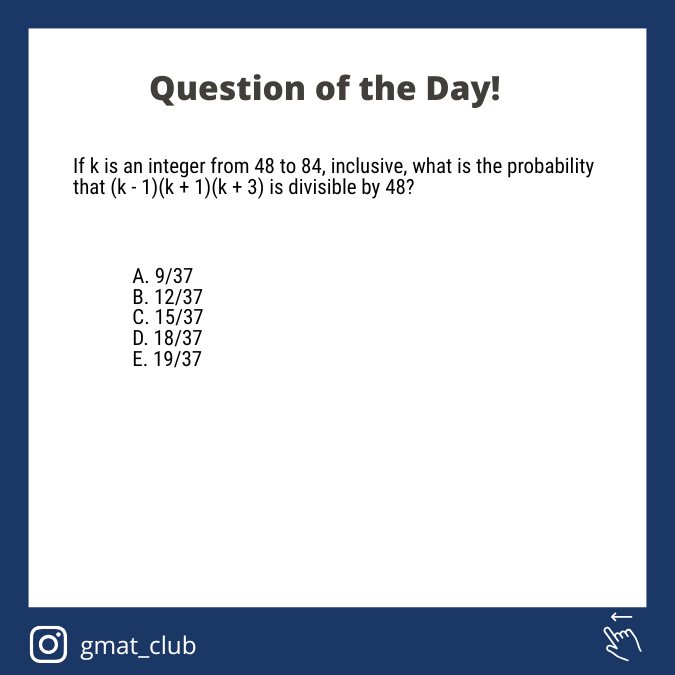
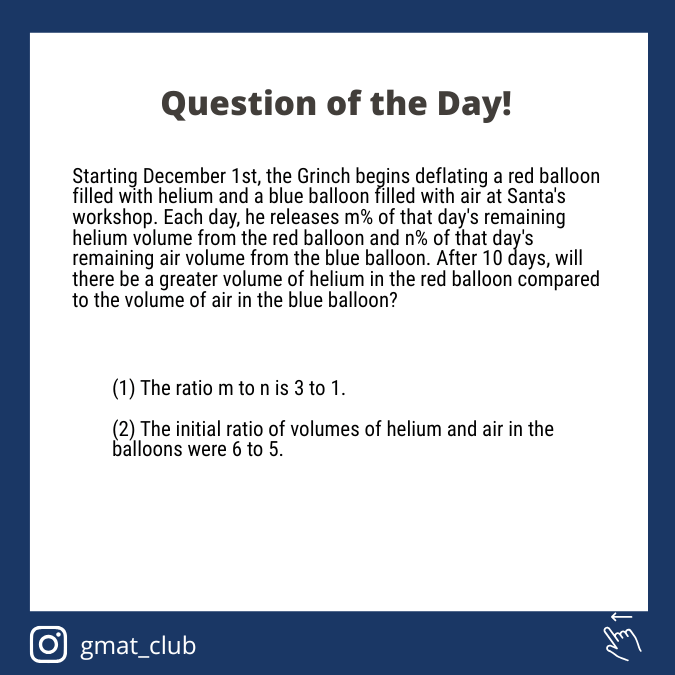
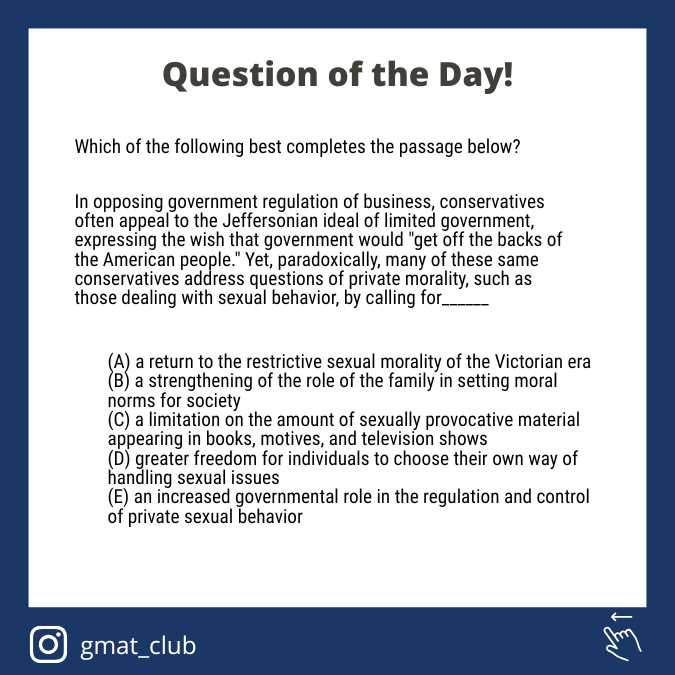
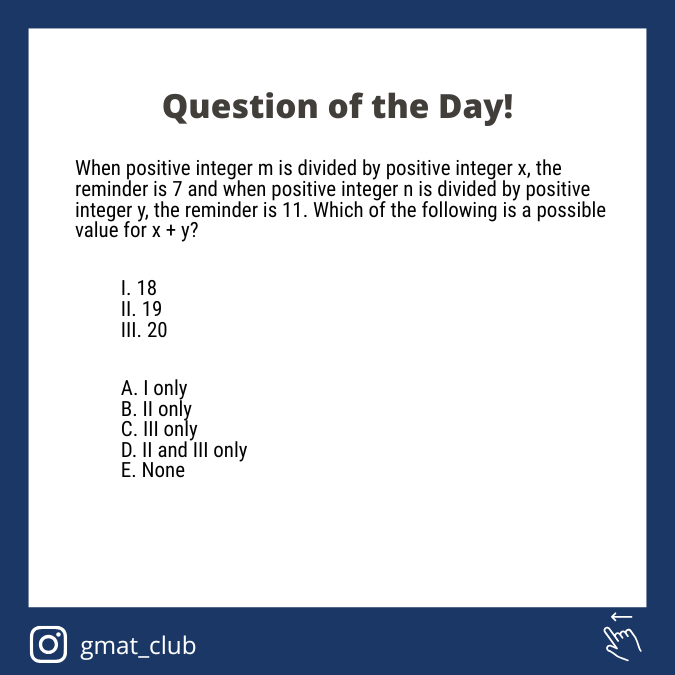
April 14th Quant Question of the Day

Answer and Explanation | Subscribe via E-mail, Forum, Instagram, or YouTube
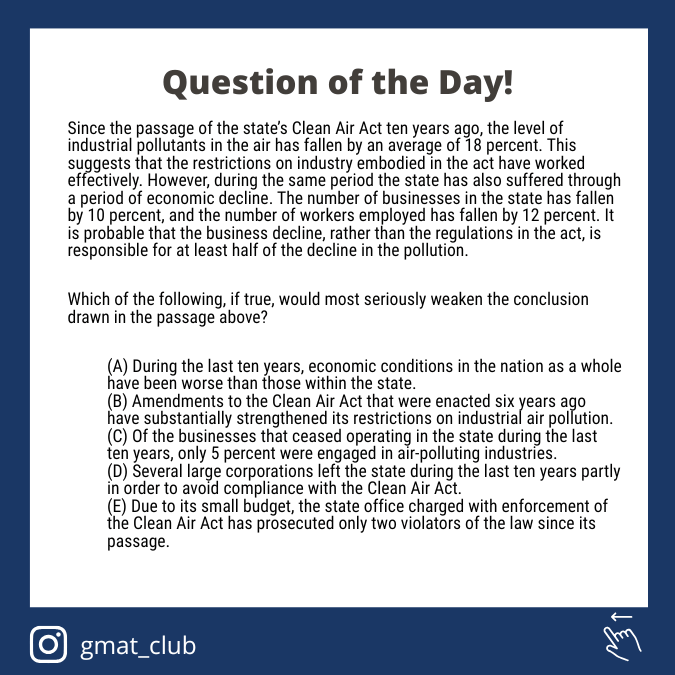
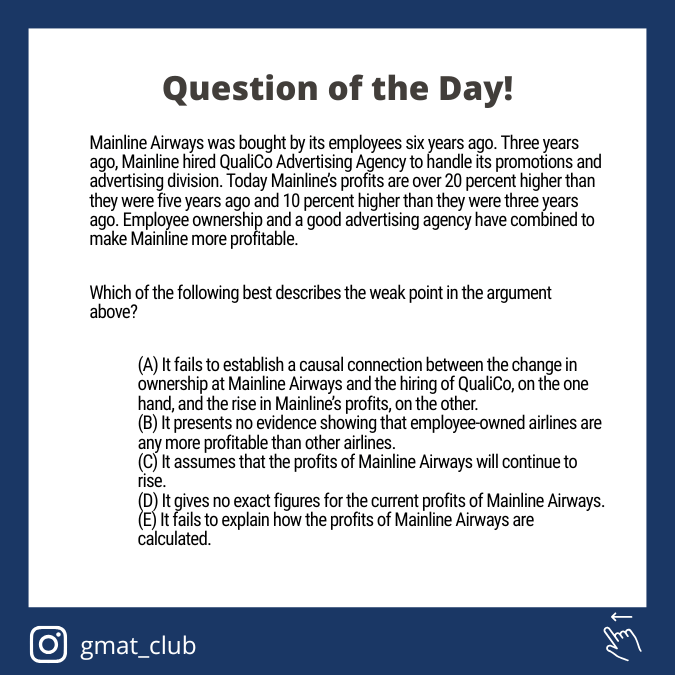
April 14th Verbal Question of the Day
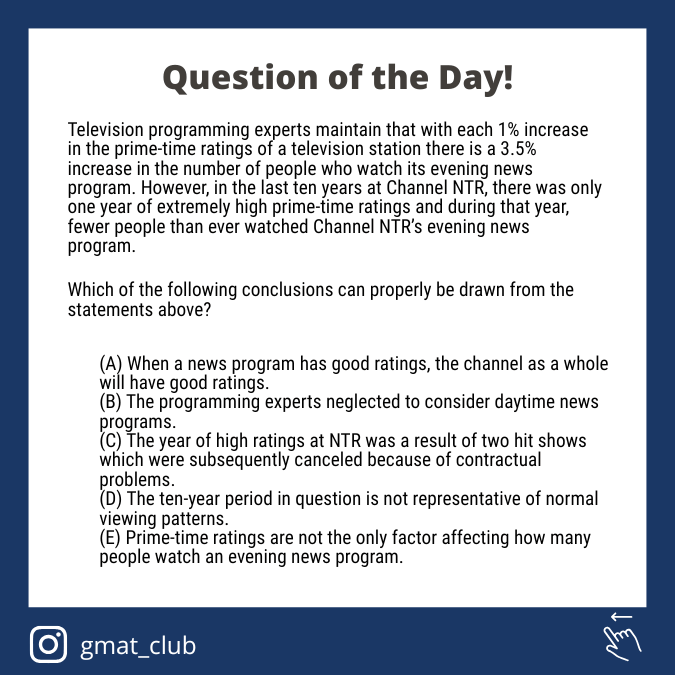
Answer and Explanation | Subscribe via E-mail, Forum, Instagram, or YouTube
Answer and Explanation | Subscribe via E-mail, Forum, Instagram, or YouTube
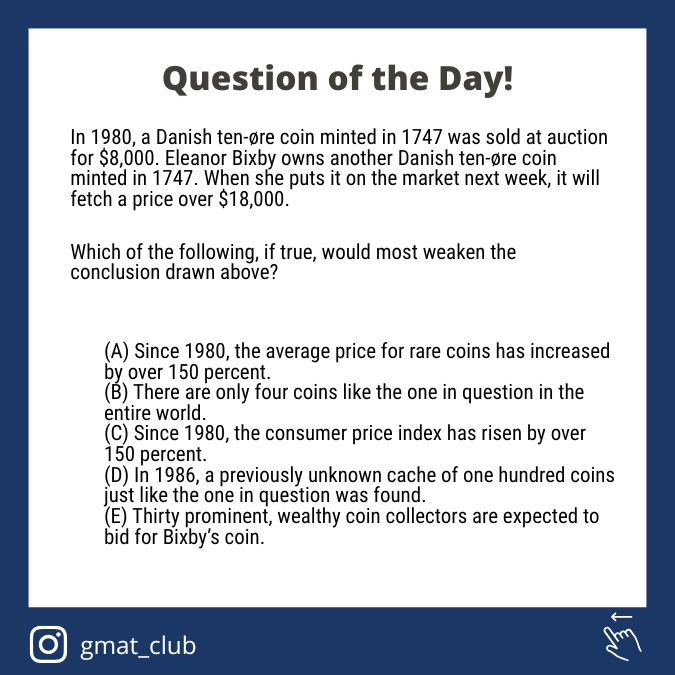
April 14th Verbal Question of the Day
Answer and Explanation | Subscribe via E-mail, Forum, Instagram, or YouTube