Events & Promotions
|
|

GMAT Club Daily Prep
Thank you for using the timer - this advanced tool can estimate your performance and suggest more practice questions. We have subscribed you to Daily Prep Questions via email.
Customized
for You
Track
Your Progress
Practice
Pays
Not interested in getting valuable practice questions and articles delivered to your email? No problem, unsubscribe here.
 Sep 21
07:00 PM EDT
-10:00 PM EDT
Boost your GMAT score in less than one month in a live online class + 6 months access to TTP OnDemand video courses included! Sep 18
10:00 AM IST
-11:00 PM IST
Start your journey with a fully customized action plan and work with a dedicated mentor to achieve a 735+ score. Sep 20
03:30 AM EDT
-04:30 AM EDT
Looking for your GMAT motivation to break through the score plateau? Pragati improved her score by massive 160 points with strategic guidance and hard-work! Find out how personalized mentorship and a strong mindset can turn GMAT struggles into success. Sep 23
12:30 AM EDT
-01:30 AM EDT
Learn how Keshav, a Chartered Accountant, scored an impressive 705 on GMAT in just 30 days with GMATWhiz's expert guidance. In this video, he shares preparation tips and strategies that worked for him, including the mock, time management, and more Sep 26
01:00 PM EDT
-04:00 PM EDT
Top scores are possible when you enroll in a powerful GMAT course, taught live online + 6 months access to TTP OnDemand video courses included. Class starts Saturdays Sept. 26, 2026 - Dec. 19, 2026, 1:00pm-4:00pm ES Sep 26
06:00 PM PDT
-07:00 PM PDT
Free- full-length test + 15 concept videos + 150+ short videos + study plan!


 12 Nov 2024, 03:55
Kudos
Bookmarks
Dropdown 1: negatively correlated
Dropdown 2: 8
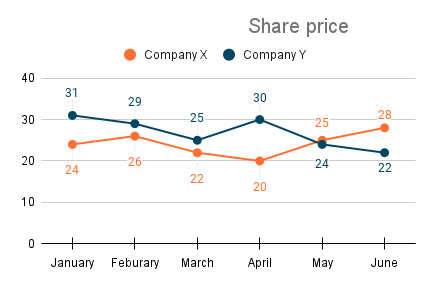
The graph above shows the share prices of Company X and Company Y over the first six months of 2021, based on the last working day of each month.
Select from each drop-down menu the option that creates the most accurate statement, given the information provided.
Based on the graph above, the share prices of the companies are .
The range of the share price of Company X on the last working day for the six months shown in the graph is .
ShowHide Answer
Official Answer
Dropdown 1: negatively correlated
Dropdown 2: 8
12 Nov 2024, 03:55
Kudos
Bookmarks
Official Solution:
Drop-down 1:
Two data sets are positively correlated if they both tend to be higher in the same cases. They are negatively correlated if one tends to be higher in cases where the other is lower. For positively correlated data, their lines tend to slope up or down together; the more consistently this happens, the stronger the positive correlation. Conversely, when two data sets are negatively correlated, the line for one tends to slope up while the other slopes down, and vice versa. The more consistently these opposite slopes occur, the stronger the negative correlation.
Examining the graph, we observe that the lines for the shares of Company X and Y slope in opposite directions in 4 out of 5 cases. Thus, we can conclude that the share prices are negatively correlated.
Drop-down 2:
The range is the difference between the highest value and the lowest value. The highest price for Company X's share was in June at 28, and the lowest price was in April at 20, making the range equal to 28 - 20 = 8.
Correct answer:
Dropdown 1: "negatively correlated"
Dropdown 2: "8"
Bunuel
Drop-down 1:
Two data sets are positively correlated if they both tend to be higher in the same cases. They are negatively correlated if one tends to be higher in cases where the other is lower. For positively correlated data, their lines tend to slope up or down together; the more consistently this happens, the stronger the positive correlation. Conversely, when two data sets are negatively correlated, the line for one tends to slope up while the other slopes down, and vice versa. The more consistently these opposite slopes occur, the stronger the negative correlation.
Examining the graph, we observe that the lines for the shares of Company X and Y slope in opposite directions in 4 out of 5 cases. Thus, we can conclude that the share prices are negatively correlated.
Drop-down 2:
The range is the difference between the highest value and the lowest value. The highest price for Company X's share was in June at 28, and the lowest price was in April at 20, making the range equal to 28 - 20 = 8.
Correct answer:
Dropdown 1: "negatively correlated"
Dropdown 2: "8"
16 Dec 2024, 04:53
Kudos
Bookmarks
I have revised the question, solution, and formatting by adding more details to enhance clarity.