Last visit was: 29 Apr 2026, 13:07 It is currently 29 Apr 2026, 13:07
Close
GMAT Club Daily Prep
Thank you for using the timer - this advanced tool can estimate your performance and suggest more practice questions. We have subscribed you to Daily Prep Questions via email.

Customized
for You

we will pick new questions that match your level based on your Timer History

Track
Your Progress

every week, we’ll send you an estimated GMAT score based on your performance

Practice
Pays

we will pick new questions that match your level based on your Timer History
Not interested in getting valuable practice questions and articles delivered to your email? No problem, unsubscribe here.
Close
Request Expert Reply
Confirm Cancel
User avatar
KarishmaB
Joined: 16 Oct 2010
Last visit: 28 Apr 2026
Posts: 16,447
Own Kudos:
Given Kudos: 485
Location: Pune, India
Products:
Expert
Expert reply
Active GMAT Club Expert! Tag them with @ followed by their username for a faster response.
Posts: 16,447
Kudos: 79,447
Kudos
Add Kudos
Bookmarks
Bookmark this Post
avatar
saiesta
Joined: 03 Jan 2015
Last visit: 15 Nov 2018
Posts: 59
Own Kudos:
Given Kudos: 146
Posts: 59
Kudos: 321
Kudos
Add Kudos
Bookmarks
Bookmark this Post
User avatar
thangvietnam
Joined: 29 Jun 2017
Last visit: 04 Apr 2026
Posts: 743
Own Kudos:
Given Kudos: 2,198
Posts: 743
Kudos: 419
Kudos
Add Kudos
Bookmarks
Bookmark this Post
User avatar
jaysonbeatty12
Joined: 14 Aug 2018
Last visit: 14 Dec 2023
Posts: 18
Own Kudos:
72
 [1]
Given Kudos: 3
Location: United States (WA)
GMAT 1: 670 Q43 V40
GMAT 2: 750 Q47 V47
GPA: 3.3
WE:Education (Education)
GMAT 2: 750 Q47 V47
Posts: 18
Kudos: 72
 [1]
1
Kudos
Add Kudos
Bookmarks
Bookmark this Post
Quick elimination tip here

An triangle formed by the diameter of a circle and any other point on that circle is a right triangle. The diameter is the hypotenuse and the right angle is formed by the two legs extending to the point. So, in this case, we can create a right triangle by drawing a line from, say, E to D. This shows that angle CED is greater than 90, so eliminate C, D and E.
User avatar
fskilnik
Joined: 12 Oct 2010
Last visit: 03 Jan 2025
Posts: 883
Own Kudos:
Given Kudos: 57
Status:GMATH founder
Expert
Expert reply
Posts: 883
Kudos: 1,889
Kudos
Add Kudos
Bookmarks
Bookmark this Post
PathFinder007
Attachment:
Circle_Angle.JPG
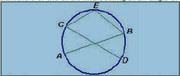
In the figure AB and CD are two diameters of circle. Intersecting at angle 48 degree. E is any point on Arc CB. find angle CEB

A. 114
B. 100
C. 80
D. 96
E. 40
All angles are measured in degrees.

\(? = x = \angle CEB\)


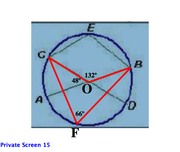
01. Triangle AOC is isosceles with base AC, hence the 66-degrees angle is justified.

02. Angle BAC is inscribed in the circle, hence the 132-degrees red arc (CEB) is justified.

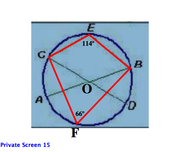
03. Angle x (our FOCUS) is inscribed in the circle and corresponds to the blue arc CADB, hence:

\(? = {{360 - 132} \over 2} = 114\,\,\,\,\,\,\,\, \Rightarrow \,\,\,\,\,\left( A \right)\)


This solution follows the notations and rationale taught in the GMATH method.

Regards,
Fabio.
avatar
HAPPYatHARVARD
Joined: 07 Apr 2018
Last visit: 11 Apr 2020
Posts: 72
Own Kudos:
Given Kudos: 271
Location: United States
Concentration: General Management, Marketing
GMAT 1: 600 Q45 V28
GPA: 3.8
GMAT 1: 600 Q45 V28
Posts: 72
Kudos: 67
Kudos
Add Kudos
Bookmarks
Bookmark this Post
Angle CBE + Angle ODB = 180 degree as sum of opposite angles of a quadrilateral is 180.
So, CBE =180-66=114
avatar
yashna36
Joined: 18 Jul 2018
Last visit: 07 Apr 2019
Posts: 15
Own Kudos:
Given Kudos: 11
Posts: 15
Kudos: 3
Kudos
Add Kudos
Bookmarks
Bookmark this Post
karishma,

I have a doubt..so from what I understand is that the angle around O should be 360 degree, so shouldnt angle COB be 132 degree? angle COA and angle AOD adds up to 180 degree. angle BOD is 48 degree, making it all add up to 228 degree. Then should angle COB not be 360-228=132 degree?Where am I going wrong, pls help

2nd doubt- is angle COA =48 degree? if not, why? (i assumed angle BOD and COA to be vertically opposite)
User avatar
GMATGuruNY
Joined: 04 Aug 2010
Last visit: 02 Apr 2026
Posts: 1,347
Own Kudos:
3,910
 [3]
Given Kudos: 9
Schools:Dartmouth College
Expert
Expert reply
Posts: 1,347
Kudos: 3,910
 [3]
1
Kudos
Add Kudos
1
Bookmarks
Bookmark this Post
Quote:


In the figure AB and CD are two diameters of circle. Intersecting at angle 48 degree. E is any point on Arc CB. find angle CEB

A. 114
B. 100
C. 80
D. 96
E. 40

An INSCRIBED ANGLE is formed by two chords.
A CENTRAL ANGLE is formed by two radii.
When an inscribed angle and a central angle intercept the same two points on a circle, the inscribed angle is 1/2 the central angle.

Here, inscribed angle CFB and central angle COB both intercept the circle at points C and B.
Since central angle COB = 132º, inscribed angle CFB = (1/2)(132) = 66º.

Rule:
When a quadrilateral is inscribed in a circle, opposite angles sum to 180º.

Since opposite angles inside inscribed quadrilateral CEBF must sum to 180º, angle CEB = 180-66 = 114.

User avatar
AlN
Joined: 02 Jan 2017
Last visit: 19 Dec 2023
Posts: 53
Own Kudos:
Given Kudos: 23
Location: India
Schools: Oxford "21
Schools: Oxford "21
Posts: 53
Kudos: 7
Kudos
Add Kudos
Bookmarks
Bookmark this Post
VeritasKarishma
Shree9975
Hi,

Can any1 explain me how angle COB=180 degrees. Why is the sum 180+48?

Angle COB is not 180.

Note that the angle around O will be 360 degrees. There is angle COB, the smaller angle (the angle that arc CEB subtends at the center) and angle COB, the larger angle (shown by red arrow around center O in the second diagram). The major arc CADB subtends larger angle COB at the center and inscribed angle CEB at the circle. The central angle will be twice the inscribed angle.

The larger angle COB = angle COA + angle AOD + angle DOB = 180 + 48 = 228 = Central angle

Inscribed angle = 228/2 = 114

Answer (A)

Can uou please tell me how is this inscribed angle. I am nt able to figure it out
User avatar
AlN
Joined: 02 Jan 2017
Last visit: 19 Dec 2023
Posts: 53
Own Kudos:
Given Kudos: 23
Location: India
Schools: Oxford "21
Schools: Oxford "21
Posts: 53
Kudos: 7
Kudos
Add Kudos
Bookmarks
Bookmark this Post
GMATGuruNY
Quote:


In the figure AB and CD are two diameters of circle. Intersecting at angle 48 degree. E is any point on Arc CB. find angle CEB

A. 114
B. 100
C. 80
D. 96
E. 40

An INSCRIBED ANGLE is formed by two chords.
A CENTRAL ANGLE is formed by two radii.
When an inscribed angle and a central angle intercept the same two points on a circle, the inscribed angle is 1/2 the central angle.

Here, inscribed angle CFB and central angle COB both intercept the circle at points C and B.
Since central angle COB = 132º, inscribed angle CFB = (1/2)(132) = 66º.

Rule:
When a quadrilateral is inscribed in a circle, opposite angles sum to 180º.

Since opposite angles inside inscribed quadrilateral CEBF must sum to 180º, angle CEB = 180-66 = 114.


Bunuel

Thanksfor the explanantion. It would be great if you could direct me to more questions of inscribed-central angle?
avatar
ArupRS
Joined: 23 Jan 2018
Last visit: 02 Jul 2025
Posts: 246
Own Kudos:
Given Kudos: 358
Location: India
Concentration: Technology, General Management
GMAT 1: 640 Q48 V29
GMAT 2: 700 Q49 V36 (Online)
WE:Information Technology (Computer Software)
Products:
GMAT 2: 700 Q49 V36 (Online)
Posts: 246
Kudos: 253
Kudos
Add Kudos
Bookmarks
Bookmark this Post
VeritasKarishma & chetan2u

Dear experts,

I thought smaller angle COB is 48 degree. Hence the angle CEB is half of angle COB. Please explain what I am missing here.

Regards,
Arup
User avatar
chetan2u
User avatar
GMAT Expert
Joined: 02 Aug 2009
Last visit: 29 Apr 2026
Posts: 11,234
Own Kudos:
45,046
 [1]
Given Kudos: 335
Status:Math and DI Expert
Location: India
Concentration: Human Resources, General Management
GMAT Focus 1: 735 Q90 V89 DI81
Products:
Expert
Expert reply
GMAT Focus 1: 735 Q90 V89 DI81
Posts: 11,234
Kudos: 45,046
 [1]
1
Kudos
Add Kudos
Bookmarks
Bookmark this Post
ArupRS
VeritasKarishma & chetan2u

Dear experts,

I thought smaller angle COB is 48 degree. Hence the angle CEB is half of angle COB. Please explain what I am missing here.

Regards,
Arup

No COB is not 48..
Even if you take COB as 48, CEB is not half of COB..
Any point say r in major arc CB that is CADB will make an angle CrB which will be half of COB.
This becomes half of 48 so 24..
Now CEB+CrB will be 180 as sum of opposite angles of a cyclic quadrilateral is 180 and CEBr is cyclic quadrilateral.
Thus CEB = 180-24=156..
But no choice is given as 156.

So you have to take COB as 180-48=132
And CEB = 180-132/2=180-66=114
User avatar
KarishmaB
Joined: 16 Oct 2010
Last visit: 28 Apr 2026
Posts: 16,447
Own Kudos:
79,447
 [1]
Given Kudos: 485
Location: Pune, India
Products:
Expert
Expert reply
Active GMAT Club Expert! Tag them with @ followed by their username for a faster response.
Posts: 16,447
Kudos: 79,447
 [1]
1
Kudos
Add Kudos
Bookmarks
Bookmark this Post
ArupRS
VeritasKarishma & chetan2u

Dear experts,

I thought smaller angle COB is 48 degree. Hence the angle CEB is half of angle COB. Please explain what I am missing here.

Regards,
Arup

Angle COB is the larger angle so it will not be 48 degrees.
Also, inscribed angle is half of the central angle that subtends the same arc.

COB and CEB subtend different arcs.
Angle COB subtends arc CEB.
Angle CEB subtends arc CADB.
So angle COB will be twice of angle CAB or CDB.
avatar
ArupRS
Joined: 23 Jan 2018
Last visit: 02 Jul 2025
Posts: 246
Own Kudos:
Given Kudos: 358
Location: India
Concentration: Technology, General Management
GMAT 1: 640 Q48 V29
GMAT 2: 700 Q49 V36 (Online)
WE:Information Technology (Computer Software)
Products:
GMAT 2: 700 Q49 V36 (Online)
Posts: 246
Kudos: 253
Kudos
Add Kudos
Bookmarks
Bookmark this Post
VeritasKarishma & chetan2u

Thank you both for the nice explanation. The problem says two diameters intersect at an angle 48 degree. How should I understand which one is 48 among the possible 4 angles?

Regards,
Arup
avatar
mup05ro
Joined: 01 Feb 2015
Last visit: 28 May 2022
Posts: 10
Own Kudos:
Given Kudos: 24
Posts: 10
Kudos: 1
Kudos
Add Kudos
Bookmarks
Bookmark this Post
I really don't understand any of the solutions here. When the diameters intersect at 48 degrees, why do we take COB as 48 and not BOD as 48? Even BOD is an intersection angle right?

Can some pls explain the solution with a diagram? (pls highlight the inscribed and central angle, I am getting confused :( )
User avatar
dcummins
Joined: 14 Feb 2017
Last visit: 16 Mar 2026
Posts: 1,021
Own Kudos:
Given Kudos: 368
Location: Australia
Concentration: Technology, Strategy
GMAT 1: 560 Q41 V26
GMAT 2: 550 Q43 V23
GMAT 3: 650 Q47 V33
GMAT 4: 650 Q44 V36
GMAT 5: 600 Q38 V35
GMAT 6: 710 Q47 V41
WE:Management Consulting (Consulting)
Products:
Kudos
Add Kudos
Bookmarks
Bookmark this Post
Remember this- an inscribed angle is equal to 1/2 the central angle it intercepts.

Thus, the central angle (excluding COB) is 228 (48*2+132) so divide in two to get CEB
User avatar
Fdambro294
Joined: 10 Jul 2019
Last visit: 20 Aug 2025
Posts: 1,331
Own Kudos:
Given Kudos: 1,656
Posts: 1,331
Kudos: 772
Kudos
Add Kudos
Bookmarks
Bookmark this Post
The Angle at <CEB is the Inscribed Angle Subtended by Major Arc CADB


Rule: the Central Angle of a Major Arc is measured by the Reflex Angle around the Center

Rule: the Inscribed Angle Subtended by an Arc = (1/2) * (Central Angle Subtended by that Same Arc)c


Label the Center Point O

we are Given that the Intersection of the 2 Diameters creates:

Angle <COA = 48 deg. = Angle <BOD

the other pairs of Congruent Vertically Opposite Angles that complete the Circle around Point 0:

Angle <COB = 132 deg. = Angle <AOD


Major Arc CABD Subtends:

Inscribed Angle <CEB

and

the Reflex Angle around the Center = <COA + <AOD + <DOB = 48 + 132 + 48 = 228 deg.


Inscribed Angle <CEB = (1/2) * 223 deg. = 114 deg.


-A-

114 deg.
avatar
AjitPatil
Joined: 04 Jun 2019
Last visit: 05 Nov 2021
Posts: 4
Own Kudos:
Given Kudos: 8
Posts: 4
Kudos: 1
Kudos
Add Kudos
Bookmarks
Bookmark this Post
Center angle is twice of inscribed angle ,Yes but position of central angle differs in the case of Minor segment, How come we are not taking COB has central angle in this case?
User avatar
NakulDiwakar10
Joined: 14 Jun 2021
Last visit: 18 Mar 2026
Posts: 141
Own Kudos:
Given Kudos: 65
Location: India
Products:
Posts: 141
Kudos: 33
Kudos
Add Kudos
Bookmarks
Bookmark this Post
User avatar
bumpbot
User avatar
Non-Human User
Joined: 09 Sep 2013
Last visit: 04 Jan 2021
Posts: 38,996
Own Kudos:
Posts: 38,996
Kudos: 1,120
Kudos
Add Kudos
Bookmarks
Bookmark this Post
Automated notice from GMAT Club BumpBot:

A member just gave Kudos to this thread, showing it’s still useful. I’ve bumped it to the top so more people can benefit. Feel free to add your own questions or solutions.

This post was generated automatically.
   1   2 
Moderators:
Math Expert
109974 posts
Tuck School Moderator
852 posts