Events & Promotions
|
|

GMAT Club Daily Prep
Thank you for using the timer - this advanced tool can estimate your performance and suggest more practice questions. We have subscribed you to Daily Prep Questions via email.
Customized
for You
Track
Your Progress
Practice
Pays
Not interested in getting valuable practice questions and articles delivered to your email? No problem, unsubscribe here.
 Sep 27
01:30 AM EDT
-02:30 AM EDT
At one point, she believed GMAT wasn’t for her. After scoring 595, self-doubt crept in and she questioned her potential. But instead of quitting, she made the right strategic changes. The result? A remarkable comeback to 695. Check out how Saakshi did it. Sep 26
12:30 AM EDT
-01:30 AM EDT
Struggling to find the right strategies to score a 99 %ile on GMAT Focus? Riya (GMAT 715) boosted her score by 100-points in just 15 days! Discover how the right mentorship, tailored strategies, and an unwavering mindset can transform your GMAT prep. Sep 26
06:00 PM PDT
-07:00 PM PDT
Free- full-length test + 15 concept videos + 150+ short videos + study plan! Sep 28
07:00 PM EDT
-10:00 PM EDT
Boost your GMAT score in less than one month in a live online class + 6 months access to TTP OnDemand video courses included! Class starts Mon, Tues, Wed, Thur, Fri Sept. 28, 2026 - Oct. 16, 2027, 7:00pm-10:00pm EST Sep 29
11:00 AM EDT
-01:00 PM EDT
" Description: Top scores are possible when you enroll in a powerful GMAT course, taught live online + 6 months access to TTP OnDemand video courses included! Class starts Tues/Thur Sept. 29, 2026 - Dec. 3, 2026, 11:00am-1:00pm EST Oct 01
07:00 AM BST
-08:00 AM GMT
Welcome to the GMAT Club's Free Interview Prep Event for Top MBA Programs! Buy tickets - Virtual series that’s all set to equip you to -excel in your MBA interviews. Oct 03
01:00 PM EDT
-04:00 PM EDT
Top scores are possible when you enroll in a powerful GMAT course, taught live online + 6 months access to TTP OnDemand video courses included! Class starts Saturdays Oct. 3, 2026 - Dec. 26, 2026, 1:00pm-4:00pm EST


 07 Oct 2021, 08:00
Kudos
Bookmarks
Question 1


D
Be sure to select an answer first to save it in the Error Log before revealing the correct answer (OA)!
Difficulty:
 55%
(hard)
55%
(hard)
Question Stats:
51% (02:47) correct 49%
(02:48) wrong
based on 208
sessions
49%
(02:48) wrong
based on 208
sessions
History
Date
Time
Result
Not Attempted Yet
Question 2
E
Be sure to select an answer first to save it in the Error Log before revealing the correct answer (OA)!
Difficulty:
 25%
(medium)
25%
(medium)
Question Stats:
68% (00:47) correct 32%
(01:05) wrong
based on 201
sessions
History
Date
Time
Result
Not Attempted Yet
Question 3
C
Be sure to select an answer first to save it in the Error Log before revealing the correct answer (OA)!
Difficulty:
 5%
(low)
5%
(low)
Question Stats:
96% (00:33) correct 4%
(00:23) wrong
based on 191
sessions
History
Date
Time
Result
Not Attempted Yet
The role that lipids, commonly known as "fats," play in diet and health has remained woefully unclear to most consumers. As a nation, we have demonized fat and, in particular, cholesterol, the fat-like substance found in most animal tissues. The truth is, as a population, our consumption of fats has declined dramatically over the last few decades. In the 1960s, Americans obtained 45 percent of their calories from fats and oils; today, we get approximately 33 percent of our calories from these sources. But in the 1960s, only 13 percent of the population was obese, with less than 1 percent having type 2 diabetes. Today those figures are 34 percent and 8 percent, respectively.
We might well ask how this can be. The simple answer is that fat is a nutrient so vital to life that it is present in nearly all foods. Small amounts can even be found in lettuce. Physical health, then, is primarily determined not by the amount of fat consumed but by the type. Saturated and Trans fats, which are heavily used by the processed food industry, are the fats to avoid, as they can damage a healthy circulatory system. Conversely, triglycerides, which are a natural form of fat and oils, move easily through the bloodstream and are essential to life. Likewise, the omega-3 fatty acids found in fish and other sources promote good health. And just as some fats have been unfairly demonized, some forms of cholesterol are actually beneficial. For example, high density lipoproteins (HDLs) scrub clogging cholesterol from artery walls.
While this new understanding of fat and cholesterol is battling conventional wisdom, one maxim of healthy eating still seems to hold true: Anything in excess is potentially harmful. Triglycerides have health benefits, but if the human body has too many at its disposal, it builds up adipose tissue, which becomes visible body fat.
We might well ask how this can be. The simple answer is that fat is a nutrient so vital to life that it is present in nearly all foods. Small amounts can even be found in lettuce. Physical health, then, is primarily determined not by the amount of fat consumed but by the type. Saturated and Trans fats, which are heavily used by the processed food industry, are the fats to avoid, as they can damage a healthy circulatory system. Conversely, triglycerides, which are a natural form of fat and oils, move easily through the bloodstream and are essential to life. Likewise, the omega-3 fatty acids found in fish and other sources promote good health. And just as some fats have been unfairly demonized, some forms of cholesterol are actually beneficial. For example, high density lipoproteins (HDLs) scrub clogging cholesterol from artery walls.
While this new understanding of fat and cholesterol is battling conventional wisdom, one maxim of healthy eating still seems to hold true: Anything in excess is potentially harmful. Triglycerides have health benefits, but if the human body has too many at its disposal, it builds up adipose tissue, which becomes visible body fat.
1. It can be inferred from this passage that
A. a healthy diet should consist primarily of HDLs and triglycerides.
B. people in the 1960s were healthier despite having higher body fat.
C. there is no correlation between fat consumption and such health risks as obesity and diabetes.
D. processed food is less likely to be healthful than fish is.
E. popular misconceptions play a decreasing role in public attitudes about fat.
A. a healthy diet should consist primarily of HDLs and triglycerides.
B. people in the 1960s were healthier despite having higher body fat.
C. there is no correlation between fat consumption and such health risks as obesity and diabetes.
D. processed food is less likely to be healthful than fish is.
E. popular misconceptions play a decreasing role in public attitudes about fat.
2. The author mentions statistics from the 1960s in order to
A. demonstrate a trend toward the consumption of healthier fats.
B. illustrate the cultural differences between the 1960s and today.
C. assert a connection between popular trends and fat consumption.
D. underscore a widely held belief about past fat consumption in this country.
E. support the argument that fat consumption is not inherently unhealthy.
A. demonstrate a trend toward the consumption of healthier fats.
B. illustrate the cultural differences between the 1960s and today.
C. assert a connection between popular trends and fat consumption.
D. underscore a widely held belief about past fat consumption in this country.
E. support the argument that fat consumption is not inherently unhealthy.
3. According to the passage, high density lipoproteins (HDLs) are good for health because they
A. are a type of Trans fat.
B. occur naturally in the human body.
C. clean cholesterol from arteries.
D. move easily through the body.
E. reduce the incidence of obesity and diabetes.
A. are a type of Trans fat.
B. occur naturally in the human body.
C. clean cholesterol from arteries.
D. move easily through the body.
E. reduce the incidence of obesity and diabetes.
Participate and Win! GMAT Club RC Mini Marathon
Passage # 07 Date: 07-Oct-2021
This question is a part of GMAT Club RC Mini Marathon. Click here for Details
Passage # 07 Date: 07-Oct-2021
This question is a part of GMAT Club RC Mini Marathon. Click here for Details


 07 Oct 2021, 11:13
Kudos
Bookmarks
Q1. It can be inferred from this passage that
My answer is D).
A) a healthy diet should consist primarily of HDLs and triglycerides.
"Primarily" is a bit extreme. Sure HDLs and triglycerides are healthier than saturated and trans fat, but this does not mean a healthy diet should be primarily of HDLs and triglycerides. What about vitamin, protein, and carbohydrate?
B) people in the 1960s were healthier despite having higher body fat.
People in the 60s were healthier based on stats at the end of paragraph 1, but having higher body fat? Seems like the opposite is true considering only 13% was obese vs. 34% today.
C) there is no correlation between fat consumption and such health risks as obesity and diabetes.
Too much consumption of the healthy stuff or of the unhealthy kind surely would have correlations with these health risks.
D) processed food is less likely to be healthful than fish is.
Yes. Processed food contains saturated and trans fat as described in paragraph 2, whereas fish contains omega-3 fatty acids, which promote good health.
E) popular misconceptions play a decreasing role in public attitudes about fat.
If this were the case, this passage would be unnecessary. The 1st few sentences in the 1st paragraph would dispute this.
Q2. The author mentions statistics from the 1960s in order to
My answer is E). The stats were mentioned towards the end of paragraph 1, and were mainly used to present a paradox in CR's parlance: lower % of our calories today come from fats and oils vs. 1960s, yet we are more unhealthy now vs. back then.
A) demonstrate a trend toward the consumption of healthier fats.
If anything, seems to indicate that our consumption of the unhealthy kinds are on the rise.
B) illustrate the cultural differences between the 1960s and today.
Maybe regarding the demonization of fats and oils, but this point ignores the 2nd part of the paradox as discussed above: i.e., why we are more unhealthy now.
C) assert a connection between popular trends and fat consumption.
Similar to B) this answer only addresses the 1st part of the paradox.
D) underscore a widely held belief about past fat consumption in this country.
No such beliefs were discussed in the passage or the 1st paragraph.
E) support the argument that fat consumption is not inherently unhealthy.
Correct. That's the way to resolve the paradox.
Q3. According to the passage, high density lipoproteins (HDLs) are good for health because they
My answer is C). The answer to this question is at the end of paragraph 2: "high density lipoproteins (HDLs) scrub clogging cholesterol from artery walls."
A) are a type of Trans fat.
Nope, trans fat is the unhealthy kind. HDLs are not a type of that.
B) occur naturally in the human body.
Not discussed in the passage.
C) clean cholesterol from arteries.
Yes. See above.
D) move easily through the body.
That's triglyceride, not HDLs.
E) reduce the incidence of obesity and diabetes.
HDLs are relatively healthier but that does not mean they reduce the incidence of obesity and diabetes. Too extreme.
My answer is D).
A) a healthy diet should consist primarily of HDLs and triglycerides.
"Primarily" is a bit extreme. Sure HDLs and triglycerides are healthier than saturated and trans fat, but this does not mean a healthy diet should be primarily of HDLs and triglycerides. What about vitamin, protein, and carbohydrate?
B) people in the 1960s were healthier despite having higher body fat.
People in the 60s were healthier based on stats at the end of paragraph 1, but having higher body fat? Seems like the opposite is true considering only 13% was obese vs. 34% today.
C) there is no correlation between fat consumption and such health risks as obesity and diabetes.
Too much consumption of the healthy stuff or of the unhealthy kind surely would have correlations with these health risks.
D) processed food is less likely to be healthful than fish is.
Yes. Processed food contains saturated and trans fat as described in paragraph 2, whereas fish contains omega-3 fatty acids, which promote good health.
E) popular misconceptions play a decreasing role in public attitudes about fat.
If this were the case, this passage would be unnecessary. The 1st few sentences in the 1st paragraph would dispute this.
Q2. The author mentions statistics from the 1960s in order to
My answer is E). The stats were mentioned towards the end of paragraph 1, and were mainly used to present a paradox in CR's parlance: lower % of our calories today come from fats and oils vs. 1960s, yet we are more unhealthy now vs. back then.
A) demonstrate a trend toward the consumption of healthier fats.
If anything, seems to indicate that our consumption of the unhealthy kinds are on the rise.
B) illustrate the cultural differences between the 1960s and today.
Maybe regarding the demonization of fats and oils, but this point ignores the 2nd part of the paradox as discussed above: i.e., why we are more unhealthy now.
C) assert a connection between popular trends and fat consumption.
Similar to B) this answer only addresses the 1st part of the paradox.
D) underscore a widely held belief about past fat consumption in this country.
No such beliefs were discussed in the passage or the 1st paragraph.
E) support the argument that fat consumption is not inherently unhealthy.
Correct. That's the way to resolve the paradox.
Q3. According to the passage, high density lipoproteins (HDLs) are good for health because they
My answer is C). The answer to this question is at the end of paragraph 2: "high density lipoproteins (HDLs) scrub clogging cholesterol from artery walls."
A) are a type of Trans fat.
Nope, trans fat is the unhealthy kind. HDLs are not a type of that.
B) occur naturally in the human body.
Not discussed in the passage.
C) clean cholesterol from arteries.
Yes. See above.
D) move easily through the body.
That's triglyceride, not HDLs.
E) reduce the incidence of obesity and diabetes.
HDLs are relatively healthier but that does not mean they reduce the incidence of obesity and diabetes. Too extreme.

800gal
Joined: 12 Jun 2021
Last visit: 06 Oct 2023
Posts: 16
Given Kudos: 16
Location: India
Schools: Booth '24 Columbia CBS '24 Harvard '24 Kellogg '24 LBS '24 Sloan '24 Stanford '24 Wharton '24
Schools: Booth '24 Columbia CBS '24 Harvard '24 Kellogg '24 LBS '24 Sloan '24 Stanford '24 Wharton '24
Posts: 16
07 Oct 2021, 11:49
Kudos
Bookmarks
ANSWERS :
1. D
2. E
3. C
REASONING :
1. It can be inferred from this passage that
This is an inference question. Assume everything stated in the passage is true and given that, the answer choice MUST HOLD TRUE. Answers to look out for that are WRONG are MAY BE TRUE’s and FALSE choices.
A. a healthy diet should consist primarily of HDLs and triglycerides.
The passage states that fat is essential for health and vital to life in general, not that a healthy diet should PRIMARILY consist of HDLs and triglycerides. The amount of fat in the diet is not addressed in this passage. (MAYBE)
B. people in the 1960s were healthier despite having higher body fat.
The statistics do show that people in the 1960’s had lesser obesity and diabetes percentages which could be construed as healthier however we do not know whether they had higher body fat. In fact the lesser obesity percentage can point to people of that era having LESSER body fat. (MAYBE)
C. there is no correlation between fat consumption and such health risks as obesity and diabetes.
This cannot be inferred because all the passage says is that the misconception that all fat is bad for health is wrong. In fact in the final paragraph the author states “Triglycerides have health benefits, but if the human body has too many at its disposal, it builds up adipose tissue, which becomes visible body fat.” , which states that too much of even a good fat can actually cause obesity. This is a FALSE choice.
D. processed food is less likely to be healthful than fish is. CORRECT
This CAN be inferred from paragraph 2.
“Saturated and Trans fats, which are heavily used by the processed food industry, are the fats to avoid, as they can damage a healthy circulatory system.” - which shows that processed food CAN be unhealthy.
“Likewise, the omega-3 fatty acids found in fish and other sources promote good health.”- which shows that fish contains healthy fats that can promote good health
It is reasonable to infer that fish are RELATIVELY healthy in comparison to processed foods
E. popular misconceptions play a decreasing role in public attitudes about fat.
This is a FALSE choice. It can be inferred from paragraph 1 that the popular misconception that all fats are bad play an increasing role in public attitudes about fat which is reflected in the drop in fat consumption even though the obesity and diabetes statistics rose.
2. The author mentions statistics from the 1960s in order to
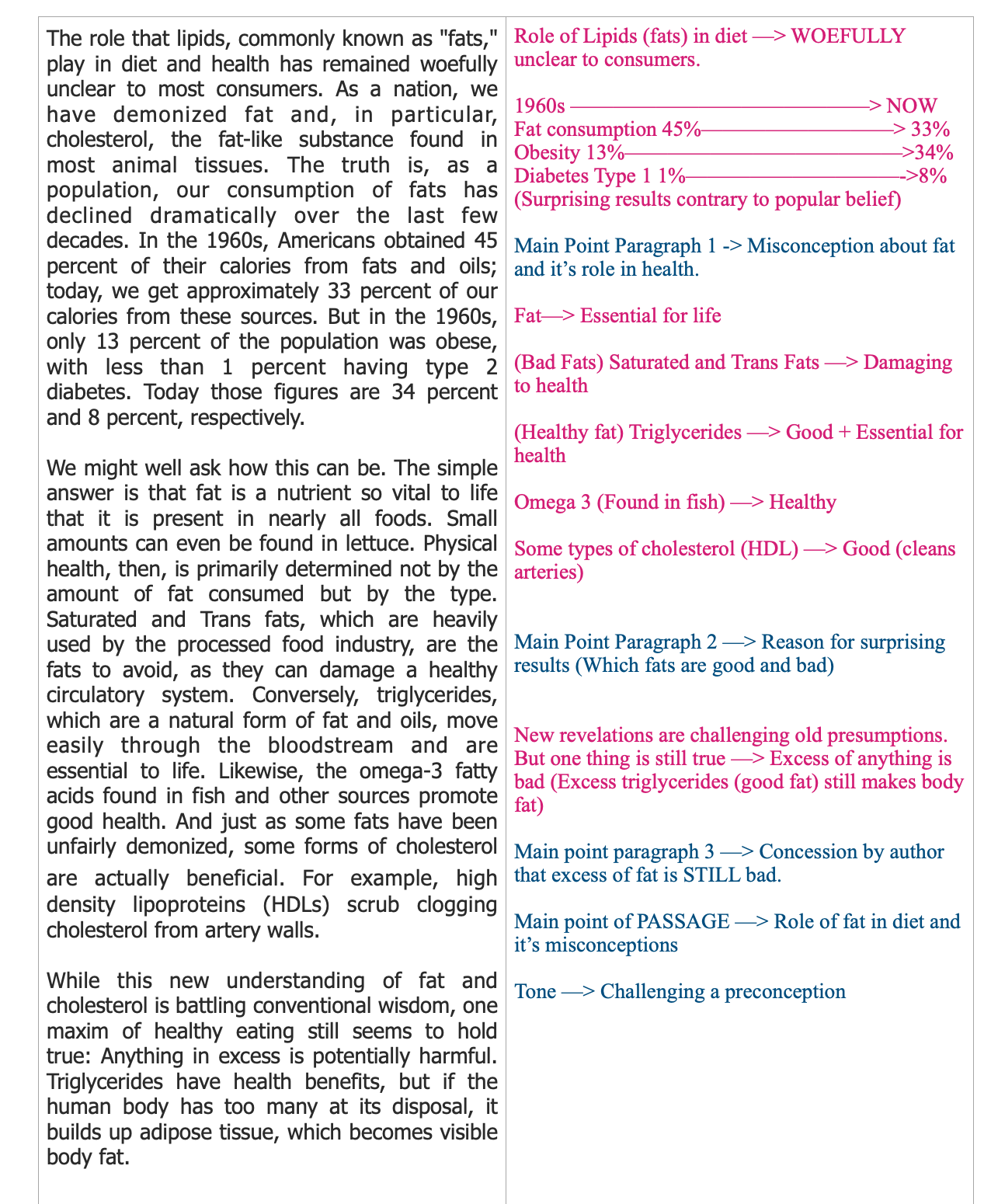
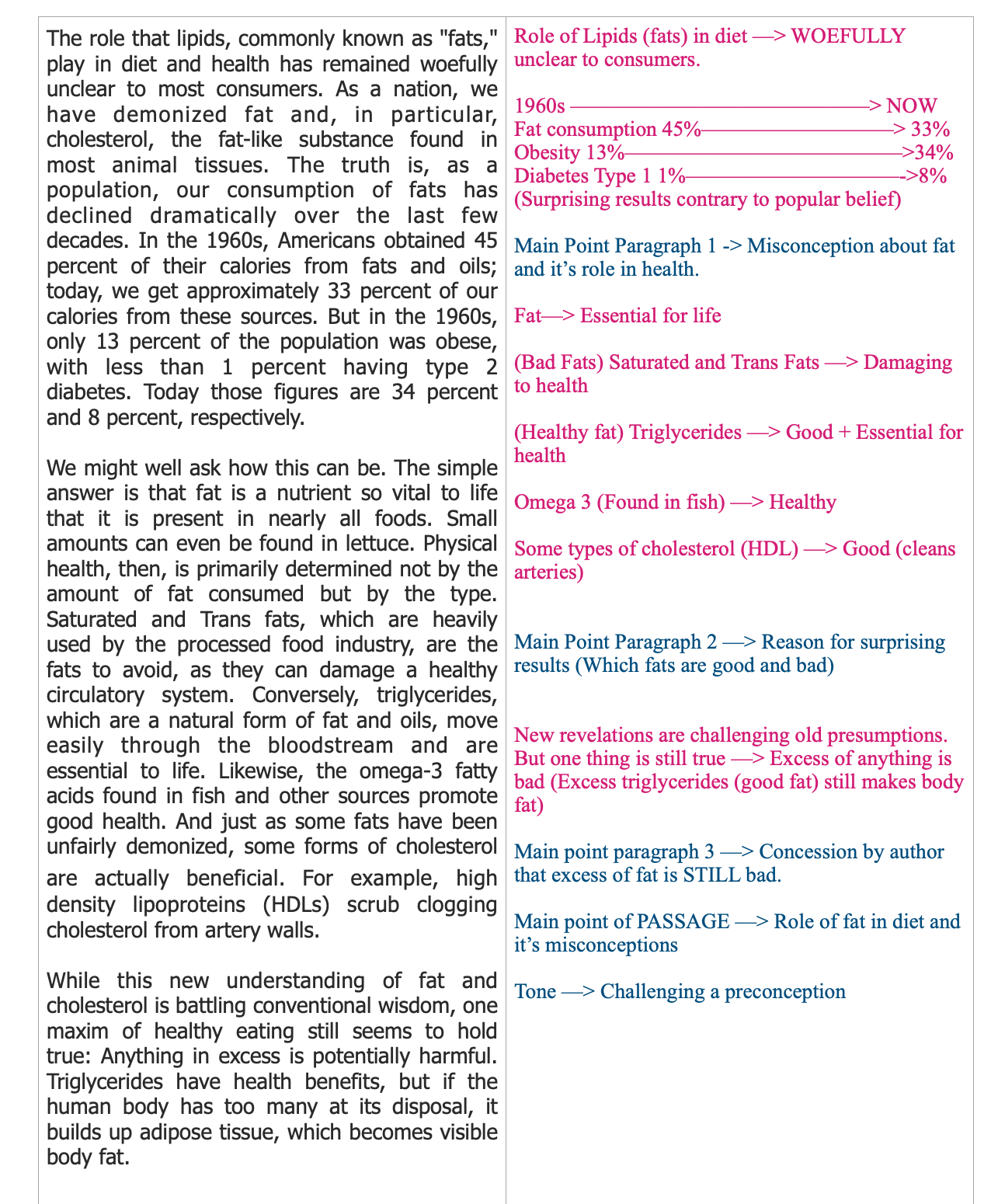
This is a ROLE question, where you need to find WHY the author mentioned the 1960’s statistics. From the passage map we can see that he uses these statistics to show a comparison between an era where fat consumption and general health remained high and the modern era where fat consumption has dropped along with general health.
A. demonstrate a trend toward the consumption of healthier fats.
No this is not explored in the paragraph. All we know is that the trend is toward consuming less fat in general.
B. illustrate the cultural differences between the 1960s and today.
Cultural differences are not explored anywhere in this passage. FALSE.
C. assert a connection between popular trends and fat consumption.
The statistics were mentioned specifically to highlight a surprising result and shed light on a POPULAR MISCONCEPTION , not how popular trends relate with fat consumption.
D. underscore a widely held belief about past fat consumption in this country.
There is not widely held belief about PAST fat consumption being explored here. The belief mentioned is about fat consumption IN GENERAL.
E. support the argument that fat consumption is not inherently unhealthy. CORRECT
Yes. By contrasting an era where people consumed more fat and stayed healthy clearly shows the author using this piece of evidence to point out that fat consumption is not completely healthy.
3. According to the passage, high density lipoproteins (HDLs) are good for health because they
This is an EVIDENCE question. The correct answer choice must support why HDL’s are good for health. According to Paragraph 2 “For example, high density lipoproteins (HDLs) scrub clogging cholesterol from artery walls.”, HDL’s help clean cholesterol off artery walls.
A. are a type of Trans fat.
They are not. They are a type of healthy fat.
B. occur naturally in the human body.
They do not occur naturally in the body as per the passage.
C. clean cholesterol from arteries. CORRECT
Yes they do. This matches our passage map and evidence statement exactly.
D. move easily through the body.
This is mentioned as a characteristic of TRIGLYCERIDES.
E. reduce the incidence of obesity and diabetes.
This is not mentioned as a reason why HDL is unhealthy. In fact nothing is mentioned as REDUCING the instance of obesity and/or diabetes in this passage.
Screenshot 2021-10-08 at 00.09.57.png [ 583.16 KiB | Viewed 4811 times ]
1. D
2. E
3. C
REASONING :
1. It can be inferred from this passage that
This is an inference question. Assume everything stated in the passage is true and given that, the answer choice MUST HOLD TRUE. Answers to look out for that are WRONG are MAY BE TRUE’s and FALSE choices.
The passage states that fat is essential for health and vital to life in general, not that a healthy diet should PRIMARILY consist of HDLs and triglycerides. The amount of fat in the diet is not addressed in this passage. (MAYBE)
The statistics do show that people in the 1960’s had lesser obesity and diabetes percentages which could be construed as healthier however we do not know whether they had higher body fat. In fact the lesser obesity percentage can point to people of that era having LESSER body fat. (MAYBE)
This cannot be inferred because all the passage says is that the misconception that all fat is bad for health is wrong. In fact in the final paragraph the author states “Triglycerides have health benefits, but if the human body has too many at its disposal, it builds up adipose tissue, which becomes visible body fat.” , which states that too much of even a good fat can actually cause obesity. This is a FALSE choice.
D. processed food is less likely to be healthful than fish is. CORRECT
This CAN be inferred from paragraph 2.
“Saturated and Trans fats, which are heavily used by the processed food industry, are the fats to avoid, as they can damage a healthy circulatory system.” - which shows that processed food CAN be unhealthy.
“Likewise, the omega-3 fatty acids found in fish and other sources promote good health.”- which shows that fish contains healthy fats that can promote good health
It is reasonable to infer that fish are RELATIVELY healthy in comparison to processed foods
This is a FALSE choice. It can be inferred from paragraph 1 that the popular misconception that all fats are bad play an increasing role in public attitudes about fat which is reflected in the drop in fat consumption even though the obesity and diabetes statistics rose.
2. The author mentions statistics from the 1960s in order to
This is a ROLE question, where you need to find WHY the author mentioned the 1960’s statistics. From the passage map we can see that he uses these statistics to show a comparison between an era where fat consumption and general health remained high and the modern era where fat consumption has dropped along with general health.
No this is not explored in the paragraph. All we know is that the trend is toward consuming less fat in general.
Cultural differences are not explored anywhere in this passage. FALSE.
The statistics were mentioned specifically to highlight a surprising result and shed light on a POPULAR MISCONCEPTION , not how popular trends relate with fat consumption.
There is not widely held belief about PAST fat consumption being explored here. The belief mentioned is about fat consumption IN GENERAL.
E. support the argument that fat consumption is not inherently unhealthy. CORRECT
Yes. By contrasting an era where people consumed more fat and stayed healthy clearly shows the author using this piece of evidence to point out that fat consumption is not completely healthy.
3. According to the passage, high density lipoproteins (HDLs) are good for health because they
This is an EVIDENCE question. The correct answer choice must support why HDL’s are good for health. According to Paragraph 2 “For example, high density lipoproteins (HDLs) scrub clogging cholesterol from artery walls.”, HDL’s help clean cholesterol off artery walls.
They are not. They are a type of healthy fat.
They do not occur naturally in the body as per the passage.
C. clean cholesterol from arteries. CORRECT
Yes they do. This matches our passage map and evidence statement exactly.
This is mentioned as a characteristic of TRIGLYCERIDES.
This is not mentioned as a reason why HDL is unhealthy. In fact nothing is mentioned as REDUCING the instance of obesity and/or diabetes in this passage.
Attachment:
Screenshot 2021-10-08 at 00.09.57.png [ 583.16 KiB | Viewed 4811 times ]