Events & Promotions
|
|

GMAT Club Daily Prep
Thank you for using the timer - this advanced tool can estimate your performance and suggest more practice questions. We have subscribed you to Daily Prep Questions via email.
Customized
for You
Track
Your Progress
Practice
Pays
Not interested in getting valuable practice questions and articles delivered to your email? No problem, unsubscribe here.
 Sep 13
12:30 AM EDT
-01:30 AM EDT
Struggling to find the right strategies to score a 99 %ile on GMAT Focus? Riya (GMAT 715) boosted her score by 100-points in just 15 days! Discover how the right mentorship, tailored strategies, and an unwavering mindset can transform your GMAT prep. Sep 13
01:30 AM EDT
-02:30 AM EDT
At one point, she believed GMAT wasn’t for her. After scoring 595, self-doubt crept in and she questioned her potential. But instead of quitting, she made the right strategic changes. The result? A remarkable comeback to 695. Check out how Saakshi did it. Sep 15
07:00 PM EDT
-09:00 PM EST
Elite scores are possible when you enroll in a powerful GMAT course, taught live online + 6 months access to TTP OnDemand video courses included! Class starts Tues/Thurs Sept. 15, 2026 - Nov. 15, 2027, 7:00pm-9:00pm EST Sep 18
08:00 PM PDT
-09:00 PM PDT
Video explanations + diagnosis of 10 weakest areas + 150+ short videos + study plan! Sep 21
07:00 PM EDT
-10:00 PM EDT
Boost your GMAT score in less than one month in a live online class + 6 months access to TTP OnDemand video courses included! Class starts Mon, Tues, Wed, Thur, Fri Sept. 21, 2026 - Oct. 9, 2027, 7:00pm-10:00pm EST


Be sure to select an answer first to save it in the Error Log before revealing the correct answer (OA)!
Difficulty:
 95%
(hard)
95%
(hard)
Question Stats:
62% (02:48) correct 38%
(03:00)
wrong
based on 1528
sessions
38%
(03:00)
wrong
based on 1528
sessions
History
Date
Time
Result
Not Attempted Yet
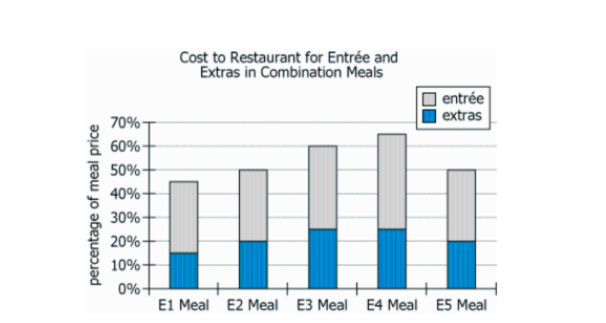
A certain restaurant serves exactly 5 entrées—E1 through E5. Customers may order an entrée alone, but most customers order an entrée as part of a combination meal, which consists of one entrée plus extras—a side dish and drink. While the entrées vary in cost to the restaurant, the extras always have the same cost to the restaurant. The graph shows the actual cost to the restaurant for the entrée and the extras as a percent of the price charged for the meal.
Based on the information provided, select from each drop-down menu the option that creates the most accurate statement.
Of the five combination meals, the meal with entrée has the highest price.
Of the five combination meals, the sale of a single meal with entrée nets the least profit.
A certain restaurant serves exactly 5 entrées—E1 through E5. Customers may order an entrée alone, but most customers order an entrée as part of a combination meal, which consists of one entrée plus extras—a side dish and drink. While the entrées vary in cost to the restaurant, the extras always have the same cost to the restaurant. The graph shows the actual cost to the restaurant for the entrée and the extras as a percent of the price charged for the meal.
Based on the information provided, select from each drop-down menu the option that creates the most accurate statement.
Of the five combination meals, the meal with entrée has the highest price.
Of the five combination meals, the sale of a single meal with entrée nets the least profit.
ID: 101121

guddo
We are shown the cost to a restaurant as a percentage of meal price.
So if a meal price is $30, and cost to the restaurant for that meal is 70%, the cost to the restaurant for that meal will be $21 and the restaurant will make $9 profit on that meal. The $21 cost will be a sum of cost of entree (say $11) and a fixed cost of sides of $10.
Cost to restaurant of entrees are different but cost of 'extras' are always same (say $10 for all meal combinations). So assuming meal prices of combinations are E1, E2, E3, E4 and E5,
We know that 15% of E1 = 20% of E2 = 25% of E3 = 25% of E4 = 20% of E5 = Constant (price of extras i.e. $10)
Hence, E1 is highest. (because its 15% is equal to higher percentage of others)
Of the five combination meals, the meal with entrée ___ has the highest price.
ANSWER: E1
Of the five combination meals, the sale of a single meal with entrée ___ nets the least profit.
The least profit will be made by a meal with the smallest price and maximum cost. E3 and E4 have the same combination meal price since cost of sides is 25% of the price in both. But cost of entree is higher in E4. It is 40% of meal price. Hence profit in E4 will be lowest.
ANSWER: E4
The question is an application of percentages: https://youtu.be/HxnsYI1Rws8
_________________
-
Start FREE with selected GMAT/EA Content upon registration at anaprep.com
YouTube Channel: karishma.anaprep
Start FREE with selected GMAT/EA Content upon registration at anaprep.com
YouTube Channel: karishma.anaprep

mayankdgmat
Joined: 13 May 2022
Last visit: 07 Feb 2025
Posts: 106
Location: India
Concentration: Finance, General Management
Posts: 106
E1, E4
(1) since cost of extras is fix let it be "E". now total cost of meal become
P% (in blue bar)*T (total meal cost) = E
T=E/P. Hence we need to minimize P to make meal costliest hence answer is E1
(2) Highest bar will have highest cost and remaining will be profit. Hence least for E4
(1) since cost of extras is fix let it be "E". now total cost of meal become
P% (in blue bar)*T (total meal cost) = E
T=E/P. Hence we need to minimize P to make meal costliest hence answer is E1
(2) Highest bar will have highest cost and remaining will be profit. Hence least for E4
General Discussion


A certain restaurant serves exactly 5 entrées—E1 through E5. Customers may order an entrée alone, but most customers order an entrée as part of a combination meal, which consists of one entrée plus extras—a side dish and drink. While the entrées vary in cost to the restaurant, the extras always have the same cost to the restaurant. The graph shows the actual cost to the restaurant for the entrée and the extras as a percent of the price charged for the meal.
Based on the information provided, select from each drop-down menu the option that creates the most accurate statement.
A. Of the five combination meals, the meal with entrée _______ has the highest price.
B. Of the five combination meals, the sale of a single meal with entrée _________ nets the least profit.
On basis of the Graph, the Total Price of a particular Combination Meal (E1/2/3/4/5) can be divided into :-
Entree (%) Extras (%) Profit (%)
E1 30 15 55
E2 30 20 50
E3 35 25 40
E4 40 25 35
E5 30 20 50
A. Of the five combination meals, the meal with entrée _______ has the highest price.
Since the Extras always have the same cost to the restaurant, maximum costs will be incurred wherein the ratio of Entree : Extras wll be maximum.
E1 (with 2:1) has the maximum ratio for Entree : Extras
E1 is the correct option
B. Of the five combination meals, the sale of a single meal with entrée _________ nets the least profit.
Since E4 has the least percentage for the profit portion, the sale of a single meal with entree E4 will make the minimum profit.
E4 is the correct option
Based on the information provided, select from each drop-down menu the option that creates the most accurate statement.
A. Of the five combination meals, the meal with entrée _______ has the highest price.
B. Of the five combination meals, the sale of a single meal with entrée _________ nets the least profit.
On basis of the Graph, the Total Price of a particular Combination Meal (E1/2/3/4/5) can be divided into :-
Entree (%) Extras (%) Profit (%)
E1 30 15 55
E2 30 20 50
E3 35 25 40
E4 40 25 35
E5 30 20 50
A. Of the five combination meals, the meal with entrée _______ has the highest price.
Since the Extras always have the same cost to the restaurant, maximum costs will be incurred wherein the ratio of Entree : Extras wll be maximum.
E1 (with 2:1) has the maximum ratio for Entree : Extras
E1 is the correct option
B. Of the five combination meals, the sale of a single meal with entrée _________ nets the least profit.
Since E4 has the least percentage for the profit portion, the sale of a single meal with entree E4 will make the minimum profit.
E4 is the correct option


more understandable explanation for first part-
since price of all extras are same:
15% of meal1 = 20% of meal2 = 25% of meal3 = 25% of meal4 = 20% of meal5 = K(assume)
so, price of meal1 = 100k/15, price of meal2 = 100k/20 and so on.....
now E1 entre price = 30% of meal1
=> 30/100 * 100k/15
=>2k
and similarly we can find entre price for all the rest!
This is how people are directly concluding we can see the ratio of entre to extra, whichever is highest is our answer
since price of all extras are same:
15% of meal1 = 20% of meal2 = 25% of meal3 = 25% of meal4 = 20% of meal5 = K(assume)
so, price of meal1 = 100k/15, price of meal2 = 100k/20 and so on.....
now E1 entre price = 30% of meal1
=> 30/100 * 100k/15
=>2k
and similarly we can find entre price for all the rest!
This is how people are directly concluding we can see the ratio of entre to extra, whichever is highest is our answer

Posts: 7
Official Solution
Attachments
File comment: OG solution
IMG_1882.jpeg [ 1.29 MiB | Viewed 8971 times ]

So there is a line that caught my eye 'extras cost the same to the restaurant' ...and we have the % given with proportion to the meal price charged. Let's take extra cost to be $60..
Now for E1, extra is 15% of the total price
60 is 15%, so 100% is $400,
Same way we can do for other meals but i know other meals will cost lesser. Eg: E2 - $60 will be 20% of the total meal price, overall price comes out to be $300. Hence for (1) ans is E1
Now for E1, extra is 15% of the total price
60 is 15%, so 100% is $400,
Same way we can do for other meals but i know other meals will cost lesser. Eg: E2 - $60 will be 20% of the total meal price, overall price comes out to be $300. Hence for (1) ans is E1

Hi,
Can you please tell how do you calculate profit %
Can you please tell how do you calculate profit %
rn1112

Profit % = 100% − Total Cost %
Total Cost % = Entrée cost % + Extras cost % (from the bar chart).
The chart already shows these costs as a percentage of the meal price, so you don’t need to know the actual prices.
E1: Entrée ≈ 15%, Extras ≈ 30% → Total ≈ 45%
E2: Entrée ≈ 20%, Extras ≈ 30% → Total ≈ 50%
E3: Entrée ≈ 25%, Extras ≈ 35% → Total ≈ 60%
E4: Entrée ≈ 25%, Extras ≈ 40% → Total ≈ 65%
E5: Entrée ≈ 20%, Extras ≈ 30% → Total ≈ 50%
Total Cost % = Entrée cost % + Extras cost % (from the bar chart).
The chart already shows these costs as a percentage of the meal price, so you don’t need to know the actual prices.
E1: Entrée ≈ 15%, Extras ≈ 30% → Total ≈ 45%
E2: Entrée ≈ 20%, Extras ≈ 30% → Total ≈ 50%
E3: Entrée ≈ 25%, Extras ≈ 35% → Total ≈ 60%
E4: Entrée ≈ 25%, Extras ≈ 40% → Total ≈ 65%
E5: Entrée ≈ 20%, Extras ≈ 30% → Total ≈ 50%
| Entrée | Total Cost % | Profit % |
|---|---|---|
| E1 | 45% | 55% |
| E2 | 50% | 50% |
| E3 | 60% | 40% |
| E4 | 65% | 35% |
| E5 | 50% | 50% |
aronbhati

OFFICIAL SOLUTION:
RO1:
Since the extras always have the same cost to the restaurant, that cost must be lowest as a percentage of the highest price charged for a combination meal. The graph shows the extras cost only about 15% of the price charged for the combination meal with entrée E1, but at least 20% of the price charged for each of the other combination meals. So, the combination meal with entrée E1 has the highest price.
The correct answer is E1.
RO2:
Let's assume that apart from the costs shown in the graph, any other costs to the restaurant are the same for each combination meal served. Out of the sales price of a combination meal, the percentage profits to the restaurant are then lower for combination meals whose total percentage costs shown in the graph are higher. The total percentage costs shown in the graph are highest for the combination meal with entrée E4, so this meal must net the least profit as a percentage of its sales price. Next, note that the graph shows that the extras cost at least as high a percentage of this meal’s sales price as of any of the other combination meals’ sales prices. That means this meal must have a sales price no higher than any of the other combination meals do. So, because the meal with entrée E4 nets the least profit as a percentage of its sales price, and that sales price is no higher than any other combination meal’s sales price, the meal with entrée E4 must net the least total amount profit per meal served.
The correct answer is E4.
RO1:
Since the extras always have the same cost to the restaurant, that cost must be lowest as a percentage of the highest price charged for a combination meal. The graph shows the extras cost only about 15% of the price charged for the combination meal with entrée E1, but at least 20% of the price charged for each of the other combination meals. So, the combination meal with entrée E1 has the highest price.
The correct answer is E1.
RO2:
Let's assume that apart from the costs shown in the graph, any other costs to the restaurant are the same for each combination meal served. Out of the sales price of a combination meal, the percentage profits to the restaurant are then lower for combination meals whose total percentage costs shown in the graph are higher. The total percentage costs shown in the graph are highest for the combination meal with entrée E4, so this meal must net the least profit as a percentage of its sales price. Next, note that the graph shows that the extras cost at least as high a percentage of this meal’s sales price as of any of the other combination meals’ sales prices. That means this meal must have a sales price no higher than any of the other combination meals do. So, because the meal with entrée E4 nets the least profit as a percentage of its sales price, and that sales price is no higher than any other combination meal’s sales price, the meal with entrée E4 must net the least total amount profit per meal served.
The correct answer is E4.

AditiDeokar
Joined: 12 Jan 2025
Last visit: 21 May 2026
Posts: 86
Location: India
Concentration: Finance
Schools: NUS ESSEC MiM '26 ESSEC MiF '26 INSEAD MiM '26 ESADE Imperial ISB '26 ESADE HEC Sept '26 IE INSEAD Jan '26
GMAT Focus 1: 525 Q77 V77 DI74 
GPA: 3.5
Schools: NUS ESSEC MiM '26 ESSEC MiF '26 INSEAD MiM '26 ESADE Imperial ISB '26 ESADE HEC Sept '26 IE INSEAD Jan '26
GMAT Focus 1: 525 Q77 V77 DI74
Posts: 86
Hi KarishmaB, I did not understand the solution.
Hence, E1 is highest. (because its 15% is equal to higher percentage of others), this part.
I got the Q wrong had switched the answers, my understanding was that for First Blank it would be E4 as it is the highest % of meal price hence cost to restaurant, and the higher the cost to restaurant the higher they would charge the price of the meal, similar logic for blank 2
Hence, E1 is highest. (because its 15% is equal to higher percentage of others), this part.
I got the Q wrong had switched the answers, my understanding was that for First Blank it would be E4 as it is the highest % of meal price hence cost to restaurant, and the higher the cost to restaurant the higher they would charge the price of the meal, similar logic for blank 2
KarishmaB


AditiDeokar
Extras (the blue bars) have the same dollar cost in every combo. The blue bar is “extras as a percent of price.” If the same dollar amount is 15% of the price (E1), the price must be higher than when that same dollar amount is 20% or 25% of the price (E2 to E5). That is why E1 has the highest price, even though its cost percentage is not the highest.
For example, say the extras cost the restaurant $15 for every combo. Price = 15 divided by (extras percent as a decimal):
E1: 15% extras, price = 15/0.15 = 100
E2: 20% extras, price = 15/0.20 = 75
E3: 25% extras, price = 15/0.25 = 60
E4: 25% extras, price = 15/0.25 = 60
E5: 20% extras, price = 15/0.20 = 75
So E1 has the highest price.
Second drop down: E3 and E4 have the same price (both 60).
E3 total cost is 60%, so profit is 40% of 60 = 24.
E4 total cost is 65%, so profit is 35% of 60 = 21.
So E4 nets the least profit.
_________________
New to the GMAT Club?
- • Questions: Question Bank | Bunuel's Signature Collection
• Tests: GMAT Club Tests | Forum Quiz
• Guides: Quantitative | Critical Reasoning | Reading Comprehension | Ultimate Quant Guide | All You Need for Quant
• Rules: Quantitative | Verbal

totamofficiis
Joined: 21 Jan 2026
Last visit: 27 Apr 2026
Posts: 21
Location: India
Concentration: Economics, Finance
Schools: Booth (Chicago)
Schools: Booth (Chicago)
Posts: 21
I am not sure why computing profits is necessary here.
Extra is has fixed cost. hence lowest the share of the overall price it is higher the price is. Hence E1.
same can be applied for E4.
Extra is has fixed cost. hence lowest the share of the overall price it is higher the price is. Hence E1.
same can be applied for E4.
Moderators:
Announcements
How to Tell If Your GMAT Prep Resources Are Actually Helping You

Subscribe to GMAT Club for New Podcast Episodes, Debriefs, & Insightful Sessions on GMAT Preparation
Subscribe to GMAT Club for New Podcast Episodes, Debriefs, & Insightful Sessions on GMAT Preparation

Tuck at Dartmouth
AI at Dartmouth Tuck: How the School Is Preparing Leaders for the Age of Artificial Intelligence
Inside the courses, research, and hands-on learning defining wise, decisive leadership in an AI-driven world.
Read More
Inside the courses, research, and hands-on learning defining wise, decisive leadership in an AI-driven world.
Read More


Top 5 GMAT Debrief Videos
Success stories and strategies from high-scoring candidates.