Events & Promotions
| Last visit was: 20 Sep 2026, 07:33 |
It is currently 20 Sep 2026, 07:33 |
|
|

GMAT Club Daily Prep
Thank you for using the timer - this advanced tool can estimate your performance and suggest more practice questions. We have subscribed you to Daily Prep Questions via email.
Customized
for You
Track
Your Progress
Practice
Pays
Not interested in getting valuable practice questions and articles delivered to your email? No problem, unsubscribe here.
 Sep 18
10:00 AM IST
-11:00 PM IST
Start your journey with a fully customized action plan and work with a dedicated mentor to achieve a 735+ score. Sep 20
03:30 AM EDT
-04:30 AM EDT
Looking for your GMAT motivation to break through the score plateau? Pragati improved her score by massive 160 points with strategic guidance and hard-work! Find out how personalized mentorship and a strong mindset can turn GMAT struggles into success. Sep 21
07:00 PM EDT
-10:00 PM EDT
Boost your GMAT score in less than one month in a live online class + 6 months access to TTP OnDemand video courses included! Sep 23
12:30 AM EDT
-01:30 AM EDT
Learn how Keshav, a Chartered Accountant, scored an impressive 705 on GMAT in just 30 days with GMATWhiz's expert guidance. In this video, he shares preparation tips and strategies that worked for him, including the mock, time management, and more Sep 26
01:00 PM EDT
-04:00 PM EDT
Top scores are possible when you enroll in a powerful GMAT course, taught live online + 6 months access to TTP OnDemand video courses included. Class starts Saturdays Sept. 26, 2026 - Dec. 19, 2026, 1:00pm-4:00pm ES Sep 26
06:00 PM PDT
-07:00 PM PDT
Free- full-length test + 15 concept videos + 150+ short videos + study plan!

 Updated on: 22 Feb 2022, 05:34
Originally posted by Jasontuyj2012 on 11 Aug 2011, 18:41.
Last edited by Bunuel on 22 Feb 2022, 05:34, edited 2 times in total.
Last edited by Bunuel on 22 Feb 2022, 05:34, edited 2 times in total.
Edited the question.
Kudos
Bookmarks


D
Be sure to select an answer first to save it in the Error Log before revealing the correct answer (OA)!
Difficulty:
 25%
(medium)
25%
(medium)
Question Stats:
75% (01:28) correct 25%
(01:41)
wrong
based on 7815
sessions
25%
(01:41)
wrong
based on 7815
sessions
History
Date
Time
Result
Not Attempted Yet
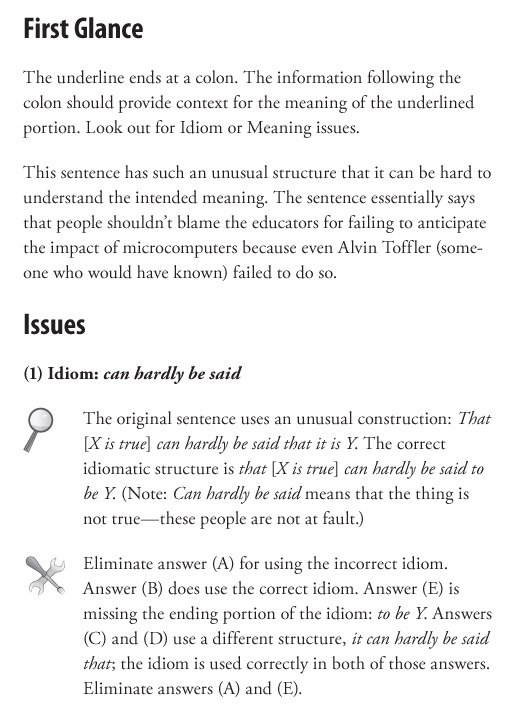
That educators have not anticipated the impact of microcomputer technology can hardly be said that it is their fault: Alvin Toffler, one of the most prominent students of the future, did not even mention microcomputers in Future Shock, published in 1970.
(A) That educators have not anticipated the impact of microcomputer technology can hardly be said that it is their fault
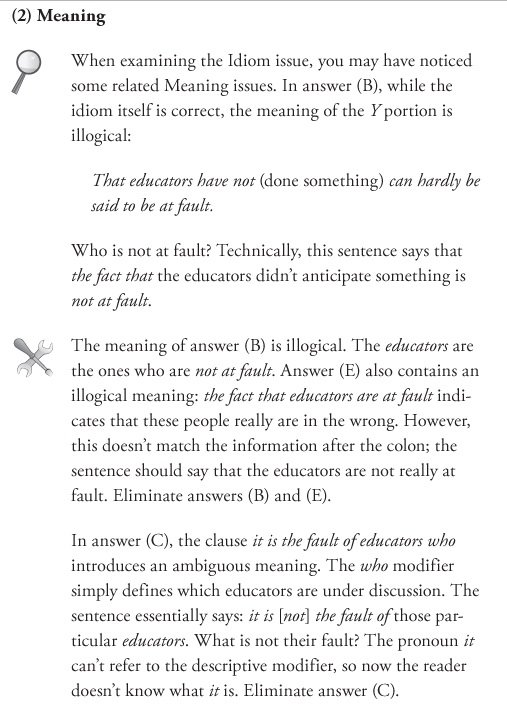
(B) That educators have not anticipated the impact of microcomputer technology can hardly be said to be at fault
(C) It can hardly be said that it is the fault of educators who have not anticipated the impact of microcomputer technology
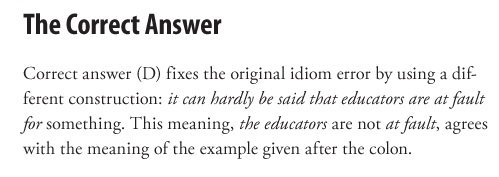
(D) It can hardly be said that educators are at fault for not anticipating the impact of microcomputer technology
(E) The fact that educators are at fault for not anticipating the impact of microcomputer technology can hardly be said
Similar Question : LINK
(A) That educators have not anticipated the impact of microcomputer technology can hardly be said that it is their fault
(B) That educators have not anticipated the impact of microcomputer technology can hardly be said to be at fault
(C) It can hardly be said that it is the fault of educators who have not anticipated the impact of microcomputer technology
(D) It can hardly be said that educators are at fault for not anticipating the impact of microcomputer technology
(E) The fact that educators are at fault for not anticipating the impact of microcomputer technology can hardly be said
Similar Question : LINK
Show Spoilernytimes article
https://www.nytimes.com/1982/04/25/education/schools-enter-the-computer-age.html
Thus far most efforts by educators to come to grips with the computer revolution have been modest and tentative. This is understandable when one recognizes that the microcomputer — the relatively small, inexpensive machine that has made computing feasible in schools and homes — is barely seven years old. In his 1970 book, ''Future Shock,'' Alvin Toffler did not even mention microcomputers!
0122.jpg [ 118.39 KiB | Viewed 50971 times ]
0123.jpg [ 117.8 KiB | Viewed 50934 times ]
0124.jpg [ 29.39 KiB | Viewed 50888 times ]
Thus far most efforts by educators to come to grips with the computer revolution have been modest and tentative. This is understandable when one recognizes that the microcomputer — the relatively small, inexpensive machine that has made computing feasible in schools and homes — is barely seven years old. In his 1970 book, ''Future Shock,'' Alvin Toffler did not even mention microcomputers!
Attachment:
0122.jpg [ 118.39 KiB | Viewed 50971 times ]
Attachment:
0123.jpg [ 117.8 KiB | Viewed 50934 times ]
Attachment:
0124.jpg [ 29.39 KiB | Viewed 50888 times ]


 30 Mar 2016, 20:30
Kudos
Bookmarks
When I review this question with students, I find the best way to think about it is to think of the following structure as an idiom:
"It's surprising that __________"
"It can hardly be said that ________"
"It's unfortunate but true that __________"
This construction is a particular type of English idiom that's used to avoid putting a very long, complicated clause at the beginning of a sentence. Given the choice, most of us native English speakers should prefer (1) to (2) below:
(1) It's unfortunate that Jordan and Lee unexpectedly divorced after five seemingly happy years of marriage. - Good
(2) That Jordan and Lee unexpectedly divorced after five seemingly happy years of marriage is unfortunate. - Weird
You might want to cross off (1) because the 'it' doesn't seem to refer to anything. However, that's because in this particular idiom, there's a 'hollow it' that doesn't refer to anything at all, and that's okay. The 'hollow it' shows up in other English sentences too, like "It's raining" or "It's going to be beautiful outside today."
Really, what I think is being tested in options (A) and (B) is whether you recognize the 'it can hardly be said that ______' idiom, and whether you know that it's better to keep an idiom in its normal form than to move the bits around.
"It's surprising that __________"
"It can hardly be said that ________"
"It's unfortunate but true that __________"
This construction is a particular type of English idiom that's used to avoid putting a very long, complicated clause at the beginning of a sentence. Given the choice, most of us native English speakers should prefer (1) to (2) below:
(1) It's unfortunate that Jordan and Lee unexpectedly divorced after five seemingly happy years of marriage. - Good
(2) That Jordan and Lee unexpectedly divorced after five seemingly happy years of marriage is unfortunate. - Weird
You might want to cross off (1) because the 'it' doesn't seem to refer to anything. However, that's because in this particular idiom, there's a 'hollow it' that doesn't refer to anything at all, and that's okay. The 'hollow it' shows up in other English sentences too, like "It's raining" or "It's going to be beautiful outside today."
Really, what I think is being tested in options (A) and (B) is whether you recognize the 'it can hardly be said that ______' idiom, and whether you know that it's better to keep an idiom in its normal form than to move the bits around.
 22 Sep 2012, 00:24
Kudos
Bookmarks
A - That educators have not anticipated the impact of microcomputer technology can hardly be said that it is their fault
That something has happened can hardly be said that it is their fault.
something = educators have not anticipated the impact of microcomputer technology
The second that is problematic.
If we change the construction to - That educators have not anticipated the impact of microcomputer technology can hardly be said to be their fault, I don't see any grammatical lapses, the construction is inelegant and awkward. I would look for a better construction.
B - That educators have not anticipated the impact of microcomputer technology can hardly be said to be at fault
That something has happened can hardly be said to be at fault.
something = educators have not anticipated the impact of microcomputer technology
What does it even mean? Who is at fault? An event cannot be at fault.
C - It can hardly be said that it is the fault of educators who have not anticipated the impact of microcomputer technology
who have not anticipated the impact of microcomputer technology is just a modifier modifying educators. So the sentence in essence reads - It can hardly be said that it is the fault of a certain kind of educators.
certain kind - those educators who have not anticipated the impact of microcomputer technology
Now what is the fault of educators? it has no referent.
E - The fact that educators are at fault for not anticipating the impact of microcomputer technology can hardly be said.
Something can hardly be said - Okay
Something - The fact that educators are at fault for not anticipating the impact of microcomputer technology
- Changes meaning. it is not a fact that educators are at fault for not anticipating the impact of microcomputer technology. In fact this very thing is debatable.
D - It can hardly be said that educators are at fault for not anticipating the impact of microcomputer technology - Perfect.
That something has happened can hardly be said that it is their fault.
something = educators have not anticipated the impact of microcomputer technology
The second that is problematic.
If we change the construction to - That educators have not anticipated the impact of microcomputer technology can hardly be said to be their fault, I don't see any grammatical lapses, the construction is inelegant and awkward. I would look for a better construction.
B - That educators have not anticipated the impact of microcomputer technology can hardly be said to be at fault
That something has happened can hardly be said to be at fault.
something = educators have not anticipated the impact of microcomputer technology
What does it even mean? Who is at fault? An event cannot be at fault.
C - It can hardly be said that it is the fault of educators who have not anticipated the impact of microcomputer technology
who have not anticipated the impact of microcomputer technology is just a modifier modifying educators. So the sentence in essence reads - It can hardly be said that it is the fault of a certain kind of educators.
certain kind - those educators who have not anticipated the impact of microcomputer technology
Now what is the fault of educators? it has no referent.
E - The fact that educators are at fault for not anticipating the impact of microcomputer technology can hardly be said.
Something can hardly be said - Okay
Something - The fact that educators are at fault for not anticipating the impact of microcomputer technology
- Changes meaning. it is not a fact that educators are at fault for not anticipating the impact of microcomputer technology. In fact this very thing is debatable.
D - It can hardly be said that educators are at fault for not anticipating the impact of microcomputer technology - Perfect.
 22 Feb 2022, 05:08
Kudos
Bookmarks
Dear Friends,
Here is a detailed explanation to this question-
Meaning is crucial to solving this problem:
Understanding the intended meaning is key to solving this question; the intended meaning of the crucial part of this sentence is that educators cannot be said to be at fault for not anticipating the impact of microcomputer technology.
Concepts tested here: Meaning + Pronouns + Awkwardness/Redundancy
• A pronoun can only have one referent in a sentence.
A: This answer alters the meaning of the sentence through the phrase "that it is their fault"; the construction of this phrase leads to an incoherent meaning; the intended meaning is that educators cannot be said to be at fault for not anticipating the impact of microcomputer technology. Further, Option A uses the needlessly indirect construction "That educators have not anticipated the impact of microcomputer technology can hardly be said", leading to awkwardness and redundancy.
B: This answer choice alters the meaning of the sentence through the clause "That educators have not anticipated...can hardly be said to be at fault"; the construction of this clause illogically implies that the fact that educators have not anticipated the impact of microcomputer technology cannot be said to be at fault for something unspecified; the intended meaning is that educators cannot be said to be at fault for not anticipating the impact of microcomputer technology. Further, Option B uses the needlessly indirect construction "That educators have not anticipated the impact of microcomputer technology can hardly be said", leading to awkwardness and redundancy.
C: This answer choice alters the meaning of the sentence through the clause "it is the fault of educators who have not anticipated the impact of microcomputer technology"; the construction of this clause incorrectly implies that the specific educators who have not anticipated the impact of microcomputer technology cannot be said to be at fault for something unspecific; the intended meaning is that educators, in general, cannot be said to be at fault for not anticipating the impact of microcomputer technology. Further, Option C incorrectly uses "it" as a placeholder pronoun in two places; please remember, a pronoun can only have one referent in a sentence.
D: Correct. This answer choice uses the clause "It can hardly be said that educators are at fault", conveying the intended meaning - that educators, in general, cannot be said to be at fault for not anticipating the impact of microcomputer technology. Further, Option D avoids the pronoun error seen in Option C, as it only uses "it" as a placeholder pronoun in one place. Additionally, Option D is free of any awkwardness or redundancy.
E: This answer choice alters the meaning of the sentence through the clause "The fact that educators are at fault...can hardly be said"; the construction of this phrase incorrectly implies that educators are at fault for not anticipating the impact of microcomputer technology, but this fact cannot be said; the intended meaning is that educators are not at fault for not anticipating the impact of microcomputer technology.
Hence, D is the best answer choice.
All the best!
Experts' Global Team
Here is a detailed explanation to this question-
Jasontuyj2012
Meaning is crucial to solving this problem:
Understanding the intended meaning is key to solving this question; the intended meaning of the crucial part of this sentence is that educators cannot be said to be at fault for not anticipating the impact of microcomputer technology.
Concepts tested here: Meaning + Pronouns + Awkwardness/Redundancy
• A pronoun can only have one referent in a sentence.
A: This answer alters the meaning of the sentence through the phrase "that it is their fault"; the construction of this phrase leads to an incoherent meaning; the intended meaning is that educators cannot be said to be at fault for not anticipating the impact of microcomputer technology. Further, Option A uses the needlessly indirect construction "That educators have not anticipated the impact of microcomputer technology can hardly be said", leading to awkwardness and redundancy.
B: This answer choice alters the meaning of the sentence through the clause "That educators have not anticipated...can hardly be said to be at fault"; the construction of this clause illogically implies that the fact that educators have not anticipated the impact of microcomputer technology cannot be said to be at fault for something unspecified; the intended meaning is that educators cannot be said to be at fault for not anticipating the impact of microcomputer technology. Further, Option B uses the needlessly indirect construction "That educators have not anticipated the impact of microcomputer technology can hardly be said", leading to awkwardness and redundancy.
C: This answer choice alters the meaning of the sentence through the clause "it is the fault of educators who have not anticipated the impact of microcomputer technology"; the construction of this clause incorrectly implies that the specific educators who have not anticipated the impact of microcomputer technology cannot be said to be at fault for something unspecific; the intended meaning is that educators, in general, cannot be said to be at fault for not anticipating the impact of microcomputer technology. Further, Option C incorrectly uses "it" as a placeholder pronoun in two places; please remember, a pronoun can only have one referent in a sentence.
D: Correct. This answer choice uses the clause "It can hardly be said that educators are at fault", conveying the intended meaning - that educators, in general, cannot be said to be at fault for not anticipating the impact of microcomputer technology. Further, Option D avoids the pronoun error seen in Option C, as it only uses "it" as a placeholder pronoun in one place. Additionally, Option D is free of any awkwardness or redundancy.
E: This answer choice alters the meaning of the sentence through the clause "The fact that educators are at fault...can hardly be said"; the construction of this phrase incorrectly implies that educators are at fault for not anticipating the impact of microcomputer technology, but this fact cannot be said; the intended meaning is that educators are not at fault for not anticipating the impact of microcomputer technology.
Hence, D is the best answer choice.
All the best!
Experts' Global Team








