Events & Promotions
|
|

GMAT Club Daily Prep
Thank you for using the timer - this advanced tool can estimate your performance and suggest more practice questions. We have subscribed you to Daily Prep Questions via email.
Customized
for You
Track
Your Progress
Practice
Pays
Not interested in getting valuable practice questions and articles delivered to your email? No problem, unsubscribe here.
 Aug 27
10:00 AM EDT
-11:00 AM EDT
We’ve worked incredibly hard to build TTP into the best test prep experience possible, and it would mean a lot to us to win Newsweek’s 2026 Readers’ Choice Award for Best Test Prep. If TTP has helped you, we’d be incredibly grateful for your vote. Sep 04
10:00 AM PDT
-11:00 AM PDT
What does test anxiety really look like on the GMAT? For many test takers, it does not look like a panic attack. Instead, it shows up as brain fog, rereading, negative comparisons, mental noise.... Sep 06
09:30 AM EDT
-12:30 PM EST
Top scores are possible when you enroll in a powerful EA course, taught live online + 6 months access to TTP OnDemand video courses included! Perfect class schedule and easy course access for working professionals. Class starts Sept. 6, 9:30am-12:30pm EST- Sep 09
07:00 AM PDT
-10:00 AM PDT
Meet AdComs and explore top Master’s programs - MiM, MiF, MSc, MSBA and more. - Application Fee Waivers - Free 1-Week of GMAT Club Tests: - Master's Application Toolkit - Grand Prize Giveaway  Sep 15
07:00 PM EDT
-09:00 PM EST
Elite scores are possible when you enroll in a powerful GMAT course, taught live online + 6 months access to TTP OnDemand video courses included! Class starts Tues/Thurs Sept. 15, 2026 - Nov. 15, 2027, 7:00pm-9:00pm EST Sep 21
08:00 PM EDT
-10:00 PM EDT
Elite scores are possible when you enroll in a powerful GMAT course, taught live online + 6 months access to TTP OnDemand video courses included! Class starts Tues/Thurs Oct. 13, 2026 - Jan. 7, 2027, 8:00pm-10:00pm EST


 03 Dec 2025, 23:36
Kudos
Bookmarks
| Problem Solving Butler: December 2025 | ||
| December 4 | PS 1 | PS 2 |
_________________________________________
PS 1
The flow of water through a drainage pipe was monitored for a 3-hour period. In the second hour, the rate of flow was 15 gallons per hour, which was 50 percent faster than the rate of flow for the first hour. If 25 percent more water flowed through the pipe in the third hour than it did in the second, how many gallons of water flowed through the pipe during the entire three hours?
A. 41.25
B. 42.5
C. 43.75
D. 45.0
E. 57.5
_________________________________________
PS 2
Mike has twice as many stamps as Jean has. After he gives Jean 6 stamps, he still has 8 more stamps than Jean does. How many stamps did Mike have originally?
A. 28
B. 32
C. 36
D. 38
E. 40
 04 Dec 2025, 08:25
Kudos
Bookmarks

RC Holding You Back? Stop rereading and start reading smart. *Join us with Marty as he provides 7 powerful ways to save time and increase accuracy in Reading Comprehension.*
- Learn how to build a mental map
- How to minimize note-taking
- How to maintain relaxed intensity for higher accuracy
*Watch Live on YouTube* https://www.youtube.com/watch?v=53_UoSWoFm4

 04 Dec 2025, 09:00
Kudos
Bookmarks
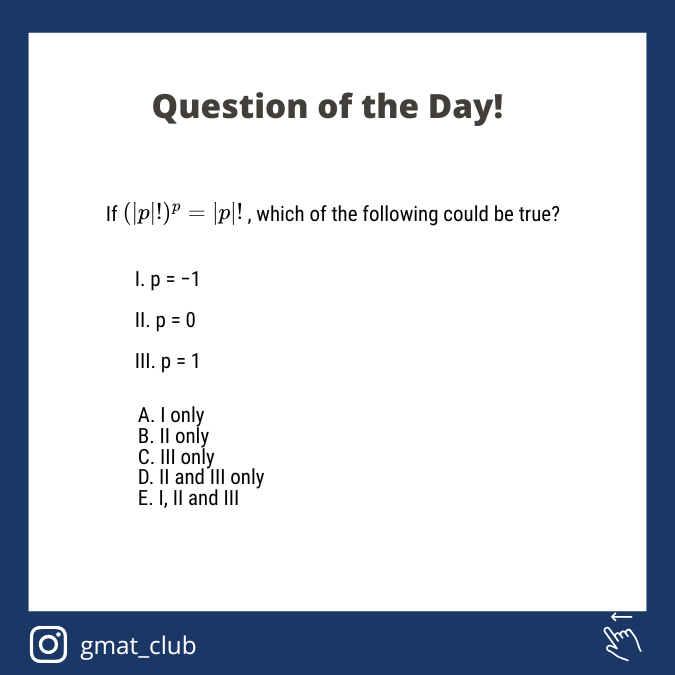
December 4th Quant Question of the Day
Answer and Explanation | Subscribe via E-mail, Forum, Instagram, or YouTube
Answer and Explanation | Subscribe via E-mail, Forum, Instagram, or YouTube