Events & Promotions
|
|

GMAT Club Daily Prep
Thank you for using the timer - this advanced tool can estimate your performance and suggest more practice questions. We have subscribed you to Daily Prep Questions via email.
Customized
for You
Track
Your Progress
Practice
Pays
Not interested in getting valuable practice questions and articles delivered to your email? No problem, unsubscribe here.
 Sep 28
07:00 PM EDT
-10:00 PM EDT
Boost your GMAT score in less than one month in a live online class + 6 months access to TTP OnDemand video courses included! Class starts Mon, Tues, Wed, Thur, Fri Sept. 28, 2026 - Oct. 16, 2027, 7:00pm-10:00pm EST Sep 29
11:00 AM EDT
-01:00 PM EDT
" Description: Top scores are possible when you enroll in a powerful GMAT course, taught live online + 6 months access to TTP OnDemand video courses included! Class starts Tues/Thur Sept. 29, 2026 - Dec. 3, 2026, 11:00am-1:00pm EST Oct 01
07:00 AM BST
-08:00 AM GMT
Welcome to the GMAT Club's Free Interview Prep Event for Top MBA Programs! Buy tickets - Virtual series that’s all set to equip you to -excel in your MBA interviews. Oct 03
01:00 PM EDT
-04:00 PM EDT
Top scores are possible when you enroll in a powerful GMAT course, taught live online + 6 months access to TTP OnDemand video courses included! Class starts Saturdays Oct. 3, 2026 - Dec. 26, 2026, 1:00pm-4:00pm EST



A
Be sure to select an answer first to save it in the Error Log before revealing the correct answer (OA)!
Difficulty:
 25%
(medium)
25%
(medium)
Question Stats:
72% (01:20) correct 28%
(01:37)
wrong
based on 11644
sessions
28%
(01:37)
wrong
based on 11644
sessions
History
Date
Time
Result
Not Attempted Yet
Salt deposits and moisture threaten to destroy the Mohenjo-Daro excavation in Pakistan, the site of an ancient civilization that flourished at the same time as the civilizations in the Nile delta and the river valleys of the Tigris and Euphrates.
(A) that flourished at the same time as the civilizations
(B) that had flourished at the same time as had the civilizations
(C) that flourished at the same time those had
(D) flourishing at the same time as those did
(E) flourishing at the same time as those were
(A) that flourished at the same time as the civilizations
(B) that had flourished at the same time as had the civilizations
(C) that flourished at the same time those had
(D) flourishing at the same time as those did
(E) flourishing at the same time as those were
https://www.nytimes.com/1985/09/24/science/progress-reported-in-struggle-to-save-imperiled-ruins.html
FOR thousands of years, the Indus River has brought the blessing of water for crops and the curse of destructive floods. But today the Indus River poses a new danger to the site of an ancient civilization that flourished at the same time as those in the river valleys of the Tigris and Euphrates and the Nile.
Moisture and salt deposits threaten to erode and destroy the remarkable Mohenjo Daro archeological excavation that has fascinated and awed scientists and visitors since its discovery under a giant mound of earth more than 60 years ago.
01.jpg [ 118.51 KiB | Viewed 79285 times ]
02.jpg [ 76.32 KiB | Viewed 79175 times ]
FOR thousands of years, the Indus River has brought the blessing of water for crops and the curse of destructive floods. But today the Indus River poses a new danger to the site of an ancient civilization that flourished at the same time as those in the river valleys of the Tigris and Euphrates and the Nile.
Moisture and salt deposits threaten to erode and destroy the remarkable Mohenjo Daro archeological excavation that has fascinated and awed scientists and visitors since its discovery under a giant mound of earth more than 60 years ago.
Attachment:
01.jpg [ 118.51 KiB | Viewed 79285 times ]
Attachment:
02.jpg [ 76.32 KiB | Viewed 79175 times ]
Every tricky question should trigger a follow up quiz.
Build that habit with
GMAT Club Forum Quiz →.

 06 Jun 2010, 00:59
Kudos
Bookmarks
Hi Guys-- besides the much-discussed comparison, did you catch the idiom they're testing you on? See explanations below.
Salt deposits and moisture threaten to destroy the
Mohenjo-Daro excavation in Pakistan, the site of an
ancient civilization that flourished at the same time
as the civilizations in the Nile Delta and the river
valleys of the Tigris and Euphrates.
(A) that flourished at the same time as the
civilizations
(B) that had flourished at the same time as had
the civilizations
(C) that flourished at the same time those had
(D) flourishing at the same time as those did
(E) flourishing at the same time as those were
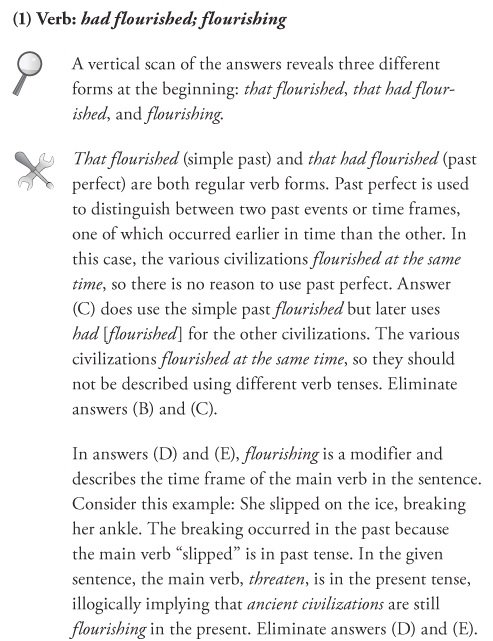
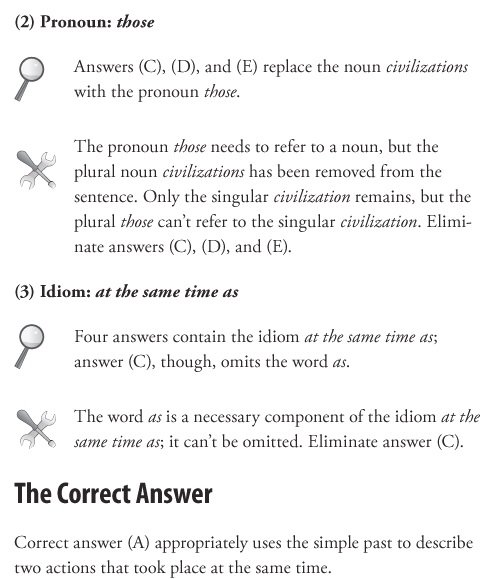
A. The comparison uses the idiom same X.... as Y. X is 'an ancient civilization', and Y is a 'the civilizations'-- a logical comparison. And what about tenses? How do we know that the past simple (flourished) is needed? The time modifier for the verb is "at the same time"; now, 'at' indicates a specific point in the past.
Note on ellipses in comparisons: As long as the verb of comparison is in the same tense for both items of comparison, you do not need to repeat the verb (you can but don't need to).
Ex. I ate dinner at the same time as my brother ('did'-- optional).
Ex. I eat as much as my brother ate ('ate'-- not optional) when he was on the football team.
B. The only error in B is the past perfect, "had flourished", for there is no indication that the flourishing had taken place before some other point in the past.
C. NOTE: THERE IS NOT 'AS'! Once you start with the word 'same' you must complete the idiom with 'as'. Second, every time you run into the words 'that'/'those' (or any pronoun for that matter) you must ask yourself 'that'/'those' what? Here, 'those' indicates 'those civilizations,' BUT THE WORD 'CIVILIZATIONS' (plural) IS NOT IN THE SENTENCE. So there is no referent for the pronoun.
D. Same as C
E. Same as C
Hope this helped!
-Sarai
If this helped, kindly give Kudos!
Salt deposits and moisture threaten to destroy the
Mohenjo-Daro excavation in Pakistan, the site of an
ancient civilization that flourished at the same time
as the civilizations in the Nile Delta and the river
valleys of the Tigris and Euphrates.
(A) that flourished at the same time as the
civilizations
(B) that had flourished at the same time as had
the civilizations
(C) that flourished at the same time those had
(D) flourishing at the same time as those did
(E) flourishing at the same time as those were
A. The comparison uses the idiom same X.... as Y. X is 'an ancient civilization', and Y is a 'the civilizations'-- a logical comparison. And what about tenses? How do we know that the past simple (flourished) is needed? The time modifier for the verb is "at the same time"; now, 'at' indicates a specific point in the past.
Note on ellipses in comparisons: As long as the verb of comparison is in the same tense for both items of comparison, you do not need to repeat the verb (you can but don't need to).
Ex. I ate dinner at the same time as my brother ('did'-- optional).
Ex. I eat as much as my brother ate ('ate'-- not optional) when he was on the football team.
B. The only error in B is the past perfect, "had flourished", for there is no indication that the flourishing had taken place before some other point in the past.
C. NOTE: THERE IS NOT 'AS'! Once you start with the word 'same' you must complete the idiom with 'as'. Second, every time you run into the words 'that'/'those' (or any pronoun for that matter) you must ask yourself 'that'/'those' what? Here, 'those' indicates 'those civilizations,' BUT THE WORD 'CIVILIZATIONS' (plural) IS NOT IN THE SENTENCE. So there is no referent for the pronoun.
D. Same as C
E. Same as C
Hope this helped!
-Sarai
If this helped, kindly give Kudos!
 19 Feb 2014, 15:15
Kudos
Bookmarks
rajgurinder
Dear rajgurinder,
I'm happy to respond.

This, of course, is SC #89 in the OG13. You may find this blog helpful:
https://magoosh.com/gmat/2013/dropping-c ... -the-gmat/
One of the hardest things about parallelism is what one can legitimately omit in the second branch, and figuring this out from sentence in which the omission has already happened.
Choice (A) gives perfectly correct parallelism. Part of what's confusing about this sentence is that the words "the site" is an appositive phrase, and the whole rest of the sentence modifies this phrase. For clarity, let's talk about the comparison directly, in its own sentence. The long way to say it would be:
The ancient Mohenjo-Daro civilization flourished at the same time that the civilizations in the Nile delta and the river valleys of the Tigris and Euphrates flourished.
That version is perfectly grammatically correct, but because it's long and wordy, it never would be correct on the GMAT. A shorter and perfectly correct way to say this is:
The ancient Mohenjo-Daro civilization flourished at the same time as the the civilizations in the Nile delta and the river valleys of the Tigris and Euphrates flourished
That is, in essence, the same structure as the OA above. Including the word "did" as you suggest would also be correct, only a little longer --- that's perfectly acceptable, but not necessary to make the sentence correct.
Think about it this way. Think about where the word "same" appears. It appears inside a prepositional phrase, "at the same time" ---- this prepositional phrase is an adverbial phrase, that is, a verb-modifier. See:
https://magoosh.com/gmat/2012/gmat-gramm ... d-clauses/
This suggests that the comparison is not between "time" and something else, but rather, that the comparison is between two verbs, both modified in the same way by the modifying phrase. For example:
A did X at the same time that B did Y.
If the two do the same action, it's redundant to say:
A did X at the same time that B did X
and much better to say
A did X at the same time as B.
The predicate, "did X", is the same, so it is dropped, and the comparison, the "same time", refers to the time of those two identical predicates.
Does all this make sense?
Mike






