Last visit was: 03 Jun 2026, 18:45 It is currently 03 Jun 2026, 18:45
Close
GMAT Club Daily Prep
Thank you for using the timer - this advanced tool can estimate your performance and suggest more practice questions. We have subscribed you to Daily Prep Questions via email.

Customized
for You

we will pick new questions that match your level based on your Timer History

Track
Your Progress

every week, we’ll send you an estimated GMAT score based on your performance

Practice
Pays

we will pick new questions that match your level based on your Timer History
Not interested in getting valuable practice questions and articles delivered to your email? No problem, unsubscribe here.
Close
Request Expert Reply
Confirm Cancel
655-705 (Hard)|   Comparisons|   Idioms/Diction/Redundancy|   Pronouns|   Punctuation|   Subject Verb Agreement|                                 
User avatar
mejia401
Joined: 15 Sep 2011
Last visit: 26 Nov 2018
Posts: 251
Own Kudos:
1,443
 [2]
Given Kudos: 46
Location: United States
WE:Corporate Finance (Manufacturing)
Posts: 251
Kudos: 1,443
 [2]
1
Kudos
Add Kudos
1
Bookmarks
Bookmark this Post
avatar
irishiraj87
Joined: 28 May 2015
Last visit: 18 Apr 2023
Posts: 31
Own Kudos:
18
 [2]
Given Kudos: 25
Location: India
GMAT 1: 710 Q51 V34
GPA: 4
Products:
GMAT 1: 710 Q51 V34
Posts: 31
Kudos: 18
 [2]
1
Kudos
Add Kudos
1
Bookmarks
Bookmark this Post
User avatar
AjiteshArun
User avatar
Major Poster
Joined: 15 Jul 2015
Last visit: 03 Jun 2026
Posts: 6,125
Own Kudos:
5,146
 [2]
Given Kudos: 744
Location: India
GMAT Focus 1: 715 Q83 V90 DI83
GMAT 1: 780 Q50 V51
GRE 1: Q170 V169
Expert
Expert reply
Active GMAT Club Expert! Tag them with @ followed by their username for a faster response.
GMAT Focus 1: 715 Q83 V90 DI83
GMAT 1: 780 Q50 V51
GRE 1: Q170 V169
Posts: 6,125
Kudos: 5,146
 [2]
2
Kudos
Add Kudos
Bookmarks
Bookmark this Post
User avatar
nigina93
Joined: 31 Jul 2017
Last visit: 23 Jul 2025
Posts: 162
Own Kudos:
342
 [2]
Given Kudos: 347
Location: Tajikistan
Posts: 162
Kudos: 342
 [2]
2
Kudos
Add Kudos
Bookmarks
Bookmark this Post
boeinz
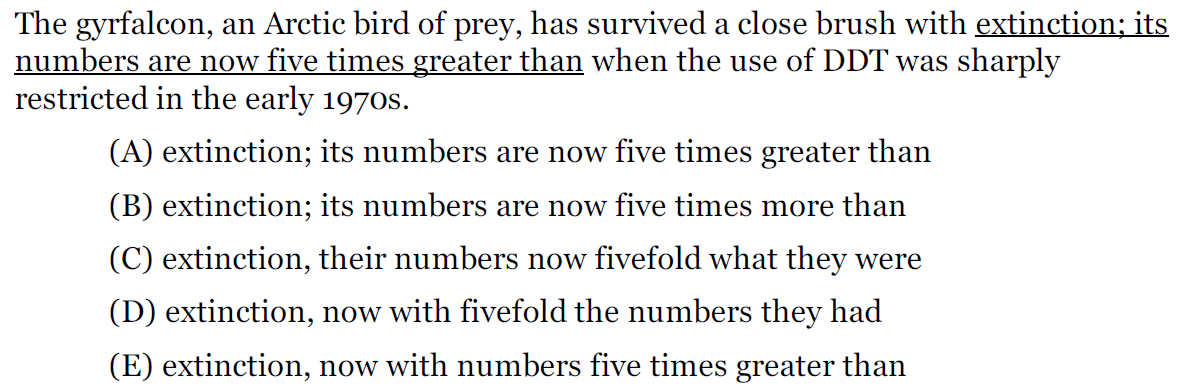
The gyrfalcon, an Arctic bird of prey, has survived a close brush with extinction; its numbers are now five times greater than when the use of DDT was sharply restricted in the early 1970's.


(A) extinction; its numbers are now five times greater than

(B) extinction; its numbers are now five times more than

(C) extinction, their numbers now fivefold what they were

(D) extinction, now with fivefold the numbers they had

(E) extinction; its numbers are now five times greater than what they were


Verbal Question of The Day: Day 233: Sentence Correction


Subscribe to GMAT Question of the Day: E-mail | RSS
For All QOTD Questions Click Here

https://www.nytimes.com/1986/01/07/science/science-watch-reduction-of-pesticides-nets-increase-in-bird-populations.html

As recently as a decade ago, the scientists noted, bald eagles were sighted in only 39 states. Now their number has increased by 92 percent to 37,000 and the living national symbol, which feeds mainly on fish, can be sighted in every state but Hawaii. The gyrfalcon, an Arctic species that feeds on snowshoe hares and grouse, has survived a close brush with extinction, its numbers rising fivefold since the early 1970's to 500. The number of peregrine falcons, which breed in cities and wilderness areas across the continent, have climbed 19 percent in 14 years to an estimated total of 1,200. But during the same period the population of Harris's hawk, a dweller of the Southwestern deserts, declined 38 percent to 5,600.

Moderator Note: Watch out - There is a similar but modified version of this question HERE


(A) extinction; its numbers are now five times greater than
CORRECT

(B) extinction; its numbers are now five times more than
When we compare numbers themselves, we use 'greater than'. E.g. five is greater than four. While we use 'more than' to compare things. E.g. I have eaten more food today than yesterday. Thus, 'more than' is wrong here.

(C) extinction, their numbers now fivefold what they were
Few things are wrong here. First, 'their' is wrong as subject is singular. Second, fivefold means 4x greater (original x + 4x), while original meaning conveys 5 times or 6folds (original x + 5 times). Third, 'what' is wrong here because it wants to say 'the things that' So, it would look like ' their numbers now fivefold THE THINGS THAT they were'. Lastly, 'they' is wrong because it refers to what? It intends to refer to bird (which is singular)

(D) extinction, now with fivefold the numbers they had
Same errors as in C. Refer to above for 'fivefold' and 'they'

(E) extinction; its numbers are now five times greater than what they were
Here, things are ok until 'what they were'. 'What' means 'the things that'. so if we substitute, it becomes a mess, if the sentence was ' its numbers are now five times greater than they were' then ok, but with 'what' it is nonsense.
User avatar
ChiranjeevSingh
Joined: 22 Oct 2012
Last visit: 31 May 2026
Posts: 427
Own Kudos:
3,230
 [2]
Given Kudos: 162
Status:Private GMAT Tutor
Location: India
Concentration: Economics, Finance
Schools: IIMA  (A)
GMAT Focus 1: 735 Q90 V85 DI85
GMAT Focus 2: 735 Q90 V85 DI85
GMAT Focus 3: 735 Q88 V87 DI84
GMAT 1: 780 Q51 V47
GRE 1: Q170 V168
Expert
Expert reply
Schools: IIMA  (A)
GMAT Focus 3: 735 Q88 V87 DI84
GMAT 1: 780 Q51 V47
GRE 1: Q170 V168
Posts: 427
Kudos: 3,230
 [2]
2
Kudos
Add Kudos
Bookmarks
Bookmark this Post
I was recently pointed by one of my students that the incorrect option (E) in the given question (let's name it Version 1) is the correct option in this question (let's say Version 2): https://gmatclub.com/forum/the-gyrfalco ... 13398.html

In my research, I found out Version 2 in GMAC Paper Test (Test Code 42 Section 5 Question 4). However, I have not been able to find Version 1. Rather, I have found Version 3 in OG 10 (Ques 251), Verbal Review 2017 (Q 208), and Verbal Review 2019 (Q 209). The tags for Version 1 suggest that this version is there in OG 10, VR 2017, and VR 2019. However, Version 1 is not there in these 3 guides.

Given my research, I'm doubtful that Version 1 even exists. Can somebody point to an official guide that has this version?

- CJ
User avatar
GMATNinja
User avatar
GMAT Club Verbal Expert
Joined: 13 Aug 2009
Last visit: 02 Jun 2026
Posts: 7,394
Own Kudos:
71,036
 [2]
Given Kudos: 2,138
Status: GMAT/GRE/LSAT tutors
Location: United States (CO)
GMAT 1: 780 Q51 V46
GMAT 2: 800 Q51 V51
GRE 1: Q170 V170
GRE 2: Q170 V170
Products:
Expert
Expert reply
GMAT 2: 800 Q51 V51
GRE 1: Q170 V170
GRE 2: Q170 V170
Posts: 7,394
Kudos: 71,036
 [2]
2
Kudos
Add Kudos
Bookmarks
Bookmark this Post
GMATaxe001
GMATNinja
I kinda hate this question. And I swear that I’m basically a very happy person. ;)
Dear GMATNinja, I know you hate this question so I am sorry that I have to bring your attention back to this again.
In your explanation below option B, is it correct to say that "I ate a greater number of burritos than Mike last night"? Should it not be "I ate a greater number of burritos than Mike DID, last night"?, since ate is a verb?

PS : kudos to your SC and RC videos, my accuracy has drastically improved.
To be clear, just because I don't like an SC problem doesn't mean I don't like answering questions about it! :) And I'm honored that hear that the videos have helped.

When comparing actions, sometimes the second action is implied. For example:

    When he was chased by a bear, Tim ran faster than his two-year-old.

There's an implied action here: we mean that Tim ran faster than his two-year-old ran. (Or that Tim ran faster than his two-year-old did.) This is fine: there's no other reasonable way to interpret the sentence, so there's no need to explicitly state the verb.

Same thing with "I ate a greater number of burritos than Mike." No one would read that and think "wait, this person ate more burritos than he ate people named 'Mike?'" Clearly it means that "I" ate more burritos than Mike ate. Because this is logical and unambiguous, even without the verb, there's no need to explicitly state it.

I hope that helps!
User avatar
GMATGuruNY
Joined: 04 Aug 2010
Last visit: 01 Jun 2026
Posts: 1,347
Own Kudos:
3,927
 [2]
Given Kudos: 9
Schools:Dartmouth College
Expert
Expert reply
Posts: 1,347
Kudos: 3,927
 [2]
1
Kudos
Add Kudos
1
Bookmarks
Bookmark this Post
shanks2020
Hi GMATGuruNY

Really nice explanation!
And do you think option E has any other error, apart from concision when compared with option A and use of "what" as mentioned by GMATNINJA?
I dont think i will ever be able to see "what" in exam the way GMATNINJA has explained...

The posted version of this SC does not reflect the official version found in my copies of the Verbal Review.
In the Verbal Review 2nd edition, the 2017 Verbal Review, and the 2018 Verbal Review, option E does NOT include the usage of what.
See the screenshot below:

Unless someone can provide a screenshot of the version posted here by the OP, do not worry about this version.
It seems unlikely that the GMAT would make us choose between options A and E.
Both answers seem viable, especially in light of the following OA in GMATPrep:
In the 1980’s the rate of increase of the minority population of the United States was nearly twice what it was in the 1970’s.
As this OA illustrates, the construction in blue is considered correct.
avatar
datatrader
Joined: 14 Sep 2017
Last visit: 16 Nov 2018
Posts: 9
Own Kudos:
2
 [1]
Given Kudos: 17
Posts: 9
Kudos: 2
 [1]
1
Kudos
Add Kudos
Bookmarks
Bookmark this Post
GMATNinja
I kinda hate this question. And I swear that I’m basically a very happy person. ;)

Quote:
(A) extinction; its numbers are now five times greater than
Two things jump out at me right away in (A), and neither of them are a problem. First, the semicolon needs to separate two independent clauses, and it does exactly that. Second, the “its” needs to refer back to a singular noun, and it does exactly that – “its” refers to “the gyrfalcon.”

So I wouldn't eliminate (A) right away. But it is awfully similar to (B), so let’s put them side-by-side:
Quote:
(A) extinction; its numbers are now five times greater than
(B) extinction; its numbers are now five times more than
The only difference is that (A) uses the phrase “greater than”, and (B) uses “more than.” In real life, I don’t think that either of these necessarily sounds better than the other, and I probably wouldn't notice if somebody said the incorrect version.

Here’s the thing: if you’re comparing numbers themselves – not quantity in general, but actual numbers – it’s generally better to use “greater than” instead of “more than.” For example, you would read the mathematical expression 20 > 10 as “twenty is greater than ten.”

Or you consider the following two sentences:
  • I ate more burritos than Mike last night. → we’re comparing quantities of burritos in general, not the numbers themselves, so “more” is OK
  • I ate a greater number of burritos than Mike last night. → now that we’re comparing the numbers, we need to use “greater”
  • I ate a more number of burritos than Mike last night. → not remotely tempting to use “more” to compare the numbers themselves in this case, right?

Back to the GMAT question. Since we’re directly and literally comparing the numbers themselves, we need to use “greater than”, and not “more than”.

So we can eliminate (B), and hang onto (A).

Quote:
(C) extinction, their numbers now fivefold what they were
Hopefully, the pronouns jump right off the page at you. “Their” needs to refer to a plural noun, and… well, we don’t have any plurals earlier in the sentence. “The gyrfalcon” is singular.

So (C) is out.

Quote:
(D) extinction, now with fivefold the numbers they had
(D) has a similar problem as (C): there’s some general awkwardness, but the much more important issue is that “they” doesn’t have a logical referent. The only plural noun earlier in the sentence is “the numbers”, and that definitely wouldn’t work: “… now with fivefold the numbers the numbers had…” Yikes. Of course, “they” is logically trying to refer to “the gyrfalcon”, and that’s singular.

So (D) is gone, too.

Quote:
(E) extinction; its numbers are now five times greater than what they were
(E) is just a crappier version of (A). The only real difference is that (E) adds the phrase “what they were” to the end of the sentence, and there’s no good reason to do that – it adds nothing to the meaning, and just makes the sentence wordier and messier.

We can eliminate (E), and (A) is the best we can do.

Thank you GMATNinja, but I am positing that A is incorrect (not just more concise). A has an incorrect parallelism issue. It would have to read: "extinction; its numbers are now five times greater than they were.... Otherwise, it incorrectly compares "its numbers" with "when the use of DDT was sharply restricted." Am I reading this incorrectly? Would love souvik101990 to weigh in with the source of this Q and reasoning behind OA. I always find it strange when the data reveals overwhelming support for a "wrong" answer (49% chose E vs. 34% for A).
User avatar
egmat
User avatar
e-GMAT Representative
Joined: 02 Nov 2011
Last visit: 03 Jun 2026
Posts: 5,636
Own Kudos:
33,494
 [1]
Given Kudos: 707
GMAT Date: 08-19-2020
Expert
Expert reply
Posts: 5,636
Kudos: 33,494
 [1]
1
Kudos
Add Kudos
Bookmarks
Bookmark this Post
kunalkhanna
my confusion is
1) doesn't it sound unidiomatic numbers 5 times greater than ( normally we use 5 times the) I am asking this not in context to this particular question but as a rule in general
2) confused between A and E
Thanks in advance


Hello kunalkhanna,


Thank you for the query. I will be glad to help you with this one. :-)

1) There is no issue with the expression numbers are five times greater than.... Another correct expression, as you indicated, is numbers are five times the number.... Don't we explain the expression 5 > 2 as five is greater than 2? So the expression the numbers are greater than... is absolutely fine.


2) Choice E is very wordy compared to Choice A. There is no need for the expression what they were mentioned in Choice E. Choice A presents correct comparison in a very concise manner.


Hope this helps. :-)
Thanks.
Shraddha
User avatar
rish2708
Joined: 12 Jul 2017
Last visit: 15 Sep 2022
Posts: 173
Own Kudos:
244
 [1]
Given Kudos: 442
Location: India
Schools: ISB '21 (A)
GMAT 1: 570 Q43 V26
GMAT 2: 690 Q50 V32
GPA: 3.8
Schools: ISB '21 (A)
GMAT 2: 690 Q50 V32
Posts: 173
Kudos: 244
 [1]
1
Kudos
Add Kudos
Bookmarks
Bookmark this Post
Hello Experts daagh , GMATNinja ,
I have a small query here:
Will the placement of now matter in the sentence?

Statement 1:
now its numbers are five times greater than when they werewhen the use of DDT was sharply restricted in the early 1970's.

Statement 2:
its numbers are now five times greater than when the use of DDT was sharply restricted in the early 1970's.

Is there any difference in statement 1 and statement 2?
avatar
AndrewN
avatar
Volunteer Expert
Joined: 16 May 2019
Last visit: 29 Mar 2025
Posts: 3,489
Own Kudos:
7,714
 [1]
Given Kudos: 500
Expert
Expert reply
Posts: 3,489
Kudos: 7,714
 [1]
1
Kudos
Add Kudos
Bookmarks
Bookmark this Post
shanks2020
Hi GMATNinja AndrewN

While i agree to the explanation above, there is some sense of ambiguity with option A. In option A, it appears that we are comparing numbers with time, since the part after than begins with "When". When typically denotes time.
In general, when do we know that concision is correct and when do we know that concision is causing ambuguity.
Hello, shanks2020. I could not have written a more thorough and on-point reply than the one GMATGuruNY has supplied above. I particularly enjoy the inclusion of official examples in that post to make a point. To add something to this dialogue, I wrote a post just recently (albeit to a Princeton Review question) in which I suggested, not for the first time, that someone consider the whole sentence before allowing a certain split to be decided on the basis of conciseness. I cannot emphasize that point enough. When paired with seeking to disprove the worst answers first, you can get pretty strong at SC in no time. (Just play the probabilities that a certain answer choice is more incorrect than another.)

Thank you for thinking to ask me.

- Andrew
User avatar
GMATGuruNY
Joined: 04 Aug 2010
Last visit: 01 Jun 2026
Posts: 1,347
Own Kudos:
3,927
 [1]
Given Kudos: 9
Schools:Dartmouth College
Expert
Expert reply
Posts: 1,347
Kudos: 3,927
 [1]
1
Kudos
Add Kudos
Bookmarks
Bookmark this Post
shanks2020
In the below official GMAT PREP question:

Only seven people this century have been killed by the great white shark, the man-eater of the movies—less than those killed by bee stings.

(B) movies—fewer than have been

Here, also after than, there is no clear subject which has been used before.
Like in the question discussed above, "its numbers were" was used before and hence we could imply it after than.
But in this question, it seems that some subject is missing after than.
Can you please explain.


Generally, when a verb after than lacks an explicit subject, the subject of the preceding clause is implied.
OA: Only seven people this century have been killed by the great white shark, the man-eater of the movies—fewer [people] than [people] have been killed by bee stings.
Here, the words in brackets are omitted, but their presence is understood.
The implied subject after than is the noun highlighted in green -- the subject of the preceding main clause.
User avatar
EducationAisle
Joined: 27 Mar 2010
Last visit: 03 Jun 2026
Posts: 3,939
Own Kudos:
3,589
 [1]
Given Kudos: 159
Location: India
Schools: ISB
GPA: 3.31
Expert
Expert reply
Schools: ISB
Posts: 3,939
Kudos: 3,589
 [1]
1
Kudos
Add Kudos
Bookmarks
Bookmark this Post
Mayank221133
Can you help with PRESENT option E? EducationAisle

Here "Now" seems to clearly compare with time period "1975". I don't see run on as well.

Can we invert the Part A of sentence with Part B for understanding run on in following manner?

>> Now with numbers five times greater than when the use of DDT was sharply restricted in the early 1970's, The gyrfalcon, an Arctic bird of prey, has survived a close brush with extinction.
I don't believe E is a run-on.

Curious to know why you thought that E is a run-on? As you would be aware, a run-on is when we have two Independent clauses, connected by just a comma. However, following is not an Independent clause: now with numbers five times .....in the early 1970's.
User avatar
EducationAisle
Joined: 27 Mar 2010
Last visit: 03 Jun 2026
Posts: 3,939
Own Kudos:
3,589
 [1]
Given Kudos: 159
Location: India
Schools: ISB
GPA: 3.31
Expert
Expert reply
Schools: ISB
Posts: 3,939
Kudos: 3,589
 [1]
1
Kudos
Add Kudos
Bookmarks
Bookmark this Post
Mayank221133
Agree, I got little confused after looking at all options in which Independent clause was tested.
Not sure what you mean by "Independent clause was tested" Mayank. Please let me know, so that I can further elaborate.

As you would be aware. all correct sentences would have at least one Independent clause.
User avatar
EducationAisle
Joined: 27 Mar 2010
Last visit: 03 Jun 2026
Posts: 3,939
Own Kudos:
3,589
 [1]
Given Kudos: 159
Location: India
Schools: ISB
GPA: 3.31
Expert
Expert reply
Schools: ISB
Posts: 3,939
Kudos: 3,589
 [1]
1
Kudos
Add Kudos
Bookmarks
Bookmark this Post
Mayank221133


1) As per the meaning of the sentence, do we need to 2 Independent clauses to convey the intended meaning or can we convey the idea in a single clause by changing it in I,D form.

2) Comparsion or any other issue in this sentence : The gyrfalcon, an Arctic bird of prey, has survived a close brush with extinction, now with numbers five times greater than when the use of DDT was sharply restricted in the early 1970's.
"now with fivefold the numbers..." is actually a modifier.

Since "has survived a close brush with extinction" happened in the past and is not really concurrent with "now", a separate Independent clause (as in the original sentence) is a better construct.
User avatar
EducationAisle
Joined: 27 Mar 2010
Last visit: 03 Jun 2026
Posts: 3,939
Own Kudos:
3,589
 [1]
Given Kudos: 159
Location: India
Schools: ISB
GPA: 3.31
Expert
Expert reply
Schools: ISB
Posts: 3,939
Kudos: 3,589
 [1]
1
Kudos
Add Kudos
Bookmarks
Bookmark this Post
Mayank221133
Ok, Is it Absolute modifier? I am not able to reckon the kind of modifier here.
Hi Mayank, no it's not an Absolute modifier.

Absolute modifiers have the following construct:

Noun + Noun modifier.

That kind of a construct is not present here.

It is just an adverbial modifier.
avatar
fireagablast
Joined: 30 Jun 2019
Last visit: 17 Aug 2021
Posts: 259
Own Kudos:
130
 [1]
Given Kudos: 8
Posts: 259
Kudos: 130
 [1]
1
Kudos
Add Kudos
Bookmarks
Bookmark this Post
Why is the comparison in A considered logical? How can a number be logically compared to a date in time?

"its numbers are now five times greater than when the use of DDT was sharply restricted in the early 1970's."
How can "it's numbers be 5 times greater" than "when DDT was sharply restricted"?

What makes sense is "it's numbers are now fives times greater than it's numbers when DDT was sharply restricted".

Can anyone explain?
User avatar
mSKR
Joined: 14 Aug 2019
Last visit: 10 Mar 2024
Posts: 1,203
Own Kudos:
964
 [1]
Given Kudos: 381
Location: Hong Kong
Concentration: Strategy, Marketing
GMAT 1: 650 Q49 V29
GPA: 3.81
GMAT 1: 650 Q49 V29
Posts: 1,203
Kudos: 964
 [1]
1
Kudos
Add Kudos
Bookmarks
Bookmark this Post
fireagablast
Why is the comparison in A considered logical? How can a number be logically compared to a date in time?

"its numbers are now five times greater than when the use of DDT was sharply restricted in the early 1970's."
How can "it's numbers be 5 times greater" than "when DDT was sharply restricted"?

What makes sense is "it's numbers are now fives times greater than it's numbers when DDT was sharply restricted".

Can anyone explain?


Whenever you are confused in basic concepts, think of simple examples.

Example1:
Your house is bigger than mine--> perfect sense as you expect : comparison your house vs mine
What if you want to compare your house in different times
Your house NOW is bigger than your house when you were 10 years old.
Make it simple:
Your house now is bigger than when you were 10 years old
your house is elliptical in 2nd phrase.
why? because there is no other noun that can make other sense.
you are comparing your house in different times; comparison --> your house this time vs that time

let's read A:
its numbers are now five times greater than when the use of DDT was sharply restricted in the early 1970's
time vs time

How can you avoid such issues?
--> Think of meaning --> you can depict comparison elements --> identify errors

I hope it is clear:) :blushing:
User avatar
GMATNinja
User avatar
GMAT Club Verbal Expert
Joined: 13 Aug 2009
Last visit: 02 Jun 2026
Posts: 7,394
Own Kudos:
71,036
 [1]
Given Kudos: 2,138
Status: GMAT/GRE/LSAT tutors
Location: United States (CO)
GMAT 1: 780 Q51 V46
GMAT 2: 800 Q51 V51
GRE 1: Q170 V170
GRE 2: Q170 V170
Products:
Expert
Expert reply
GMAT 2: 800 Q51 V51
GRE 1: Q170 V170
GRE 2: Q170 V170
Posts: 7,394
Kudos: 71,036
 [1]
1
Kudos
Add Kudos
Bookmarks
Bookmark this Post
dingodudesir
Hi, GMATNinja

I read all your explanations. I understand why A is correct, and how E can be eliminated on the basis of the "what" error (which would have felt really counter-intuitive, had you not provided supporting examples).

While solving the question, I could not help but think about differences in how the comparison is carried out, and the use of "now". Please let me know if my understanding of the comparison, and of the use of "now" is correct.

Issue#1: the comparison (ellipsis)

In A,

Quote:
The gyrfalcon, an Arctic bird of prey, has survived a close brush with extinction; its numbers are now five times greater than [its numbers] when the use of DDT was sharply restricted in the early 1970's
its numbers, as written in the bracket, does logically fill the ellipsis because numbers is attached to its, meaning we know that the numbers are of the gyrfalcon.

However in E,

Quote:
The gyrfalcon, an Arctic bird of prey, has survived a close brush with extinction, now with numbers five times greater than [the numbers] when the use of DDT was sharply restricted in the early 1970's
the numbers, in the bracket, does not clearly indicate whose numbers are referred to. Are these the numbers of the gyrfalcon? Unclear.

I drew a pattern of such questions and discovered that every time an ellipsis is conveyed in the sentence, the its or similar pronouns become important in justifying that ellipsis.

Issue #2: the use and placement of "now"

In A,

Quote:
The gyrfalcon, an Arctic bird of prey, has survived a close brush with extinction; its numbers are NOW five times greater than [its numbers] when the use of DDT was sharply restricted in the early 1970's
The placement of "now" is conveying the intended meaning that the numbers are now five times the old numbers.

But in E,

Quote:
The gyrfalcon, an Arctic bird of prey, has survived a close brush with extinction, NOW with numbers five times greater than [the numbers] when the use of DDT was sharply restricted in the early 1970's
What I'm reading is: The gyrfalcon has survived...extinction, now "with" numbers five times greater...
This, to me, implies that the gyrfalcon has survived this time (now) with the help of numbers five times greater than...? I found this illogical and this is what helped me eliminate E while I was solving the problem with the clock ticking.

It would be really helpful if you could clarify my concerns. Thank you!
Regarding issue #1: I agree, that the "its" in (A) helps clarify that we are comparing the gyrfalcon's numbers now to the gyrfalcon's numbers in the early 1970's.

Regarding issue #2:

  • In (E), the "now" part seems to modify the preceding clause. As you explained, that doesn't make much sense.
  • In (A), we have, "its numbers are now five times greater than [they were] when the use of DDT was sharply restricted in the early 1970's" Here, the "now" part very clearly modifies the verb "are". When are its numbers five times greater than they were when the use of DDT was sharply restricted {...}? Now.

I don't think either of these points is enough to definitively eliminate (E), though. And I certainly wouldn't try to turn these into rules that you can blindly apply to other questions. You looked at the differences, compared those differences based on meaning, realized that these tiny differences made the meaning clearer in (A), and then counted them as votes in favor of (A) over (E) -- and that's exactly the sort of thing that we encourage our students to do.

Very nice work!
avatar
vmgmat
Joined: 07 May 2013
Last visit: 08 Sep 2014
Posts: 7
Own Kudos:
Given Kudos: 2
Posts: 7
Kudos: 2
Kudos
Add Kudos
Bookmarks
Bookmark this Post
Mike,

I have seen the below question in The official Guide for GMAT Verbal Review.Could you provide your view on it.

The gyrfalcon, an Arctic bird of prey, has survived a close brush with extinction; its numbers are now five times greater than when the use of DDT was sharply restricted in the early 1970’s.
A. extinction; its numbers are now five times greater than
B. extinction; its numbers are now five times more than
C. extinction, their numbers now fivefold what they were
D. extinction, now with fivefold the numbers they had
E. extinction, now with numbers five times greater than

Now in the underline sentence , its comparing the The Gyrfalcon numbers before and after the use of DDT.Shouldn't the underlined sentence be " its numbers are now five times greater than the numbers,when the use off DDT was ....."

Please Advise.

Thanks,
Vinay Menon
   1   2   3   4   5   
Moderators:
GMAT Club Verbal Expert
7394 posts
645 posts