Last visit was: 22 Apr 2026, 01:50 It is currently 22 Apr 2026, 01:50
Close
GMAT Club Daily Prep
Thank you for using the timer - this advanced tool can estimate your performance and suggest more practice questions. We have subscribed you to Daily Prep Questions via email.

Customized
for You

we will pick new questions that match your level based on your Timer History

Track
Your Progress

every week, we’ll send you an estimated GMAT score based on your performance

Practice
Pays

we will pick new questions that match your level based on your Timer History
Not interested in getting valuable practice questions and articles delivered to your email? No problem, unsubscribe here.
Close
Request Expert Reply
Confirm Cancel
User avatar
calreg11
Joined: 27 Oct 2011
Last visit: 07 Mar 2013
Posts: 84
Own Kudos:
1,160
 [51]
Given Kudos: 4
Location: United States
Concentration: Finance, Strategy
GPA: 3.7
WE:Account Management (Consumer Packaged Goods)
12
Kudos
Add Kudos
39
Bookmarks
Bookmark this Post
Most Helpful Reply
User avatar
Bunuel
User avatar
Math Expert
Joined: 02 Sep 2009
Last visit: 22 Apr 2026
Posts: 109,740
Own Kudos:
810,524
 [8]
Given Kudos: 105,816
Products:
Expert
Expert reply
Active GMAT Club Expert! Tag them with @ followed by their username for a faster response.
Posts: 109,740
Kudos: 810,524
 [8]
8
Kudos
Add Kudos
Bookmarks
Bookmark this Post
General Discussion
User avatar
mikemcgarry
User avatar
Magoosh GMAT Instructor
Joined: 28 Dec 2011
Last visit: 06 Aug 2018
Posts: 4,474
Own Kudos:
30,878
 [3]
Given Kudos: 130
Expert
Expert reply
Posts: 4,474
Kudos: 30,878
 [3]
2
Kudos
Add Kudos
1
Bookmarks
Bookmark this Post
avatar
kys123
Joined: 31 Jan 2012
Last visit: 25 Oct 2018
Posts: 57
Own Kudos:
Given Kudos: 3
Posts: 57
Kudos: 65
Kudos
Add Kudos
Bookmarks
Bookmark this Post
Finally get why it's B.
Total residence = 60.
Those with no pets = X
Those with cats = 38. Those with cats only = 38 -x
With cats n dogs = x.
Dogs = D. Dogs only = D - x

Total residence with pet = Dogs + Cats only.
60 - x = Cats only (38 - x) + D. The reason for doing this is because total amount of pet owners is people with cats + people with dogs plus people with both. If you add total # of dog owners plus total # of cat owners together your adding owners of both pets twice.

Therefore 60 - X + X -38 = D.
D = 22.

B only is significant
User avatar
mikemcgarry
User avatar
Magoosh GMAT Instructor
Joined: 28 Dec 2011
Last visit: 06 Aug 2018
Posts: 4,474
Own Kudos:
Given Kudos: 130
Expert
Expert reply
Posts: 4,474
Kudos: 30,878
Kudos
Add Kudos
Bookmarks
Bookmark this Post
kys123
Finally get why it's B.
Total residence = 60.
Those with no pets = X
Those with cats = 38. Those with cats only = 38 -x
With cats n dogs = x.
Dogs = D. Dogs only = D - x

Total residence with pet = Dogs + Cats only.
60 - x = Cats only (38 - x) + D. The reason for doing this is because total amount of pet owners is people with cats + people with dogs plus people with both. If you add total # of dog owners plus total # of cat owners together your adding owners of both pets twice.

Therefore 60 - X + X -38 = D.
D = 22.

B only is significant

It's true that

(# with 1+ pets) = (# with cats only) + (# with dogs only) + (number with both)

Using the notation you adopted,

60 - x = (38 - x) + D + x ---> you forgot that last term.

60 - x + x - 38 - x = D

22 - x = D

And, thus, we cannot establish the value of D with knowing the value of x, so Statement #2, by itself, is insufficient.

As I show in the pdf posted above, the answer is


Please let me know if you have any questions.

Mike :)
avatar
kys123
Joined: 31 Jan 2012
Last visit: 25 Oct 2018
Posts: 57
Own Kudos:
65
 [1]
Given Kudos: 3
Posts: 57
Kudos: 65
 [1]
1
Kudos
Add Kudos
Bookmarks
Bookmark this Post
Okay, but answer still true. D who only only dogs. Individuals who only own dogs plus individual who only own cats = Total individual who own dogs. That's what we're trying to find, so therefore B is correct.
22 = Number in the neighbourhood with a dog (D [# of people who own only dogs] +X [# of people who own dogs and cats].

Same equation you stated
avatar
kys123
Joined: 31 Jan 2012
Last visit: 25 Oct 2018
Posts: 57
Own Kudos:
Given Kudos: 3
Posts: 57
Kudos: 65
Kudos
Add Kudos
Bookmarks
Bookmark this Post
This is what I did. The way that Bunuel solve this problem was a lot more elegant, but for me my way is more intuitive. I know everything inside the matrix should add to 60. Hence my solution.
Attachments

Picture 16.png
Picture 16.png [ 22.91 KiB | Viewed 24312 times ]

User avatar
mikemcgarry
User avatar
Magoosh GMAT Instructor
Joined: 28 Dec 2011
Last visit: 06 Aug 2018
Posts: 4,474
Own Kudos:
30,878
 [1]
Given Kudos: 130
Expert
Expert reply
Posts: 4,474
Kudos: 30,878
 [1]
1
Kudos
Add Kudos
Bookmarks
Bookmark this Post
My apologies to kys123

The solution given by Bunuel & kys123 is perfectly correct.

I realize I was misreading/misinterpreting the question, thinking it was asking for the number of people who owned only a dog, i.e. a dog and no cat, not simply the number of dog owners. A good reminder how crucial careful reading is.

If the question were asking for the people who owned only a dog, the answer would be C.

As it stands, though, with the question asking for the number of people who own only a dog, the answer is clearly B, as Bunuel and kys123 have shown.

Again, my apologies for any confusion.

Mike :)
User avatar
thevenus
Joined: 17 Mar 2010
Last visit: 17 Dec 2024
Posts: 317
Own Kudos:
Given Kudos: 76
Status:Final Countdown
Location: United States (NY)
GPA: 3.82
WE:Account Management (Retail Banking)
Posts: 317
Kudos: 1,524
Kudos
Add Kudos
Bookmarks
Bookmark this Post
very very tricky,
Bunuel's response is fantastic(as usual :) )

well, (i) is insufficient
(ii) is sufficient , here is the catch;
as we all know that A+B=C
so, A=C-B
& B=C-A
Now check out the file attached :)
Attachments

cats and dogs.docx [10.37 KiB]
Downloaded 212 times

User avatar
KarishmaB
Joined: 16 Oct 2010
Last visit: 21 Apr 2026
Posts: 16,439
Own Kudos:
79,380
 [3]
Given Kudos: 484
Location: Pune, India
Expert
Expert reply
Active GMAT Club Expert! Tag them with @ followed by their username for a faster response.
Posts: 16,439
Kudos: 79,380
 [3]
2
Kudos
Add Kudos
Bookmarks
Bookmark this Post
calreg11
Of the 60 families in a certain neighborhood, 38 have a cat. How many of the families in this neighborhood have a dog?

(1) 28 of the families in this neighborhood have a cat but not a dog
(2) The number of families in the neighborhood who have a dog and a cat is the same as the number of families who have neither a cat nor a dog.

Yes, the question is really good. I like to show a series of diagrams to my students to explain what the statement 'number of families with both = number of families with none' implies. It means the sum of number of families with cat and number of families with dog is constant and is equal to 60. For every one family that has both, there is a family that has none (to keep their numbers equal)

Look at the diagrams below. If the number of families that have neither a dog nor a cat is 0, the number of families with a dog is 60 - 38 = 22.
Now what happens when you overlap one family? There is one family which has neither a cat nor a dog. The number of families with a cat or a dog or both reduces by 1 and the number of families with neither increases by 1. The sum is kept constant at 60. The following diagrams should make it clear.

Attachment:
Ques3.jpg
Ques3.jpg [ 6.73 KiB | Viewed 23639 times ]

Attachment:
Ques4.jpg
Ques4.jpg [ 6.91 KiB | Viewed 23679 times ]

Attachment:
Ques5.jpg
Ques5.jpg [ 7.11 KiB | Viewed 23638 times ]
User avatar
LalaB
User avatar
Current Student
Joined: 23 Oct 2010
Last visit: 17 Jul 2016
Posts: 227
Own Kudos:
Given Kudos: 73
Location: Azerbaijan
Concentration: Finance
Schools: HEC '15 (A)
GMAT 1: 690 Q47 V38
Schools: HEC '15 (A)
GMAT 1: 690 Q47 V38
Posts: 227
Kudos: 1,378
Kudos
Add Kudos
Bookmarks
Bookmark this Post
38+x+Neither-Both=60
Neither=Both

38+x=60
x=22
User avatar
tk1tez7777
Joined: 26 Apr 2013
Last visit: 05 Jun 2014
Posts: 39
Own Kudos:
Given Kudos: 2
Location: United States
Concentration: Marketing, Nonprofit
GPA: 3.5
WE:Marketing (Telecommunications)
Posts: 39
Kudos: 405
Kudos
Add Kudos
Bookmarks
Bookmark this Post
mikemcgarry
My apologies to kys123

The solution given by Bunuel[/b ]& [b]kys123 is perfectly correct.

I realize I was misreading/misinterpreting the question, thinking it was asking for the number of people who owned only a dog, i.e. a dog and no cat, not simply the number of dog owners. A good reminder how crucial careful reading is.

If the question were asking for the people who owned only a dog, the answer would be C.

As it stands, though, with the question asking for the number of people who own only a dog, the answer is clearly B, as Bunuel and kys123 have shown.

Again, my apologies for any confusion.

Mike :)

Its strange that a tutor got it wrong and lot of students have got it right :)
avatar
sanket1991
Joined: 14 Sep 2014
Last visit: 22 Aug 2015
Posts: 74
Own Kudos:
109
 [1]
Given Kudos: 51
WE:Engineering (Consulting)
Posts: 74
Kudos: 109
 [1]
1
Kudos
Add Kudos
Bookmarks
Bookmark this Post
Bunuel
Good question. +1 to calreg11.

Mike is right that a double-matrix method is probably the easiest way to solve this problem and kys123 is right that the answer to the question is B (+1).

Of the 60 families in a certain neighborhood, 38 have a cat. How many of the families in this neighborhood have a dog?

Consider matrix below. Numbers in black are given and numbers in red are calculated.
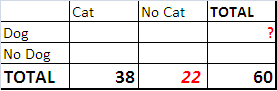
Attachment:
Stem.PNG
(1) 28 of the families in this neighborhood have a cat but not a dog.
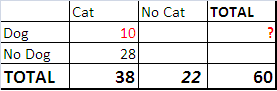
Attachment:
Statement 1.PNG
So you can see that we can no way get # of the families in this neighborhood who has a dog (? in the matrix). Not sufficient.

(2) The number of families in the neighborhood who have a dog and a cat is the same as the number of families who have neither a cat nor a dog.
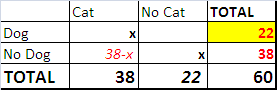
Attachment:
Statement 2.PNG
You can see that if # of families who have a dog and a cat and # of families who have neither a cat nor a dog is x, then # of families who has cat but not dog is 38-x. Next, total # of families who has no dog is (38-x)+x=38 and # of families who has a dog is 60-38=22. Sufficient.

Answer: B.

Hope it helps.


If we use Venn Diagram it's a lot faster and space saver.
Even though, because of timer, I misread question and thought 'the examiner asked about families with just a dog' and marked wrong answer :beatup
User avatar
shasadou
Joined: 12 Aug 2015
Last visit: 24 Nov 2022
Posts: 219
Own Kudos:
3,175
 [1]
Given Kudos: 1,475
Concentration: General Management, Operations
GMAT 1: 640 Q40 V37
GMAT 2: 650 Q43 V36
GMAT 3: 600 Q47 V27
GPA: 3.3
WE:Management Consulting (Consulting)
GMAT 3: 600 Q47 V27
Posts: 219
Kudos: 3,175
 [1]
1
Kudos
Add Kudos
Bookmarks
Bookmark this Post
indeed Venn + formula solve Statement 2 in 15 secs - very straightforward. on the overlapping sets very often matrix is the best approach however this question is the case when Venn is the shortest solution
User avatar
MathRevolution
User avatar
Math Revolution GMAT Instructor
Joined: 16 Aug 2015
Last visit: 27 Sep 2022
Posts: 10,063
Own Kudos:
Given Kudos: 4
GMAT 1: 760 Q51 V42
GPA: 3.82
Expert
Expert reply
GMAT 1: 760 Q51 V42
Posts: 10,063
Kudos: 19,999
Kudos
Add Kudos
Bookmarks
Bookmark this Post
Forget conventional ways of solving math questions. In DS, Variable approach is the easiest and quickest way to find the answer without actually solving the problem. Remember equal number of variables and independent equations ensures a solution.

Of the 60 families in a certain neighborhood, 38 have a cat. How many of the families in this neighborhood have a dog?

(1) 28 of the families in this neighborhood have a cat but not a dog
(2) The number of families in the neighborhood who have a dog and a cat is the same as the number of families who have neither a cat nor a dog.

We get a '2by2' table as below:
Attachment:
GCDS calreg11 Of the 60 families in a certain neighborhood (20151113).jpg
GCDS calreg11 Of the 60 families in a certain neighborhood (20151113).jpg [ 29.17 KiB | Viewed 19194 times ]

The question asks a+c=? There are 4 variables (a,b,c,d) and 2 equations (a+b=38, a+b+c+d=60).
2 more equations are given by the 2 conditions, so there is high chance (C) will be our answer.
Condition 1) a=28
Condition 2) a=d. question is asking for the same thing as whether a+c=d+c? so we get a+b+c+d=60, 38+c+d=60, c+d=22 from the original condition, and the answer becomes (B).

For cases where we need 2 more equation, such as original conditions with “2 variables”, or “3 variables and 1 equation”, or “4 variables and 2 equations”, we have 1 equation each in both 1) and 2). Therefore, there is 70% chance that C is the answer, while E has 25% chance. These two are the majority. In case of common mistake type 3,4, the answer may be from A, B or D but there is only 5% chance. Since C is most likely to be the answer using 1) and 2) separately according to DS definition (It saves us time). Obviously there may be cases where the answer is A, B, D or E.
User avatar
BrainLab
User avatar
Current Student
Joined: 10 Mar 2013
Last visit: 26 Jan 2025
Posts: 343
Own Kudos:
Given Kudos: 200
Location: Germany
Concentration: Finance, Entrepreneurship
GMAT 1: 580 Q46 V24
GPA: 3.7
WE:Marketing (Telecommunications)
GMAT 1: 580 Q46 V24
Posts: 343
Kudos: 3,212
Kudos
Add Kudos
Bookmarks
Bookmark this Post
I've also solved this one easily using double-matrix. When you have 2 terms use always double-matrix, if you have >2 use formulas.
User avatar
MathRevolution
User avatar
Math Revolution GMAT Instructor
Joined: 16 Aug 2015
Last visit: 27 Sep 2022
Posts: 10,063
Own Kudos:
Given Kudos: 4
GMAT 1: 760 Q51 V42
GPA: 3.82
Expert
Expert reply
GMAT 1: 760 Q51 V42
Posts: 10,063
Kudos: 19,999
Kudos
Add Kudos
Bookmarks
Bookmark this Post
Forget conventional ways of solving math questions. In DS, Variable approach is the easiest and quickest way to find the answer without actually solving the problem. Remember equal number of variables and independent equations ensures a solution

Of the 60 families in a certain neighborhood, 38 have a cat. How many of the families in this neighborhood have a dog?

(1) 28 of the families in this neighborhood have a cat but not a dog
(2) The number of families in the neighborhood who have a dog and a cat is the same as the number of families who have neither a cat nor a dog.


This is a “2-by-2” question, one of the most common types of questions in GMAT math. From modifying the original condition and the question, we can obtain a table below.

From the table, we can see that the question is a+b=? There are 4 variables (a,b,c, and d) and 2 equations (a+b+c+d=60 and a+c=38). In order to match the number of variables and the number of equations, we need 2 more equations. Since the condition 1) and 2) each has 1 equation, there is high chance that C is the answer.

Using both the condition 1) and 2), we get c=28. Also, since a=d, we get a+c=d+c=a+28=d+28=38. Then, a=d=10. So, if we substitute in a+b+c+d=60, we get 10+b+28+10=60. Then, b=12. So, a+b=10+12=22. So, the answer is unique and the condition is sufficient. So we can see how C could be the answer.

However, a question involving hidden integer is one of key questions (integer, statistics, inequality, probability, absolute value) and we have to consider Mistake Type 4(A).

In the case of the condition 2), since a=d, we get a+c=d+c=38. Then, if we substitute it into a+b+c+d=60, we get a+b+38=60. So, a+b=22. The answer is unique and the condition is sufficient. If both C and B are the answers to the question, the final correct answer choice is B.


For cases where we need 2 more equations, such as original conditions with “2 variables”, or “3 variables and 1 equation”, or “4 variables and 2 equations”, we have 1 equation each in both 1) and 2). Therefore, there is 70% chance that C is the answer, while E has 25% chance. These two are the majority. In case of common mistake type 3,4, the answer may be from A, B or D but there is only 5% chance. Since C is most likely to be the answer using 1) and 2) separately according to DS definition (It saves us time). Obviously there may be cases where the answer is A, B, D or E.
Attachments

GCDS   calreg11     Of the 60 families in a certain (20160103).jpg
GCDS calreg11 Of the 60 families in a certain (20160103).jpg [ 23.73 KiB | Viewed 18903 times ]

User avatar
Goldenfuture
Joined: 24 Dec 2024
Last visit: 29 Jan 2026
Posts: 150
Own Kudos:
Given Kudos: 48
Posts: 150
Kudos: 12
Kudos
Add Kudos
Bookmarks
Bookmark this Post
Can be solved mentally - here it goes
60 = Cat + Only Dog (since overlap is added in Cat) + none
Statement 1 only gives us what this overlap is not none part => okay 10 have both - I don't know none so I can't solve this

Statement II Says overlap = none = x
so 60 = Only Cat + Overlap + Only Dog + None
60 = 38 + Dog + X (which is overlap)
22 = Only dOG + OVERLAp - answer in 1.5 min
Moderators:
Math Expert
109740 posts
498 posts
211 posts



