Last visit was: 22 Apr 2026, 13:46 It is currently 22 Apr 2026, 13:46
Close
GMAT Club Daily Prep
Thank you for using the timer - this advanced tool can estimate your performance and suggest more practice questions. We have subscribed you to Daily Prep Questions via email.

Customized
for You

we will pick new questions that match your level based on your Timer History

Track
Your Progress

every week, we’ll send you an estimated GMAT score based on your performance

Practice
Pays

we will pick new questions that match your level based on your Timer History
Not interested in getting valuable practice questions and articles delivered to your email? No problem, unsubscribe here.
Close
Request Expert Reply
Confirm Cancel
User avatar
enigma123
Joined: 25 Jun 2011
Last visit: 16 Mar 2016
Posts: 392
Own Kudos:
Given Kudos: 217
Status:Finally Done. Admitted in Kellogg for 2015 intake
Location: United Kingdom
Concentration: International Business, Strategy
GMAT 1: 730 Q49 V45
GPA: 2.9
WE:Information Technology (Consulting)
GMAT 1: 730 Q49 V45
Posts: 392
Kudos: 19,850
 [166]
5
Kudos
Add Kudos
160
Bookmarks
Bookmark this Post
Most Helpful Reply
User avatar
Bunuel
User avatar
Math Expert
Joined: 02 Sep 2009
Last visit: 22 Apr 2026
Posts: 109,754
Own Kudos:
Given Kudos: 105,823
Products:
Expert
Expert reply
Active GMAT Club Expert! Tag them with @ followed by their username for a faster response.
Posts: 109,754
Kudos: 810,659
 [59]
27
Kudos
Add Kudos
32
Bookmarks
Bookmark this Post
avatar
svaughn2020
Joined: 10 Aug 2012
Last visit: 08 Aug 2013
Posts: 4
Own Kudos:
63
 [52]
Given Kudos: 1
GMAT 1: 720 Q47 V41
GPA: 3.82
GMAT 1: 720 Q47 V41
Posts: 4
Kudos: 63
 [52]
41
Kudos
Add Kudos
11
Bookmarks
Bookmark this Post
General Discussion
User avatar
priyalr
Joined: 03 Dec 2010
Last visit: 03 May 2012
Posts: 17
Own Kudos:
53
 [1]
Posts: 17
Kudos: 53
 [1]
1
Kudos
Add Kudos
Bookmarks
Bookmark this Post
Hi,

Can u explain in a simpler way, I didn't get it. This is what I tried, since QS is perpendicular to PR, it divides PR in 2 equal parts ie, PS=SR. Also now we are given perimeter is 60 for the given right triangle, hence I tried to use 3-4-5 rule, so now length of the sides are PQ=20, QR=15, PR=25 since its given PQ greater than QR.
So now, area of PQS= 1/2 PS * QS =1/2 * 25/2* 12 =75
area of RQS = 1/2*SR*QS = 1/2*25/2*12= 75
I know I'm wrong, could you please correct me.

Thnx.
User avatar
Bunuel
User avatar
Math Expert
Joined: 02 Sep 2009
Last visit: 22 Apr 2026
Posts: 109,754
Own Kudos:
Given Kudos: 105,823
Products:
Expert
Expert reply
Active GMAT Club Expert! Tag them with @ followed by their username for a faster response.
Posts: 109,754
Kudos: 810,659
Kudos
Add Kudos
Bookmarks
Bookmark this Post
priyalr
Hi,

Can u explain in a simpler way, I didn't get it. This is what I tried, since QS is perpendicular to PR, it divides PR in 2 equal parts ie, PS=SR. Also now we are given perimeter is 60 for the given right triangle, hence I tried to use 3-4-5 rule, so now length of the sides are PQ=20, QR=15, PR=25 since its given PQ greater than QR.
So now, area of PQS= 1/2 PS * QS =1/2 * 25/2* 12 =75
area of RQS = 1/2*SR*QS = 1/2*25/2*12= 75
I know I'm wrong, could you please correct me.

Thnx.

Perpendicular to hypotenuse divides it in half if and only the right triangle is isosceles, so when PQ=QR but it's given that PQ>QR, so it's not the case.

Hope it's clear.
avatar
boddhisattva
Joined: 26 Nov 2012
Last visit: 08 Jan 2015
Posts: 3
Own Kudos:
Given Kudos: 2
Posts: 3
Kudos: 5
Kudos
Add Kudos
Bookmarks
Bookmark this Post
Can anyone please explain how do we arrive at the values for x and y using xy = 300 and x + y = 35.

I tried using (x+y)^2 = x^2 + y^2 + 2xy formulae as below:-

35^2 = x^2 + y^2 + 2*300 , how to proceed from here to get values of x and y?

Thank you.
User avatar
Marcab
Joined: 03 Feb 2011
Last visit: 22 Jan 2021
Posts: 840
Own Kudos:
4,943
 [1]
Given Kudos: 221
Status:Retaking after 7 years
Location: United States (NY)
Concentration: Finance, Economics
GMAT 1: 720 Q49 V39
GPA: 3.75
GMAT 1: 720 Q49 V39
Posts: 840
Kudos: 4,943
 [1]
1
Kudos
Add Kudos
Bookmarks
Bookmark this Post
boddhisattva
Can anyone please explain how do we arrive at the values for x and y using xy = 300 and x + y = 35.

I tried using (x+y)^2 = x^2 + y^2 + 2xy formulae as below:-

35^2 = x^2 + y^2 + 2*300 , how to proceed from here to get values of x and y?

Thank you.

\(x=300/y\)
Put this in equation: \(x+y=35\),
you will get the equation \(y^2-35y+300=0\)

You may write it down as :
\(y^-20y-15y-300=0\)

OR

\(y(y-20)-15(y-20)=0---------> (y-20)(y-15)\)
Hence y=20 or 15.
Thereby x=15 or 20

But since its given that PQ>QR, therefore x=20 and y=15.

Now my question is:
Is there a 2 minute approach to this question.
avatar
boddhisattva
Joined: 26 Nov 2012
Last visit: 08 Jan 2015
Posts: 3
Own Kudos:
5
 [5]
Given Kudos: 2
Posts: 3
Kudos: 5
 [5]
5
Kudos
Add Kudos
Bookmarks
Bookmark this Post
@Marcab, thanks, I didn't see it was that easy and btw I did find a 2minute approach to this problem. Unfortunately I don't have 5 posts yet on this forum to share the link, nevertheless I would say simply Google for "In the diagram, triangle PQR" and click the MGMAT link wrt this problem and you would find what your looking for there. Hth.

P.S.: Please don't forget to click on Kudos if you think my post helped.
User avatar
Marcab
Joined: 03 Feb 2011
Last visit: 22 Jan 2021
Posts: 840
Own Kudos:
4,943
 [9]
Given Kudos: 221
Status:Retaking after 7 years
Location: United States (NY)
Concentration: Finance, Economics
GMAT 1: 720 Q49 V39
GPA: 3.75
GMAT 1: 720 Q49 V39
Posts: 840
Kudos: 4,943
 [9]
6
Kudos
Add Kudos
3
Bookmarks
Bookmark this Post
Thanks Boddhisattva. +1 to you.

Here is the best approach to the problem.
Quoting ChristianCRyan from MGMAT:

I personally think that the trick to this particular problem is to switch gears at a certain point -- after you write down the equations describing all the relationships, you might realize (as I myself did on first trying this problem) that it would take a long time to derive the solution using algebra. So then you need to say, let me try some common right triangles. 3-4-5 becomes the first candidate -- especially since the perpendicular is 12, which is divisible by both 3 and 4. So a side of 12 (in the two smaller triangles) is easy to "scale" to -- if it's the shortest side (the "3" side), then the longer sides are 16 and 20; likewise, if it's the middle side, the other two sides are 9 and 15. Magically this fits the perimeter constraint (the big triangle's perimeter=60), and you're done.
User avatar
alphabeta1234
Joined: 12 Feb 2012
Last visit: 03 Jun 2016
Posts: 105
Own Kudos:
313
 [1]
Given Kudos: 28
Posts: 105
Kudos: 313
 [1]
1
Kudos
Add Kudos
Bookmarks
Bookmark this Post
Here is another approach I don't think anyone has mention that takes 10's.

We know whatever the answer is going to be it is going to satisfy this equation. A1/A2=S1^2/S2^2=(S1/S2)^2. Now even after ratio S1/S2 is reduced to smallest possible fraction. The answer choices have to satify the condition that the numbers are squares. The only answer choice in this problem where the answer choices are squares is 16/9=4^2/3^2.

Here is my question for Bunuel. How did find the solution for x+y=35 & xy=300. I know you could just substitute and solve. But you get an ugly quadratic. I don't know how to find all the factors of 300 in less than 30 secs. Besides plugging number was there a shortcut you used?
User avatar
b2bt
Joined: 25 Sep 2012
Last visit: 14 Apr 2024
Posts: 192
Own Kudos:
651
 [1]
Given Kudos: 242
Location: India
Concentration: Strategy, Marketing
GMAT 1: 660 Q49 V31
GMAT 2: 680 Q48 V34
Products:
GMAT 2: 680 Q48 V34
Posts: 192
Kudos: 651
 [1]
Kudos
Add Kudos
1
Bookmarks
Bookmark this Post
Ok.. so my idea is not foolproof but it got me the right answer within 15 secs...

By a property (QS)^2 = PS*SR.
PS*SR = 12^2 = 144
Also, the traingles are similar so the ratio of the area can be given by ratio of side PS and SR.

In exam I could reverse it to affirm the answer (16+9 = 25 i.e. hyp of pqr is 25. If I take the triplet (3*5,4*5,5*5). I can see perimeter = 60 and so on
Basically find a ratio which multiplies to 144
User avatar
gmat6nplus1
Joined: 04 Oct 2013
Last visit: 09 Jan 2019
Posts: 141
Own Kudos:
703
 [9]
Given Kudos: 29
Concentration: Finance, Leadership
GMAT 1: 590 Q40 V30
GMAT 2: 730 Q49 V40
WE:Project Management (Media/Entertainment)
GMAT 2: 730 Q49 V40
Posts: 141
Kudos: 703
 [9]
9
Kudos
Add Kudos
Bookmarks
Bookmark this Post
I solved it this way:

we are given:

QS = 12
PQ>QR
Perimeter = 60

Fist off, we are dealing with a right triangle, it is glaring, and the first thing that pops up in my mind is: Pythagorean Triples.
Let's just recall the basic one because any other is just a multiple of the basic one.
3+4+5 = 12 not really close to 60.
15+20+25= 60 there we go!

Now we know that PQ= 20, QR= 15 and PR=25.

Since QS is perpendicular to PR the two smaller triangles are also right triangles. Let's figure out the length of the sides of PSQ.
Once again the smaller cathetus (QS) turns out to be our fundamental Pythagorean triplet multiplied by 4. Once realized this we can quickly gauge the length of the remaining cathetus and hypothenuse. 12:16:20

Now we have all the elements that we need to find out our answer.

Area PQS- Area PQS = 54 (=Area QSR) and our ratio is going to be 16/9
User avatar
vad3tha
Joined: 22 Feb 2009
Last visit: 15 Dec 2023
Posts: 106
Own Kudos:
584
 [1]
Given Kudos: 148
Posts: 106
Kudos: 584
 [1]
1
Kudos
Add Kudos
Bookmarks
Bookmark this Post
enigma123
Attachment:
Triangle PQR.GIF
In the diagram, triangle PQR has a right angle at Q and a perimeter of 60. Line segment QS is perpendicular to PR and has a length of 12. PQ > QR. What is the ratio of the area of triangle PQS to the area of triangle RQS?

A. 3/2
B. 7/4
C. 15/8
D. 16/9
E. 2

If a,b,c are not integers, the solution will take a lot of time. That is not kind of GMAT question, if it takes like forever to solve the problem
For a right triangle, the first thing happened in my mind was a:b:c = 3:4:5. Maybe a = 3k, b = 4k, c = 5k
so I have the equation: 3k + 4k + 5k = 60 --> 12k = 60 --> k = 5
--> a = 15, b = 20, c = 25 (b>a)
Try whether a*b/2 = QS*25/2 -> 15*20/2 = 12*25/2 --> correct

Area of PQS/ Area of RQS = b^2/a^2 = 16/9

Answer is D
User avatar
tinytiger
Joined: 26 Aug 2017
Last visit: 29 Mar 2026
Posts: 46
Own Kudos:
123
 [1]
Given Kudos: 695
Location: Singapore
GMAT 1: 710 Q49 V37
GMAT 2: 760 Q50 V44
WE:General Management (Healthcare/Pharmaceuticals)
Products:
GMAT 2: 760 Q50 V44
Posts: 46
Kudos: 123
 [1]
1
Kudos
Add Kudos
Bookmarks
Bookmark this Post
Given the time constraints, I tried to solve by using the similarity properties of the two triangles formed by splitting the right angle using QS.

To frame the question, ratio of area PQS:RSQ = ratio of PS:SR.

Note that SR:QS = QS:PS; QS = 12.
Therefore, PS:SR = QS^2 = 12^2 = 144 = (3 x 4)^2 = (3^2 x 2^4).
There are many ways to assign the prime values of 144 but only 1 answer fits a suitable ratio i.e. 2^4 : 3^2 = 16:9.
Therefore, answer is D. No other answer allows the allocation of the prime factors available. This is another way to solve it. I was pressed for time and not able to do the detailed method Bunuel did, so I tried my luck and got the answer. Should there be another answer that fits the available ratio, then I would have compared it to the given information in the stem and try to figure out from there.

Hope this works.
User avatar
bashdeep
Joined: 03 Sep 2018
Last visit: 19 Nov 2019
Posts: 13
Own Kudos:
Given Kudos: 32
WE:Analyst (Consulting)
Posts: 13
Kudos: 12
Kudos
Add Kudos
Bookmarks
Bookmark this Post
enigma123


In the diagram, triangle PQR has a right angle at Q and a perimeter of 60. Line segment QS is perpendicular to PR and has a length of 12. PQ > QR. What is the ratio of the area of triangle PQS to the area of triangle RQS?

A. 3/2
B. 7/4
C. 15/8
D. 16/9
E. 2

Attachment:
Triangle PQR.GIF


Ans:

Since its not a equilateral right triangle, the sides must be in ration of 3:4:5. Using this

1) Triangle PQR is a right triangle w/ perimeter of 60, we get QR=15, PQ=20, and PR=25.

2) Triangle QRS has side QS=12 (given) and QR=15 (from 1). Using 3:4:5, SR=9.

3) Triangle PQS has side QS=12 (given) and PQ=20 (from 1). Using 3:4:5, PS=16 (also PR-RS=25-9=16).

4) Area of PQS is 1/2*12*16=96

5) Area of QRS is 1/2*12*9=54

6) Ratio is 96/54=16/9
User avatar
Kritisood
Joined: 21 Feb 2017
Last visit: 19 Jul 2023
Posts: 488
Own Kudos:
Given Kudos: 1,090
Location: India
GMAT 1: 700 Q47 V39
Products:
GMAT 1: 700 Q47 V39
Posts: 488
Kudos: 1,315
Kudos
Add Kudos
Bookmarks
Bookmark this Post
Marcab
Thanks Boddhisattva. +1 to you.

Here is the best approach to the problem.
Quoting ChristianCRyan from MGMAT:

I personally think that the trick to this particular problem is to switch gears at a certain point -- after you write down the equations describing all the relationships, you might realize (as I myself did on first trying this problem) that it would take a long time to derive the solution using algebra. So then you need to say, let me try some common right triangles. 3-4-5 becomes the first candidate -- especially since the perpendicular is 12, which is divisible by both 3 and 4. So a side of 12 (in the two smaller triangles) is easy to "scale" to -- if it's the shortest side (the "3" side), then the longer sides are 16 and 20; likewise, if it's the middle side, the other two sides are 9 and 15. Magically this fits the perimeter constraint (the big triangle's perimeter=60), and you're done.

Hi Marcab Bunuel is it necessary for the triangle to be in a 3-4-5 ratio? Just cus its right triangle it's not necessarily in the 3-4-5 ratio right? it could be in any other ratio as well?
User avatar
ak2121
User avatar
Current Student
Joined: 26 Jun 2021
Last visit: 19 May 2022
Posts: 50
Own Kudos:
Given Kudos: 89
Location: India
GMAT 1: 650 Q45 V35
GPA: 3.3
GMAT 1: 650 Q45 V35
Posts: 50
Kudos: 56
Kudos
Add Kudos
Bookmarks
Bookmark this Post
svaughn2020
Bunuel,

What about this methodology?

1) Triangle PQR is a right triangle w/ perimeter of 60. We know PQ is the longer side. Using the right triangle ratio 3:4:5, we get QR=15, PQ=20, and PR=25.

2) Triangle QRS has side QS=12 (given) and QR=15 (from 1). Using 3:4:5, SR=9.

3) Triangle PQS has side QS=12 (given) and PQ=20 (from 1). Using 3:4:5, PS=16 (also PR-RS=25-9=16).

4) Area of PQS is 1/2*12*16=96

5) Area of QRS is 1/2*12*9=54

6) Ratio is 96/54=16/9
how did you eliminate the 5:12:13 possibility in this?
avatar
tramobile
Joined: 24 Sep 2020
Last visit: 13 Aug 2022
Posts: 12
Own Kudos:
Given Kudos: 82
Location: India
Posts: 12
Kudos: 4
Kudos
Add Kudos
Bookmarks
Bookmark this Post
Bunuel
In the diagram, triangle PQR has a right angle at Q and a perimeter of 60. Line segment QS is perpendicular to PR and has a length of 12. PQ > QR. What is the ratio of the area of triangle PQS to the area of triangle RQS?

A) 3/2
B) 7/4
C) 15/8
D) 16/9
E) 2
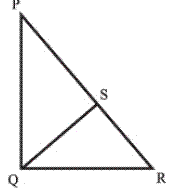


Let \(PQ=x\), \(QR=y\) and \(PR=z\).

Given: \(x+y+z=60\) (i);
Equate the areas: \(\frac{1}{2}*xy=\frac{1}{2}*QS*z\) (area of PQR can be calculated by 1/2*leg*leg and 1/2* perpendicular to hypotenuse*hypotenuse) --> \(xy=12z\) (ii);
Aslo \(x^2+y^2=z^2\) (iii);

So, we have:
(i) \(x+y+z=60\);
(ii) \(xy=12z\);
(iii) \(x^2+y^2=z^2\).

From (iii) \((x+y)^2-2xy=z^2\) --> as from (i) \(x+y=60-z\) and from (ii) \(xy=12z\) then (\(60-z)^2-2*12z=z^2\) --> \(3600-120z+z^2-24z=z^2\) --> \(3600=144z\) --> \(z=25\);

From (i) \(x+y=35\) and from (ii) \(xy=300\) --> solving for \(x\) and \(y\) --> \(x=20\) and \(y=15\) (as given that \(x>y\)).

Next, perpendicular to the hypotenuse will always divide the triangle into two triangles with the same properties as the original triangle. So, PQS and SQR are similar. In two similar triangles, the ratio of their areas is the square of the ratio of their sides: \(\frac{AREA}{area}=\frac{S^2}{s^2}\).

So, \(\frac{x^2}{y^2}=\frac{AREA}{area}\) --> \(\frac{AREA}{area}=\frac{400}{225}=\frac{16}{9}\)

Answer: D.
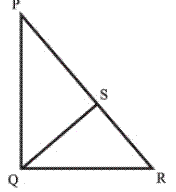
Attachment:
Triangle PQR.GIF


Lets say PQ=a, QR =b, PS=c, SR =d, QS =e

a^2 - c^2 = 12^2 -------i
b^2 - d^2 = 12^2 -------ii
a^2 + b^2 = (c+d)^2 ------iii

Sum eq i+ii
a^2 + b^2 -c^2-d^2 = 2*12^2
replace a^2+b^2 by (c+d)^2 ref eq. iii

(c+d)^2 -c^2-d^2 = 2*12^2
c^2 + d^2 +2.c.d-c^2-d^2 = 2*12^2
solving it
cd = 12^2 =144
scan answer voice for cd = 144 only option 16*9 = 144 so the ratio = 16/9.
Bunuel pls suggest if this method is ok.
User avatar
bumpbot
User avatar
Non-Human User
Joined: 09 Sep 2013
Last visit: 04 Jan 2021
Posts: 38,969
Own Kudos:
Posts: 38,969
Kudos: 1,117
Kudos
Add Kudos
Bookmarks
Bookmark this Post
Automated notice from GMAT Club BumpBot:

A member just gave Kudos to this thread, showing it’s still useful. I’ve bumped it to the top so more people can benefit. Feel free to add your own questions or solutions.

This post was generated automatically.
Moderators:
Math Expert
109754 posts
Tuck School Moderator
853 posts