Events & Promotions
|
|

GMAT Club Daily Prep
Thank you for using the timer - this advanced tool can estimate your performance and suggest more practice questions. We have subscribed you to Daily Prep Questions via email.
Customized
for You
Track
Your Progress
Practice
Pays
Not interested in getting valuable practice questions and articles delivered to your email? No problem, unsubscribe here.
 Sep 21
07:00 PM EDT
-10:00 PM EDT
Boost your GMAT score in less than one month in a live online class + 6 months access to TTP OnDemand video courses included! Sep 18
10:00 AM IST
-11:00 PM IST
Start your journey with a fully customized action plan and work with a dedicated mentor to achieve a 735+ score. Sep 20
03:30 AM EDT
-04:30 AM EDT
Looking for your GMAT motivation to break through the score plateau? Pragati improved her score by massive 160 points with strategic guidance and hard-work! Find out how personalized mentorship and a strong mindset can turn GMAT struggles into success. Sep 23
12:30 AM EDT
-01:30 AM EDT
Learn how Keshav, a Chartered Accountant, scored an impressive 705 on GMAT in just 30 days with GMATWhiz's expert guidance. In this video, he shares preparation tips and strategies that worked for him, including the mock, time management, and more Sep 26
01:00 PM EDT
-04:00 PM EDT
Top scores are possible when you enroll in a powerful GMAT course, taught live online + 6 months access to TTP OnDemand video courses included. Class starts Saturdays Sept. 26, 2026 - Dec. 19, 2026, 1:00pm-4:00pm ES Sep 26
06:00 PM PDT
-07:00 PM PDT
Free- full-length test + 15 concept videos + 150+ short videos + study plan!

The passage is based on a document published in 2005.
The rate of growth in global coffee consumption has been falling behind the rate of growth in global production, creating a scenario of recurring price crises that take a heavy toll on coffee producing countries. Programs to expand coffee consumption in coffee producing countries can improve the situation and make the cyclical crises less acute.
In mature markets, costs to increase consumption are probably higher than in emerging markets, such as Brazil, the largest coffee producer. The case of Brazil shows that probably the highest returns for institutional investments to develop coffee consumption are to be found in the emerging markets of coffee producing countries. A Brazilian institutional investment valued at US$25 million in 10 years brought about an increase in yearly coffee sales worth 40 times as much. Promotion of coffee consumption in coffee producing countries is likely to represent the best investment of scarce promotion resources because of this multiplier effect. There are huge gaps in per capita consumption between Brazil and many other smaller producers, some (such as Indonesia) with large populations.
It is often argued that the Brazilian promotion program worked only because there was a marked income increase within the same period. But income increases alone, without promotion, are not sufficient to increase coffee consumption. Actually, for the 20 years up to 2003 in Brazil, it was only during the period 1993 to 1998 that coffee consumption increased as income was increasing.
The rate of growth in global coffee consumption has been falling behind the rate of growth in global production, creating a scenario of recurring price crises that take a heavy toll on coffee producing countries. Programs to expand coffee consumption in coffee producing countries can improve the situation and make the cyclical crises less acute.
In mature markets, costs to increase consumption are probably higher than in emerging markets, such as Brazil, the largest coffee producer. The case of Brazil shows that probably the highest returns for institutional investments to develop coffee consumption are to be found in the emerging markets of coffee producing countries. A Brazilian institutional investment valued at US$25 million in 10 years brought about an increase in yearly coffee sales worth 40 times as much. Promotion of coffee consumption in coffee producing countries is likely to represent the best investment of scarce promotion resources because of this multiplier effect. There are huge gaps in per capita consumption between Brazil and many other smaller producers, some (such as Indonesia) with large populations.
It is often argued that the Brazilian promotion program worked only because there was a marked income increase within the same period. But income increases alone, without promotion, are not sufficient to increase coffee consumption. Actually, for the 20 years up to 2003 in Brazil, it was only during the period 1993 to 1998 that coffee consumption increased as income was increasing.


Coffee production and per capita coffee consumption in Brazil are significantly higher than in most of the major coffee producing countries.: Yes
The coffee consumed in the major coffee producing countries comes entirely from domestic production.: No
As a means of boosting world coffee demand, increasing consumption of domestically produced coffee has greater potential in India than in China.: Yes
Be sure to select an answer first to save it in the Error Log before revealing the correct answer (OA)!
Difficulty:
 65%
(hard)
65%
(hard)
Question Stats:
64% (03:43) correct 36%
(03:54)
wrong
based on 2789
sessions
36%
(03:54)
wrong
based on 2789
sessions
History
Date
Time
Result
Not Attempted Yet
ID: 100385
For each of the following statements, select Yes if, based on the information provided in the passage or the first graph or both, the statement would have been true in 2003. Otherwise, select No.
For each of the following statements, select Yes if, based on the information provided in the passage or the first graph or both, the statement would have been true in 2003. Otherwise, select No.
| Yes | No | |
| Coffee production and per capita coffee consumption in Brazil are significantly higher than in most of the major coffee producing countries. | ||
| The coffee consumed in the major coffee producing countries comes entirely from domestic production. | ||
| As a means of boosting world coffee demand, increasing consumption of domestically produced coffee has greater potential in India than in China. |
ShowHide Answer
Official Answer
Coffee production and per capita coffee consumption in Brazil are significantly higher than in most of the major coffee producing countries.: Yes
The coffee consumed in the major coffee producing countries comes entirely from domestic production.: No
As a means of boosting world coffee demand, increasing consumption of domestically produced coffee has greater potential in India than in China.: Yes
1988 to 1989
Be sure to select an answer first to save it in the Error Log before revealing the correct answer (OA)!
Difficulty:
85%
(hard)
Question Stats:
58% (01:40) correct
42%
(01:51)
wrong
based on 3257
sessions
History
Date
Time
Result
Not Attempted Yet
ID: 100386
Which one of the following data ranges in the second graph most clearly indicates that the final sentence of the Discussion tab involves oversimplification?
Which one of the following data ranges in the second graph most clearly indicates that the final sentence of the Discussion tab involves oversimplification?
| 1998 to 2003 | |
| 1992 to 1994 | |
| 1987 to 1988 | |
| 1988 to 1989 | |
| 1994 to 1996 |
ShowHide Answer
Official Answer
1988 to 1989
Brazil’s 10-year program to promote domestic coffee consumption through institutional investment began in 1993.: Yes
Worldwide demand for coffee began to fall in 1999, resulting in economic recessions in most coffee producing countries.: Yes
The trend in per capita consumption of coffee in Brazil between 1986 and 2003 is indicative of the trend in the global per capita rate of production.: No
Be sure to select an answer first to save it in the Error Log before revealing the correct answer (OA)!
Difficulty:
95%
(hard)
Question Stats:
39% (01:53) correct
61%
(02:08)
wrong
based on 3229
sessions
History
Date
Time
Result
Not Attempted Yet
ID: 100387
Assuming each of the following statements is true, select Yes if the statement helps explain trends shown in the second graph in a way that is consistent with information in the passage. Otherwise, select No.
Assuming each of the following statements is true, select Yes if the statement helps explain trends shown in the second graph in a way that is consistent with information in the passage. Otherwise, select No.
| Yes | No | |
| Brazil’s 10-year program to promote domestic coffee consumption through institutional investment began in 1993. | ||
| Worldwide demand for coffee began to fall in 1999, resulting in economic recessions in most coffee producing countries. | ||
| The trend in per capita consumption of coffee in Brazil between 1986 and 2003 is indicative of the trend in the global per capita rate of production. |
ShowHide Answer
Official Answer
Brazil’s 10-year program to promote domestic coffee consumption through institutional investment began in 1993.: Yes
Worldwide demand for coffee began to fall in 1999, resulting in economic recessions in most coffee producing countries.: Yes
The trend in per capita consumption of coffee in Brazil between 1986 and 2003 is indicative of the trend in the global per capita rate of production.: No
Brazil’s 10-year program to promote domestic coffee consumption through institutional investment began in 1993.: Yes
Worldwide demand for coffee began to fall in 1999, resulting in economic recessions in most coffee producing countries.: Yes
The Brazilian institutional investment that brought about a significant increase in yearly coffee sales had a positive impact on job growth and wages in Brazil for many years afterwards.: No
Be sure to select an answer first to save it in the Error Log before revealing the correct answer (OA)!
Difficulty:
 45%
(medium)
45%
(medium)
Question Stats:
53% (00:49) correct
47%
(01:05)
wrong
based on 462
sessions
History
Date
Time
Result
Not Attempted Yet
Assuming each of the following statements is true, select Yes if the statement helps explain trends shown in the second graph in a way that is consistent with information in the passage. Otherwise, select No.
| Yes | No | |
| Brazil’s 10-year program to promote domestic coffee consumption through institutional investment began in 1993. | ||
| Worldwide demand for coffee began to fall in 1999, resulting in economic recessions in most coffee producing countries. | ||
| The Brazilian institutional investment that brought about a significant increase in yearly coffee sales had a positive impact on job growth and wages in Brazil for many years afterwards. |
ShowHide Answer
Official Answer
Brazil’s 10-year program to promote domestic coffee consumption through institutional investment began in 1993.: Yes
Worldwide demand for coffee began to fall in 1999, resulting in economic recessions in most coffee producing countries.: Yes
The Brazilian institutional investment that brought about a significant increase in yearly coffee sales had a positive impact on job growth and wages in Brazil for many years afterwards.: No
Attachment:
223.jpg [ 77.2 KiB | Viewed 63162 times ]
Attachment:
123.jpg [ 69.8 KiB | Viewed 63150 times ]


 26 Nov 2025, 13:15
Kudos
Bookmarks
2. Which one of the following data ranges in the second graph most clearly indicates that the final sentence of the Discussion tab involves oversimplification?

The final sentence in the Discussion tab says that coffee consumption in Brazil increased along with income only during 1993 to 1998. But the second graph shows that both income and consumption also rose between 1988 and 1989. That period contradicts the claim, proving the statement is an oversimplification.
The correct answer is 1988 to 1989.
A contradiction would be another period when both income and consumption rose together, showing that this pattern wasn’t unique to 1993-1998.
The period you mention, 1998-2003, isn’t that. Income fell while consumption rose. That’s not a contradiction, it’s simply a different pattern, showing that consumption can rise even when income declines.

GMAT-Club-Forum-i5flub1j.png [ 12.09 KiB | Viewed 9799 times ]
The final sentence in the Discussion tab says that coffee consumption in Brazil increased along with income only during 1993 to 1998. But the second graph shows that both income and consumption also rose between 1988 and 1989. That period contradicts the claim, proving the statement is an oversimplification.
The correct answer is 1988 to 1989.
nihilre
The final sentence claims that coffee consumption in Brazil increased only when income was rising (1993-1998).
A contradiction would be another period when both income and consumption rose together, showing that this pattern wasn’t unique to 1993-1998.
The period you mention, 1998-2003, isn’t that. Income fell while consumption rose. That’s not a contradiction, it’s simply a different pattern, showing that consumption can rise even when income declines.
Attachment:
GMAT-Club-Forum-i5flub1j.png [ 12.09 KiB | Viewed 9799 times ]
27 Nov 2025, 10:06
Kudos
Bookmarks
1. For each of the following statements, select Yes if, based on the information provided in the passage or the first graph or both, the statement would have been true in 2003. Otherwise, select No.
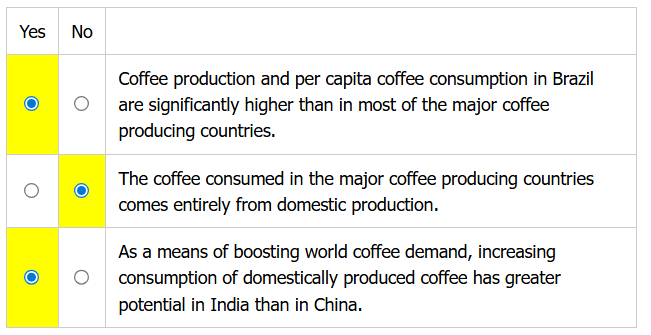
• Coffee production and per capita coffee consumption in Brazil are significantly higher than in most of the major coffee producing countries.
The text in the first graph says that in 2003 Brazil’s production was much higher than that of Central America, which has the highest production among all shown in the graph. This means Brazil had the highest coffee production overall. The graph also shows that Brazil’s per capita consumption was 4.5 kilograms, which is much higher than the second highest, Costa Rica, at about 3 kilograms.
Answer: Yes.
• The coffee consumed in the major coffee producing countries comes entirely from domestic production.
Neither the passage nor the graph says that all coffee consumed in these countries comes from domestic production. The first graph only shows how much coffee each country produces and consumes but does not indicate where the consumed coffee comes from. Therefore, we cannot conclude that consumption is entirely domestic.
Answer: No.
• As a means of boosting world coffee demand, increasing consumption of domestically produced coffee has greater potential in India than in China.
The graph shows that India produces much more coffee than China. Both countries have similar very low per-capita coffee consumption and similar large populations (similar bubble sizes). Since India’s domestic production is far greater, promoting internal coffee consumption there could absorb more of its own output and contribute more to global demand growth. Hence, the potential is greater in India than in China.
Answer: Yes.

GMAT-Club-Forum-52lzimb2.png [ 36.97 KiB | Viewed 9267 times ]
• Coffee production and per capita coffee consumption in Brazil are significantly higher than in most of the major coffee producing countries.
The text in the first graph says that in 2003 Brazil’s production was much higher than that of Central America, which has the highest production among all shown in the graph. This means Brazil had the highest coffee production overall. The graph also shows that Brazil’s per capita consumption was 4.5 kilograms, which is much higher than the second highest, Costa Rica, at about 3 kilograms.
Answer: Yes.
• The coffee consumed in the major coffee producing countries comes entirely from domestic production.
Neither the passage nor the graph says that all coffee consumed in these countries comes from domestic production. The first graph only shows how much coffee each country produces and consumes but does not indicate where the consumed coffee comes from. Therefore, we cannot conclude that consumption is entirely domestic.
Answer: No.
• As a means of boosting world coffee demand, increasing consumption of domestically produced coffee has greater potential in India than in China.
The graph shows that India produces much more coffee than China. Both countries have similar very low per-capita coffee consumption and similar large populations (similar bubble sizes). Since India’s domestic production is far greater, promoting internal coffee consumption there could absorb more of its own output and contribute more to global demand growth. Hence, the potential is greater in India than in China.
Answer: Yes.
Attachment:
GMAT-Club-Forum-52lzimb2.png [ 36.97 KiB | Viewed 9267 times ]