Events & Promotions
|
|

GMAT Club Daily Prep
Thank you for using the timer - this advanced tool can estimate your performance and suggest more practice questions. We have subscribed you to Daily Prep Questions via email.
Customized
for You
Track
Your Progress
Practice
Pays
Not interested in getting valuable practice questions and articles delivered to your email? No problem, unsubscribe here.
 Sep 24
01:30 AM EDT
-01:30 AM EDT
Tejas studied hard but kept repeating the same mistakes. After 3 attempts at 645, a focused 4-week strategy helped him identify and fix what was holding him back—leading to a 695 with just 12–15 hours of study per week. Sep 24
08:00 AM EDT
-08:30 AM EDT
Meet Tuck at an informal student or staff-hosted coffee chat in a city near you! Sep 26
12:30 AM EDT
-01:30 AM EDT
Struggling to find the right strategies to score a 99 %ile on GMAT Focus? Riya (GMAT 715) boosted her score by 100-points in just 15 days! Discover how the right mentorship, tailored strategies, and an unwavering mindset can transform your GMAT prep. Sep 26
01:00 PM EDT
-04:00 PM EDT
Top scores are possible when you enroll in a powerful GMAT course, taught live online + 6 months access to TTP OnDemand video courses included. Class starts Saturdays Sept. 26, 2026 - Dec. 19, 2026, 1:00pm-4:00pm ES Sep 26
06:00 PM PDT
-07:00 PM PDT
Free- full-length test + 15 concept videos + 150+ short videos + study plan! Sep 29
11:00 AM EDT
-01:00 PM EDT
" Description: Top scores are possible when you enroll in a powerful GMAT course, taught live online + 6 months access to TTP OnDemand video courses included! Class starts Tues/Thur Sept. 29, 2026 - Dec. 3, 2026, 11:00am-1:00pm EST Oct 01
07:00 AM BST
-08:00 AM GMT
Welcome to the GMAT Club's Free Interview Prep Event for Top MBA Programs! Buy tickets - Virtual series that’s all set to equip you to -excel in your MBA interviews.


Dropdown 1: 4
Dropdown 2: 30,000 acres more
Be sure to select an answer first to save it in the Error Log before revealing the correct answer (OA)!
Difficulty:
 95%
(hard)
95%
(hard)
Question Stats:
31% (03:39) correct 69%
(03:50)
wrong
based on 455
sessions
69%
(03:50)
wrong
based on 455
sessions
History
Date
Time
Result
Not Attempted Yet
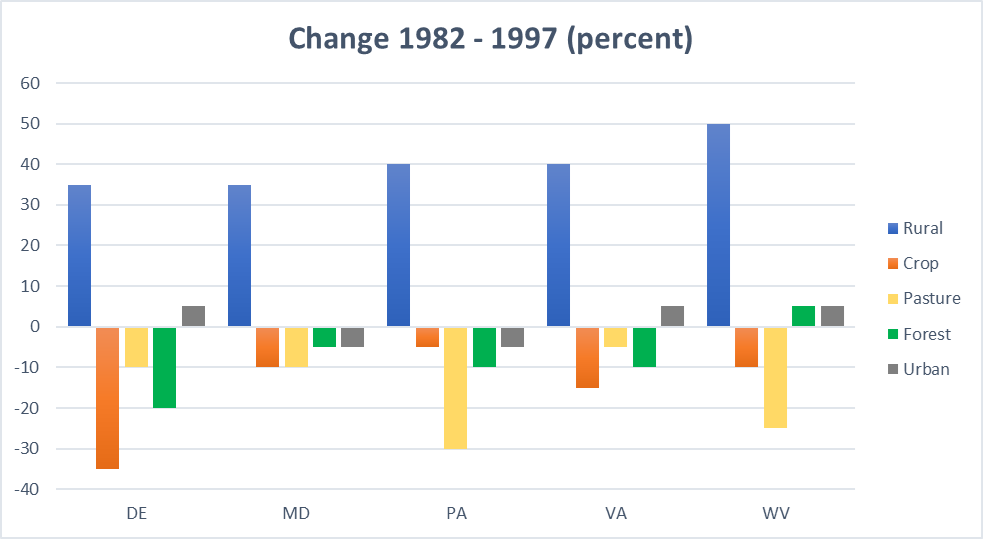
The graph shows the percent change in the area of different land cover types across five states (DE, MD, PA, VA, and WV) from 1982 to 1997.
Select from each drop-down menu the option that creates the most accurate statement based on the information provided.
If the combined rural area of Pennsylvania (PA) and Virginia (VA) was twice that of the pasture area in West Virginia (WV) in 1982, then in 1997, the combined rural area of Pennsylvania (PA) and Virginia (VA) was approximately times larger than the pasture area in West Virginia.
If Delaware (DE) had 380,000 acres of cropland in 1997 and Maryland (MD) had 500,000 acres of cropland in 1997, then Delaware had approximately cropland than Maryland in 1982.
Attachment:
256.jpg [ 62.31 KiB | Viewed 9392 times ]
ShowHide Answer
Official Answer
Dropdown 1: 4
Dropdown 2: 30,000 acres more
 18 Nov 2024, 10:19
Kudos
Bookmarks
Bunuel
Official Solution:
Drop-down 1:
Assuming the combined rural area of Pennsylvania (PA) and Virginia (VA) was 100 \(unit^2\) in 1982, the pasture area in West Virginia (WV) would be 50 \(unit^2\) in the same year. From the graph, we see that the rural areas of both Pennsylvania (PA) and Virginia (VA) increased by 40%, so in 1997, the combined rural area would become 140 \(unit^2\). Meanwhile, the pasture area in West Virginia (WV) decreased by 25%, reducing it to 37.5 \(unit^2\). Therefore, in 1997, the combined rural area of Pennsylvania (PA) and Virginia (VA) was \(\frac{140}{37.5} \approx 4\) times larger than the pasture area in West Virginia.
Drop-down 2:
Delaware's cropland decreased by 35% from 1982 to 1997, so 380,000 acres of cropland in 1997 implies that in 1982 it was \(\frac{380,000}{0.65} \approx 585,000\) acres. During the same period, Maryland's (MD) cropland decreased by 10%, so 500,000 acres of cropland in 1997 implies that in 1982 it was \(\frac{500,000}{0.90} \approx 555,000\) acres. Therefore, in 1982, Delaware had approximately 30,000 acres more cropland than Maryland.
Correct answer:
Dropdown 1: "4"
Dropdown 2: "30,000 acres more"
 23 Dec 2024, 18:27
Kudos
Bookmarks
1. Let the pasture area of West Virginia before and after be \(W_1\) and \(W_2\). Also let the rural areas of Pennsylvania and Virginia before and after be \(P_1\), \(P_2\), \(V_1\), and \(V_2\), respectively.
2. It is known that \(2W_1 = P_1 + V_1\).
3. From the charts it can be deduced: \((1 - 0.25) * W_1 = W_2\), \((1 + 0.4) * P_1 = P_2\), and \((1 + 0.4) * V_1 = V_2\).
4. The question asks us to find the value of \(\frac{P_2 + V_2}{W_2}\). It can be simplified into \(\frac{P_2 + V_2}{W_2} = \frac{1.4P_1 + 1.4V_1}{0.75W_1} = \frac{1.4(P_1 + V_1)}{0.75 * 0.5(P_1 + V_1)} \approx 3.73\), which is closest to 3.5.
5. Let the cropland area of Delaware and Maryland before and after be \(D_1\), \(D_2\), \(M_1\), and \(M_2\), respectively.
6. It is known that \(D_2 = 380000\) and \(M_2 = 500000\).
7. From the charts it can be deduced: \((1 - 0.35)D_1 = D_2 \rightarrow D_1 = \frac{380000}{0.65} \approx 584615\) and \((1 - 0.1)M_1 = M_2 \rightarrow M_1 = \frac{500000}{0.9} \approx 555555\).
8. The questions asks to find \(D_1 - M_1 = 584615 - 555555 = 29060\), which is about 30000 acres more.
9. Our answer will be: 3.5 and "30000 acres more."
2. It is known that \(2W_1 = P_1 + V_1\).
3. From the charts it can be deduced: \((1 - 0.25) * W_1 = W_2\), \((1 + 0.4) * P_1 = P_2\), and \((1 + 0.4) * V_1 = V_2\).
4. The question asks us to find the value of \(\frac{P_2 + V_2}{W_2}\). It can be simplified into \(\frac{P_2 + V_2}{W_2} = \frac{1.4P_1 + 1.4V_1}{0.75W_1} = \frac{1.4(P_1 + V_1)}{0.75 * 0.5(P_1 + V_1)} \approx 3.73\), which is closest to 3.5.
5. Let the cropland area of Delaware and Maryland before and after be \(D_1\), \(D_2\), \(M_1\), and \(M_2\), respectively.
6. It is known that \(D_2 = 380000\) and \(M_2 = 500000\).
7. From the charts it can be deduced: \((1 - 0.35)D_1 = D_2 \rightarrow D_1 = \frac{380000}{0.65} \approx 584615\) and \((1 - 0.1)M_1 = M_2 \rightarrow M_1 = \frac{500000}{0.9} \approx 555555\).
8. The questions asks to find \(D_1 - M_1 = 584615 - 555555 = 29060\), which is about 30000 acres more.
9. Our answer will be: 3.5 and "30000 acres more."